
Loading, please wait...
LOT 1079
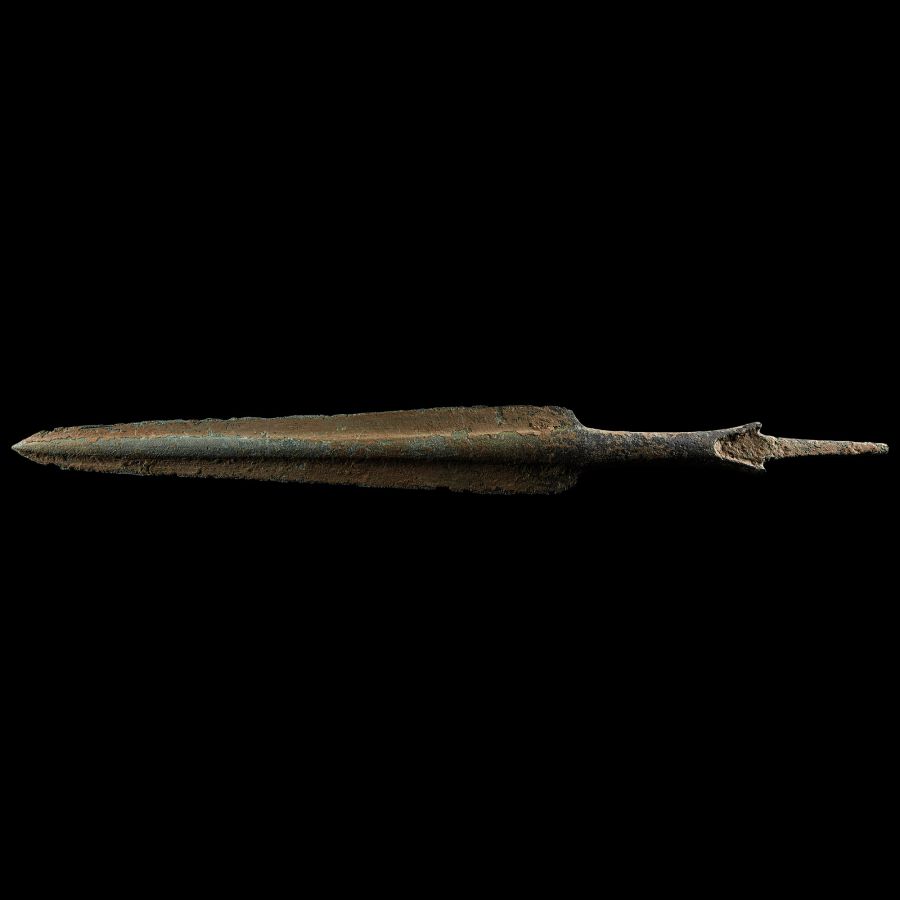
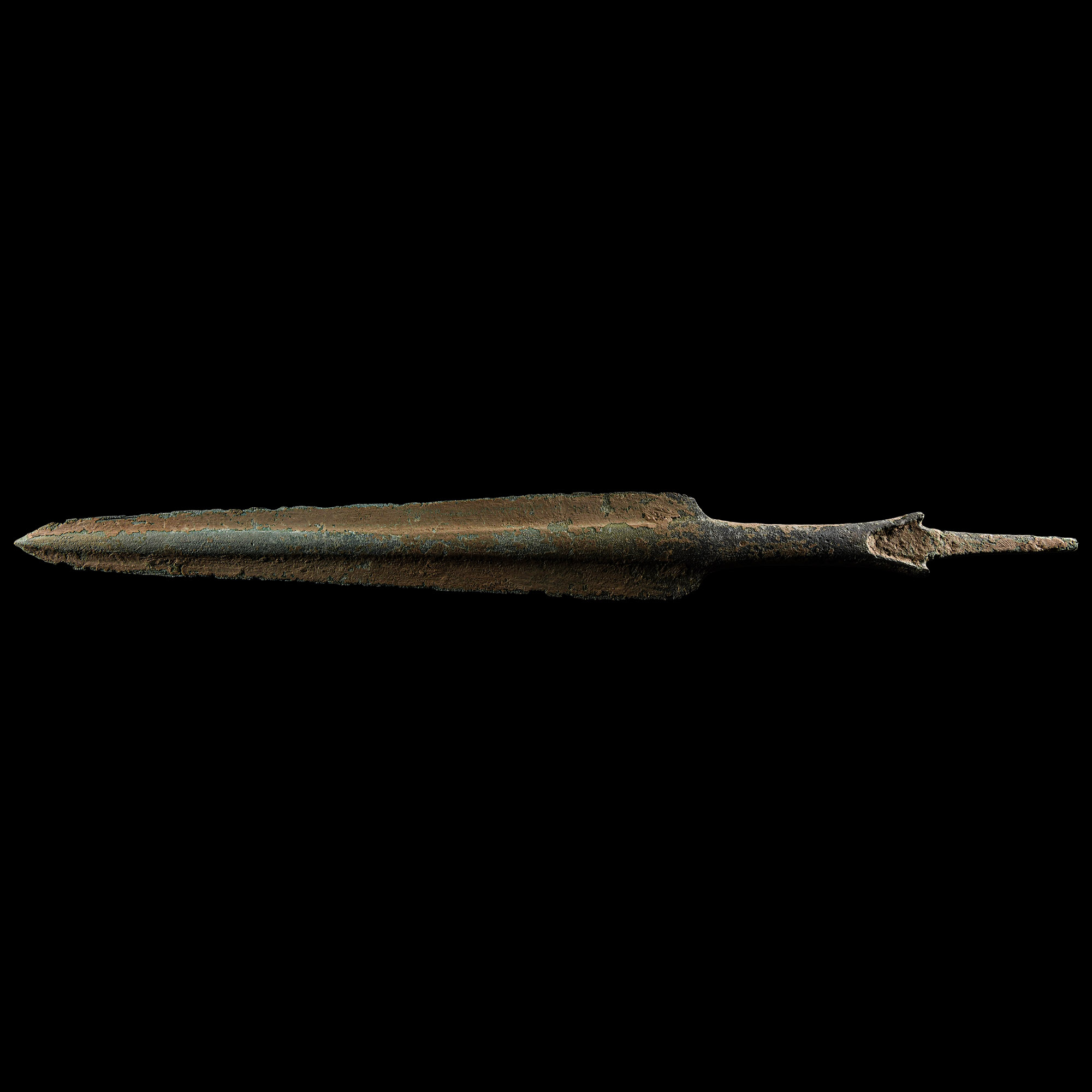
Amlash Type Bronze Spearhead
13TH-12TH CENTURY B.C.
16 in. (411 grams, 40.5 cm).
Showing a long tapering blade with rounded shoulders and prominent mid-rib, the tang straight and rectangular in section.
ProvenanceAcquired 1980-2015.
Ex Abelita family collection.
Cf. Khorasani, M.M., Arms and Armour from Iran. The Bronze Age to the End of the Qajar Period, Tübingen, 2006, s.cat 280, for type; Christies, Axel Guttmann Collection of Ancient Arms and Armour, Part 2, London, South Kensington, 28th April 2004, lot 40.
FootnotesThe weapon belongs to the type 1 of the Khorasani spearhead classification, mainly from the Marlik or Amlash areas. Similar pieces have been dated by Stutzinger to 1200-1100 B.C., but the period of use is attested to at least until 1000 B.C.
CONDITIONTimeLine Auctions follows a vetting process to ensure the authenticity and legality of all items, reinforcing our commitment to integrity and responsible trading. Each antiquity, antique, and coin lot undergoes thorough examination by a vetting committee of at least ten external specialists, professional trade association members, scientists, and archaeologists: Our Vetting Process
AUCTIONS:
TimeLine is a leading auction house specialising in antiquities, ancient art, collectables, natural history, coins, medals, and books. Our auctions offer museums, collectors, historians, and enthusiasts the opportunity to acquire unique and historically significant pieces.
-
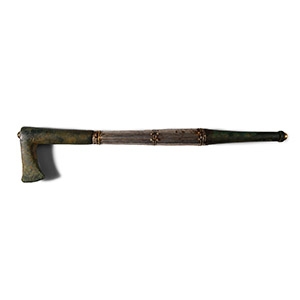
Elamite Ceremonial Axe with Silver Sleeve
3rd-2nd millennium B.C.Estimate: £12,000 - 17,000 (‡+bp*)
Opening Bid: £6,000
With later sheet-silver sleeve to the shaft, attached with ball-headed rivets; gilt dome finial to each end, the lower one in a gusseted collar. 750 grams, 45.5 cm
Acquired in 1996. Ex Samad Khameneh collection. Private Swiss collection. This lot has been checked against the Interpol Database of stolen works of art and is accompanied by search certificate no.11647-199005.
The axe belongs typologically to Type 4 of Maxwell-Hyslop’s classification, with a long and thin shaft narrowing towards the base. When technical developments resulted in heavier axe-blades, it was necessary to prolong the socket into a shaft tube and to cut away the underside of the blade where it joined the shaft. The edge of the blade was curved and this shifted the point of impact of the cutting edge. -
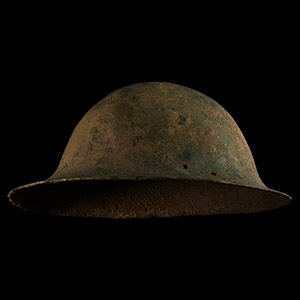
Villanovan Bronze Helmet
8th century B.C.Estimate: £10,000 - 14,000 (‡+bp*)
Opening Bid: £5,000
With rounded bowl and flared rim; three sets of paired piercings for attachment of leather cheek-flaps; cracked; accompanied by a custom-made display stand. 1.7 kg, 30.5 cm wide
Bowl pierced and cracked.
Acquired early 1990s. Ex private American collection; thence by descent. Private European collection since 1998. Accompanied by an academic report by Dr Raffaele D'Amato. This lot has been checked against the Interpol Database of stolen works of art and is accompanied by search certificate no.11573-199009.
The ‘pot’ or ‘bell’ helmet, found in contexts as early as the 8th century coffer grave (ad arca) from the Esquiline (Rome) and other graves (Coussin, 1926, p.88, fig.23; Sekunda, Northwood,1995, p.6, grave 94) was made from a single piece of bronze, while later Italic variants were fashioned from jointed plates (Connolly, 1981, p.102, figs.2-2a; Egg, 1988, p.223, variant Vetulonia). The skull was somewhat spherical, with a flared rim: in some Etruscan and Italic specimens, this was rivetted for strength. -
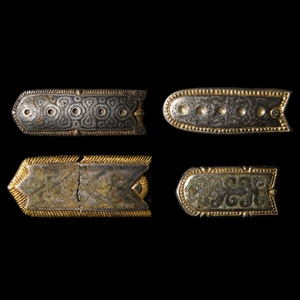
Viking Rus Silver-Gilt Sword Belt End Group
10th century A.D.Sold for (Inc. bp): £338
Comprising four sword belt strap ends of roughly rectangular form, with one rounded or gabled end and one fishtail end, each bearing a different nielloed decorative scheme, comprising: one with split front plate bearing geometric foliage framed by radiating lines to the perimeter; one with pelletted border and medial scrolled bar; one displaying a medial row of circular recesses and surrounding circular motifs; one decorated with five medial circular recesses on a ground of foliate forms, pellet border; all with a set of mounting lugs to the reverse. 34 grams total, 37-50 mm
Fine condition.
Acquired in the 1980s-1990s. Ex an important central London gallery, London W1.
During the medieval period, belts had a range of functions. They girdled the clothes and enabled suspension of small items such as knives, whetstones, purses and leather bags. The decoration of the belt depended on the social status of its owner: peasants wore woven and simple leather straps, whereas feudal lords, prominent warriors, and princes wore golden belts, which were passed down through the generations.
