Loading, please wait...
Details
LOT 1241
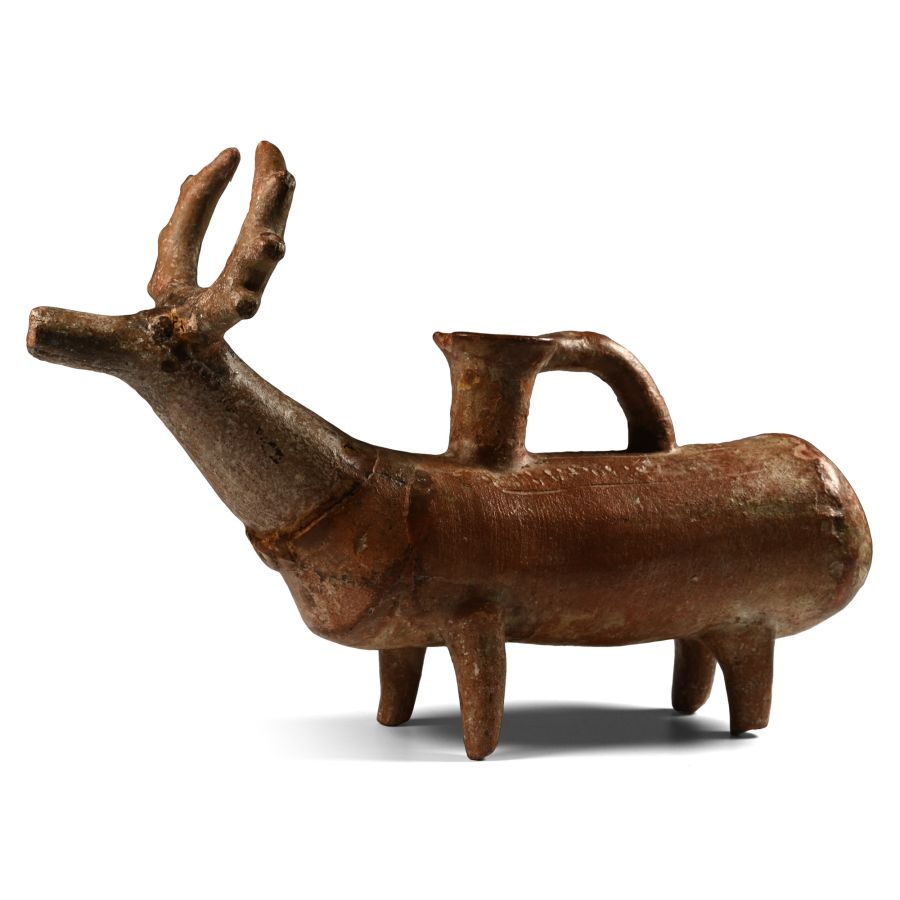
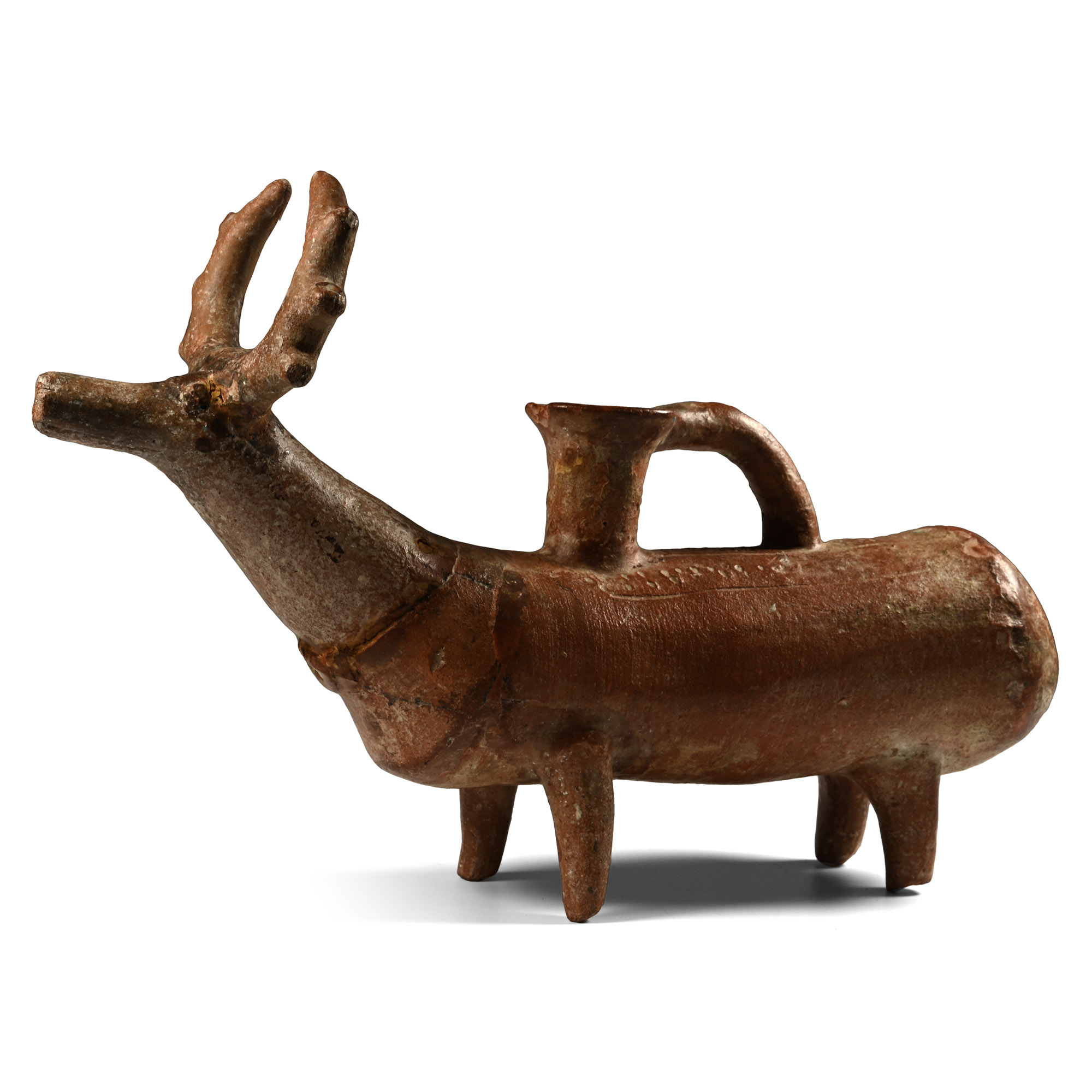
Amlash Terracotta Stag Rhyton
1ST MILLENNIUM B.C.
12 1/4 in. (841 grams, 30.9 cm wide).
Comprising a tubular body with dommed rump and four stub legs, angled neck to accept a separate neck and head with applied domed eyes and antlers with lateral spurs; trumpet-shaped filler tube to upper face and strap handle to the rear; impressed longitudinal lines; pouring hole at throat.
Provenance
with a London, UK gallery 1971-early 2000s.
Accompanied by an original thermoluminescence analysis report and photograph by Oxford Authentication with sample no.281z20 dated 16 June 1981.
This lot has been cleared against the Art Loss Register database, and is accompanied by an illustrated lot declaration signed by the Head of the Antiquities Department, Dr Raffaele D'Amato.
VETTING:
TimeLine Auctions follows a vetting process to ensure the authenticity and legality of all items, reinforcing our commitment to integrity and responsible trading. Each antiquity, antique, and coin lot undergoes thorough examination by a vetting committee of at least ten external specialists, professional trade association members, scientists, and archaeologists: Our Vetting Process
AUCTIONS:
TimeLine is a leading auction house specialising in antiquities, ancient art, collectables, natural history, coins, medals, and books. Our auctions offer museums, collectors, historians, and enthusiasts the opportunity to acquire unique and historically significant pieces.
LOT 1241
Amlash Terracotta Stag Rhyton
Estimate £1,000 - 1,400€1,160 - 1,620 (for guidance only)$1,350 - 1,890 (for guidance only)
RELATED LOTS
-
Large South Arabian Alabaster Standing Figure of a Goddess
1st century B.C.-1st century A.D.Sold for (Inc. bp): £54,600
Modelled in the round figure of a standing deity with textural detailing to the hair, naïve facial features with exaggerated eyes to accept inserts (absent) and slit mouth, gripping hands held out at the chest and one pierced to accept an attribute, knee-length garment, collar or necklace below the throat; mounted on a custom-made stand. 15.55 kg total, 47.5 cm high including stand
Ex Hans G. collection, Belgium, 1967-1983. Belgian art market, 1983. Private German collection of Mrs H., 1985-1993. with Pierre Bergé & Associés, Paris, 26 November 2013, no.198 (€40,000-45,000). Accompanied by an academic report by Dr Raffaele D’Amato. Accompanied by a copy of the relevant Pierre Bergé & Associés printed catalogue pages (double page spread). Accompanied by a copy of an Art Loss Register certificate no.S00119290. This lot has been checked against the Interpol Database of stolen works of art and is accompanied by search certificate number no.12468-230327. This lot has been cleared against the Art Loss Register database, and is accompanied by an illustrated lot declaration signed by the Head of the Antiquities Department, Dr Raffaele D'Amato.
Similar free-standing statues have been found in the royal cemetery in Aswan (probably Khazinet ed-Darb in the Wādī Markha), and at Hayd ibn Aqil (Timna), in Yemen. They are mainly statuettes from the Yemeni kingdoms of Awsan and Qataban, which developed in the Beihan Valley. They represent rulers or important dignitaries of both reigns. The statue is remarkable for the detailed treatment of the facial features, hair and dress: the woman is portrayed wearing a long plain dress, similar to the modern futah of Yemenite people. The eyes were originally inlaid with shell set with polished obsidian pupils, giving a life-like effect to the static statuettes. -
Neo Babylonian Chalcedony Stamp Seal with Worshipper and Prancing Bull
5th-4th century B.C.Sold for (Inc. bp): £1,300
Discoid in plan with convex upper face; accompanied by an old scholarly note, typed and signed by W.G. Lambert, late Professor of Assyriology, University of Birmingham, 1970-1993, which states: 'Stamp Seal of Amber Chalcedony 21 x 19 x 11 mm. This is a scaraboid pieced vertically. The design shows a standing worshipper in long robe raising one hand to a stand on which is a prancing bull on the back of which rises a pole surmounted with a lunar crescent. The stand is covered with wavey lines. This is a Late Babylonian seal, c. 600-350 B.C. from Mesopotamia or an adjacent area. The general design is typical for the period, but the stand with wavey lines and the prancing bull are rare and may be unique to this seal. The seal is worn and there is a chip by the head of the worshipper, but the design is entirely clear'; accompanied by a museum-quality impression. 6.33 grams, 20.92 mm
with Christie's, London, 13 June 2000, no.517 [Part]. Accompanied by a copy of a scholarly note, typed and signed by Professor Wilfrid George Lambert in July 2000. Accompanied by copies of the relevant Christie's catalogue pages. This lot has been cleared against the Art Loss Register database, and is accompanied by an illustrated lot declaration signed by the Head of the Antiquities Department, Dr Raffaele D'Amato. -
Old Babylonian 'Kings of Larsa' Terracotta Cuneiform Tablet Collection
2000-1500 B.C.Estimate: £7,000 - 9,000 (‡+bp*)
Opening Bid: £3,750
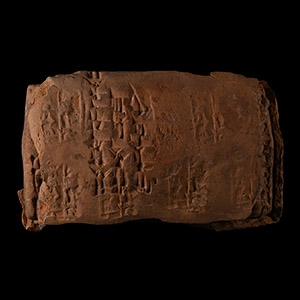
Group of pillow-shaped tablets, each with cuneiform text to the broad faces and an edge, reading: a) 'Loan of money by a deity during the reign of Sin-iqišam king of Larsa (1840-1836 BC). The tablet was sealed. Idnin-Sîn and Sutitum have obtained from the god Šamaš (a loan of) 5/6 mine 5 shekels of silver, the silver (has) an interest of 4 shekels 1/3. He° will have to repay the money at the time of sowing. Before (the god) Ea, Before (the goddess) Sugallitum Before (the god) Nanna Before Dani Seal of one (of the) witnesses... In the month of Tebitum The year of Sin-iqišam the king. b) sale of a palm grove during the reign of Nur-Adad king of Larsa (1865-1850 BC) 50 sar of orchard, planted with palm trees, next to Kunia, next to Amurutu, on the first small side: Rabutum. Sîn-pilah bought from Huzalum. He paid him its full price of 1/3 silver mine. He swore in the name of Nur-Adad the king that no one would constest in the future. In front of Itišumum In front of Sinennam Before Sugalum Before Kurušum Before Awīl-Amurrim the scribe In the month of šabatu, the year Nur-Adad (offered) a throne of justice (?) ... c) interest-free loan from the moon god Nanna, during the reign of Warad-Sîn (year 12), king of Larsa (1834-1823 BC) 12 shekels of interest-free silver, from (the moon-god) Nanna, debt of Bitanum. Before Qišti-Enlil Before Dadiya Before Sîn-šemi In the month of Innana, the 5th. The year (the king) built the temple of Ninug... inside (the city of) Maškan-šapir. d) contract for the sale of a palm grove during the reign of Sumu-el (year 26), king of Larsa (1894-1866 BC) 36 sar of orchard, planted with palm trees, next to Batuli and next to Kutanum, Sin-pilah bought from Bedi-el. He paid its full price 10... of silver. He swore in the name of the king that in the future no one would dispute. Before ... Before Sîn Dayan In front of Naqimum In front of Damu In front of Munakum In the month of Kislimu, the 4th year of the priest of Nanna.' 230 grams total, 47-58 mm
Ex private collection. with Bonhams, Antiquities, London, 21 October 1999, no.260. Private central European collection. Accompanied by copies of the relevant Bonhams catalogue pages. This lot has been checked against the Interpol Database of stolen works of art and is accompanied by search certificate number no.12244-219769. This lot has been cleared against the Art Loss Register database, and is accompanied by an illustrated lot declaration signed by the Head of the Antiquities Department, Dr Raffaele D'Amato.