
Loading, please wait...
_900x900.jpg "Akkadian Cylinder Seal with Combat Scene")
_200x200.jpg "Akkadian Cylinder Seal with Combat Scene")
.jpg "Akkadian Cylinder Seal with Combat Scene")
LOT 0181
Akkadian Cylinder Seal with Combat Scene
24TH-22ND CENTURY B.C.
1 1.8 in. (16.1 grams, 29 mm).
A marble cylinder seal with frieze; accompanied by an old scholarly note, typed and signed by W.G. Lambert, late Professor of Assyriology, University of Birmingham, 1970-1993, which states: 'Cylinder seal of white marble, 28 x 20 mm. Design : a standing hero with spikey hair is defending two horned animals being attacked by two lions. A second such hero is grappling with a monster with long plait. Akkadian, c.2400-2200 B.C. Condition very good save for chipped edges.'
ProvenanceFrom an important family collection.
Examined by Professor Wilfrid George Lambert FBA (1926-2011), historian, archaeologist, and specialist in Assyriology and Near Eastern archaeology, in the late 1980s and early 1990s.
TimeLine Auctions follows a vetting process to ensure the authenticity and legality of all items, reinforcing our commitment to integrity and responsible trading. Each antiquity, antique, and coin lot undergoes thorough examination by a vetting committee of at least ten external specialists, professional trade association members, scientists, and archaeologists: Our Vetting Process
AUCTIONS:
TimeLine is a leading auction house specialising in antiquities, ancient art, collectables, natural history, coins, medals, and books. Our auctions offer museums, collectors, historians, and enthusiasts the opportunity to acquire unique and historically significant pieces.
LOT 0181
Akkadian Cylinder Seal with Combat Scene
Estimate £600 - 800€700 - 930 (for guidance only)$810 - 1,080 (for guidance only)
-
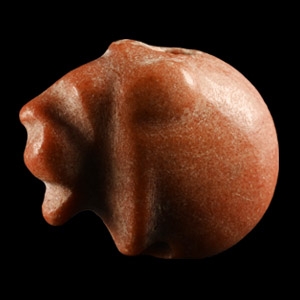
Sumerian Lion-Headed Seal Amulet
Circa 3rd millennium B.C.Sold for (Inc. bp): £598
A stone seal amulet in the form of a stylised lion's head, drilled vertically for suspension; drilled motif to reverse likely depicting a leaping feline. 2.5 grams, 18 mm
Acquired 1969-1999. London collection of the late Mr S.M., thence by descent. -
.jpg)
Mesopotamian Cuneiform Tablet Fragment Relating to Inventory of Sheep
Mid 3rd millennium B.C.Sold for (Inc. bp): £1,105
A bifacial clay tablet with cuneiform text to both faces, an accounting tablet concerning an inventory of various types of sheep associated with names of persons. 28 grams, 64 mm wide
Specialised collection of cuneiform texts, the property of a London gentleman and housed in London before 1992. Thence by descent to family members. Examined by Professor Wilfrid George Lambert FBA (1926-2011), historian, archaeologist, and specialist in Assyriology and Near Eastern archaeology, in the late 1980s and early 1990s. The collection is exceptional for the variety of types, including some very rare and well preserved examples. -
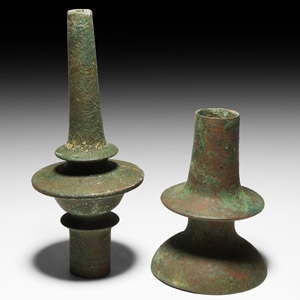
Byzantine Bronze Oil Lamp Stands
9th-10th century A.D.Estimate: £500 - 700 (+bp*)
Opening Bid: £200
A pair of copper-alloy oil lamp stands with ornamental stems. 1.7 kg total, 16-25.2 cm
UK private collection before 2000. UK art market. Property of a London gentleman.
