
Loading, please wait...
LOT 1085
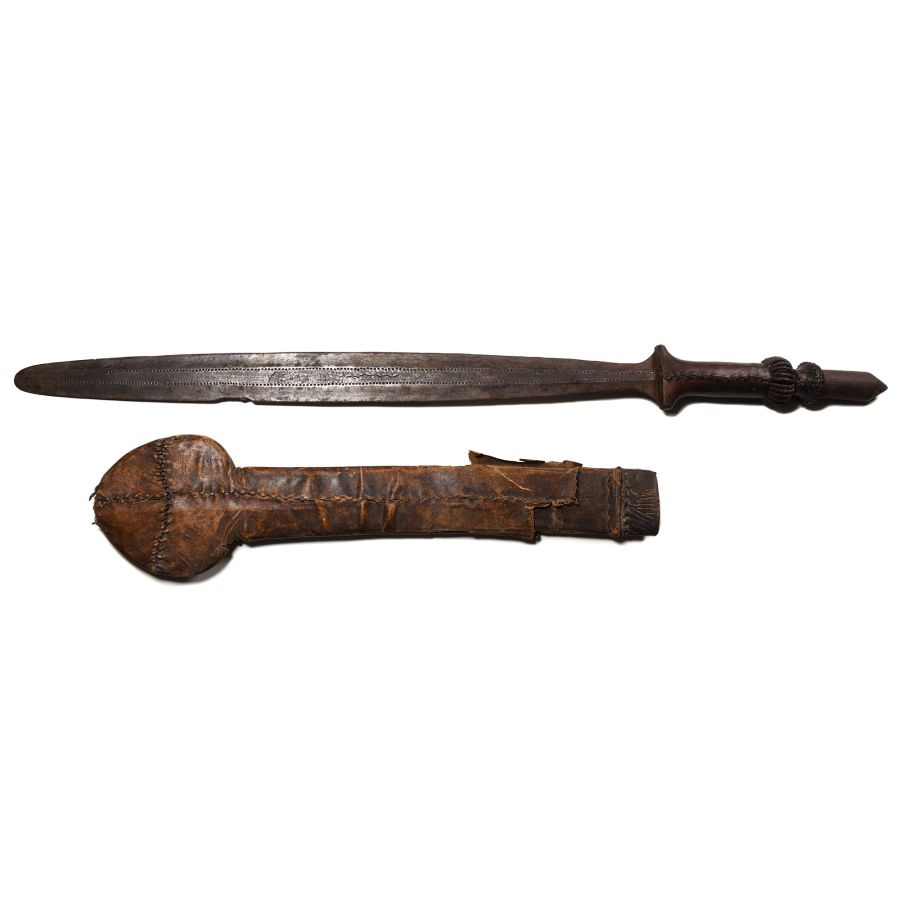
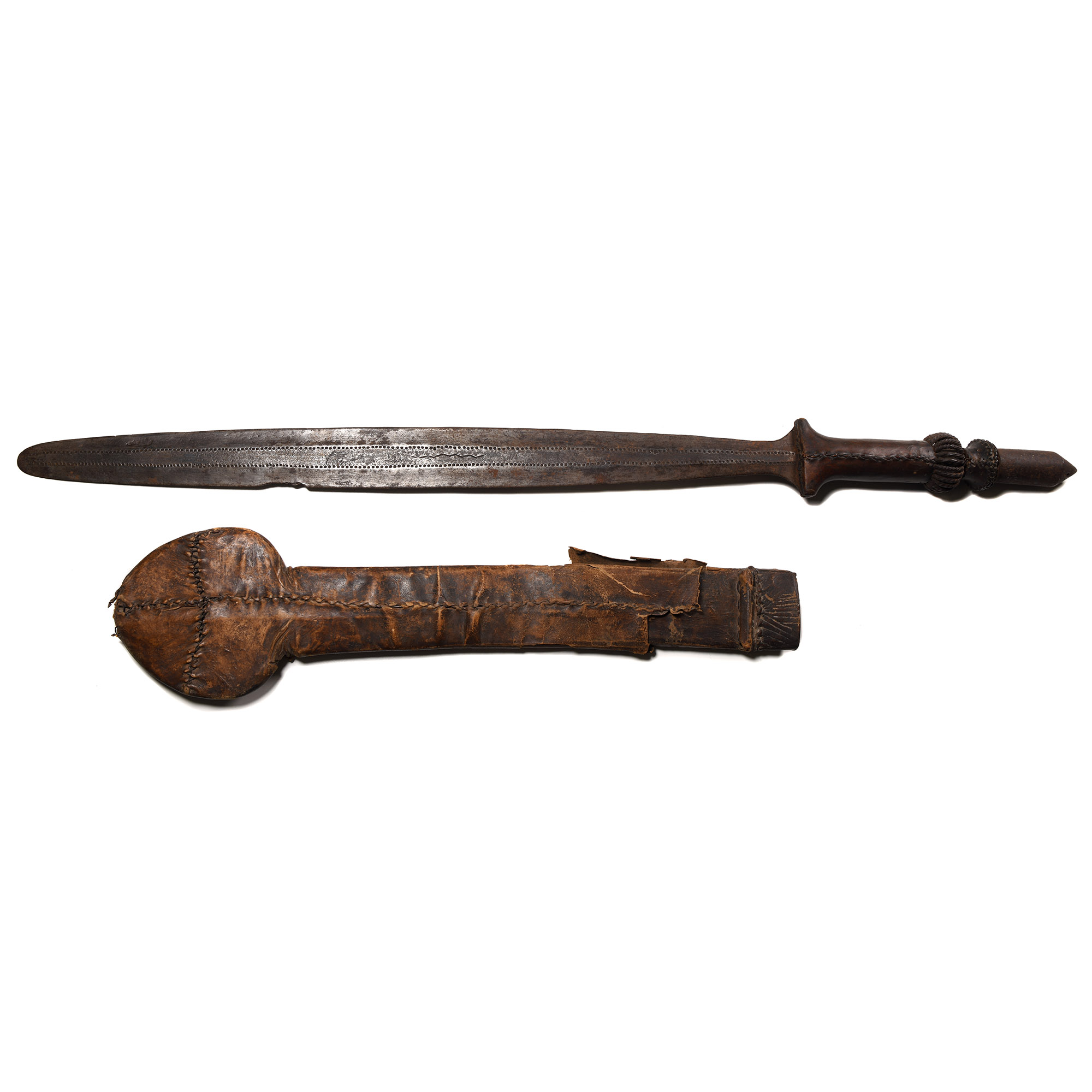
African Yaka Sword with Scabbard
19TH CENTURY A.D.
27 1/2 in. (684 grams, 70 cm long).
An iron sword with leaf-shaped blade decorated with a simple punched line punched and zig-zag ornament; the hilt partially covered with leather with stitched junctions, twisted iron wire 'cage' and elongated iron pommel; accompanied by a fragmentary wooden leather-covered sheath with spatulate end. [No Reserve]
ProvenanceAcquired locally by donation.
Property of Sense Charity, Cambridgeshire, UK.
Cf. Spring, C., African Arms and Armour, Smithsonian Institution Press, 1993, p.65.
FootnotesThe Yaka are an African ethnic group found in the south-west of the DRC, with the Angolan border to their west. The Yaka people were historically known for their excellent diplomatic and military abilities which enabled them to found the Yaka kingdom in the 17th century. One of their distinctive weapons was a long, straight sabre which developed into an increasingly elaborate style during the 19th and 20th centuries A.D.
CONDITIONTimeLine Auctions follows a vetting process to ensure the authenticity and legality of all items, reinforcing our commitment to integrity and responsible trading. Each antiquity, antique, and coin lot undergoes thorough examination by a vetting committee of at least ten external specialists, professional trade association members, scientists, and archaeologists: Our Vetting Process
AUCTIONS:
TimeLine is a leading auction house specialising in antiquities, ancient art, collectables, natural history, coins, medals, and books. Our auctions offer museums, collectors, historians, and enthusiasts the opportunity to acquire unique and historically significant pieces.
-
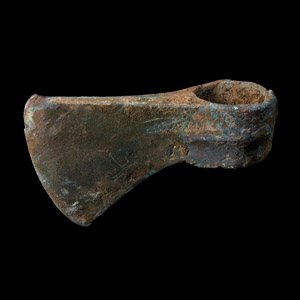
Western Asiatic Socketted Axehead
3rd millennium B.C.Sold for (Inc. bp): £89
A Bronze Age axehead with swept blade, large socket with raised circumferential rib and a vertical rib to the rear. 545 grams, 13 cm
Fine condition.
Private UK collection, 1980s-1990s. Acquired from a UK gallery, circa 2000.
This axe belongs to a group mainly including those of rectangular shape, the blades themselves rectangular or with slightly divergent edges, with a straight or rounded edges. -
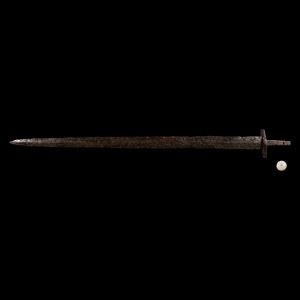
Migration Period Spatha Sword Blade with Sword Bead
Circa 4th-5th century A.D.Sold for (Inc. bp): £572
A double-edged spatha with a lentoid section parallel-sided iron blade with pointed tip; battle nicks to both cutting edges; rhomboid-section cross-guard; a fastening nail on the upper tang; accompanied by a sword bead. 921 grams total, 2.7- 86.5 cm
cleaned and conserved.
Acquired 1971-1972. From the collection of the vendor's father. Property of a London, UK, collector. Accompanied by an academic report by Dr Raffaele D’Amato.
A Migration Period sword, originating from Central Asia, often used by nomadic populations and particularly by the Huns, defined as a Nomadic-Asiatic sword by Menghin, or as a sword with plate guard. The long and thin blade, with a lenticular or lozenge section, was equipped with a guard composed of an iron plate inserted into the tang. Little is known about the scabbard of these swords but it is known that they usually had disc-shaped pommels, and stones hanging from the pommel or hilt. This typology was widespread in Central Europe by the Huns and there are also specimens attested in Gaul in the 5th century. -
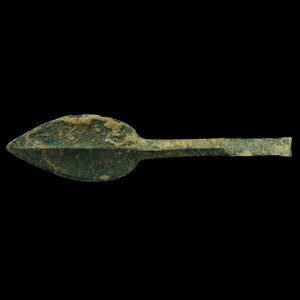
Western Asiatic Tanged Leaf-Shaped Spearhead
Circa 21st-mid 15th century B.C.Estimate: £100 - 140 (+bp*)
Opening Bid: £50
A large bronze tripartite spearhead with biconvex blade and flattened tang. 315 grams, 27.7 cm
Fine condition.
Ex Abelita family collection, 1980-2015.
The spearhead belongs to the subtype L2.B.d of the Gernez classification.
