
Loading, please wait...
_900x900.jpg "Achaemenid Turquoise Blue Glass Bead Necklace String")
_200x200.jpg "Achaemenid Turquoise Blue Glass Bead Necklace String")
.jpg "Achaemenid Turquoise Blue Glass Bead Necklace String")
LOT 1168
Achaemenid Turquoise Blue Glass Bead Necklace String
6TH-4TH CENTURY B.C. AND LATER
13 in. (11.4 grams, 33 cm).
A designer necklace composed of various beads and restrung to a Y-shape, central feature comprising a large melon and an annular bead. [No Reserve]
ProvenanceAcquired 1980-2015.
Ex Abelita family collection.
This lot has been cleared against the Art Loss Register database, and is accompanied by an illustrated lot declaration signed by the Head of the Antiquities Department, Dr Raffaele D'Amato.
TimeLine Auctions follows a vetting process to ensure the authenticity and legality of all items, reinforcing our commitment to integrity and responsible trading. Each antiquity, antique, and coin lot undergoes thorough examination by a vetting committee of at least ten external specialists, professional trade association members, scientists, and archaeologists: Our Vetting Process
AUCTIONS:
TimeLine is a leading auction house specialising in antiquities, ancient art, collectables, natural history, coins, medals, and books. Our auctions offer museums, collectors, historians, and enthusiasts the opportunity to acquire unique and historically significant pieces.
-
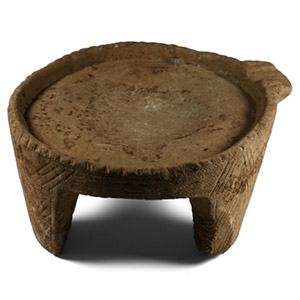
Hittite Limestone Altar
2nd-1st millennium B.C.Estimate: £700 - 900 (‡+bp*)
Opening Bid: £389
Carved from a limestone block with three trapezoidal stub legs, horizontal dished centre with notched edge to the raised rim and U-section pouring lip; panel of geometric linear ornament to the outer face of the body and legs; integral T-shaped reinforcing arms to underside. 3.5 kg, 26.3 cm wide
Private collection, Israel. with Archaeological Centre, Auction 59, no.433. Accompanied by a copy of the Archaeological Centre online catalogue page. This lot has been cleared against the Art Loss Register database, and is accompanied by an illustrated lot declaration signed by the Head of the Antiquities Department, Dr Raffaele D'Amato. -
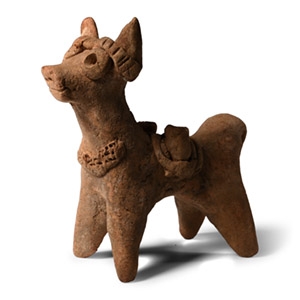
Amorite Terracotta Saddled Animal
1800-1600 B.C.Estimate: £600 - 800 (‡+bp*)
Opening Bid: £333
Modelled in the round with halter to the chest, strap to the brow and saddle with two lateral containers and straps. 88 grams, 85 mm
Acquired in the mid 1980s-1990s. Private collection, Switzerland, thence by descent. Private collection, since the late 1990s. This lot has been cleared against the Art Loss Register database, and is accompanied by an illustrated lot declaration signed by the Head of the Antiquities Department, Dr Raffaele D'Amato. -
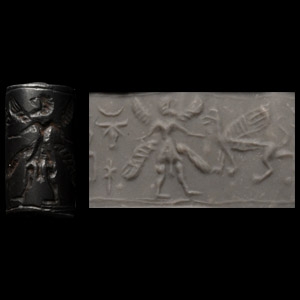
Neo Assyrian Haematite Cylinder Seal with Gods
900-600 B.C.Sold for (Inc. bp): £364
With frieze depicting a four-winged demon advancing towards a gryphon, bull-head standard and other objects in the field. 3.14 grams, 15 mm
Ex S collection, London, UK, 1970-1990s. This lot has been cleared against the Art Loss Register database, and is accompanied by an illustrated lot declaration signed by the Head of the Antiquities Department, Dr Raffaele D'Amato.
