
Loading, please wait...
_900x900.jpg "Achaemenid Heavy Gold Earring Pair")
_200x200.jpg "Achaemenid Heavy Gold Earring Pair")
.jpg "Achaemenid Heavy Gold Earring Pair")
LOT 0271
Achaemenid Heavy Gold Earring Pair
CIRCA 6TH-4TH CENTURY B.C.
1 1/2 in. (23.78 grams total, 38 mm each).
A matched pair of large earrings decorated with pomegranates on the outer edge, the crescentic body divided in transversal grooves representing the abdomen of a bee, with granulation on the inner and outer edge, a horizontal gold wire with circlets to the centre. [2]
ProvenanceFrom a private family collection formed since the early 19th century, thence by descent.
Property of a New Zealand legal professional.
Accompanied by an academic report by Dr Raffaele D’Amato.
This lot has been checked against the Interpol Database of stolen works of art and is accompanied by search certificate number no.12326-223715.
This lot has been cleared against the Art Loss Register database, and is accompanied by an illustrated lot declaration signed by the Head of the Antiquities Department, Dr Raffaele D'Amato.
See very similar earrings in the Metropolitan Museum, accession no. 1995.180a,b; Schmidt, E.F., Persepolis I, Structures, Reliefs, Inscriptions, Chicago, 1953; Schmidt, E.F., Persepolis II, Contents of the Treasury and other discoveries, Chicago, 1957, pl.44 no.27; J.M., Gold Jewellery in Ptolemaic, Roman and Byzantine Egypt, In two volumes, Volume 2 – Figures, Durham, 1990; Ogden, J. and Williams, D., Greek Gold Jewelry of The Classical World, New York, 1994.
FootnotesFruit were generally considered to be a symbol of sensuality, temptation and fertility; the giving and accepting of fruit may be regarded as a symbolic sexual act, or at least a prelude to marriage. It follows naturally that the pomegranate, with its innumerable fleshy seeds symbolising life and fecundity, was an attribute of Aphrodite.
CONDITIONTimeLine Auctions follows a vetting process to ensure the authenticity and legality of all items, reinforcing our commitment to integrity and responsible trading. Each antiquity, antique, and coin lot undergoes thorough examination by a vetting committee of at least ten external specialists, professional trade association members, scientists, and archaeologists: Our Vetting Process
AUCTIONS:
TimeLine is a leading auction house specialising in antiquities, ancient art, collectables, natural history, coins, medals, and books. Our auctions offer museums, collectors, historians, and enthusiasts the opportunity to acquire unique and historically significant pieces.
-
.jpg)
Sasanian High Tin Bronze Bowl
3rd-7th century A.D.Sold for (Inc. bp): £156
A shallow, wide bowl with rounded walls and flat base, incised concentric decoration to the inner base. 143 grams, 15.4 cm
Ex London, UK, collections, 1990s-2000s. This lot has been cleared against the Art Loss Register database, and is accompanied by an illustrated lot declaration signed by the Head of the Antiquities Department, Dr Raffaele D'Amato. -
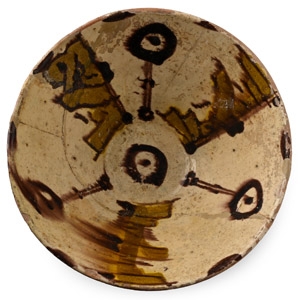
Nishapur Cream-Glazed Calligraphic Bowl
10th-13th century A.D.Sold for (Inc. bp): £169
Funnel-shaped with stepped foot, cream-glazed inner face with bold orange Kufic script motif; repaired. 324 grams, 17.2 cm wide
From the private family collection of Ersula Barter-Hemmerich, the longest serving member of staff working at the United Nations, her private collection formed in the 1950s and 1960s; thence by descent to her grandson. This lot has been cleared against the Art Loss Register database, and is accompanied by an illustrated lot declaration signed by the Head of the Antiquities Department, Dr Raffaele D'Amato. -
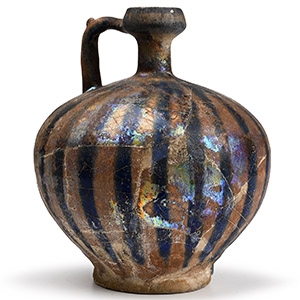
Kashan Glazed Handled Jug
12th-13th century A.D.Sold for (Inc. bp): £845
Spherical body on short ring foot, thin tubular neck, flared spout with D-section handle, blue and white glazed vertical stripes with iridescence; an old label to the underside; repaired. 445 grams, 15.8 cm
From the private family collection of Ersula Barter-Hemmerich, the longest serving member of staff working at the United Nations, her private collection formed in the 1950s and 1960s; thence by descent to her grandson. This lot has been cleared against the Art Loss Register database, and is accompanied by an illustrated lot declaration signed by the Head of the Antiquities Department, Dr Raffaele D'Amato.
