
Loading, please wait...
_900x900.jpg "Achaemenid Chalcedony Stamp Seal with Ahura Mazda")
_200x200.jpg "Achaemenid Chalcedony Stamp Seal with Ahura Mazda")
.jpg "Achaemenid Chalcedony Stamp Seal with Ahura Mazda")
LOT 0230
Achaemenid Chalcedony Stamp Seal with Ahura Mazda
CIRCA 5TH CENTURY B.C.
1 in. (14.3 grams, 25 mm).
Fragment of a conoid seal; Bivar notes in his summary: 'White chalcedony conoid with the reverse end broken off, leaving disk-shaped bezel. Fifth century B.C. This shape is perhaps typical of Babylonia. Above, "Ahuramazda symbol" r., with a human bust crowned...'; accompanied by a museum-quality impression.
Provenancewith Christie's, London, 21 April 1999, no.12.
Accompanied by a copy of a scholarly note typed and signed by A.D.H. (David) Bivar.
This lot has been checked against the Interpol Database of stolen works of art and is accompanied by a search certificate number no.12541-230316.
This lot has been cleared against the Art Loss Register database, and is accompanied by an illustrated lot declaration signed by the Head of the Antiquities Department, Dr Raffaele D'Amato.
TimeLine Auctions follows a vetting process to ensure the authenticity and legality of all items, reinforcing our commitment to integrity and responsible trading. Each antiquity, antique, and coin lot undergoes thorough examination by a vetting committee of at least ten external specialists, professional trade association members, scientists, and archaeologists: Our Vetting Process
AUCTIONS:
TimeLine is a leading auction house specialising in antiquities, ancient art, collectables, natural history, coins, medals, and books. Our auctions offer museums, collectors, historians, and enthusiasts the opportunity to acquire unique and historically significant pieces.
-
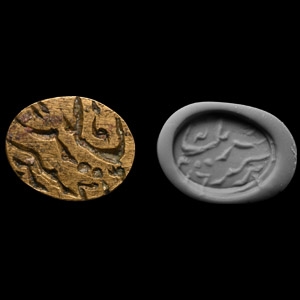
Western Asiatic Bronze Fob Seal
17th-18th century A.D.Sold for (Inc. bp): £26
With ellipsoid body bearing incised Nastaliq(?) inscription, openwork stem and suspension loop to the top. 3.34 grams, 24 mm
Ex H. Barker collection, UK. Property of a North London, UK, gentleman. This lot has been cleared against the Art Loss Register database, and is accompanied by an illustrated lot declaration signed by the Head of the Antiquities Department, Dr Raffaele D'Amato.
The Nastaʿlīq is one of the most important and widespread calligraphic styles used to write Farsi and was developed in Iran in the 8th and 9th centuries. -
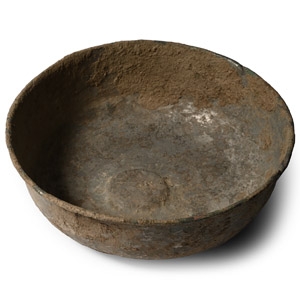
Achaemenid Tinned Bronze Phiale Mesomphalos
6th-4th century B.C.Estimate: £100 - 140 (+bp*)
Opening Bid: £50
Of low profile with raised central boss. 106 grams, 13.3 cm
Acquired 1980-2015. Ex Abelita family collection. This lot has been cleared against the Art Loss Register database, and is accompanied by an illustrated lot declaration signed by the Head of the Antiquities Department, Dr Raffaele D'Amato. -
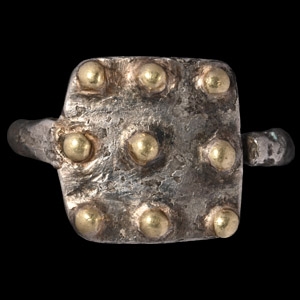
Western Asiatic Silver-Gilt Ring with Bosses
Eastern Roman Period, circa 3rd-5th century A.D.Sold for (Inc. bp): £169
Penannular in form with square bezel, nine gilt bosses. 4.58 grams, 23.23 mm overall, 18.16 mm internal diameter (approximate size British N 1/2, USA 6 3/4, Europe 14.35, Japan 13)
Ex German art market, 2000s. Acquired from an EU collector living in London. From the collection of Surrey, UK, gentleman. This lot has been cleared against the Art Loss Register database, and is accompanied by an illustrated lot declaration signed by the Head of the Antiquities Department, Dr Raffaele D'Amato.
