Loading, please wait...
LOT 1342
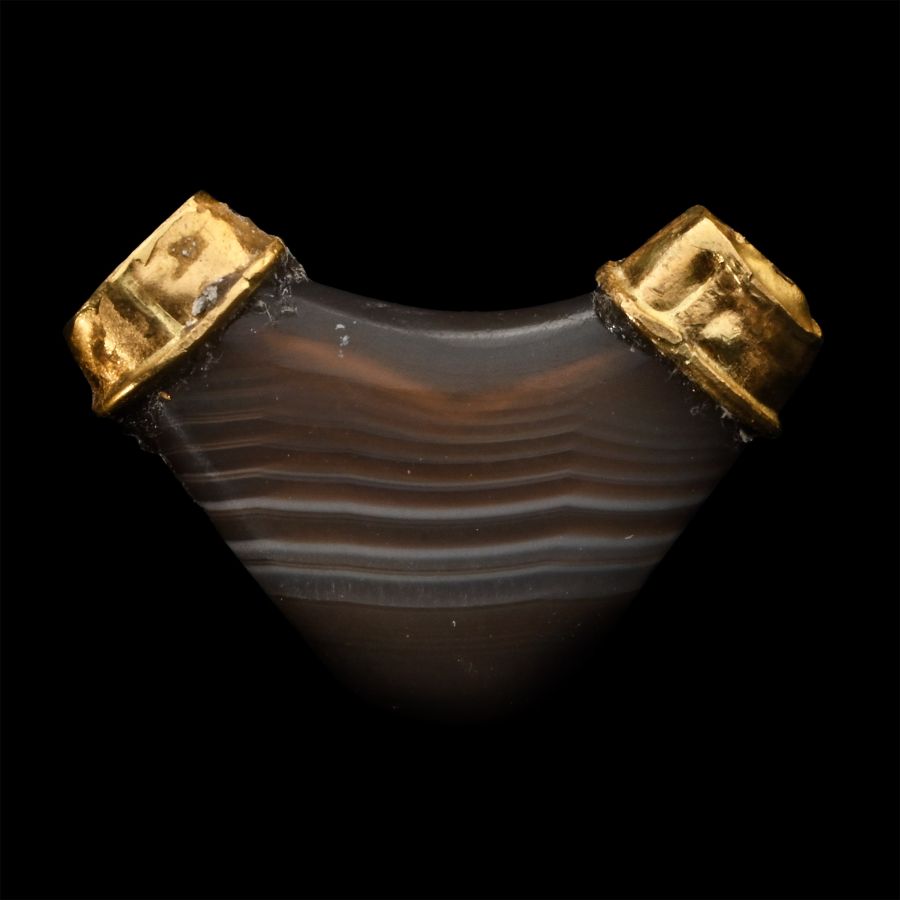
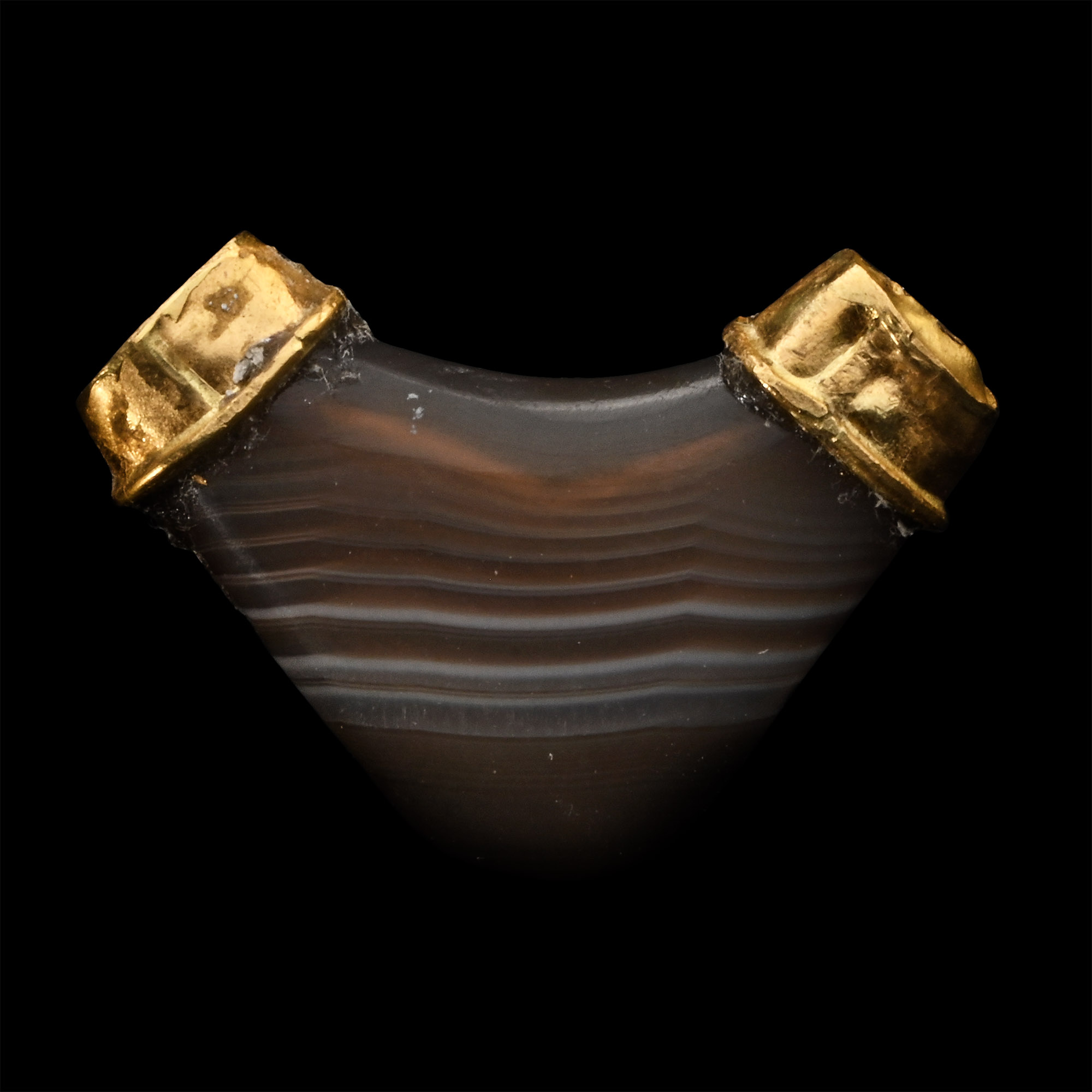
Achaemenid Banded Agate Elbow Bead
6TH-4TH CENTURY B.C.
3/4 in. (1.26 grams, 19 mm).
Carved from agate with horizontal contrasting banding, with a later ellipsoid gold cap to each finial.
ProvenanceFrom the collection of a late Japanese gentleman, 1970s onwards.
CONDITIONTimeLine Auctions follows a vetting process to ensure the authenticity and legality of all items, reinforcing our commitment to integrity and responsible trading. Each antiquity, antique, and coin lot undergoes thorough examination by a vetting committee of at least ten external specialists, professional trade association members, scientists, and archaeologists: Our Vetting Process
AUCTIONS:
TimeLine is a leading auction house specialising in antiquities, ancient art, collectables, natural history, coins, medals, and books. Our auctions offer museums, collectors, historians, and enthusiasts the opportunity to acquire unique and historically significant pieces.
LOT 1342
Achaemenid Banded Agate Elbow Bead
Estimate £200 - 300€230 - 350 (for guidance only)$270 - 410 (for guidance only)
Opening Bid
£111 (EUR 129; USD 150) +BP*
-
Sasanian Bronze Bowl
3rd-7th century A.D.Estimate: £80 - 100 (+bp*)
Bids: 4 | Current Bid: £25
With broad base and deep everted sidewall. 194 grams, 17 cm
From the collection of North West London, UK, gentleman, 1990-2000s. -
Large Neo-Assyrian Cuneiform Frieze Section with Annals for King Ashurnasirpal II
883-859 B.C.Estimate: £7,000 - 9,000 (+bp*)
Bids: 1 | Current Bid: £4,250
A stone frieze with four lines of large cuneiform text accompanied by documentation to support that this a section from the annals of King Ashurnasirpal II: 'Ashurnasirpal (II), great king, mighty king, king of the universe, king of Assyria, son of Tukulti-Ninurta (II), great king, mighty king, king of the universe, king of Assyria, son of Adad-nirari (II), great king, mighty king, king of the universe, king of Assyria, valiant man, who acts with the support of the weapons of Assur, his lord, who has no equal among the princes of the four regions, king who has subdued (the territories extending) from the opposite bank of the Tigris to Mount Lebanon and the Great Sea, the entire land of Laqû, the land of Suhu as far as the city of Rapiqu. He conquered the sources of the Subnat river as far as the land of Nirbu…'; mounted on a custom-made display stand. 2.85 kg total, 36.5 cm wide including stand
Belgian private collection, acquired before 1960, and thence by descent to the collector's widow. with Mrs Drees (?), Brussels, acquired from the widow of the above, 2004. with Pierre Bergé & Associés, Paris, 28 October 2006, lot 219. with Gorny & Mosch, Munich, 12 December 2023, lot 416. This lot has been checked against the Interpol Database of stolen works of art and is accompanied by search certificate number no.13369-258955.
Most of the reliefs and inscriptions of this king are in the British Museum and Louvre. Further holdings are in the New York Historical Society, the Metropolitan Museum of Art and Yale University. They celebrated the glory of the Assyrians at the apogee of their Empire. -
Aramaic Terracotta Magical Incantation Bowl
Circa 4th-8th century A.D.Estimate: £500 - 700 (+bp*)
Bids: 7 | Current Bid: £450
Flat-based bowl, inscribed in spiral from the bottom inner wall to the rim with Aramaic text. 360 grams, 17.6 cm
Private collection, 1980s. UK private collection before 2000. Acquired on the UK art market. Private collection, London, UK
Aramaic incantation bowls are particular to the Sasanian period and have been found in the regions of modern Iraq. These simple ceramic bowls, also known as magic bowls, each contain an Aramaic inscription, written in ink, which spirals from the centre. The bowls seem to have played an important part in domestic life. For example, during excavation in Nippur in 1889, one or more incantation bowls were found in each house together with domestic artefacts, most often in doorways or under floorboards in the corner of rooms. The bowls are predominantly apotropaic, and the inscriptions tend to protect their owners from misfortunes such as childbirth, illness and evil spirits.