
![Group of Thirteen [13] AE Greek Coins.](https://timelineauctions.com/upload/images/items/225125.jpg "Group of Thirteen [13] AE Greek Coins.")
LOT 2732
Group of Thirteen [13] AE Greek Coins. 4th-3rd century BC.
Various cities. Fine to Good Very Fine.(18.45gr total.). [13]
ProvenanceFrom the collection of a London antiquarian, formed since the 1980s.
TimeLine Auctions follows a vetting process to ensure the authenticity and legality of all items, reinforcing our commitment to integrity and responsible trading. Each antiquity, antique, and coin lot undergoes thorough examination by a vetting committee of at least ten external specialists, professional trade association members, scientists, and archaeologists: Our Vetting Process
AUCTIONS:
TimeLine is a leading auction house specialising in antiquities, ancient art, collectables, natural history, coins, medals, and books. Our auctions offer museums, collectors, historians, and enthusiasts the opportunity to acquire unique and historically significant pieces.
-
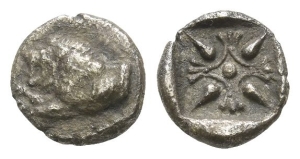
Western Asia Minor, uncertain mint AR Diobol. Circa 6th-5th century BC.
Sold for (Inc. bp): £195
Possibly Caria, uncertain mint or Ionia, Miletos. Forepart of roaring lion to left / Stellate pattern within incuse square. Unpublished in the standard references including HN Online. 0.98gr, 9mm.
Very Fine. Apparently unpublished and possibly unique.
From the collection of a London antiquarian, formed since the 1980s.
The fact that the present coin has the same reverse stellate pattern as the Diobols of Miletos (cf. SNG Kayhan I 462-75 and SNG Copenhagen 953) and some of the silver coins of the satraps of Caria (cf. HN Online 2926), leads us to attribute its origin to one of these two regions. -
![Group of Eight [8] AE Ancient Coins.](https://timelineauctions.com/upload/images/items/small/224339-s.jpg)
Group of Eight [8] AE Ancient Coins. 3rd-1st century BC.
Sold for (Inc. bp): £46
Various rulers and cities. 29.51gr total.
Fine to Very Fine.
From a private, UK, collection in the 1980s. Property of a London, UK, antiquarian. -
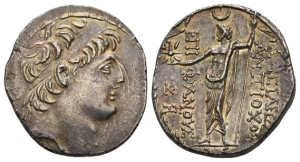
Seleukid Empire, Antiochos VIII Epiphanes (Grypos) AR Tetradrachm. 121/0-97/6 BC.
Estimate: £300 - 400 (‡+bp*)
Opening Bid: £150
Damaskos mint. Dated SE 204 (109/8 BC). Diademed head to right within fillet border / ΒΑΣΙΛΕΩΣ ΑΝΤΙΟΧΟΥ ΕΠΙΦΑΝΟΥΣ, Zeus Ouranios, nude, standing to left, holding star and sceptre; monogram above ZH to outer left; ΔΣ (date) in exergue; all within wreath. SC 2324.1b; HGC 9, 1196e; DCA 266. 16.12gr, 30mm, 12h.
Good Very Fine. Nicely toned. Slightly double struck.
From a private collection, Europe.
