
![Group of Seventeen [17] Mixed Ancient Greek Coins.](https://timelineauctions.com/upload/images/items/224525.jpg "Group of Seventeen [17] Mixed Ancient Greek Coins.")
LOT 2751
Group of Seventeen [17] Mixed Ancient Greek Coins. 3rd-1st century BC.
Various types. Near Fine to Near Very Fine.(54gr total.). [17]
ProvenanceProperty of a Cambridgeshire, UK, gentleman.
TimeLine Auctions follows a vetting process to ensure the authenticity and legality of all items, reinforcing our commitment to integrity and responsible trading. Each antiquity, antique, and coin lot undergoes thorough examination by a vetting committee of at least ten external specialists, professional trade association members, scientists, and archaeologists: Our Vetting Process
AUCTIONS:
TimeLine is a leading auction house specialising in antiquities, ancient art, collectables, natural history, coins, medals, and books. Our auctions offer museums, collectors, historians, and enthusiasts the opportunity to acquire unique and historically significant pieces.
-
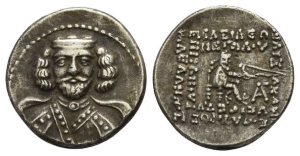
Kings of Parthia. Phraates III AR Drachm. 70/69-58/7 BC.
Sold for (Inc. bp): £468
Ekbatana mint. Struck circa 62 BC. Diademed facing bust, wearing necklace with medallion / BAΣIΛEΩΣ MEΓAΛOV APΣ-AKOV ΘΕOΠATOPOΣ EVEPΓETOV EΠIΦANOVΣ ΦIΛEΛΛHNOΣ, archer seated to right on throne, holding bow; monogram of ΑΓ beneath bow. Sellwood 35.1 var. (Darius?); Sunrise 326; Shore -. 4.02gr, 20mm, 12h.
Good Very Fine.
From the collection of a gentleman, acquired on the London art market in the 1990s. -
![Group of Eight [8] AR Sigloi of Achaemenid Empire.](https://timelineauctions.com/upload/images/items/small/223547-s.jpg)
Group of Eight [8] AR Sigloi of Achaemenid Empire. 5th-4th century BC.
Sold for (Inc. bp): £390
Various types. 44.04gr total.
Fine to Very Fine.
Ex 'V' gentleman's collection, Switzerland. From the property of a North London, UK, gentleman. -
![Group of Ten [10] AE Greek Coins.](https://timelineauctions.com/upload/images/items/small/225130-s.jpg)
Group of Ten [10] AE Greek Coins. 3rd-2nd century BC.
Sold for (Inc. bp): £52
Various rulers and cities. 47.80gr total.
Fine to Good Very Fine.
From the collection of a London antiquarian, formed since the 1980s.
