
![Group of Four [4] AE Greek Coins.](https://timelineauctions.com/upload/images/items/224310b.jpg "Group of Four [4] AE Greek Coins.")
![Group of Four [4] AE Greek Coins.](https://timelineauctions.com/upload/images/items/224310.jpg "Group of Four [4] AE Greek Coins.")
LOT 2741
Group of Four [4] AE Greek Coins. 2nd-1st century BC.
Various cities. Very Fine.(26.10gr total.). [4]
ProvenanceEx 'V' gentleman's collection, Switzerland.
From the property of a North London, UK, gentleman.
TimeLine Auctions follows a vetting process to ensure the authenticity and legality of all items, reinforcing our commitment to integrity and responsible trading. Each antiquity, antique, and coin lot undergoes thorough examination by a vetting committee of at least ten external specialists, professional trade association members, scientists, and archaeologists: Our Vetting Process
AUCTIONS:
TimeLine is a leading auction house specialising in antiquities, ancient art, collectables, natural history, coins, medals, and books. Our auctions offer museums, collectors, historians, and enthusiasts the opportunity to acquire unique and historically significant pieces.
-
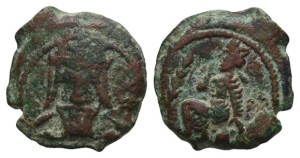
Kings of Parthia. Vologases III AE Dichalkon. Circa AD 105-147.
Sold for (Inc. bp): £20
Seleukeia mint. Dated Seleucid Era 451 (AD 139/140). Crowned facing bust wearing tiara; ANY (date) upwards to right / Tyche seated to left on column; palm to left. Sellwood 79.50; Shore -. 3.70gr, 18mm, 12h.
Near Very Fine. Very rare.
Property of a North London, UK, gentleman. -
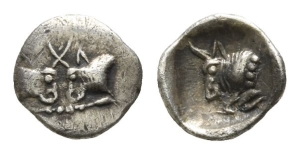
Caria, Uncertain mint 'D' AR Tetartemorion. Circa 450-400 BC.
Sold for (Inc. bp): £65
Foreparts of two confronted bulls, with horns intertwined / Forepart of bull to left within incuse square. HNO Online 73. 0.18gr, 7mm, 6h.
Extremely Fine. Unusually well struck for the type.
From the collection of a London antiquarian, formed since the 1980s. -
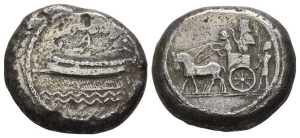
Phoenicia, Sidon. Ba'alsillem (Sakton) II AR Dishekel. Circa 401-365 BC.
Estimate: £2,000 - 3,000 (‡+bp*)
Opening Bid: £1,000
Undated issue, struck circa 401-370 BC. Phoenician galley to left; B (in Phoenician) above, waves below / Persian king and driver in chariot to left; to right, king of Sidon, in Egyptian style garments, holding cultic sceptre, walking to left. E&E-S Group IV.1.1; HGC 10, 236. 27.25gr, 29mm, 12h.
Near Very Fine.
Acquired in the mid 1980s-1990s. From a private collection, Switzerland; thence by descent. From a private collection, since the late 1990s.
