
![Group of Eight [8] BI Roman Antoniniani.](https://timelineauctions.com/upload/images/items/224857b.jpg "Group of Eight [8] BI Roman Antoniniani.")
![Group of Eight [8] BI Roman Antoniniani.](https://timelineauctions.com/upload/images/items/224857.jpg "Group of Eight [8] BI Roman Antoniniani.")
LOT 3179
Group of Eight [8] BI Roman Antoniniani. 3rd century AD.
Various emperors. Fine to Good Very Fine.(20.92gr total.). [8]
ProvenanceAcquired on the UK art market before 2000.
Property of an Essex, UK, gentleman.
TimeLine Auctions follows a vetting process to ensure the authenticity and legality of all items, reinforcing our commitment to integrity and responsible trading. Each antiquity, antique, and coin lot undergoes thorough examination by a vetting committee of at least ten external specialists, professional trade association members, scientists, and archaeologists: Our Vetting Process
AUCTIONS:
TimeLine is a leading auction house specialising in antiquities, ancient art, collectables, natural history, coins, medals, and books. Our auctions offer museums, collectors, historians, and enthusiasts the opportunity to acquire unique and historically significant pieces.
-
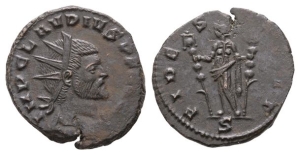
Claudius II Gothicus BI Antoninianus. AD 268-270.
Estimate: £20 - 30 (+bp*)
Opening Bid: £10
Mediolanum mint; struck circa AD 269-270. 2nd officina. IMP CLAVDIVS P F [AVG], radiate, draped, [and cuirassed?] bust to right, seen from behind / FIDES [MIL]IT, Fides standing facing, head to left, holding standard in each hand; S in exergue. Cf. RIC V 149; cf. Cohen 89; cf. MER-RIC 57. 2.92gr, 20mm, 5h.
Extremely Fine.
From a London, UK, collection, 1990s. -
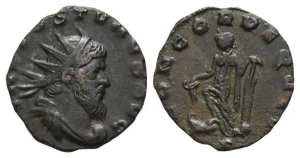
Aureolus, Romano-Gallic Usurper, BI Antoninianus. AD 268-269.
Sold for (Inc. bp): £52
Mediolanum (Milan) mint; struck mid AD 268. 2nd officina. In the name of Postumus. IMP POSTVMVS AVG, radiate, draped, and cuirassed bust of Postumus to right / CONCORD EQVIT, Concordia standing to left, holding patera with right hand and rudder with left; her right foot on prow of galley to left; S in exergue. RIC V.2 (Postumus) 373; RIC V.4 446; AGK (Postumus) 6a. 2.85gr, 19mm, 6h.
Very Fine.
Property of a Cambridgeshire, UK, gentleman.
Aureolus was an extraordinarily capable general who served under Valerian and Gallienus. He revolted against Gallienus in AD 267, who sieged him in the city of Mediolanum (Milan) where these coins were struck. -
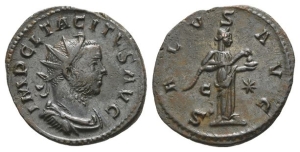
Tacitus BI Antoninianus. AD 275-276.
Sold for (Inc. bp): £39
Lugdunum mint; struck May-June AD 276. 3rd officina. IMP CL TACITVS AVG, radiate, draped, and cuirassed bust to right / SALVS AVG, Salus standing facing, head to right, feeding serpent in arms. C-star across fields. RIC V.1 58; MER-RIC 3338. 3.52gr, 22mm, 12h.
Extremely Fine.
Property of a Cambridgeshire, UK, gentleman.
