-
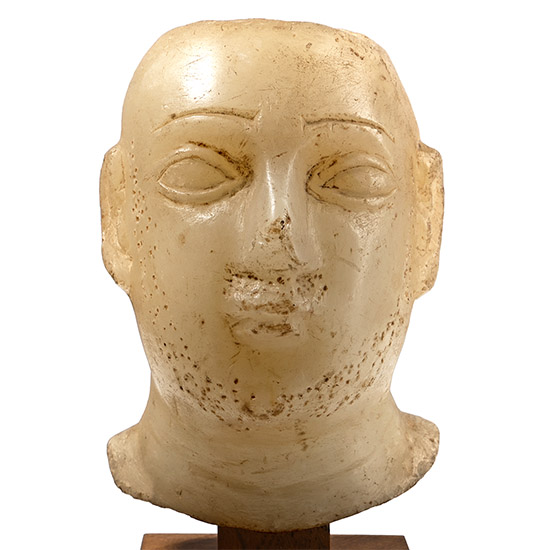
South Arabian Alabaster Head of a Man
3rd-2nd century B.C.Estimate: £3,000 - 4,000 (‡+bp*)
Opening Bid: £1,650
Oval face with pointed chin, stippled beard and elongated ears; incised eyebrows above large almond-shaped eyes, protruding nose and mouth; mounted on a custom-made stand; with old label reading 'N 3268'. 903 grams total, 18.6 cm including stand
Ex Laurin, Guilloux, Buffetaud et Tailleur, Paris, 20 May 1987, no.389. with Tajan Auction, Paris, 28 March 2003, no.192. This lot has been checked against the Interpol Database of stolen works of art and is accompanied by search certificate no.13537-263100.
Within southern Arabia, the ancient tradition of carving beautiful funerary sculptures from alabaster was long-lasting. The eyes and eyebrows of these stone sculptures were usually inlaid or highlighted with red or black pigment. -
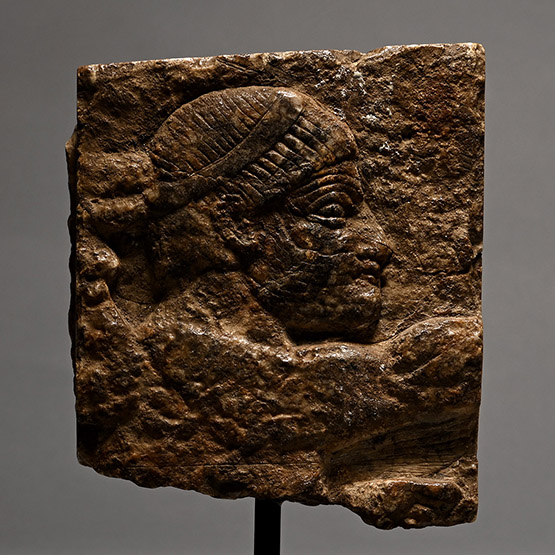
Assyrian Hardstone Relief with Head of a Bearded Man
704-681 B.C.Estimate: £7,000 - 9,000 (‡+bp*)
Opening Bid: £3,500
Rectangular frieze fragment with low-relief carving of a profile bust with short straight hair confined by a brow-band, segmented curls forming the beard, furrowed brow, one arm extended; handwritten label to rear 'from the Koyunjik palace of Sennacherib at Nineveh and incised legend 'KOUYUNJIK' and 'A'; mounted on a custom-made stand. 530 grams total, 11.6 cm including stand
Allegedly found in the Koyunjik Palace of Sennacherib. Ex property of a gentleman, UK, acquired in the 1970s. Ex private collection, Oxfordshire, UK, 1988. Anonymous sale, Christie's, London, 7 December 1994, no.235. Art market, New York. Ex private collection, Tokyo, Japan. Private European collection, 2009. This lot has been checked against the Interpol Database of stolen works of art and is accompanied by a search certificate no.12880-241660.
The image can be compared with that of a fisherman from the time of Sennacherib (705-681 B.C.). On his head, there is a fillet which slightly broadens at the front. -
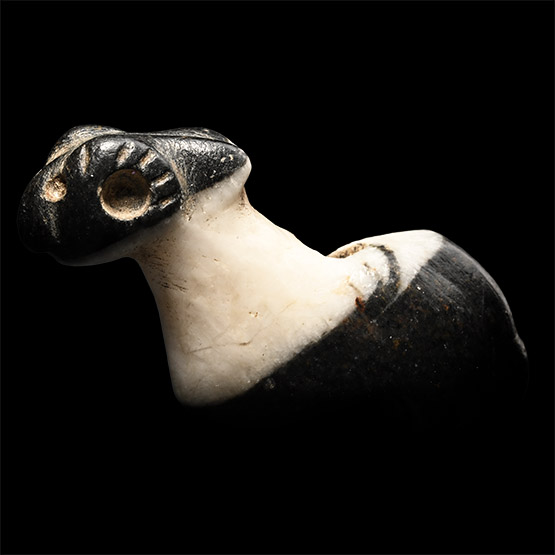
Babylonian Stone Bead in the Shape of a Ram
1st millennium B.C.Estimate: £700 - 900 (‡+bp*)
Opening Bid: £350
Carved in the round to take advantage of the banded colouration, pierced vertically through the rump, with eye and ribbed horn detailing. 8.66 grams, 40 mm
Private collection, acquired in the late 1980s-early 1990s; thence by descent. -

Babylonian Carnelian Frog-Shaped Amulet
1st millennium B.C.Estimate: £800 - 1,000 (‡+bp*)
Opening Bid: £444
Carved in the round with hind legs folded behind the body, pierced at the stomach. 2.33 grams, 19 mm
Private collection, acquired in the late 1980s-early 1990s; thence by descent. -
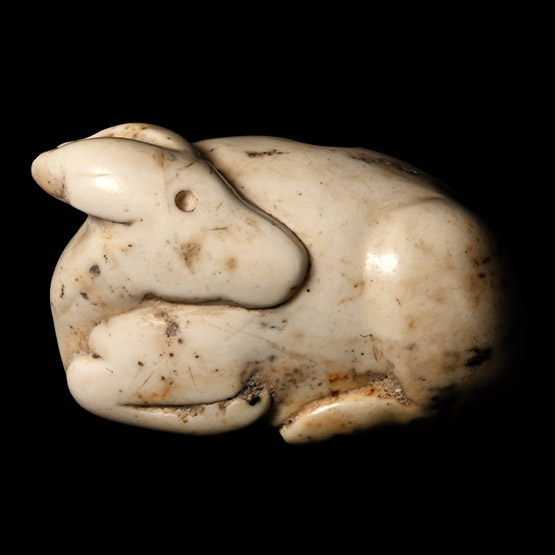
Jemdet Nasr Type Marble Gazelle Seal
Circa 3000 B.C.Estimate: £1,200 - 1,700 (‡+bp*)
Opening Bid: £650
Plano-convex in section with ellipsoid body, high-relief legs and reversed head; underside with incuse animal motifs. 11.08 grams, 31 mm
Private collection, acquired in the late 1980s-early 1990s; thence by descent. -
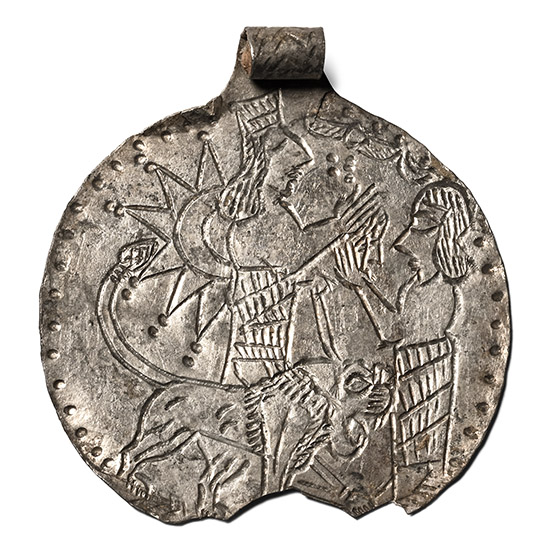
Urartu Silver Pendant with Khaldi the God of War
8th-7th century B.C.Estimate: £800 - 1,000 (+bp*)
Opening Bid: £400
Discoid in plan with tag above rolled into a suspension loop; row of punched points forming a rim enclosing low-relief image of two figures wearing tiered kilts facing each other beside an advancing lion, with sun to the rear of the higher figure. 3.42 grams, 40 mm
Private collection, 1980s. Acquired on the UK art market. Private collection, London, UK. -
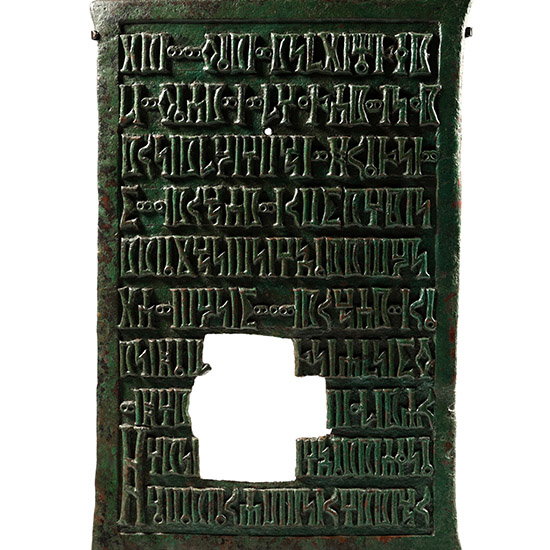
South Arabian King Rabbishamsum Nimran Bronze Dedicatory Plaque
Yemen, circa 150 A.D.Estimate: £8,000 - 10,000 (+bp*)
Opening Bid: £4,000
Rectangular in profile with spur to each upper angle; high-relief reserved epigraphic text in ten lines with void at lower centre; dedicated to the god Dhu-Samāwī by Ẓabiyum Yarḥab, under the Reign of King Rabbīshamsum Nimrān; mounted on a custom-made stand. 2.03 kg total, 28 x 18.6 cm (34.5 cm high including stand)
Ex Robin Marshal-Carter, Adelaide, South Australia, 1970. Private collection, London, UK. Accompanied by a full transliteration and translation into modern English. This lot has been checked against the Interpol Database of stolen works of art and is accompanied by a search certificate number no.12697-235195.
From the temple of Yaghrū consecrated to the god dhu-Samāwī, in the wādī 'l-Shudayf in northern Yemen. -
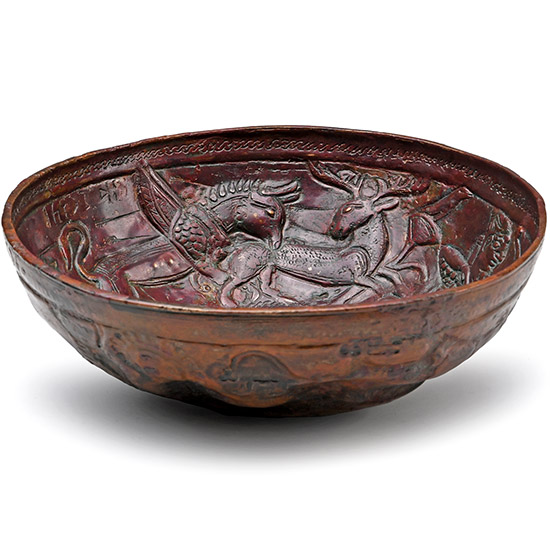
South Arabian Bronze Bowl Featuring a Hunting Scene and Inscription
Southwestern Arabia, Kingdom of Ma’in, circa 3rd century B.C.-2nd century A.D.Estimate: £5,500 - 7,500 (+bp*)
Opening Bid: £2,750
Broad and squat with impressed guilloche below the inner rim, repoussé frieze with fleeing ibex attacked by a gryphon and kneeling archer to the rear; central rosette; seven incised characters to inner face and four to outer face. 277 grams, 15.5 cm
Saleh family collection, Germany, formed prior to 1972. Private collection, UK. This lot has been checked against the Interpol Database of stolen works of art and is accompanied by search certificate no.12809-241324.
The presence of decorated bronze bowls during the later Pre-Islamic period, mainly in the territories of the modern Emirates, is well documented. Many decorated bowls and bowl fragments were discovered at Mleiha; one or more possible fragments were found at ed-Dur, and a single bowl comes from a Pre-Islamic period C tomb in Dibba. They are also similar to the so-called Phoenician - or, more correctly, Levantine - bowls produced in the 9th-early 7th century B.C. They combine local Levantine elements with imagery borrowed from Mesopotamia and Egypt, and local Arabian themes, such as camel and horse riding, often composed in radial zones.

