-
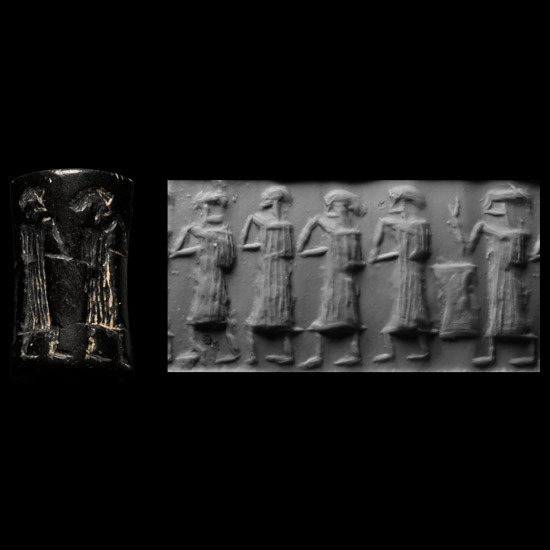
Akkadian Black Stone Cylinder Seal with Worship Scene
Circa 2300-2200 B.C.Estimate: £1,800 - 2,400 (+bp*)
Opening Bid: £900
Cylinder with standing figures, with restrung red stone bead to each end; accompanied by a copy of an old scholarly note, typed and signed by W.G. Lambert, late Professor of Assyriology, University of Birmingham, 1970-1993, which states: 'Cylinder Seal of Black Stone, 32 x 20 mm. The design shows a row of five standing figures, the first raising one hand over a stand, the other four holding their hands at the waist. All are dressed in long robes to the legs. This is an Akkadian seal, c. 2300-2200 B.C., from Mesopotamia or south-west Iran. It is in good condition, and is a rare type. The engraving is in a rather crude style, but vigorous. The scene is one of worship'; supplied with a museum-quality impression. 22.9 grams total, seal: 32.6 mm
Acquired on the French auction market. Accompanied by a copy of an old scholarly note, typed and signed by W.G. Lambert, late Professor of Assyriology, University of Birmingham, 1992. This lot has been checked against the Interpol Database of stolen works of art and is accompanied by search certificate no.13465-262418.
In the Akkadian seals parallel to the rendition of personalised might are scenes depicting quite realistic action of a divine or more divine characters. Later seals are often representing processions of attendants, worshippers (like here) or scenes of husbandry. -
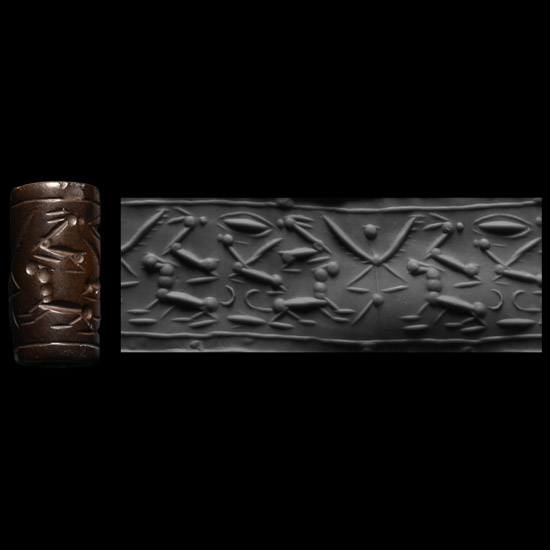
Mitanni Brown Stone Cylinder Seal with Mythical Bird
Circa 1500-1350 B.C.Estimate: £1,200 - 1,700 (+bp*)
Opening Bid: £600
Cylinder with animals, restrung red stone bead to each end; accompanied by a copy of an old scholarly note, typed and signed by W.G. Lambert, late Professor of Assyriology, University of Birmingham, 1970-1993, which states: 'Description of Cylinder Seal of brown hematite, 24 x 12 mm. Condition fine. In the centre a mythical bird figure stands while to either side are arranged symmetrically a horned animal above a lion. The remaining space is filled with a lozenge shape above a horned animal with wings above a fish. The whole design is enclosed by a horizontal line above and below. This seal in a typical Mitanni "elaborate style" specimen, c.1500-1350 B.C., from anywhere between the edges of Kurdistan in the East and the Mediterranean in the West. The identity of the bird-figure is unknown, and the symbolism of the animals and fishes is similarly not known. As usual with most Mitanni seals, the whole design was cut with mechanical means the drill and the cutting wheel.'; supplied with a museum-quality impression. 11 grams total, seal: 24.3 mm
Private collection, London, UK. Accompanied by a copy of an old scholarly note, typed and signed by W.G. Lambert, late Professor of Assyriology, University of Birmingham, 1986. -
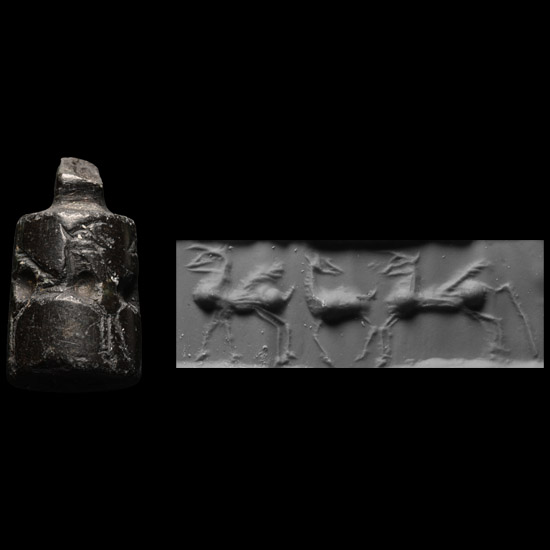
Urartu Black Stone Stamp-Cylinder Seal with Recumbent Horned Quadruped
Circa 900-700 B.C.Estimate: £1,200 - 1,700 (+bp*)
Opening Bid: £600
With mythological winged animals, accompanied by a copy of an old scholarly note, typed and signed by W.G. Lambert, late Professor of Assyriology, University of Birmingham, 1970-1993, which states: 'Description of Stamp-Cylinder Seal of black stone, 25 x 19 mm. Sides: two walking winged horned quadrupeds, a backwards looking horned quadruped. Base: a recumbent horned quadruped. This is from Urartu, the area around lake Van, and dates from c.900-700 B.C. The creatures depicted are typical of Urartian art generally. Save for a chip off the handle, condition fine.'; supplied with a museum-quality impression. 6.65 grams, 24.7 mm
Private collection, London, UK. Accompanied by a copy of an old scholarly note, typed and signed by W.G. Lambert, late Professor of Assyriology, University of Birmingham, 1987. -
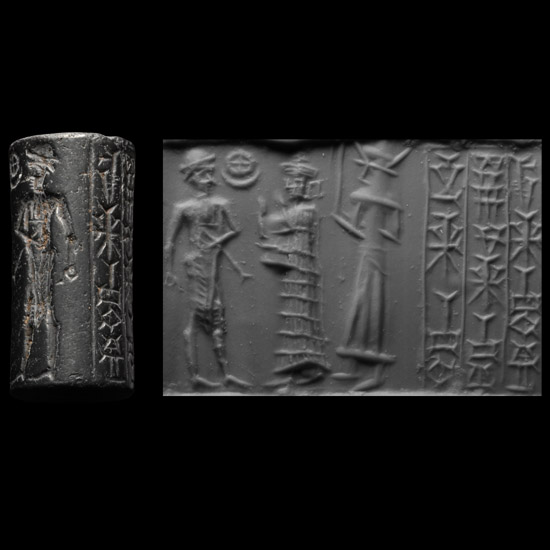
Old Babylonian Hematite Cylinder Seal for Lu-Enkika, Son of Iddin-Sin, Servant of Enki
Circa 1900-1700 B.C.Estimate: £2,500 - 3,500 (+bp*)
Opening Bid: £1,250
Cylinder with figures and inscription, restrung red stone bead to each end; accompanied by a copy of an old scholarly note, typed and signed by W.G. Lambert, late Professor of Assyriology, University of Birmingham, 1970-1993, which states: 'Description of Cylinder Seal of Hematite, 29.5 x 14.5 mm. The original art work consists of a pair of standing figures: a Lamma goddess to the right, with both hands raised, wearing a horned tiara of divinity and a long flounced dress reaching to the feet, and facing her the god with mace, wearing a Gudes-type hat, a role which reaches to the knees, and holding a mace at the waist with his right hand. Between them in the sky is a combined sun disk and lunar crescent. A third figure to the far right is out in a different style, and was added a century or two later. It shows a standing god with projections from his headdress and holding up a long rod in his right hand. His robes reach a little above the feet. There is a three line cuneiform inscription: 'Du-Enkika, son of Iddin-Sin, servant of (the god) Enki". The inscription identifies the owner. This is an Old Babylonian seal, either from southern Iraq or from the closest parts of south west Iran, such as Susa. It dates to c. 1900-1700 B.C. and is out in the fine detailed best style of the period. After 1700 B.C., until about 1500, there existed a simplified style, using especially the mechanical tools possessed by the craftsmen of the day, namely the drill and cutting wheel. The cutting wheel was used to supply the extra figure, and this was with reasonable certainty done in Iran, not Mesopotamia. The projecting hat and the rod are paralleled in seals from Susa, see P. Amiet, Glyptique Susienne nos. 1748, 1755, for the hat, and nos. 1748, 1749, 1756 for the rod.'; supplied with a museum-quality impression. 19.8 grams total, seal: 28.8 mm
Private collection, London UK. Accompanied by a copy of an old scholarly note, typed and signed by W.G. Lambert, late Professor of Assyriology, University of Birmingham, 1991. This lot has been checked against the Interpol Database of stolen works of art and is accompanied by search certificate no.13467-262421.
The Old Babylonian style produced several relatively simple yet sometimes ornate designs, some quite early but many more probably of the first half of the 18th century B.C., especially from the time of Hammurabi. -
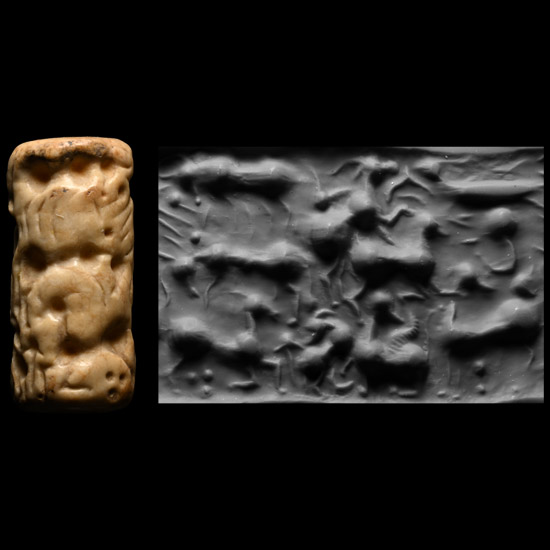
Large Cypriot or Levantine White Marble Cylinder Seal with Nine Quadrupeds and a Scorpion
2nd millennium B.C.Estimate: £1,800 - 2,400 (+bp*)
Opening Bid: £900
Cylinder with animals, restrung red stone bead to each end; accompanied by a copy of an old scholarly note, typed and signed by W.G. Lambert, late Professor of Assyriology, University of Birmingham, 1970-1993, which states: 'Cylinder Seal of White Marble, 37 x 12 mm. The glyptic shows a total of nine quadrupeds in various poses, one scorpion (?), and a few minor unidentified items. The Style of cutting shows much use of the drill, with linear representation of e.g. the animals' legs. all the various items are arranged to fill the space available very completely. This seal is not a well known type, but has similarities to seals found in Cyprus and the Levant, dating to the second half of the second millenium B.C. There was a great variety of local styles in this area and period, and the specimen being described here belongs to this category'; supplied with a museum-quality impression. 16 grams total, seal: 36.9 mm
Ex Mr K. Kobayashi, Galerie Archaique Ltd, Osaka, Japan, prior to 1988. Accompanied by a copy of an old scholarly note, typed and signed by W.G. Lambert, late Professor of Assyriology, University of Birmingham, 1991. This lot has been checked against the Interpol Database of stolen works of art and is accompanied by search certificate no.13466-262419.
This cylinder seal features a worship scene adapted from Mesopotamian tradition, which typically shows a goddess leading a worshipper toward an enthroned god. However, the Levantine artist has modified this traditional theme by replacing the goddess with a male figure. In keeping with ancient art conventions, the worshipper stands before the god with hands raised in prayer. -
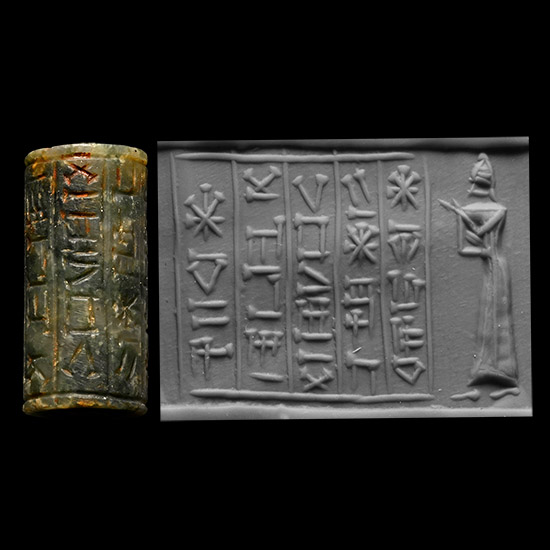
Sumerian Mottled Stone Cylinder Seal with Cuneiform Inscription
Circa 2nd millennium B.C.Estimate: £600 - 800 (+bp*)
Opening Bid: £300
With a standing figure in profile, wearing a floor-length robe and holding one bent arm with an open hand; five columns of cuneiform text; supplied with a museum-quality impression. 6.03 grams, 24.31 mm
Private collection, 1980s. Acquired on the UK art market. Private collection, London, UK. -
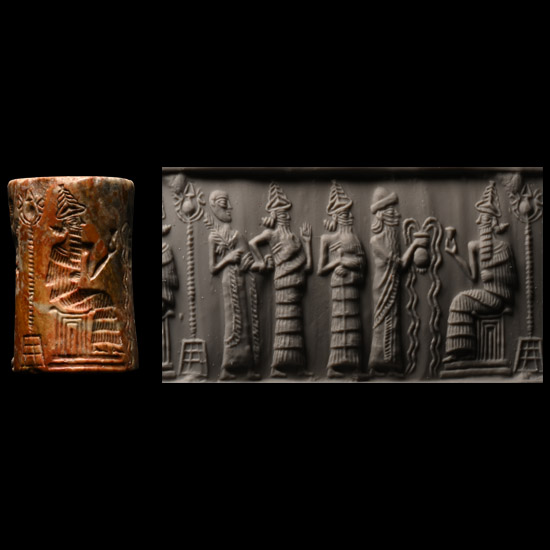
Old Babylonian Hardstone Stone Cylinder Seal with Presentation Scene
Mesopotamia, 1800-1600 B.C.Estimate: £1,200 - 1,700 (+bp*)
Bids: 3 | Current Bid: £15
Cylinder with a scene composed of a seated male figure wearing a horned crown and long dress, holding a vessel; facing two standing male figures, one of them holding a jar with overflowing water; two standing figures with one holding the other; a tall column or tree behind the seated deity figure; supplied with a museum-quality impression. 38.7 grams, 36 mm
Private European collection, 1990s. -
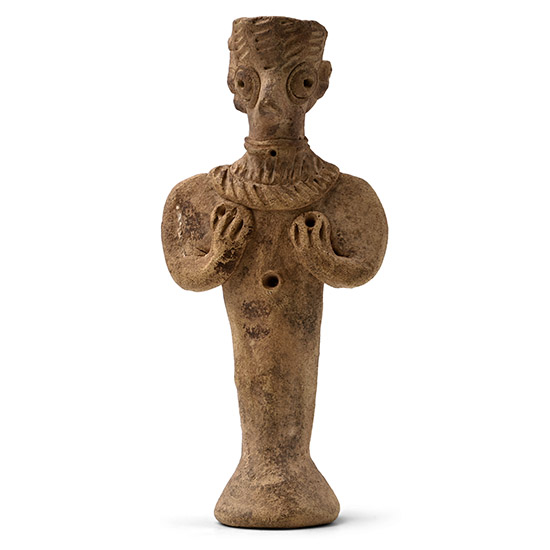
Syro-Hittite Terracotta Idol
2nd millennium B.C.Estimate: £1,000 - 1,400 (‡+bp*)
Opening Bid: £550
Modelled in the round with columnar body and flared base, arms bent and hands placed flat on the chest holding the nipples, herringbone pattern to the collar, hatched headdress, socket to rear of head. 102 grams, 14.5 cm
Collection T. Arakji, Hamburg, Germany. Private collection, Switzerland, acquired in 1994; thence by descent. -
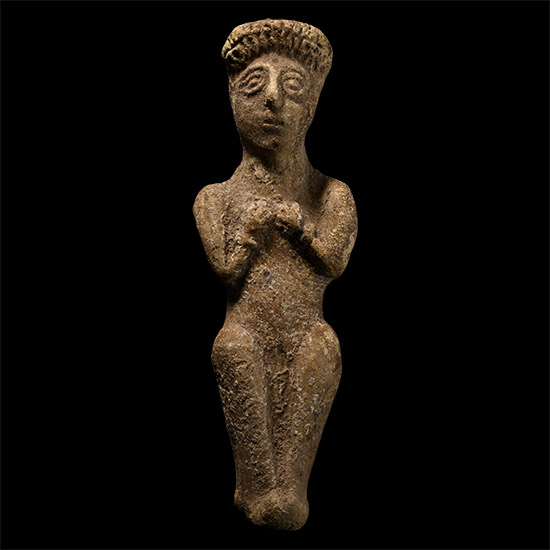
Western Asiatic Terracotta Female Idol
2nd millennium B.C.Estimate: £1,200 - 1,700 (‡+bp*)
Opening Bid: £667
Frontally standing nude female with a rounded body, hands wearing circular bracelets resting on her breasts, oval face with large eyes framed by pronounced lids, hair braided into a tall wreath. 96 grams, 13.4 cm
Acquired from Galerie Günter Puhze, Freiburg, 18 April 2000. Ex P.A.E. Hollander, 1992-2010. with Jean-David Cahn AG, Auction, 26 September 2015, no.4. -
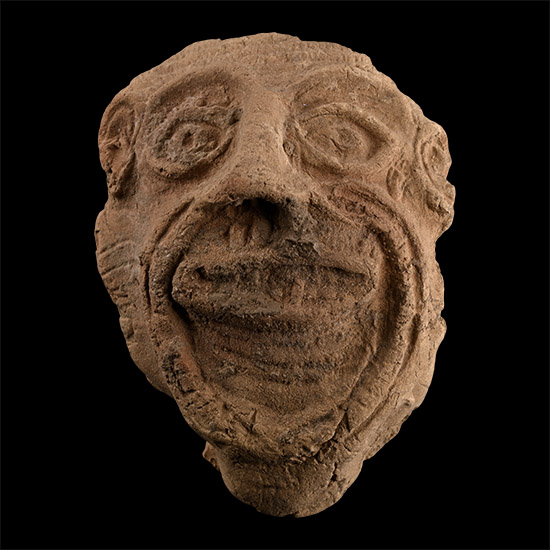
Neo-Assyrian Terracotta Plaque of Demon Humbaba
Circa 800-600 B.C.Estimate: £700 - 900 (‡+bp*)
Opening Bid: £350
Ovoid in plan with moulded high-relief facial detailing, suspension ledge to reverse. 170 grams, 10.9 cm
From the collection of Contessa L.G., assembled in the 1980s. Private collection, acquired in Switzerland in 1999. Accompanied by a copy of an Art Loss Register certificate, no.S00066787. -
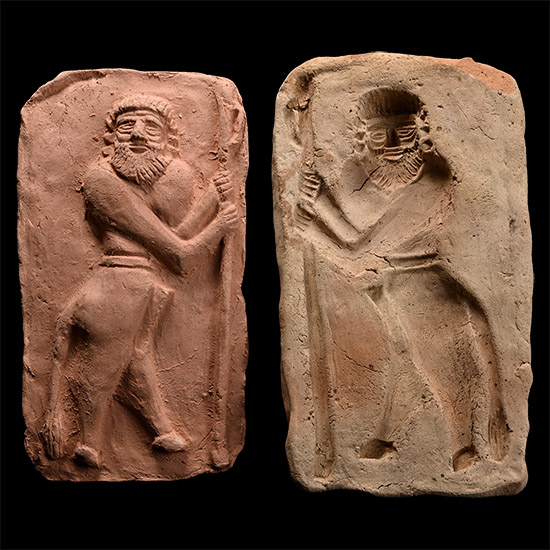
Old Babylonian Ceramic Plaque Mould of a Standing God
Early 2nd millennium B.C.Estimate: £2,000 - 3,000 (+bp*)
Opening Bid: £1,000
Rectangular mould with a recess formed as Kusarikku holding a long standard, his bearded face depicted frontally, whereas his lower body formed as a bull's legs and tail is depicted facing the staff; accompanied by an impression of the mould. 330 grams, 13.3 cm
Mayfair gallery, early 1990s. Ex North American gentleman collection. This lot has been checked against the Interpol Database of stolen works of art and is accompanied by search certificate no.13480-263297.
Kusarikku was a benevolent protective deity used to ward off evil spirits from temples and homes. -

Amlash Terracotta Horse Rhyton
10th century B.C.Estimate: £4,000 - 6,000 (+bp*)
Opening Bid: £2,222
Hollow-formed rhyton with four splayed legs, curved neck with tall mane, loop handle forming the tail; filler hole to the middle of the back, spout to the chest; incised hatched bands to the mane and flank. 2.1 kg, 37 cm
Sakae Art Gallery, Nagoya, Japan, 1982. with Aaron Gallery, acquired from the above. Accompanied by thermoluminescence analysis report no.N121q65 by Oxford Authentication. This lot has been checked against the Interpol Database of stolen works of art and is accompanied by search certificate no.12822-241329.
Amlash terracotta rhytons, significant objects of this culture, are ancient Near Eastern terracotta vessels, dating back to around 1000 BC, often in the shape of animals, particularly zebu bulls. Rhytons were used for holding and drinking wine or other liquids, and characterised by their detailed animal forms and often featuring incised details; some restoration.

