-
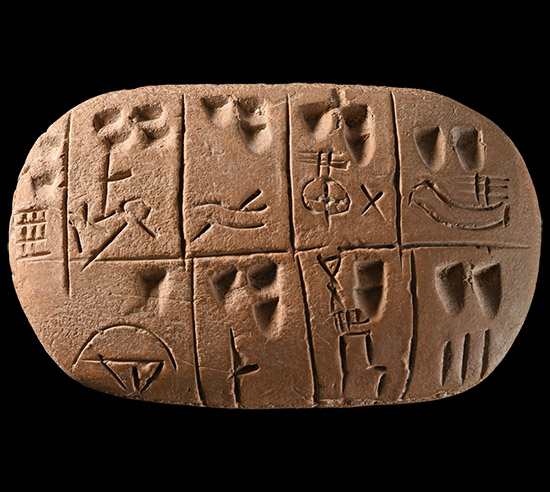
Sumerian Proto-Cuneiform Tablet with Symbols
Jemdet Nasr Period, Uruk III, 3200-3000 B.C.Estimate: £4,000 - 6,000 (+bp*)
Opening Bid: £2,000
Pillow-shaped with incised grid to the broad faces, dense cuneiform pictographic text in the columns with impressed pellet numerals. 45.6 grams, 63 mm
Percy Barnevik, Sweden. Private collection, UK, acquired June 2000. with Sam Fogg, London. Acquired by the current owner from the above, 2015. Accompanied by a copy of Professor Lambert’s notes and two-page cataloguing report. This lot has been checked against the Interpol Database of stolen works of art and is accompanied by search certificate no.13429-259930.
Various collections of cuneiform tablets form a corpus of texts mainly of administrative nature, from the Uruk III and Ur III periods. The proto-cuneiform, as a system of proto-writing, emerged in Mesopotamia ca.3500-3200 BC, during the Uruk period. -
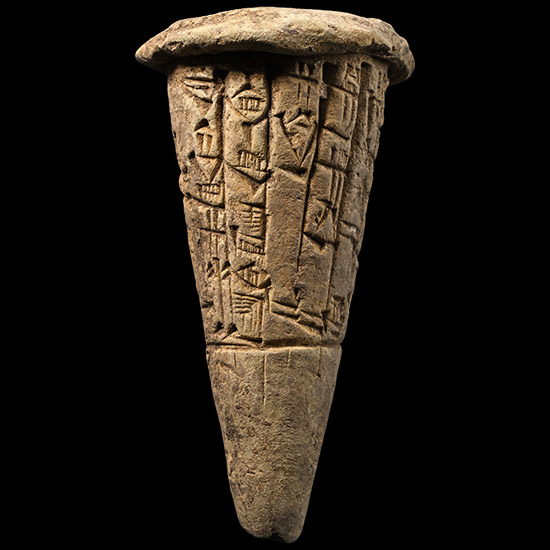
Sumerian Terracotta Foundation Cone From Lagash
Circa 2100 B.C.Estimate: £800 - 1,000 (+bp*)
Bids: 2 | Current Bid: £420
Conical in profile with domed top, vertical impressed lines and cuneiform inscription; tip absent. 220 grams, 12 cm
with Archaeologia, Switzerland, before 1983. Ex private North American collection. London private collection, 2016.
Votive cones are one type of royal foundation deposit, objects that were buried in the walls and beneath the floors of important buildings during construction to sanctify the site and to create a historical memory of the ruler and his achievements. -
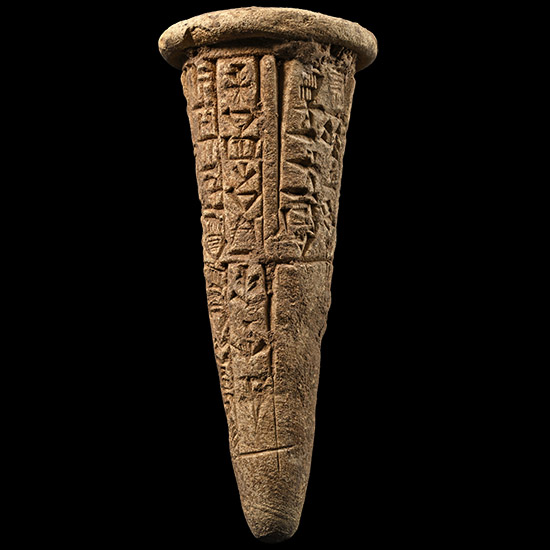
Sumerian Terracotta Foundation Cone From Lagash
Circa 2100 B.C.Estimate: £800 - 1,000 (+bp*)
Bids: 1 | Current Bid: £400
With domed upper face, conical body; incised vertical lines dividing the surface into segments, each with impressed cuneiform text. 141 grams, 12.1 cm
with Archaeologia, Switzerland, before 1983. Ex private North American collection. London private collection, 2016. -
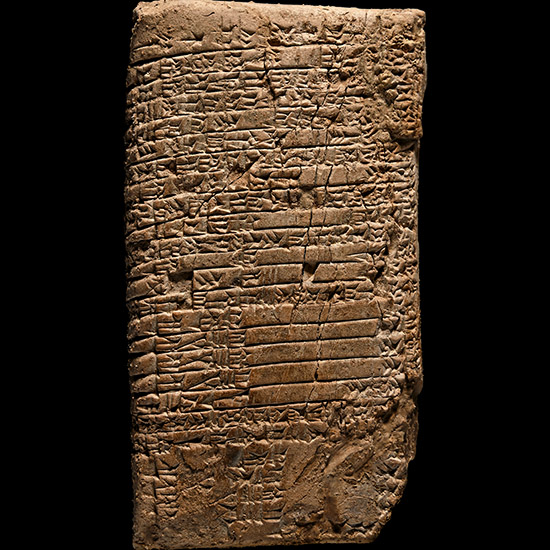
Old Babylonian Cuneiform Tablet with The Dialogue Between Two Women
Circa 1900-1700 BC.Estimate: £3,000 - 4,000 (+bp*)
Opening Bid: £1,500
Pillow-shaped ceramic tablet inscribed with 41 lines of a Sumerian cuneiform literary text, comprising a dialogue between two women who insult and abuse each other, and (may) also talk to men about the matter; this tablet is longer than any one of the published pieces of this text and in comparatively good condition; although it does not include a Babylonian translation, part of it overlaps a published copy as an aid to understanding; a provisional partial translation is offered here: 1. "Is my [ ....?] 2. Is my house like her house? 3. Is my spouse like her spouse? 4. Is my mother like her mother? 5. Am I like her? 6. She spread [slander], she called me a prostitute, and made my husband divorce me. 7. ". ... runs around. May my city quarter... you. 8. My lord, what is one man? 9. Is my house like her house? 10. Is my spouse like her spouse? 11. Is my mother like her mother? 12. Am I like her? 13. She spread slander, she called me a prostitute, and made my husband divorce me. 14. Bring on a just lawsuit. 15-16. Who is she? Ninkuzu, daughter of the king. 17. No! Herald, go! 18. Bring me one who can point her out to you while the time is fresh. 19. My lord, bring me….. 20. One who knows her case, one like her. 21. Where are those women? Let them come in! 22. You (sing.), whose name is Ninkuzu, 23. Why (did you slander) the daughter of a man, your equal, (and call her) a prostitute? (Four untranslated lines) 28. She has bought a witness against me. [….] 29. Bring a just law-suit. 30. "If I should bring on a just law-suit for you. 31. I shall write down a divorce fee of 1/3 of a mina of silver as it is. 32. Then I shall increase the divorce fee of 1/3 of a mina of silver."; in a custom-made presentation case replicating an old quarter-bound book with cloth-covered boards. 372 grams, 12.5 cm
The Library of Simon Keynes (1927–2017), great-grandson of Charles Darwin and fourth son of Sir Geoffrey Keynes, with the bulk assembled in the 1970s and 1980s. Ex Sam Fogg, London, 2019. Private collection, Europe. Acquired by the present owner from the above. Accompanied by a five-page cataloguing report. This lot has been checked against the Interpol Database of stolen works of art and is accompanied by search certificate no.13426-259927.
The existence of the (source) text has been known for some decades, and ten pieces have been published, all from the Old Babylonian period (c. 1900 - 1600 BC), the period from which this tablet also originates. A few of the ten known tablets are bilingual - that is, the Sumerian is also given in Babylonian translation - which has assisted in the translation of the text by modern scholars. While a text reconstructed from the ten published pieces and other unpublished tablets has existed for some decades now, no one has so far published it in its entirety or offered a fully convincing translation, because of the difficulties of the text. Sumerian had a woman's dialect, called 'Emesal, 1', and this text often uses Emesal forms, which are more problematic than the ordinary Sumerian dialect. There are also no indications of speaker given in the text - the reader has to deduce when another speaker takes over. Thus there is considerable uncertainty about the punctuation. It is clear that when the whole text is edited properly for all duplicates and a reliable translation can be made, this will be an enlivening commentary on human nature in Babylonia of the early second millennium BC. A beautiful and important piece of Sumerian literature. The sum of 1/3 of a mina of silver - 20 shekels - was a large sum of money at the time. -
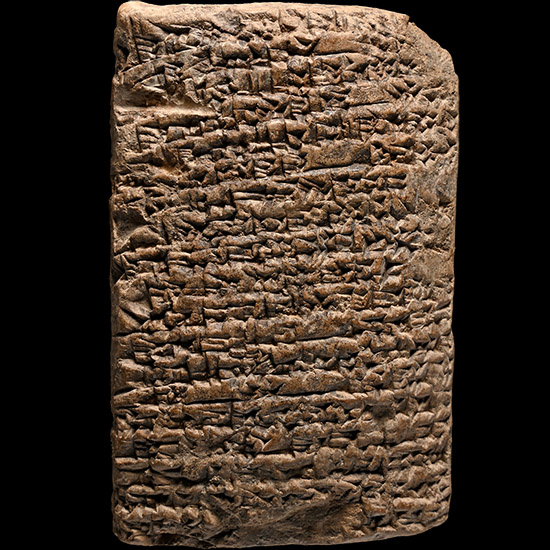
Babylonian Cuneiform Tablet, Letter by Aradmu [Irmu/Aradngu] to King Shulgi about Appilasha
Third Dynasty of Ur, circa 2095-2047 B.C.Estimate: £4,000 - 6,000 (+bp*)
Opening Bid: £2,000
A lentoid-section clay tablet, roughly rectangular in plan with Aradmu text to Sulgi to both faces. 166 grams, 89 mm
with Mrs Audrey Davies, Astarte Gallery, London, where acquired in 1985. Private collection, Montreal, Canada. Accompanied by a copy of a scholarly note by Prof. W.G.Lambert. Accompanied by a five-page cataloguing report. This lot has been checked against the Interpol Database of stolen works of art and is accompanied by search certificate no.13428-259929.
Shulgi (21st century B.C.) was the second king of the Third Dynasty of Ur. Based on available documentation, he appears to be one of the most significant figures in Sumerian history. -
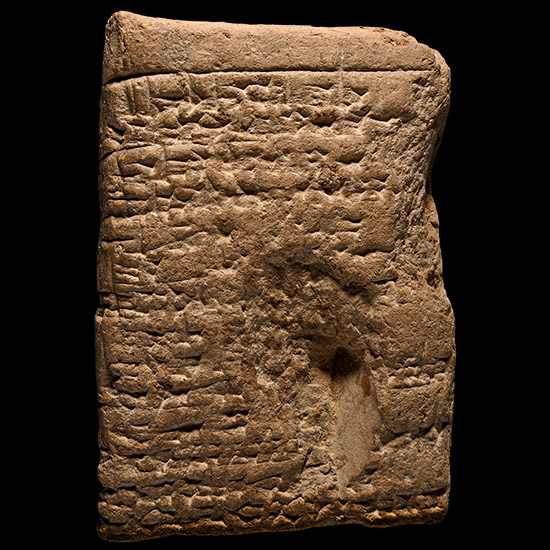
Sumerian Cuneiform Tablet with Hymn to the Sun God Utu
3rd millennium B.C.Estimate: £4,000 - 6,000 (+bp*)
Opening Bid: £2,000
An important tablet displaying a total of thirty lines of cuneiform text across both faces; reverse with an otherwise unknown hymn to the Sumerian sun-god, Utu; the text on the obverse also a hymn and probably to the same sun-god; supplied with a typed and signed scholarly note by W.G. Lambert, late Professor of Assyriology, University of Birmingham, 1970- 1993, which states 'Clay Tablet, 86 x 61 mm., with a total of 30 lines of Sumerian cuneiform on obverse and reverse. The obverse has 14 lines followed by a ruling. The reverse has an uninscribed upper portion, then a section of 16 lines, ending on the upper edge. This section is quite well preserved, that on the obverse is more damaged. The second section is part of a hymn to the Sumerian sun-god Utu, apparently not otherwise known. The text on the obverse is also a hymn, perhaps to the same sun-god.'; in a custom-made presentation case replicating an old quarter-bound book with marbled boards. 199 grams, 86 mm
Part of a specialised collection of cuneiform texts, the property of a London gentleman; examined by Professor Wilfrid George Lambert FBA (1926-2011), historian, archaeologist, and specialist in Assyriology and Near Eastern archaeology, in the late 1980s and early 1990s; this small collection is exceptional for the variety of types, including some very rare and well-preserved examples. TimeLine Auctions, 25 February 2020, no.223 (Sold for (Inc. bp): £6,875). Private collection, Europe. Accompanied by a copy of Professor Lambert’s notes and a two-page cataloguing report. This lot has been checked against the Interpol Database of stolen works of art and is accompanied by search certificate no.13427-259928.
Shamash (Utu in Sumerian) was the Mesopotamian sun god who, alongside the moon god Sin (Sumerian: Nanna) and Ishtar (Sumerian: Inanna), the goddess of love, formed an astral triad of deities. Utu was the son of Sin, and his consort was originally Aya, though she was later identified with Ishtar. As a solar deity, Utu wielded the power of light over darkness and evil. In this capacity, he was worshipped as the god of justice and equity, serving as judge to both gods and men. According to legend, the Babylonian king Hammurabi received his code of laws from Shamash. His emblems include the solar disc - featuring an inner four-pointed star from which beams of light radiate and a standard bearing this same disc atop a pole, often held by a bull-man. At night, Utu became the judge of the underworld. -
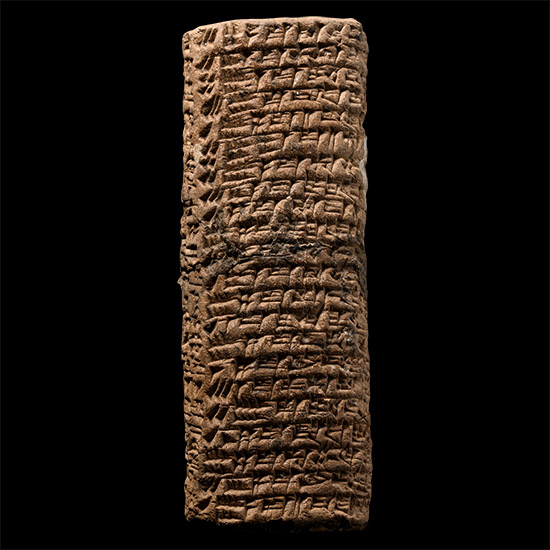
Old Babylonian Terracotta Cuneiform Tablet, an Administrative Document
Circa 2000-1700 B.C.Estimate: £800 - 1,000 (+bp*)
Opening Bid: £400
Pillow-shaped with lines of dense cuneiform text to flat faces, edges and ends; accompanied by an old handwritten slip: 'Old Babylonian administration document, c.2000-1700 B.C.'. 247 grams, 12.5 cm
Private collection, 1980s. Acquired on the UK art market. Private collection, London, UK. Accompanied by an old handwritten note by W.G. Lambert, late Professor of Assyriology, University of Birmingham, 1970-1993. -
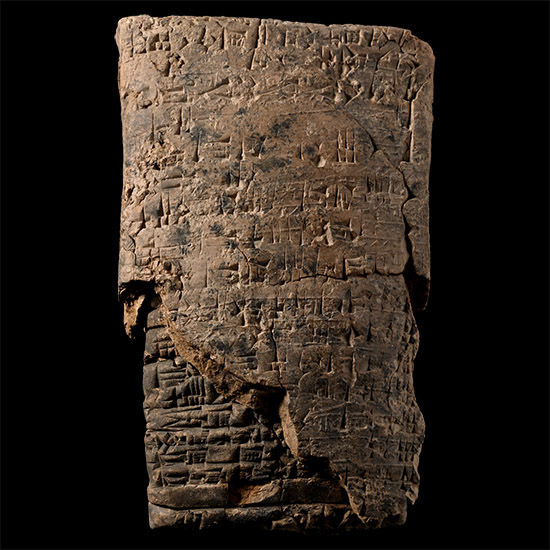
Large Old Babylonian Terracotta Cuneiform Tablet, a Legal Document in Envelope
Circa 2000-1700 B.C.Estimate: £1,000 - 1,400 (+bp*)
Opening Bid: £500
Comprising a pillow-shaped tablet in fired clay with impressed cuneiform text to both faces; covered by a clay sleeve with further cuneiform notation; accompanied by an old handwritten slip: 'Envelope tablet: legal document. Old Babylonian c.2000-1700 B.C.' 437 grams, 12 cm
Private collection, 1980s. Acquired on the UK art market. Private collection, London, UK. Accompanied by an old handwritten note by W.G. Lambert, late Professor of Assyriology, University of Birmingham, 1970-1993. -
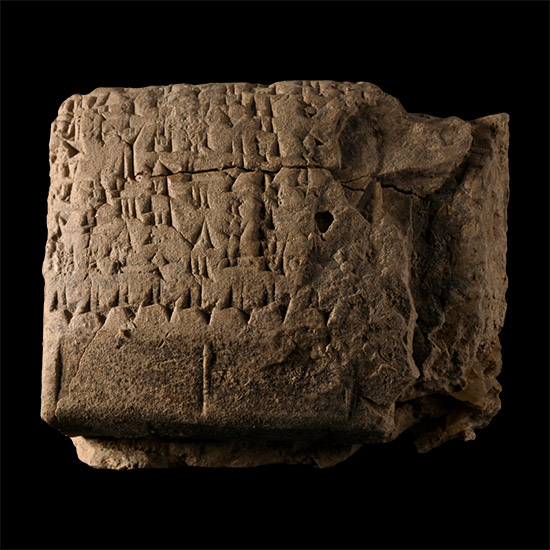
Old Babylonian Terracotta Cuneiform Tablet, a Legal Document in Envelope
Circa 2000-1700 B.C.Estimate: £600 - 800 (+bp*)
Opening Bid: £300
Pillow-shaped baked clay tablet with cuneiform legend enclosed in an unmarked clay sleeve; accompanied by an old handwritten slip: 'Tablet with envelope, a legal document, Old Babylonian, c.2000-1700 B.C.'. 307 grams, 79 mm
Private collection, 1980s. Acquired on the UK art market. Private collection, London, UK. Accompanied by an old handwritten note by W.G. Lambert, late Professor of Assyriology, University of Birmingham, 1970-1993. -
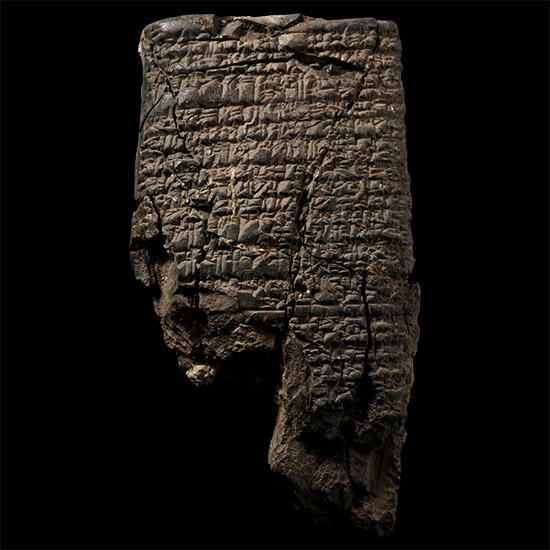
Large Old Babylonian Terracotta Cuneiform Tablet
Circa 2000-1700 B.C.Estimate: £600 - 800 (+bp*)
Opening Bid: £300
Pillow-shaped with an incised grid for layout of dense cuneiform text to the obverse, two lines at the upper edge continued to the reverse. 269 grams, 13 cm
Private collection, 1980s. Acquired on the UK art market. Private collection, London, UK. -
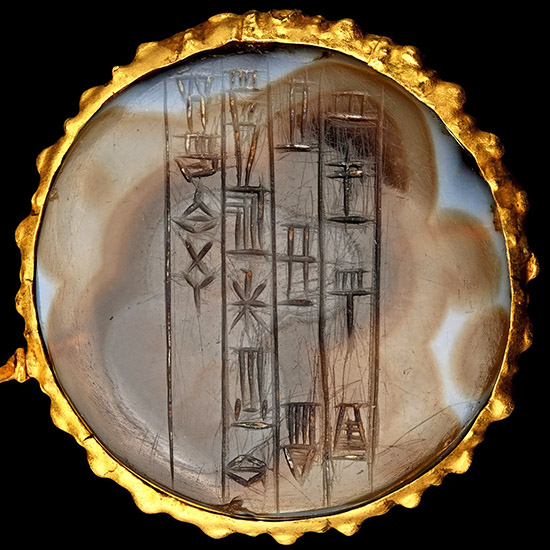
Kassite Agate Eye Bead with Cuneiform Inscription for King Kurigalzu II in Gold Mount
1400-1000 B.C.Estimate: £60,000 - 80,000 (‡+bp*)
Opening Bid: £33,333
Polished cabochon in a gold frame with radiating bosses, integral loop; reverse with four incised columns of cuneiform text naming Kurigalzu II. 18.30 grams, 42 mm
Private collection, Mrs M.V., circa 1980s. Kept in Switzerland since the late 1980s. Accompanied by an old developed photograph, 22 August 1998. This lot has been checked against the Interpol Database of stolen works of art and is accompanied by search certificate no.13202-249238.
The cuneiform inscription names Kurigalzu II (c.1332-1308 B.C.), 'strong man, King of Babylon, son of Burnaburiaš.' Kurigalzu II was one of the most powerful Kassite rulers, known for his military campaigns and extensive building projects, including the foundation of the city of Dur-Kurigalzu. Inscribed Kassite agate eye beads are rare and are generally understood to have served amuletic or votive functions, combining royal titulary with protective symbolism. -
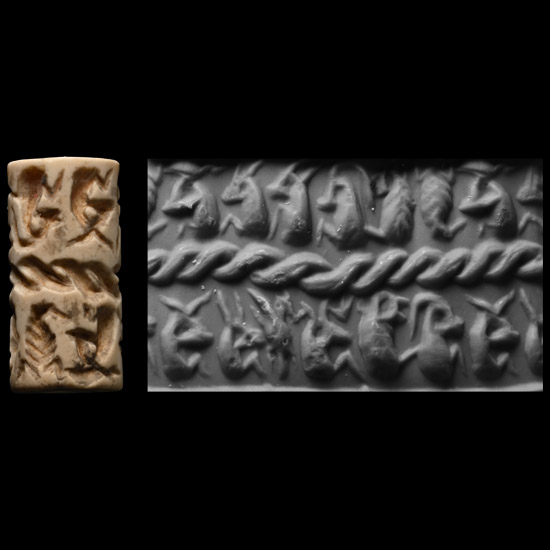
Old Syrian White Marble Cylinder Seal with Animals
Circa 2700-2400 B.C.Estimate: £1,000 - 1,400 (+bp*)
Opening Bid: £500
With two rows of zoomorphic figures and restrung red round beads at each end; supplied with a typed and signed scholarly note by W.G. Lambert, late Professor of Assyriology, University of Birmingham, 1970- 1993, which states, 'Cylinder Seal of White Marble, 20 x 10 mm. The surface is divided into two registers by a guilloche across the middle. In the upper register there are five animal protomes: at the rear a lion, then four different horned animals, each shown with one front paw. A complete scorpion serves as a terminal. In the lower register are also five animal protomes, but facing the opposite direction to those above. At the rear is a stag, then a lion, and in front of it three distinguished horned animals. A lizard serves as a terminal in this case. This is an Old Syrian seal, c. 2700-2400 B.C., and in fine condition. The engraving is deeply done and gives a sharp, clear impression. Other seals of this type are known, but are rare.' 4.73 grams total, seal: 20.1 mm
Acquired on the French auction market. Accompanied by a copy of an old scholarly note, typed and signed by W.G. Lambert, late Professor of Assyriology, University of Birmingham, 1992.

