-
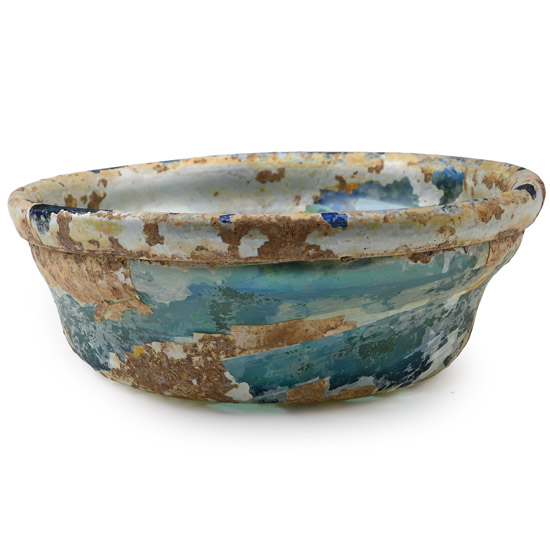
Roman Iridescent Blue Cosmetic Dish
1st century B.C.-1st century A.D.Estimate: £600 - 800 (+bp*)
Opening Bid: £300
Featuring a squat body with slightly everted sides, wide circular mouth with a thick folded rim, concave base with a pontil mark. 183 grams, 10.7 cm wide
From an important London collection of glass, 1990s. Roman glass from an important London collection, acquired from the early 1980s. Accompanied by a typed previous catalogue information page with provenance.
This was an elegantly shaped object with very precisely moulded dimensions, scooped out at the top and showing concentric circles on the flat base. It was used as a small dish for cosmetics. -
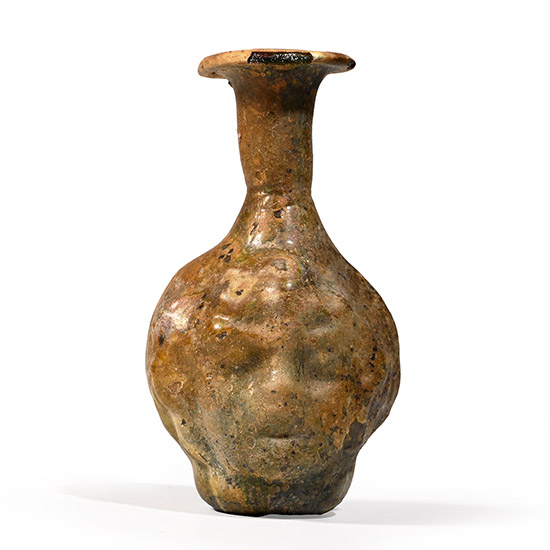
Roman Mould-Blown Blue-Green Glass Janus Flask
Circa 3rd-5th century A.D.Estimate: £600 - 800 (+bp*)
Opening Bid: £300
Round body formed of two plump-faced heads with dimpled chins and curly hair, one face peaceful, the other disgruntled; a long, cylindrical neck with a flaring, folded rim. 16.2 grams, 68 mm
Ex private collection of the late Mr S.M., London, UK, 1970-1999. Accompanied by a previous typed catalogue information page with provenance.
Janiform vessels belong to a large group of mould-blown vessels that depict human heads in a naturalistic style. The body of the vessel features either a whole head or the frontal part of two heads placed back-to-back. Most of the examples, in general, are handleless flasks or unguentaria. -
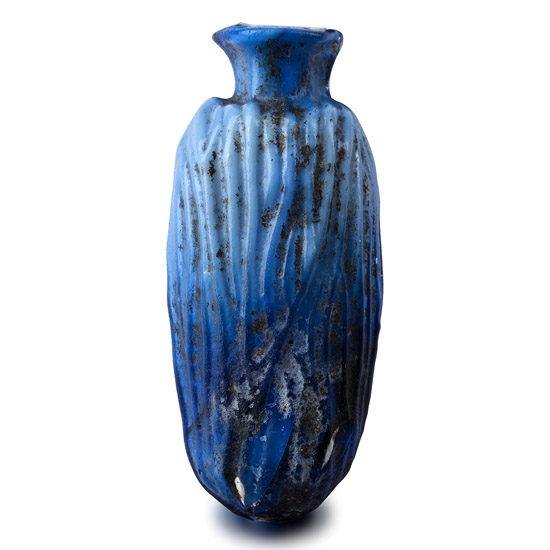
Large Roman Deep Blue Glass Date Flask
1st century A.D.Estimate: £1,800 - 2,400 (‡+bp*)
Opening Bid: £1,000
Mould-blown with elliptical body, short neck and thick everted rim, with modelled wrinkles imitating the texture of a dried date. 41.7 grams, 80 mm
Dr Gonik & Me Wirth, Geneva, 1970s. Private collection, Europe. Accompanied by an academic report by Dr Raffaele D'Amato. This lot has been checked against the Interpol Database of stolen works of art and is accompanied by a search certificate no.12394-226935.
Dates were not only a staple of the Mediterranean diet, used to sweeten food and wine, but also a symbol for the New Year and a fruit often given as a gift on the occasion. -
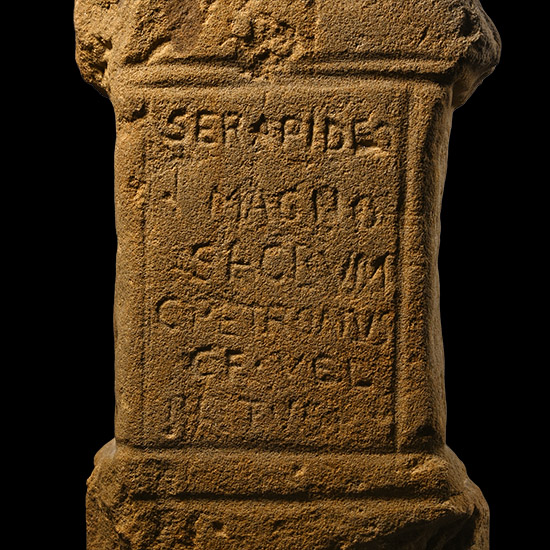
Roman Sandstone Altar for the God Serapis by Gaius Petronius Paetus
2nd century A.D.Estimate: £800 - 1,000 (+bp*)
Bids: 1 | Current Bid: £5
Rectangular in profile with stepped base and capital; dished socket to the upper face; incised rectangular panel to obverse with six lines of inscription in sans-serif capitals: 'SERAPI DEO / MAGNO / SACRVM / C. PETRONVS / C. F. VEL / PAETUS' (Sacred to the great god Serapis, G(aius) Petronus Paetus, son of Gaius, (enrolled in the) tribus Velina); accompanied by collector's record card and printed copy of the Britania journal entry headed 'Alienum'. 9.1 kg, 26.5 cm
Acquired at auction in London, December 1993. From the private collection of Peter Clayton, FCILIP, Dip, Arch, FSA, FRNS, Hemel Hempstead, Hampshire, UK; formed since the 1950s. Accompanied by copies of Roger Tomalin's article in Britannia, in which this altar is published. Accompanied by an old handwritten information card by Peter Clayton.
When the Britannia article was published in 2000, there was only one other dedication to the god Serapis known from Britain, found at York (p.448). Meanwhile, the Roman Inscriptions of Britain database records five entries. The altar was said to have been found in Yorkshire, although this is disputed. The dedicant possessed Roman citizenship, and he provides his name on this altar with all elements like praenomen, filiation, and tribus. This onomastic observation points to the end of the first century or the first half of the second century A.D. -
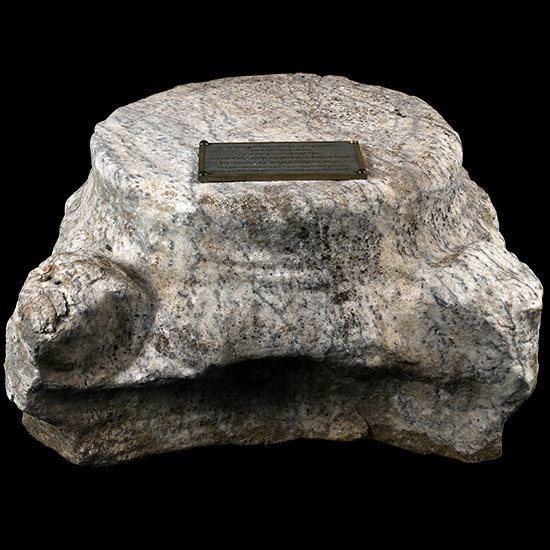
'The Earl of Vincent's' Marble Capital from the Provincia Phoenicia
Circa 2nd century A.D.Estimate: £2,000 - 3,000 (+bp*)
Bids: 1 | Current Bid: £5
White marble capital of Ionic order, with slightly curved abacus, supporting the visible traces of the epistyle, and shallow volutes; in the lower part, between the volutes, the foliate base showing an egg-and-dart decoration on the cymation, supported by two further concentric ornamented strips (astragals), again decorated by shallow egg-shaped forms; three of the four volutes preserved, one of them with three holes for the fixing of the metal fastening staples; over the reversed part of the abacus, a bronze plate with an inscription: 'A white marble capital from the top of a Phoenician Column brought in England in 1733 by Admiral of the Fleet John Jervis 1st Earl of St.Vincent GCB, PC. The Phoenicians were a very early trading nation. Origins 2300-1200 BC. High point 1200-800 BC.' approximately 400+ kg, 70 cm wide
Brought to England in 1788 by Admiral of the Fleet John Jervis, 1st Earl of St Vincent, GCB, PC. From the private collection of Admiral of the Fleet John Jervis, Rochetts, South Weald, Essex, UK. Accompanied by an academic report by Dr Raffaele D'Amato. This lot has been checked against the Interpol Database of stolen works of art and is accompanied by a search certificate number no.13411-259626.
The features of this capital are consistent with a particular type of Ionic style, which seems to have characterised the temples of Roman Phoenicia under Hadrian; the capital decoration is very similar to the capitals of the temple of Mercury, Hardine, and to the Roman temple at Bziza. -
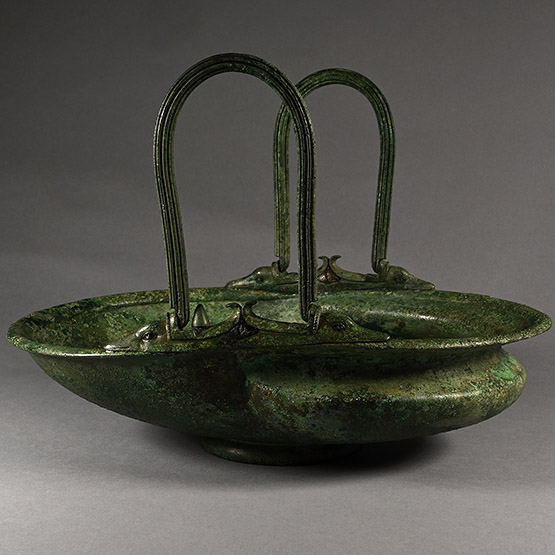
Large Roman Bronze Basket-Vase with Swinging Handles
Roman Imperial, 1st century B.C.-1st century A.D.Estimate: £12,000 - 17,000 (‡+bp*)
Opening Bid: £6,000
Ellipsoid in plan, with a low basal ring, thick convex rim, and carination towards the front, lateral hinges, the knuckles formed as addorsed duck-heads, each with silver-inlaid eyes, a scrolled panel to the rear retaining the pivot of the ribbed D-shaped handles. 1.68 kg, 28 cm
Acquired in Switzerland, 1996. Private collection, Europe. Accompanied by an academic report by Dr Raffaele D'Amato. Accompanied by a copy of an Art Loss Register certificate dated 30th April 2004. This lot has been checked against the Interpol Database of stolen works of art and is accompanied by search certificate no.12363-226688.
This vessel (lanx) was part of Roman and provincial bronze instrumentum domesticum, i.e. culinary or domestic utility ware. The form of the bowl resembles a type of helmet with carination to the front, the handles placed as hinged cheek-protectors. -
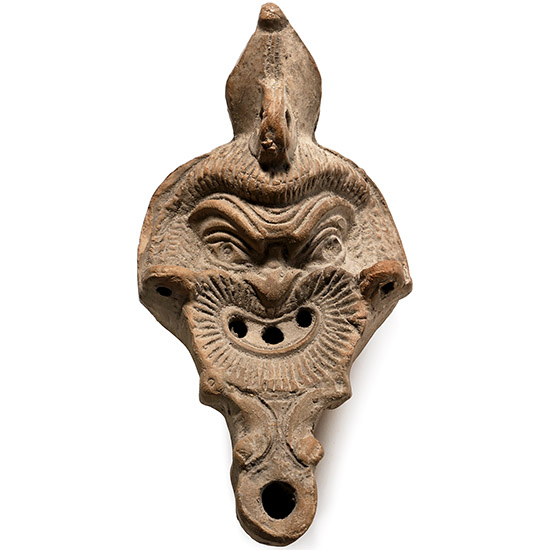
Roman Terracotta Mask Oil Lamp
1st-2nd century A.D.Estimate: £400 - 600 (+bp*)
Opening Bid: £100
Hollow-formed with a bulbous cap forming the handle, with pierced lugs above and below at the rear and two more pierced lugs flanking the cheeks; body formed as a comic theatrical mask with a large open mouth; filling holes in the mouth, volute nozzle below the chin; flat oval base with maker's stamp 'QNMVICE' and old findspot label 'from F.F[..]r Esq. Sabdown 23.3.96'; accompanied by a printed reference sheet for the maker. 94 grams, 12.7 cm wide
Excavated by Frederick George Hilton Price (1842-1909) from the Roman villa at Morton, near Sandown, Isle of Wight, 1880-1883; his manuscript label, dated March 1896. with Gorringes, 2025. Acquired by the current owner from the above.
The maker is believed to be the Italian Quintus Numi[..] Cell[..]. -
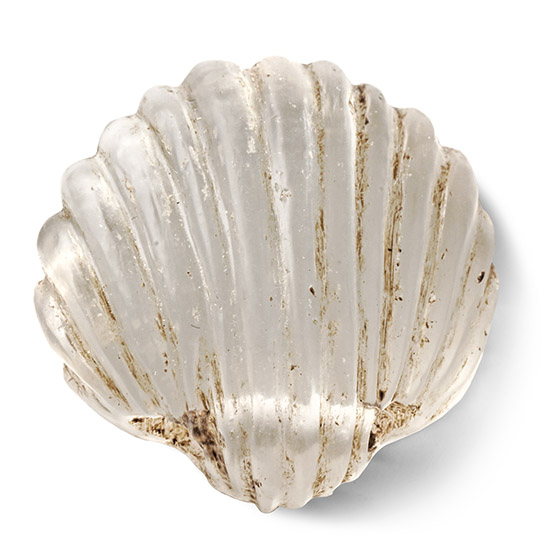
Roman Rock Crystal Shell-Shaped Amulet
1st-2nd century A.D.Estimate: £1,000 - 1,400 (+bp*)
Opening Bid: £500
Transparent clam shell-shaped amulet with deep striations and a slightly concave underside, pierced through the hinge for suspension. 5.4 grams, 25 mm
Private collection, London, UK. -
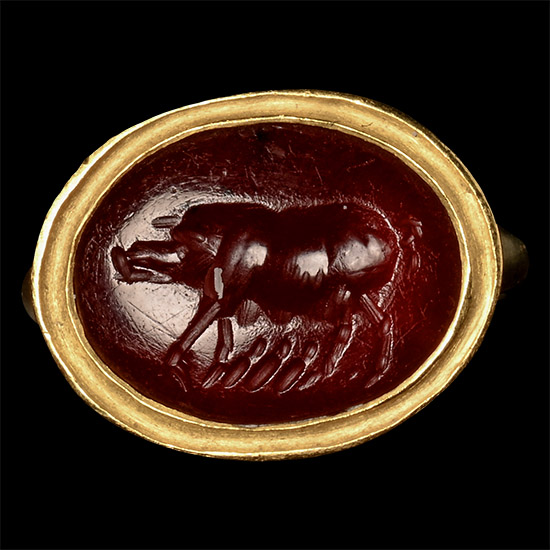
Roman Carnelian Gemstone with a Sow in Gold Ring
2nd century A.D. and laterEstimate: £2,000 - 3,000 (+bp*)
Opening Bid: £1,000
Red carnelian intaglio featuring a sow laying on its side with three stylised piglets resting between its legs; set in a modern gold ring. 6.83 grams, 22.85 mm overall, 17.78 x 16.88 mm internal diameter (approximate size British N, USA 6 1/2, Europe 13.72, Japan 13)
Private collection, London. This lot has been checked against the Interpol Database of stolen works of art and is accompanied by search certificate no.13553-263671. -
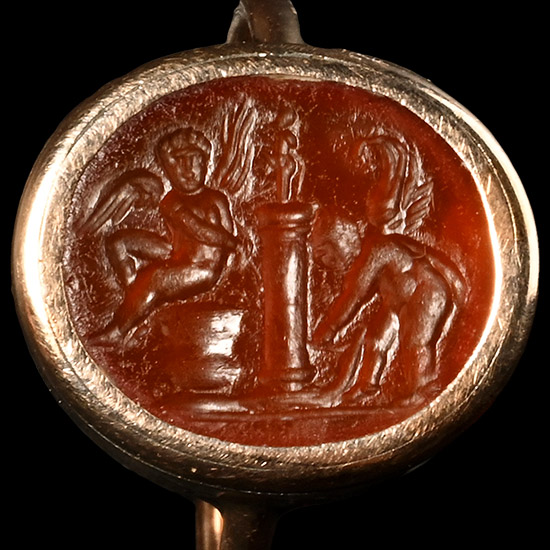
Roman Carnelian Gemstone of Two Erotes Flanking a Column in a Nineteenth-Century Gold Ring
Circa 1st-2nd century A.D. and laterEstimate: £1,200 - 1,700 (+bp*)
Opening Bid: £600
Oval intaglio engraved with two winged Erotes on either side of a central column or pedestal surmounted by a small standing statuette; one on the left seated on a large vessel, while the figure on the right bending and reaching towards the central column; set in a later gold ring with a plain oval bezel and slender hoop. 1.97 grams, 18.17 mm overall, 15.29 x 14.58 mm internal diameter (approximate size British I 1/2, USA 4 1/2, Europe 8.07, Japan 7)
Acquired on the European art market. UK, private collection. -
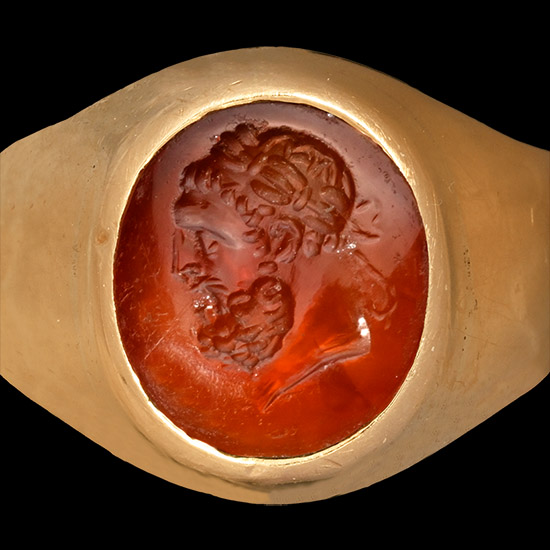
Roman Carnelian Gemstone of Hercules in Later Gold Ring
Circa 2nd century A.D. and laterEstimate: £1,500 - 2,000 (+bp*)
Opening Bid: £700
An oval intaglio engraved with the mature bearded profile head of Hercules, set within a substantial nineteenth-century gold ring. 13.21 grams, 26.27 mm overall, 20.34 x 20.81 mm internal diameter (approximate size British V, USA 10 1/2, Europe 23.77, Japan 22)
Acquired on the European art market. UK, private collection. -
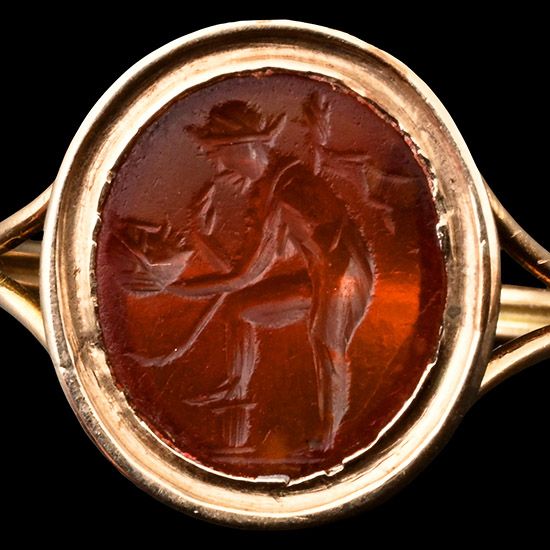
Roman Carnelian Gemstone of a Figure Contemplating a Mask in a Nineteenth-Century Gold Ring
Circa 1st-2nd century A.D. and laterEstimate: £1,000 - 1,400 (+bp*)
Opening Bid: £500
Comprising an oval carnelian intaglio depicting a male figure, resting his leg on a small pillar and holding a large mask or sculpted head in his hand; set in a later open collet setting. 1.82 grams, 19.32 mm overall, 17.12 x 15.81 mm internal diameter (approximate size British N, USA 6 1/2, Europe 13.72, Japan 13)
Acquired on the European art market. UK, private collection.

