-
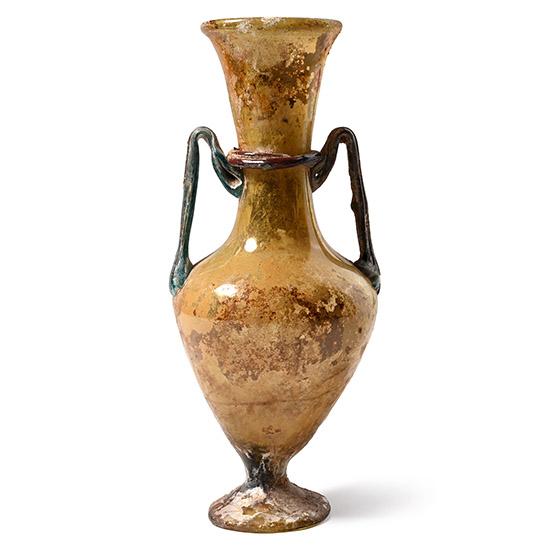
Roman Amber-Coloured Glass Footed Amphora
Circa 1st-2nd century A.D.Estimate: £500 - 700 (+bp*)
Opening Bid: £250
With broad rounded shoulder tapering to a short conical foot, cylindrical neck and everted mouth with rolled rim, applied trail handles and collar. 91 grams, 16.5 cm
From the private collection of Lloyd and Jeanne Raport, Washington, D.C. and Florida, formed between 1972-2000. Estate auction, Weschler's, Maryland, 1985, lot 351. -
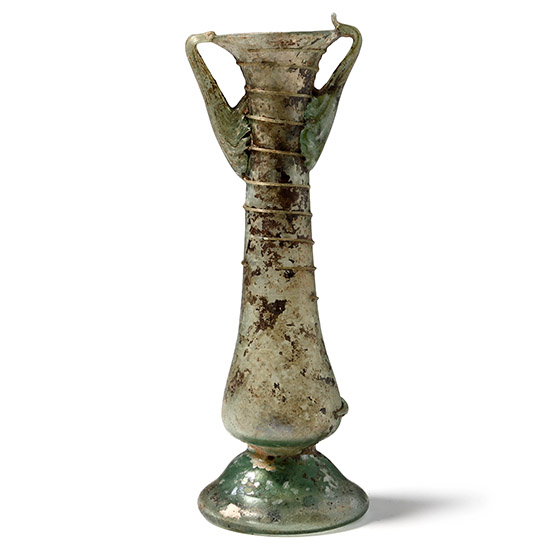
Roman Iridescent Glass Two-Handled Flask with Trail
Circa 1st century A.D.Estimate: £400 - 600 (+bp*)
Opening Bid: £150
Comprising a bulbous body with long funicular neck and flared rim, applied strap handles to the top, applied spiral decoration to the body, domed foot. 38.07 grams, 11.5 cm
From the collection of a late London gentleman, 1970s-1990s. -
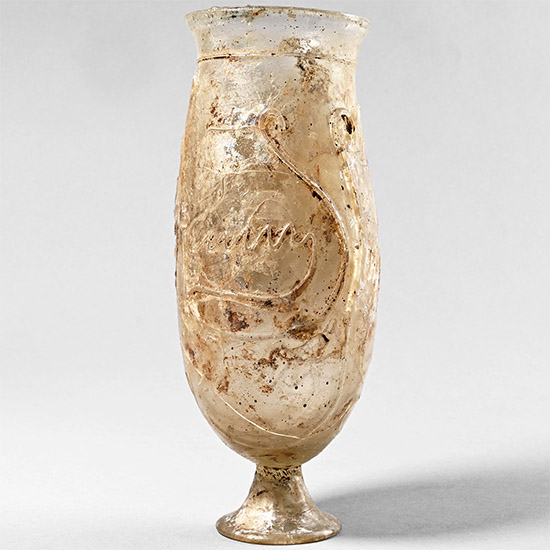
Large Roman Rhenish Type Snake-Thread Goblet from a Workshop in Cologne
Circa late 2nd-early 3rd century A.D.Estimate: £5,000 - 7,000 (+bp*)
Opening Bid: £2,250
Comprising an ovoid body with trumpet-shaped foot and rounded everted rim; applied 'snake-tread' detailing in swept curves and undulating waves; applied thread collar below rim. 87 grams, 17.4 cm
Private collection, Europe, 1970s. with Fortuna Fine Arts, Ltd., New York, USA (The Muse's Song, 2008, no.75). The Nico F Bijnsdorp collection (NFB 241), acquired from the above 2 October 2009. with Bonhams, London, 6 July 2023, no.159. From a London, UK, collection. Accompanied by a copy of the relevant Bonham's catalogue page. This lot has been checked against the Interpol Database of stolen works of art and is accompanied by search certificate no.13526-261500.
The so-called ‘snake-thread’ trail was applied to the faces of the vessel and was originally manufactured in workshops in Cologne from about the middle of the 2nd century onwards. A great variety of glass objects with quite similar decoration are on display in the Römisch-Germanisches Museum Köln. Roman Cologne was an important production centre for glass, especially for translucent vessels decorated with colourful snake-threads. -
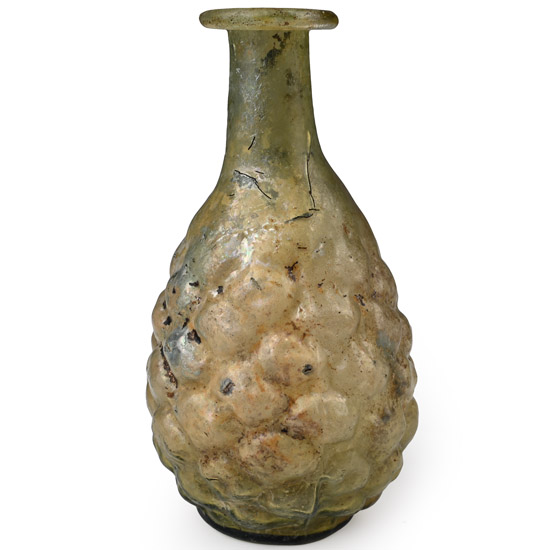
Very Large Roman Pale Green Glass Pinecone Flask
Circa 1st century A.D.Estimate: £1,500 - 2,000 (+bp*)
Opening Bid: £650
Featuring a long neck with a rounded, flattened rim and an oval body; the relief decoration on the body consisting of small, tightly packed knops imitating a bunch of grapes. 77 grams, 10.3 cm
Ex J. Lawton collection, UK, 1990-2010. Roman glass from an important London collection, acquired from the early 1980s. Accompanied by a previous typed catalogue information page with provenance.
This typology of pinecone-shaped flasks is typical of the Syro-Palestinian region and was usually produced from the middle to the second half of the 1st century A.D. The type appears in two variants: one with a broken-off rim, and vessels with a folded rim like our specimen. -
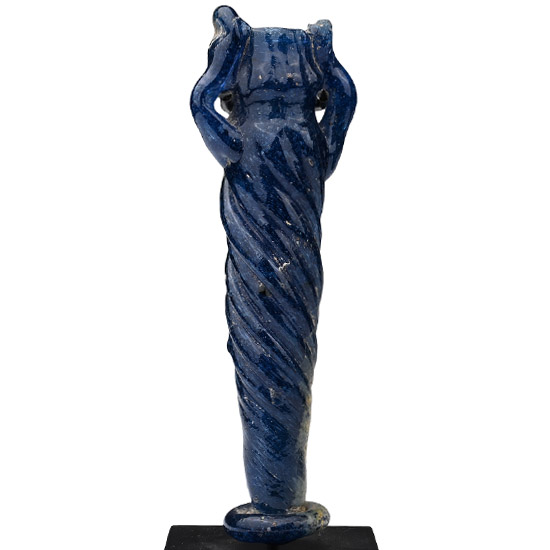
Late Roman Cobalt Blue Rod-Formed Glass Cosmetic Tube
Circa 4th-5th century A.D.Estimate: £1,000 - 1,400 (+bp*)
Opening Bid: £500
Tubular body with a smoothly-rounded interior, the exterior formed of heavily-twisted rods, two handles and standing on a slightly rounded integral base, rim absent; accompanied by a custom-made display stand. 160 grams total, 13.1 cm including stand
Ex London gallery, 1980s. Private London, UK, collection, 1980-2000s. Roman glass from an important London collection, acquired from the early 1980s. Accompanied by a typed previous catalogue information page with provenance.
These kohl tubes are provisionally dated between the 4th and the 5th centuries, and they are ascribed to the Syrian region. The majority of the kohl tubes bear spiralling ribs formed by twisting the vessel while it was still hot and malleable. -
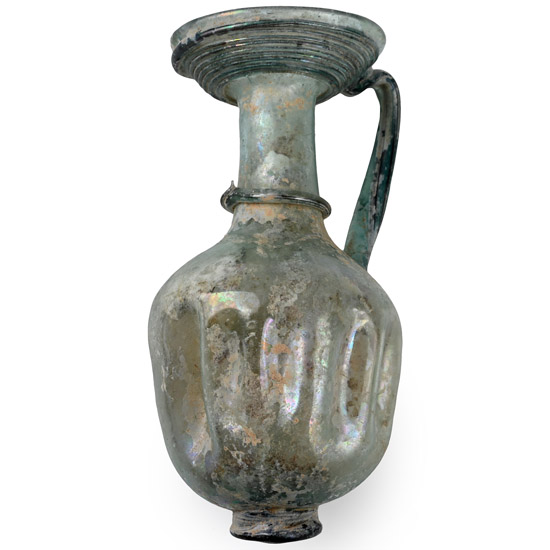
Roman Pale Green Glass Jug with Trail
Circa 4th-5th century A.D.Estimate: £1,000 - 1,400 (+bp*)
Opening Bid: £550
With a rounded body and a cylindrical neck with a funnel-shaped mouth, a small uneven foot and a blue-trailed handle; the body decorated with vertical concave indents and trails of glass applied at the base of the neck and around the mouth. 53 grams, 10.5 cm
From a London collection, acquired in the 1970s. Roman glass from an important London collection, acquired from the early 1980s. Accompanied by a typed previous catalogue information page with provenance.
This jug has many common features with the distinctive group of Syro-Palestinian glasses, free- and mould-blown ones dated to the 4th-5th centuries A.D. Common features, beginning with the characteristic colour and quality of both green and turquoise glass, are the shape of the base and the handle, the indentations along the body, and the decorative coloured coil on the neck and under the rim. -
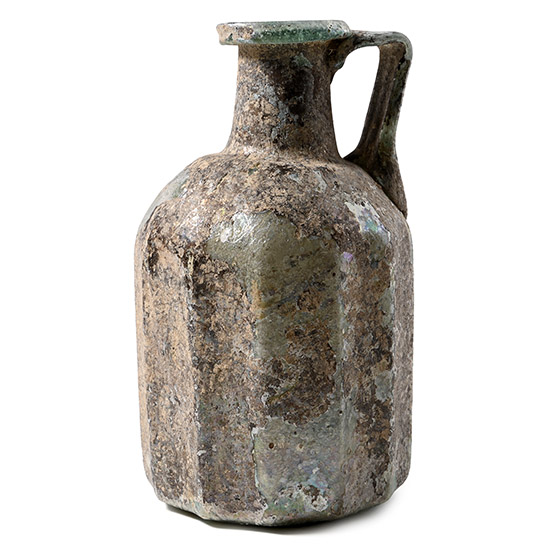
Large Roman Iridescent Twelve-Sided Jug
Circa 4th century A.D.Estimate: £500 - 700 (+bp*)
Opening Bid: £250
Round-section body with twelve segments around the body, short tubular neck, everted rim and applied strap handle; remains of iridescence. 95.5 grams, 13.6 cm
From the private collection of Lloyd and Jeanne Raport, Washinton D.C. and Florida, formed between 1972-2000. Estate auction, Weschlers, Maryland, 9-12 December 1982, lot 1074. -
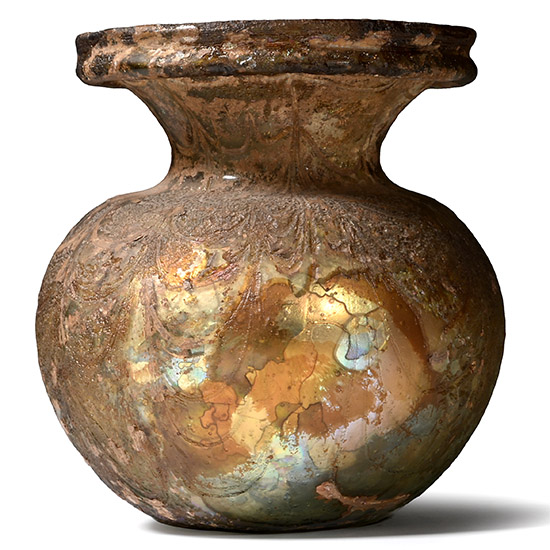
Roman Mould-Blown Dark Green Jar with Wheel-Cut Design
Circa 4th century A.D.Estimate: £3,000 - 4,000 (+bp*)
Opening Bid: £750
Featuring a broad, low, round-bellied body with a wide, hollowed base, a short neck with a funnel-shaped mouth; incised festoon-like decoration on the body. 132 grams, 92 mm high
From the collection of Sir Daniel Donehue; his collection was sold in the 2000s. Roman glass from an important London collection, acquired from the early 1980s. Accompanied by a typed previous catalogue information page with provenance. This lot has been checked against the Interpol Database of stolen works of art and is accompanied by search certificate no.13440-263208.
This jar belongs to a generic vessel form known from many eastern Mediterranean and European sites and dated to the 3rd and 4th centuries A.D. Characteristic are the annular pontil marks, patterned on the squat globular body. -
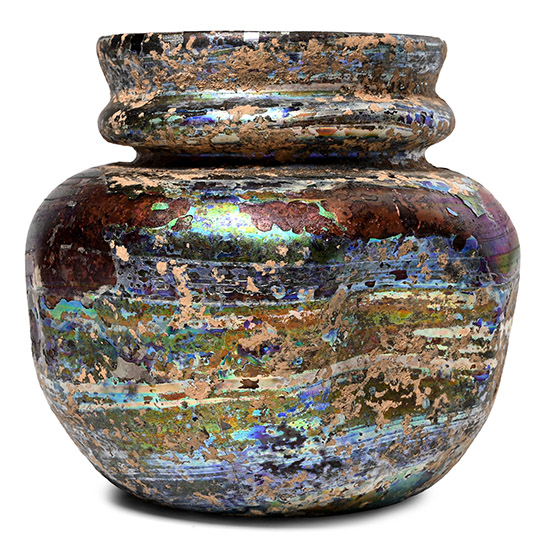
Roman Iridescent Aubergine Glass Dimpled Jar
Circa 1st-2nd century A.D.Estimate: £600 - 800 (+bp*)
Opening Bid: £300
Of squat profile with dimples to the equator, short neck, broad mouth and dimple to the underside; remains of iridescence. 124 grams, 99 mm
Acquired in Jerusalem, Israel, June 1974. From the private collection of Dr Stanley I. Batkin (1914-2015), Scarsdale, New York, USA. From a private USA collection, acquired from the estate of the above. Ex Ancient Glass from the Dr Stanley Batkin (2014-2015) collection, Bonhams, London, 6 July 2017, no.177 (part). -
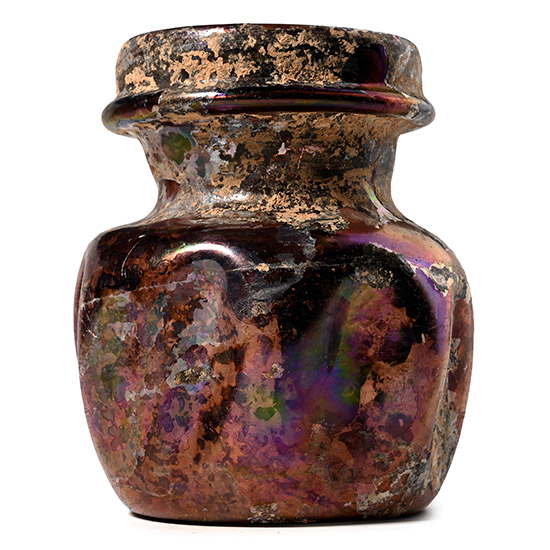
Roman Iridescent Aubergine Glass Dimpled Jar
Circa 1st-2nd century A.D.Estimate: £600 - 800 (+bp*)
Opening Bid: £300
Of squat profile with dimples to the equator, short neck, broad mouth and dimple to the underside; remains of iridescence. 74 grams, 96 mm high
Acquired Jerusalem, Israel, June 1974. From the private collection of Dr Stanley I. Batkin (1914-2015), Scarsdale, New York, USA. From a private USA collection, acquired from the estate of the above. Ex Ancient Glass from the Dr Stanley Batkin (2014-2015) collection, Bonhams, London, 6 July 2017, no.177 (part). -
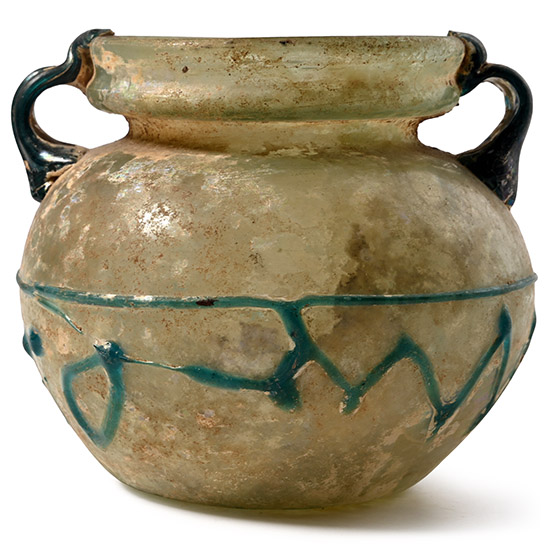
Large Roman Green Glass Vessel with Applied Blue Handles and Green Zig-Zag Trail
Circa 4th-5th century A.D.Estimate: £600 - 800 (+bp*)
Opening Bid: £300
With a bulbous body, short tubular neck, broad everted rim, applied dark green handles, zig-zag and linear lines applied to the body. 125 grams, 10.3 cm wide
From the private collection of Lloyd and Jeanne Raport, Washington, D.C. and Florida, formed between 1972-2000. Estate auction, Weschler's, Maryland, 9-12 December 1982, lot 1074. -
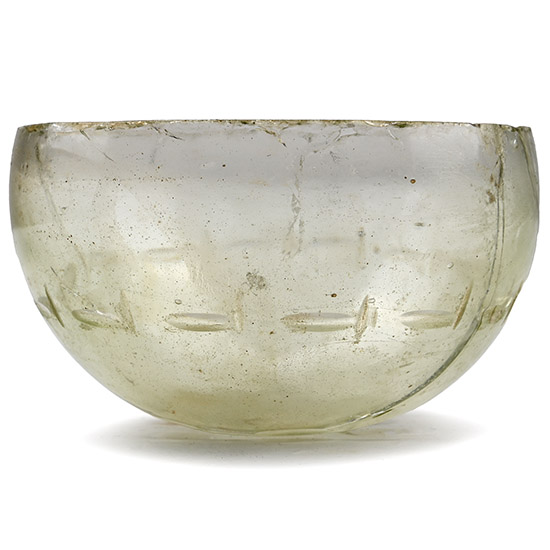
Roman Translucent Glass Bowl with Wheel-Cut Design
Circa 2nd-3rd century A.D.Estimate: £1,000 - 1,400 (+bp*)
Opening Bid: £270
Fine translucent bowl with a rounded base, hemispherical in profile with seven wheel-cut dimples on the base forming a flower motif; a circumferential band of alternating horizontal and vertical facetted cut strokes on the body; repaired. 112 grams, 90 mm wide
Mayfair, London, UK, gallery, 2000s. Ex Surrey, UK, gentleman. Roman glass from an important London collection, acquired from the early 1980s. Accompanied by a typed previous catalogue information page with provenance.
The bowl belongs to the 2nd-3rd century types with faceted and engraved decoration. The ornaments included floral decorations, like here, or birds, fruits and other objects in the middle band and bottom.

