-
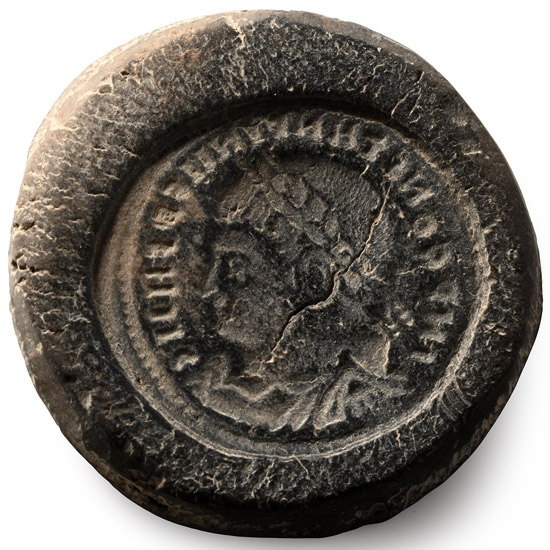
Roman Terracotta Forger's Mould for a Constantine Coin
Circa 3rd-4th century A.D.Estimate: £50 - 70 (+bp*)
Bids: 2 | Current Bid: £10
Discoid clay mould with an impressed design of a coin on each face. 4 grams, 27 mm
London gentleman's collection, 1970-1990s, by descent. -
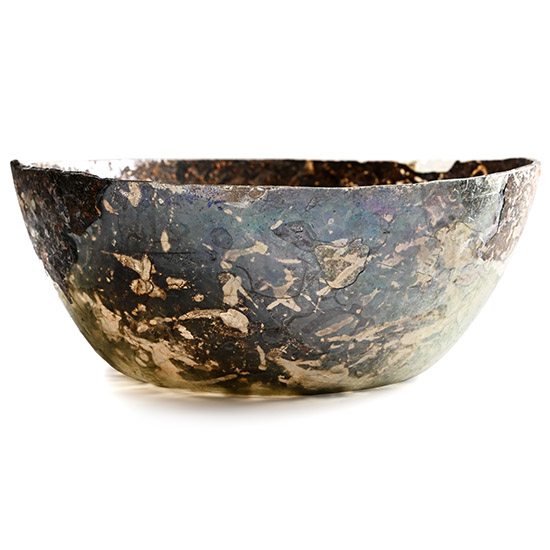
Roman Iridescent Glass High-Walled Vessel
Circa 3rd-4th century A.D.Estimate: £500 - 700 (+bp*)
Opening Bid: £250
Tall, sloping walls and a dimpled base; probably cut down from a larger vessel. 171 grams, 15.6 cm wide
From an important London, UK, glass collection, formed 1990s onwards.
This shape is a variety of hemispherical cups found in various materials and techniques during the first three centuries of the Empire. Clay cups of the same shape have been discovered alongside coins of Augustus in necropolises in Switzerland. An analogous form in glass appears in a cup fragment found at Karanis, Egypt, in a stratum dated to the 3rd century AD. The type of decoration is characteristic of the Syrian production centre during the 3rd century AD. -
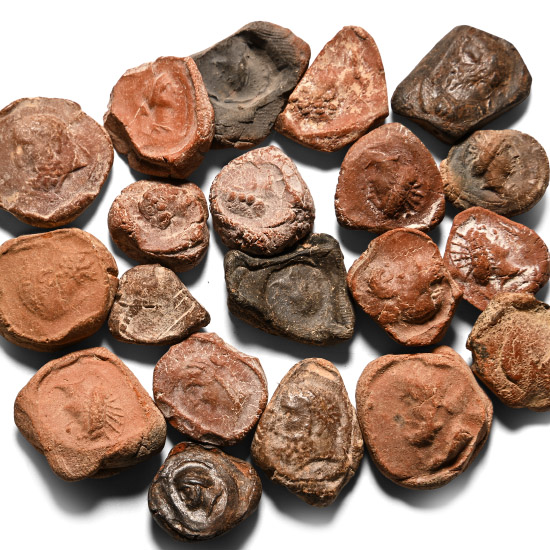
Roman Terracotta Bullae, Tesserae or Token Group
3rd century B.C.-1st century A.D.Estimate: £100 - 140 (+bp*)
Opening Bid: £5
A mixed group of ceramic bullae, tesserae or theatre tokens bearing low-relief motifs, mainly consisting of profile busts of deities. 28.9 grams total, 13-20 mm
From the private collection of a European gentleman (1942-2024), formed since the 1970s.
The term 'tessera' was used in Roman times to convey the Greek term σύμβολον (token). Small tiles are known as tokens, often shaped like coins, made of metal (copper, lead, iron), clay, bone, wood, or glass, stamped as well as engraved. The tokens, however, are not exclusively coin-shaped, as the Latin term 'tessera' suggests by etymologically referring to a square or at least a four-sided shape and confirmed in several cases by material remains of the past. Tokens and tesserae seem to have been used both in Athens and Rome for the distribution of goods. According to written sources, the term token is identified with credentials of the official authorities. They have also been interpreted as tokens of identity, as entrance tickets to theatre performances, tribunals or assemblies of citizens, archival material of seal engraving, as pawns in games, Charon’s obols and even as amulets. -
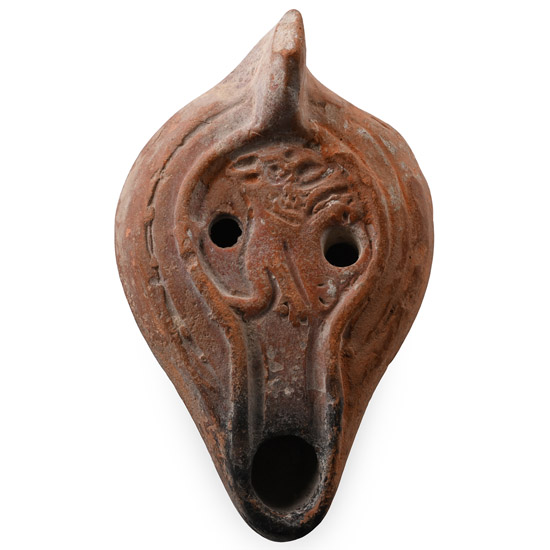
Late Roman Redware Oil Lamp with Leaping Lion
Circa 6th century A.D.Estimate: £80 - 100 (+bp*)
Bids: 1 | Current Bid: £5
Comprising a piriform body and a lug handle to the rear, the discus with two filler holes and a raised rim extending to the nozzle, a leaping lion facing towards the handle at the centre, concentric rings at the base and a raised line flanked by dotted bands beneath the nozzle. 180 grams, 12.4 cm
From a UK collection formed in the 1980s. Property of an Essex, UK, gentleman. -
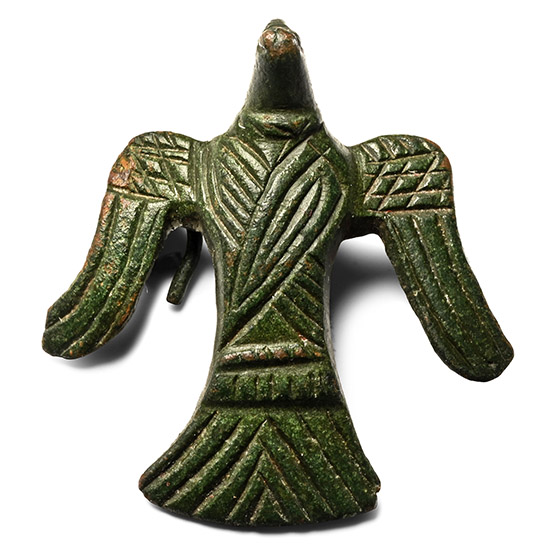
Roman Engraved Bronze Flying Bird Brooch
Circa 2nd-3rd century A.D.Estimate: £300 - 400 (+bp*)
Opening Bid: £150
Modelled as a bird in flight with raised head, outstretched wings and fanned tail, fine engraving to the body; attachment loop and catchplate to the reverse. 7.69 grams, 31.7 mm
Acquired on the UK art market in the 1980s. From an East Anglian private collection. -
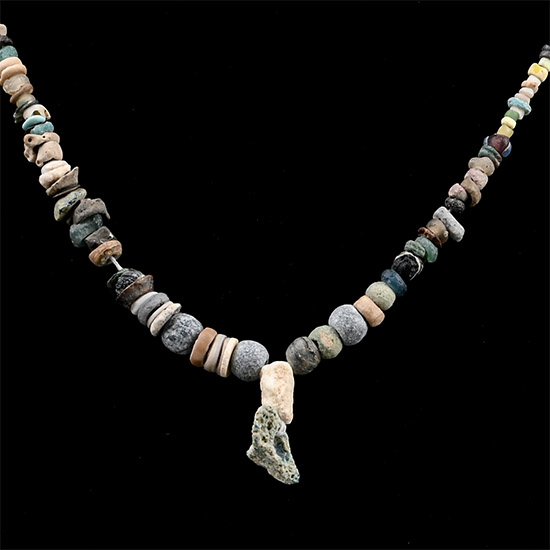
Roman and Other Mixed Glass Bead Necklace String
1st-4th century A.D. and laterEstimate: £50 - 70 (+bp*)
Opening Bid: £5
Composed of mixed beads with an axe-shaped pendant, restrung. 11.93 grams, 40 cm
Ex London, UK, collection, 1990s. -
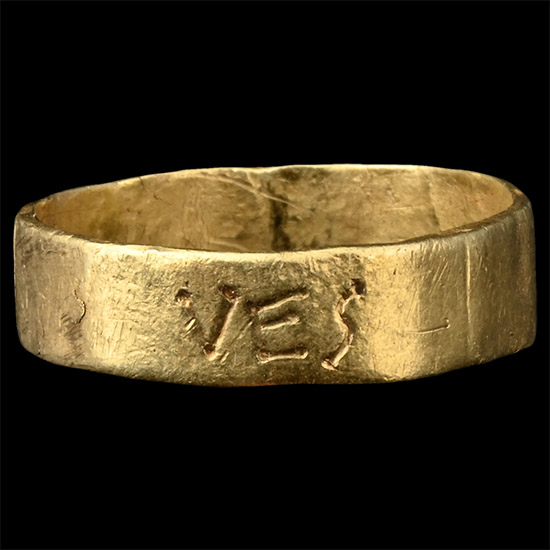
Roman Gold Military Ring with VES
Circa 3rd century A.D.Estimate: £600 - 800 (+bp*)
Opening Bid: £300
Flat-section faceted hoop with incised segmentation lines and legend 'VES' to the outer face. 2.79 grams, 18.22 mm overall, 16.64 mm internal diameter (approximate size British M, USA 6, Europe 12.46, Japan 12)
Private collection, 1980s. Acquired on the UK auction market. Private collection, London, UK.
If 'VES' is not the initials of a three-part personal name, it may be an abbreviation for 'vesper', meaning 'evening'. -
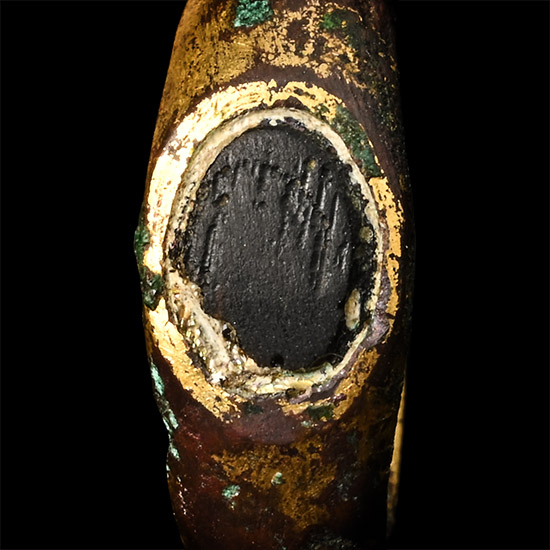
Roman Gilt Bronze Ring with Gemstone
1st-2nd century A.D.Estimate: £40 - 60 (+bp*)
Opening Bid: £5
Plaque with inset cloison, intaglio profile bust. 4.52 grams, 21.59 mm overall, 15.47 x 13.53 mm internal diameter (approximate size British H, USA 3 3/4, Europe 6.18, Japan 6)
From the private collection of a European gentleman (1942-2024), formed since the 1970s. -
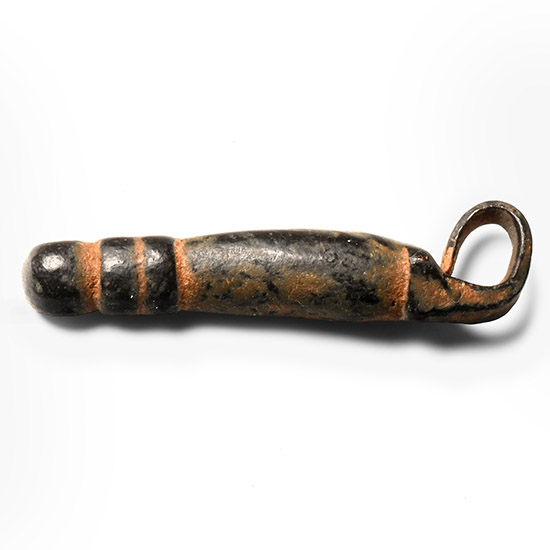
Roman Bronze Phallic Pendant
Circa 1st-4th century A.D.Estimate: £50 - 70 (+bp*)
Opening Bid: £5
Tubular pendant with ribbing at the lower end and a loop at the opposite end. 5.85 grams, 34 mm
London gentleman's collection, 1970-1990s, by descent. -
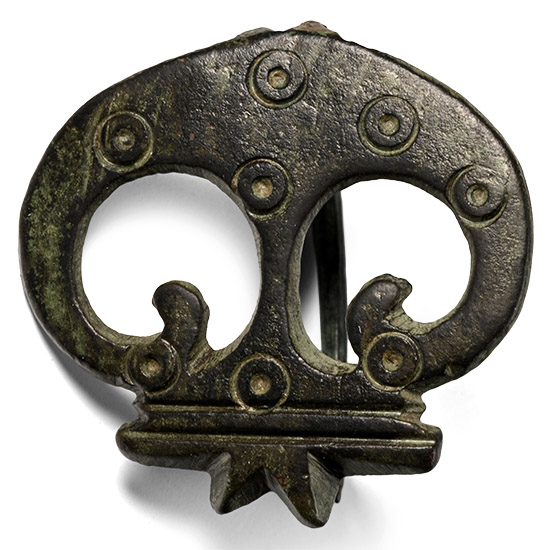
Roman Bronze Plate Brooch with Facing Bird Heads
Circa 3rd-4th century A.D.Estimate: £80 - 100 (+bp*)
Bids: 3 | Current Bid: £15
Plate brooch formed as two stylised bird heads with ring-and-dot detailing, pin and catch on the reverse. 11.1 grams, 32 mm
Ex German art market, 2000s. Acquired from an EU collector living in London. From the collection of a Surrey, UK, gentleman. -
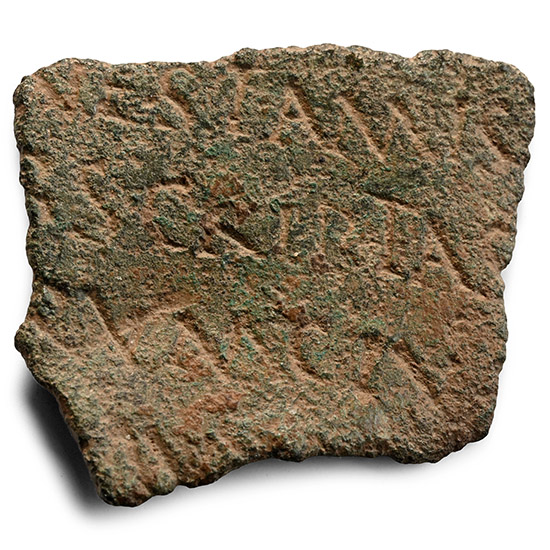
Roman Military Bronze Diploma Fragment
Circa 2nd-3rd century A.D.Estimate: £200 - 300 (+bp*)
Opening Bid: £55
Bifacial type with texts set perpendicular to each other: Side 1 - '[N]ERIANNIS[.] /[.]SCRIPTA[.]/[.]XVNCIN['.]; Side 2 - '[..]MIS / [.]NNVM['] / [.]H[.]'. 5.02 grams, 32 mm
Ex West Country, UK, collection, 1990s. -
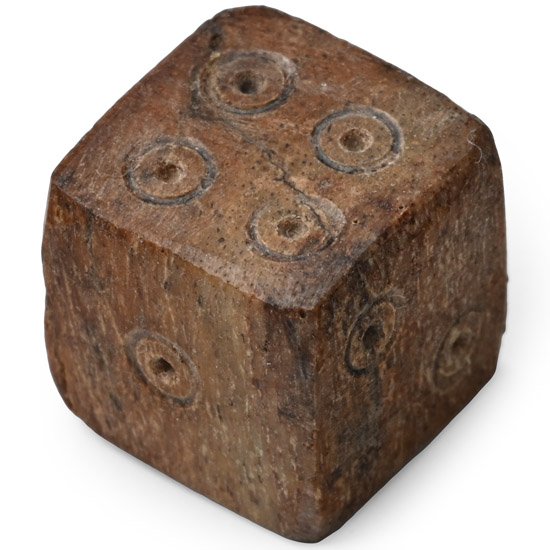
Roman Bone Gaming Die
Circa 1st-4th century A.D.Estimate: £60 - 80 (+bp*)
Opening Bid: £5
Brown cuboid dice with ring-and-dot markings disposed1:6, 2:5, 3:4. 1.9 grams, 10 mm
Ex Essex gentleman, previously in a Cambridgeshire, UK, gentleman's collection.

