-
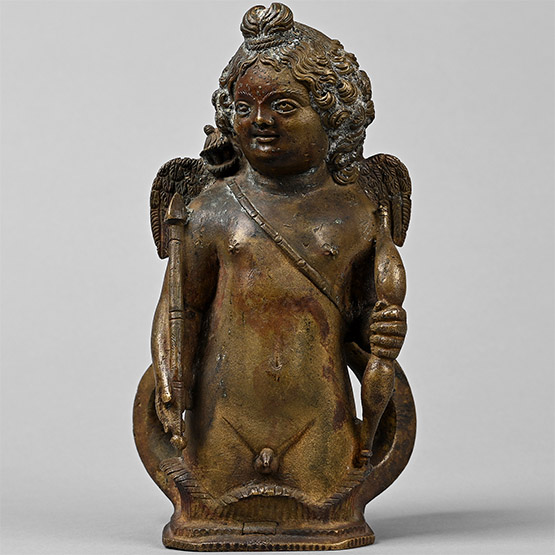
Large Roman Bronze Chariot or Lectica Mount of Cupid
2nd-3rd century A.D.Estimate: £20,000 - 30,000 (‡+bp*)
Opening Bid: £10,000
Modelled in the round hollow-formed figure of Cupid standing nude emerging from a flower, with dressed curly hair bound into a forelock, small dorsal wings on the shoulders, a recurved bow in his left hand and an arrow supported on his right forearm; looped handles to the rear and stepped base below. 1.79 kg, 19.9 cm
From the collection of J-Ph, Mariaud de Serres, Paris, France, 1990s. Piasa Auctions, 17-18 March 2003, no.584. Private collection, Europe. Accompanied by an academic report by Dr Raffaele D'Amato. This lot has been checked against the Interpol Database of stolen works of art and is accompanied by search certificate no.13215-249253. Accompanied by a copy of French passport no.237039.
These prismatic fittings covered the ends of the wooden beams, reinforcing the floor of the undercarriage on both long sides. The heavy and ornate nature of these accessories suggests they were originally attached to a more substantial vehicle such as a pilentum (used to transport aristocrats on state occasions), a carruca (for transporting emperors and aristocratic matrons) or even a thensa (a ceremonial chariot used to transport deities to the imperial games) or a lectica (portable bed for patricii and matronae). Contemporary sources describe ornate inlay, rare woods and metalwork incorporated into these vehicles, and, probably, the present fitting would originally have been gilded. -
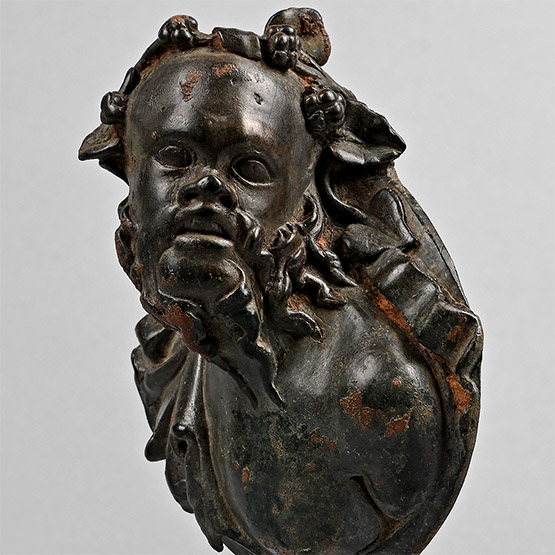
Roman Bronze Chariot Mount with Bust of Silenus
1st-2nd century A.D.Estimate: £12,000 - 17,000 (‡+bp*)
Opening Bid: £6,500
Ovoid in profile with hollow reverse, modelled in high relief with pallium tied at his right shoulder and garland draped across his shoulders and wreath of ivy around his brow; mounted on a custom-made stand. 435 grams total, 13.5 cm including stand
Private Swiss collection, before 1976. with Bonhams Antiquities, London, 3rd October 2000, no.202. Private European collection. Accompanied by a copy of an Art Loss Register certificate, no.S00038120. Accompanied by copies of the relevant Bonhams catalogue pages. Accompanied by an academic report by Dr Raffaele D'Amato. This lot has been checked against the Interpol Database of stolen works of art and is accompanied by search certificate no.13216-249243.
This type of mount was probably used as a bridle holder and placed near the driver’s seat, on the wagon platform or as a central decoration on the back of the wagon. -
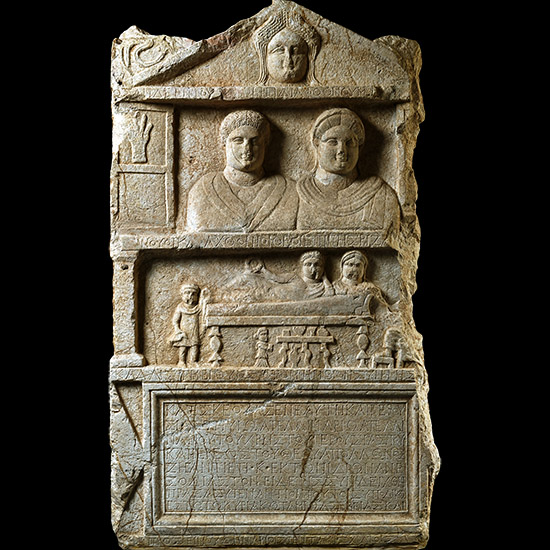
Monumental Roman Marble Funerary Stele to Senator Apellinarius and Kallisti
3rd century A.D.Estimate: £40,000 - 60,000 (+bp*)
Opening Bid: £22,222
An extremely large and imposing funerary stela, divided into three distinct sections, surmounted by a triangular pediment within which is presented the head of a female with long braided hair; below this there is the first panel, a rectangular frame inscribed at the top with Greek inscription (translation by R. Falkiner): 'AND AS…WE DISAGREE'; followed inside the frame by the facing portraits of Apellinarius and Kallisti depicted as equals, side-by-side, Apellinarius with wavy hair incised in stylised curls and wearing his toga over a simple tunic with a wide, v-shaped collar, and Kallisti shown as a commanding middle-aged matrona with the veil indicating married status falling from her voluminous hairstyle and draped around her shoulders; to the far left of the frame, a hand, carved in shallow relief within a square border; it follows another Greek inscription: 'GODS OF THE UNDERWORLD UPON THE EARTH ROOTED'; under it there is the second central panel representing, enclosed within bands of text, a conventional, stylised funerary scene in shallow relief, Apellinarius reclining on a high triclinium dining bed, wearing a heavily-draped toga supporting himself with his left hand, and holding a laurel wreath aloft in his right, Kallisti behind him in a similar pose with veil; to the far left a young man, dressed with a paenula, long trousers and closed calcei, holding a bird (dove?) in his right hand, possibly the couple's son, mourning his father and preparing to take his place as the male head of household; beneath the bed a small, highly stylised female slave wearing a peplos, her unveiled hair pulled into a bun at the nape of her neck, carrying a cup to the offering table; the following lower panel shows eight lines of Greek text, with a ninth incised on the frame below, keeping the following epigraphic cartridge, closed inside a tabula: 'KALLISTI (wife) OF BITHYS CONSTRUCTED THIS MONUMENT FOR HERSELF AND THE SENATOR (her son) APELLINARIUS SON OF APELLINARIUS THE WORTHY SENATOR AND PRIEST OF THE GOD APOLLO. HE LIVED TWENTY YEARS OUT OF HIS OWN MEANS AND WHO EVERYONE SAW NOT CAUSED PUBLIC EXPENSE, AND IF ANYONE IS CAUGHT DOING SOMETHING AGAINST (the grave)….MAY HE BE BROUGHT TO JUSTICE AND FINED 5000 DENARII FOR IMPIETY, AND PAYABLE TO THE IMPERIAL TREASURE'. 443 kg, 164 x 95 cm including stand
Very fine condition, some restoration.
Property of a London gentleman; formerly in a private collection since the early 1970s. Previously acquired on the London art market in 1970. Accompanied by an Art Loss Register certificate. Accompanied by an academic report by Dr Laura Proffitt and Dr Raffaele D’Amato. This lot has been checked against the Interpol Database of stolen works of art and is accompanied by search certificate no.10136-136699.
The funerary monument was commissioned by a woman named Kallisti (meaning in Greek the most beautiful), in honour of her deceased son Apellinarius, son of Apellinarius, with 20 years already in the rank of a senator (of Rome or of the local gerousia?) and priest of Apollo. The woman within the triangular pediment is probably Persephone, wife of Hades, and Queen of the Underworld, considering the dedication of the stela to the Gods of the Underworld. The disembodied hand on the left of the panel was almost certainly intended to have an apotropaic function, protecting the family from evil in this world and the next. This symbol can be traced as far back as ancient Mesopotamia and the Near East, and retains its meaning to this day in the form of the hamsa and 'hand of Fatima' motifs popular in the Middle East and Eastern Mediterranean. The bird in the hand of the young man could be a symbol of youth, vigour and attractiveness. However, we should not exclude another possibility, much more tragically realistic. The theme of a figure holding a bird, and especially a dove, is most common in the grave 'stelae' of Macedonia and the Balkans. It has been argued that it is an Ionian characteristic coming mostly from the Aegean islands. However, the presence of such a motif in a Cretan grave 'stele' still of the 7th century BC (Douitsi, 2017, fig.20) makes the matter more complicated as regards the origin of the theme. The presence of the bird in figure or multi-figured scenes in grave monuments is usual in tombstones from Attica, Boeotia and Thessaly during the 5th century BC, and it expands even further during the next century. Although scholars have given a chthonic essence to the presence of the bird, it is more probable that it signified the premature death of the deceased, and this topic continued in the Roman Age. The early death of a person was a horrible event that attracted attention and had to be pictured in the eternal grave monuments of antiquity. The plain presence of the bird inside the hands of the young person means that the bird refers to this person’s death and to nothing more. We should not forget that the bird used to be part of a child’s set of toys, proof of which we have in the 'stele of Xanthos' (Woysch-Meautis, 1982, pp.39-46). The female slave shown smaller than the offering table denotes the family's status and wealth, and the slave's lowly social status. Across the Roman Empire, following earlier Classical Greek conventions, it was considered a matter of prestige to display a slave on one’s funerary stela; the fact that the enslaved person was supposedly willing to mourn her master attested to the deceased’s generosity and clemency. -
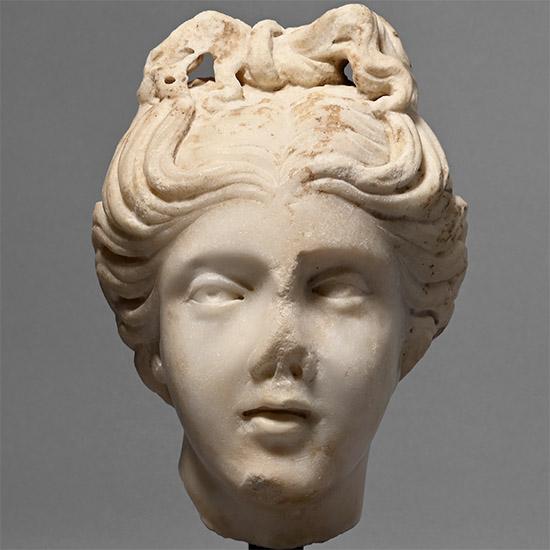
Roman Marble Head of Venus, the Goddess of Love
1st-2nd century A.D.Estimate: £12,000 - 17,000 (+bp*)
Opening Bid: £6,000
Modelled in the round as the head of Venus-Aphrodite with her hair dressed in a chignon at the nape of the neck and the tails swept and tied above the brow; the hair sculpted in deep undercuts and openwork, the face with heavy-lidded eyes evoking innocence and a soft serenity; mounted on a custom-made stand. 2.5 kg total, 20.5 cm high including stand
From the collection of Doctor C, Paris, formed 1970s. Millon & Associes, 1st June 2011, no.400. Accompanied by an academic report by Dr Raffaele D'Amato. This lot has been checked against the Interpol Database of stolen works of art and is accompanied by search certificate no.13435-262426.
The earlobes show perforations, likely for attaching earrings made of gold or another precious material. -
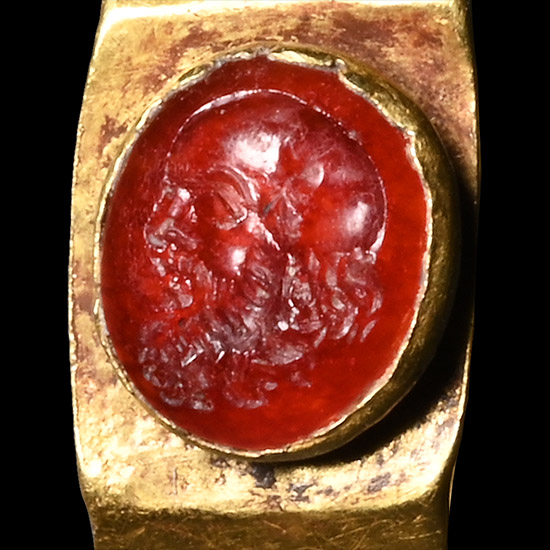
Roman Gold Ring with Gemstone of Silenus
1st-3rd century A.D.Estimate: £2,000 - 3,000 (+bp*)
Opening Bid: £1,000
Comprising a flat-section facetted hoop with a raised collet set with a red carnelian intaglio showing the profile head of Silenus; the intaglio is of the 1st century and set in a 3rd-century ring. 2.58 grams, 22.25 mm overall, 18.29 x 17.68 mm internal diameter (approximate size British P 1/2, USA 7 3/4, Europe 16.86, Japan 16)
Private collection, London. This lot has been checked against the Interpol Database of stolen works of art and is accompanied by search certificate no.13534-263674.
The ring belongs to the type VI, variant 1, of Ruseva-Slokoska classification of Roman gold rings. Polygonal-ellipsoid hoops with sectoral planes cut on the outside of the massive hoop, widening and thickening towards the shoulders, are typical of the 3rd century A.D. -
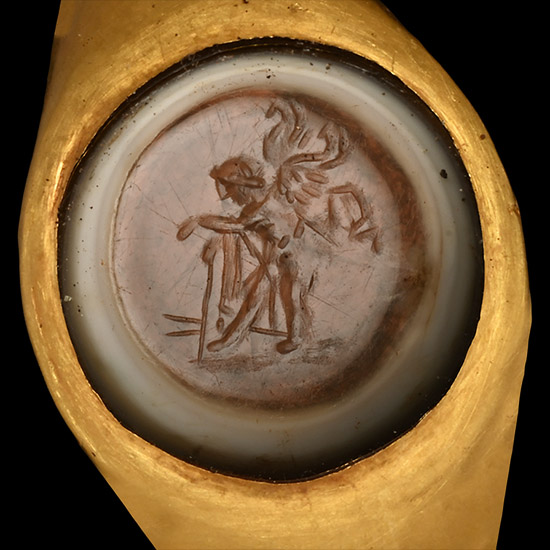
Roman Gold Ring with Intaglio of Cupid
2nd-3rd century A.D.Estimate: £1,200 - 1,700 (+bp*)
Opening Bid: £600
Hollow-formed hoop with inset glass cloison, intaglio winged figure with a staff. 3.00 grams, 24.50 mm overall, 19.95 x 17.34 mm internal diameter (approximate size British Q, USA 8, Europe 17.49, Japan 16)
Private collection, 1990s-early 2000s. -
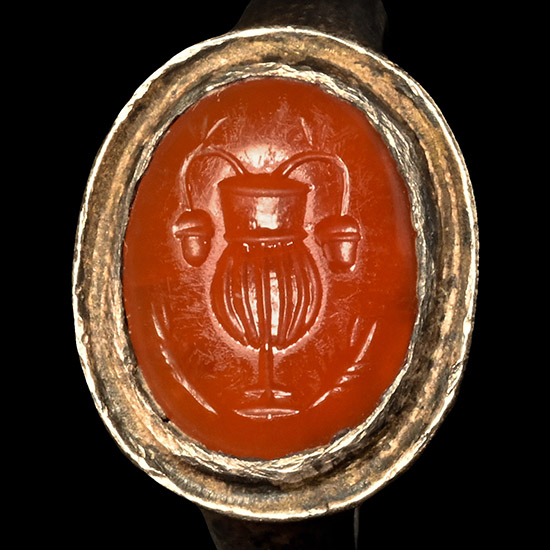
Roman Silver Ring with Carnelian Gemstone with Krater
2nd century A.D.Estimate: £1,000 - 1,400 (+bp*)
Opening Bid: £500
With angled shoulders and flared rim to the bezel, inset cabochon with intaglio krater and vine tendrils. 8.88 grams, 24.03mm overall, 17.42 x 20.45 mm internal diameter (approximate size British Q, USA 8, Europe 17.49, Japan 16)
Private collection, 1980s. Acquired on the UK art market. Private collection, London, UK. -
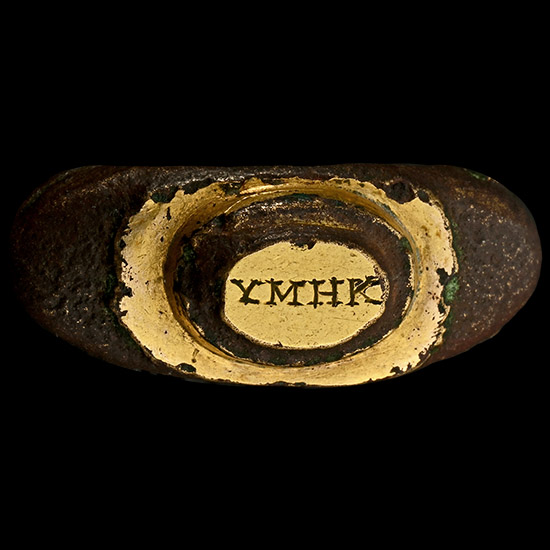
Roman Gilt Bronze Ring with Inscription
Circa 3rd century A.D.Estimate: £400 - 600 (+bp*)
Opening Bid: £150
D-section hoop with expanding shoulders and raised oval bezel with inscription 'YMHK'; traces of gilding. 19.26 grams, 32 mm overall, 16.61 mm internal diameter (approximate size British I 1/2, USA 4 1/2, Europe 8.07, Japan 7)
Ex German art market, 2000s. Acquired from an EU collector living in London. From the collection of a Surrey, UK, gentleman. -
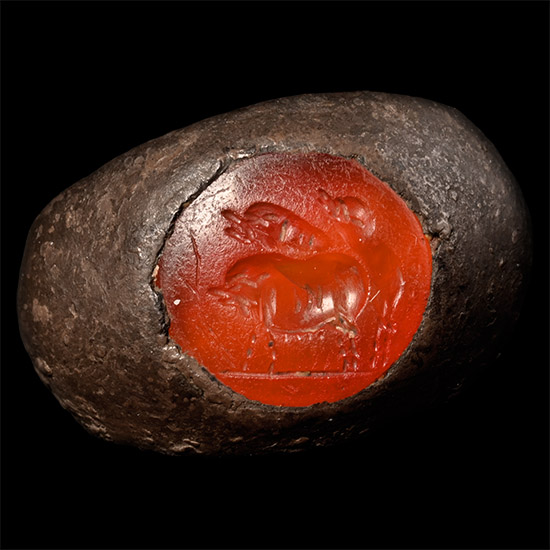
Roman Silver Ring with Carnelian Gemstone of Mating Pigs
2nd century A.D.Estimate: £2,000 - 3,000 (+bp*)
Opening Bid: £975
Comprising a keeled hoop with wide shoulders, set with a carnelian intaglio engraved with two copulating pigs with a third one shown on the sow's back. 9.44 grams, 24.60 mm overall, 19.12 x 13.03 mm internal diameter (approximate size British H 1/2, USA 4, Europe 6.81, Japan 6)
Private collection, London. This lot has been checked against the Interpol Database of stolen works of art and is accompanied by search certificate no.13532-263672.
The type belongs to variant 4, type 1, of the Roman iron rings in the Ruseva-Slokoska classification. Ellipsoid shield-bezels with conically cut gemstones are typical of the 2nd century A.D. -
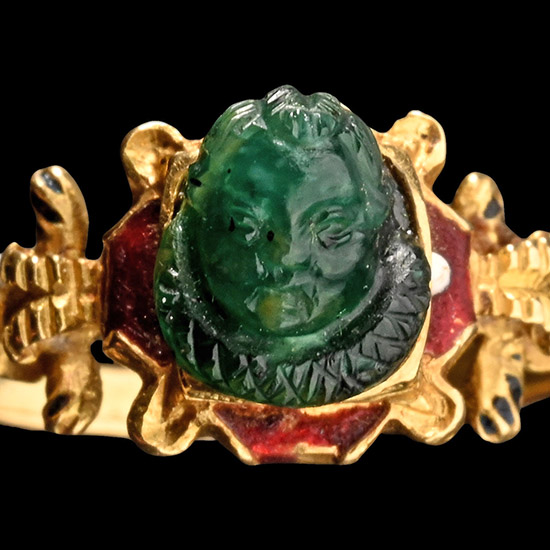
Roman Chrome Chalcedony Cameo of Eros in Renaissance Gold and Enamel Ring
Circa 1st-2nd century A.D., ring circa 1570-1580 A.D.Estimate: £18,000 - 24,000 (+bp*)
Opening Bid: £9,000
The cameo carved in high relief with the head of a child, probably Eros, with a later adaptation of a ruff-like collar around the neck, set in an ornate gold mount decorated with white, red and black enamel, the shoulders pierced with side lugs, while the underside of the setting incorporates X-shaped ribs, fine striations enriching the sides of the projecting collet. 3.70 grams, 29.54 mm overall, 18.55 x 16.53 mm internal diameter (approximate size British O, USA 7, Europe 14.98, Japan 14)
Acquired on the European art market. UK, private collection. This lot has been checked against the Interpol Database of stolen works of art and is accompanied by search certificate no.13504-263463.
Eros was the god of love, and his image was an appropriate token to give to one's beloved, though he could be a symbol of much more, especially in Dionysiac context where he stood for the young Bacchus and was a symbol of salvation. -

Roman Gold Ring with Engraved Agate Gemstone
1st century A.D.Estimate: £1,500 - 2,000 (‡+bp*)
Opening Bid: £750
Hollow-formed with inset banded agate cloison, intaglio vine-leaf motif. 3.26 grams, 23.66 mm overall, 18.15 x 14.73 mm internal diameter (approximate size British J 1/2, USA 5, Europe 9.32, Japan 9)
Private collection, acquired on the German art market in 1993; thence by descent. This lot has been checked against the Interpol Database of stolen works of art and is accompanied by search certificate no.13184-249301.
These rings were characterised by an oval opening with a flat rim for a banded agate gem, which tapered towards the top. -
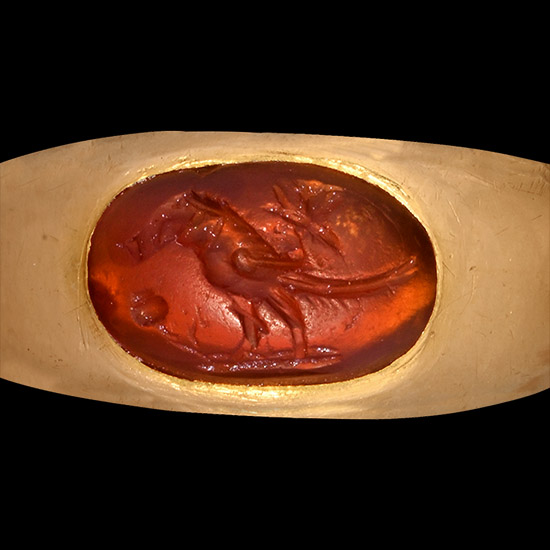
Roman Carnelian Gemstone with Bird in Gold Ring
1st century A.D.Estimate: £1,000 - 1,400 (+bp*)
Opening Bid: £500
With inset cabochon engraved with a perching bird on a baseline with a flower. 4.67 grams, 21.13 mm overall, 16.42 x 17.95 mm internal diameter (approximate size British M, USA 6, Europe 12.46, Japan 12)
Private collection, 1980s. Acquired on the UK art market. Private collection, London, UK.

