-
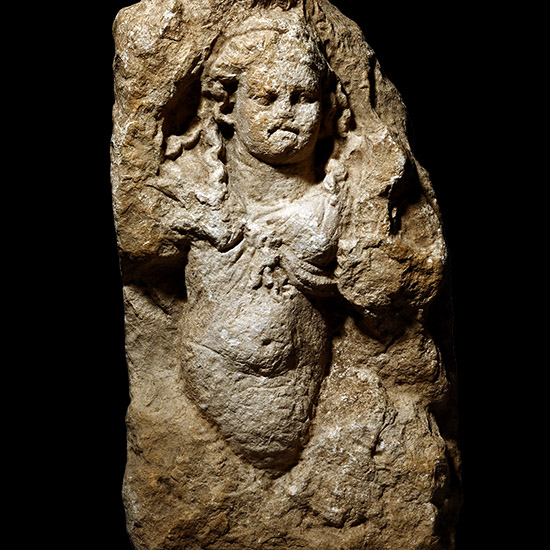
Large Roman Marble Relief with Triton
2nd century A.D.Estimate: £4,000 - 6,000 (‡+bp*)
Opening Bid: £2,000
Carved in high relief on a dressed block; with broad fleshy face and long strands of curly hair draped over the shoulders; mantle to the shoulders secured on the chest, narrow trunk with rounded abdomen and navel, fish-scale detailing to the lower body; left arm supporting a conch shell or cornucopia, right arm raised; mounted on a custom-made stand. 18.65 kg total, 49.5 cm including stand
with Archaeologia, Switzerland, before 1983. Ex private North American collection. London private collection, 2016. -
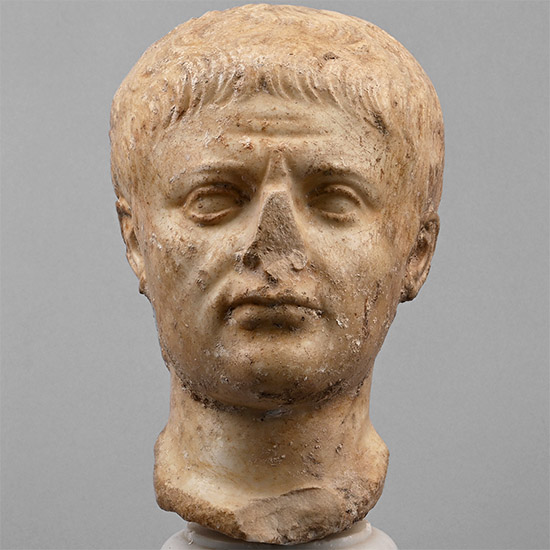
Roman Marble Head of the Emperor Tiberius
2nd century A.D.Estimate: £20,000 - 30,000 (‡+bp*)
Opening Bid: £10,000
Finely carved portrait head of a youthful, beardless male, characterised by short, softly modelled wavy locks, carefully defined eyes, and full lips; mounted on an antique white marble base. 11.5 kg, 34.5 cm
Private collection, South of France, formed between 1930 and 1960. with Galerie Saint-Honoré, Cannes, 1997. Bonnaz & Lecomte, Hôtel des Ventes Méditerranée, Marseille, 29 July 2018, lot 215. Artcurial, 29 April 2021, lot 89. Private collection, France, 2022. Accompanied by a printed copy of the Spanish cultural export licence no.1775-3178156. Accompanied by a copy of a French passport, no.228557. Accompanied by a copy of the Galerie Saint-Honore invoice, 9 July 1997. Accompanied by copies of the relevant Artcurial catalogue pages. Accompanied by an academic report by Dr Marina Mattei. This lot has been checked against the Interpol Database of stolen works of art and is accompanied by search certificate no.13458-260919.
The features display a restrained classicism and a composed expression typical of Roman Imperial portraiture inspired by earlier Julio-Claudian prototypes. The physiognomy and hairstyle closely relate to established portraits of Tiberius, suggesting a possible identification, although the work may represent an idealised or later reinterpretation of the imperial type. -
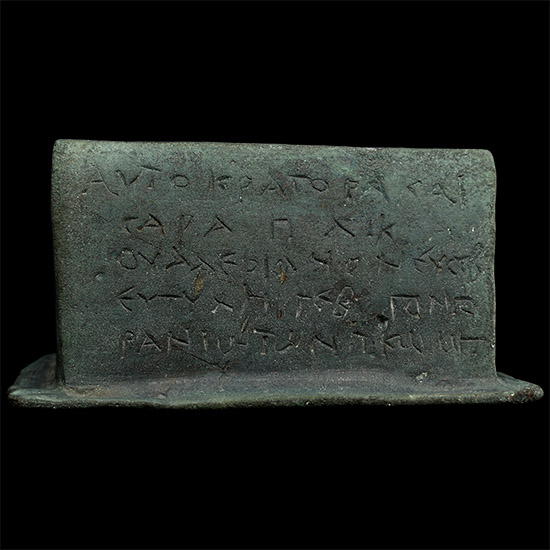
Roman Bronze Statue Plinth with Inscription for Publius Licinius Valerianus
2nd-3rd century A.D.Estimate: £2,000 - 3,000 (‡+bp*)
Opening Bid: £1,175
Hollow rectangular plinth with everted basal rim; hastily incised, five-line Greek inscription on one side: 'Αυτοκρατορα Και/σαρα Π Λικ/Ουαλεριανον ευσεβ/ευτυχη Σεβ 50-Ν-50 (?)/ρανιωτων η κωμ(ι)τ' (translated as 'To the Autokrator and Emperor P(ublius) Licinius Valerianus, pious and good-fortuned Augustus [? ...]'. 1.04 kg, 12.8 cm
with Hirsch Auction 246, 19-20 September 2006, no.838. This lot has been checked against the Interpol Database of stolen works of art and is accompanied by search certificate no.13547-263147.
Probably the base of a statuette of the Roman Emperor Publius Licinius Valerianus (r. 253–260 A.D.) presumably used by devotees of the imperial cult. Marks made by the standing statuette are still visible on top of the plinth. The number and last line incomprehensible. -
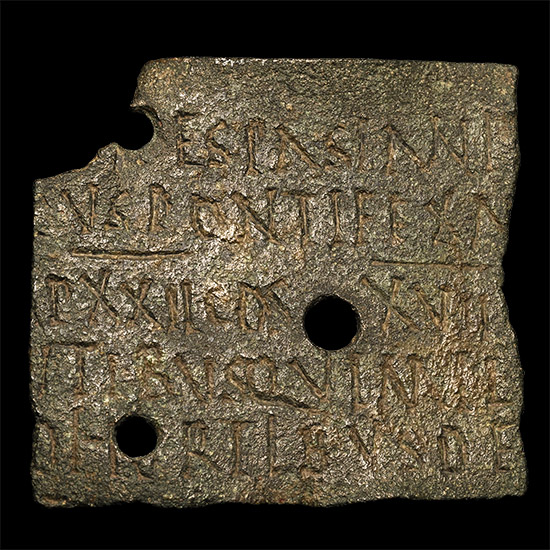
Fragment of a Roman Bronze Military Diploma Granted by Emperor Domitian
95-96 A.D.Estimate: £500 - 700 (+bp*)
Bids: 1 | Current Bid: £5
A rectangular plaque with three holes, one original one and two from later reuse; obverse with five lines of text with well engraved letters: (1) [IMP(erator) CAESAR DIVI] VESPASIANI [F(ilius) DOMITIANVS] / (2) [AVGVSTVS GERMANI]CVS PONTIFEX M[AXIMVS TRIB(unicia) / (3) [POTESTAT(e) XV I]MP(erator) XXII CO(n)S(ul) XVII [CENSOR PERPETVVS P(ater) P(atriae)] / (4) [EQVITIBVS ET PED]ITIBVS QVO MIL[ITANT IN ---] / (5) [--- ET C]OHORTIBVS DE[CEM ---]. 17 grams, 48 mm
From the collection of a European gentleman, formed since the 1990s, acquired on the German art market.
Issued for a member of a cohors, an auxiliary unit probably from the province of Moesia superior; granted by Domitian between 1 January AD 95 and his death at 18 September 96. -
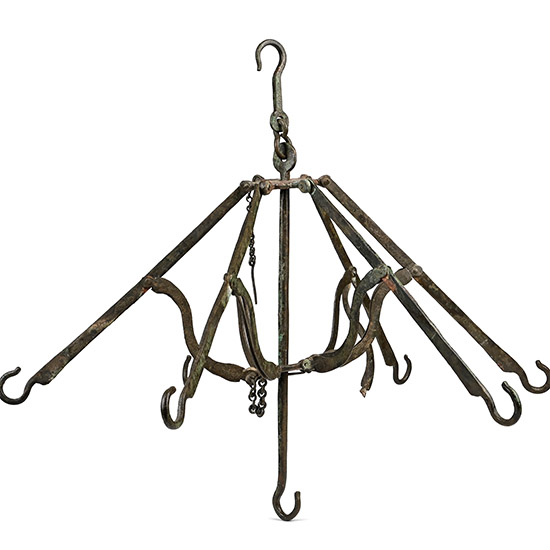
Roman Military Bronze Folding Campaign Chandelier
1st-2nd century A.D.Estimate: £4,000 - 6,000 (+bp*)
Opening Bid: £2,000
Consisting of six vertical supports with hook-shaped terminals, connected to a circular top plate via ring joints and to a circular bottom plate by paired double hooks, attached to the supports with rivets; the top circular plate linked to the bottom one by a sturdy element terminating in a hook at the lower end and a round loop at the top, where the main suspension hook for the chandelier is attached; a small chain link attached to the bottom circular plate. 1.6 kg, 54.2 cm wide
UK private collection assembled 1970s-1990s, and thence to the liquidated estate of the above. This lot has been checked against the Interpol Database of stolen works of art and is accompanied by search certificate no.13446-263437.
A chandelier like this (candelabrum, λυχνίον, λαμπτήρ, φανός) was designed for easy transport and was most probably created to be used in military activities. These field chandeliers featured platforms fitted with lamp supports, which branched out into several arms from which the lamps were hung. They were highly portable and collapsible, designed to be easily dismantled and reassembled as needed. -
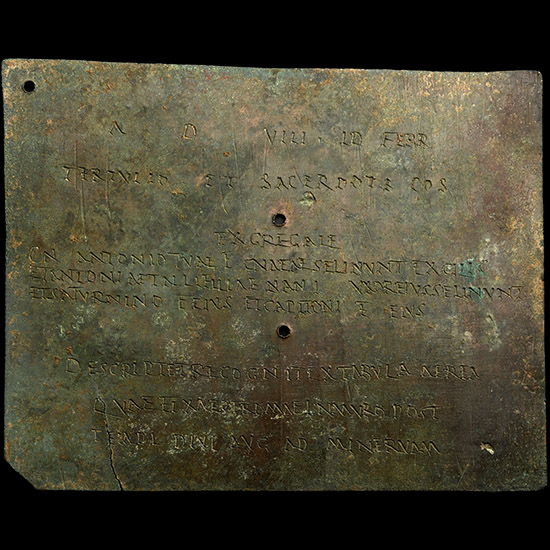
Fully Preserved Tabella II of a Roman Military Diploma Granted by Antoninus Pius
158 A.D.Estimate: £12,000 - 17,000 (+bp*)
Opening Bid: £6,000
A large rectangular tablet with traces of the capsula of the seals visible on the outer face, with three additional fragments of the capsula; text to the obverse: 'A(nte) d(iem) VIII id(us) Febr(uarias) Tertullo et Sacerdote co(n)s(ulibus). / Ex gregale Cn(aeo) Antonio Tuae f(ilio) Cnaeae Selinunt(o) ex Cilic(ia) et Antoniae Talli filiae Nani uxor(i) / eius Selinunt(o) et Saturnino f(ilio) eius et Capitoni f(ilio) eius. / Descript(um) et recognit(um) ex tabula aerea, quae fixa est Romae in muro post templ(um) divi Aug(usti) / ad Minervam.'; text to the reverse '// M(arci) Servili Getae / L(uci) Pulli Chresimi / M(arci) Sentili Iasi / Ti(beri) Iuli Felicis / C(ai) Belli Urbani / C(ai) Pomponi Statiani / P(ubli) Ocili Prisci'. 280 grams total, 12.7-19 cm
German private collection, formed since the 1990s. This lot has been checked against the Interpol Database of stolen works of art and is accompanied by search certificate no.13525-263654.
Completely preserved tabula II of a Roman military diploma which was issued under Emperor Antoninus Pius (138-161 A.D.). The owner was a Gnaeus Antonius Gnaea, who served 26 years in the classis praetoria Misenensis, the Praetorian fleet stationed at Misenum, and who was honourably discharged from military service. The emperor granted Roman citizenship to him, his wife and children on 6 February 158. Following the legal requirements of the time, it was signed by seven witnesses. Originally, tabella 1 and 2 had been bound together. Unique are the well-preserved bronze strips for closing the space between the rims of both tablets, which form part of this extraordinary lot. The first tablet of this diploma is stored at the National Museum of Scotland, inv. A.1987.133. -
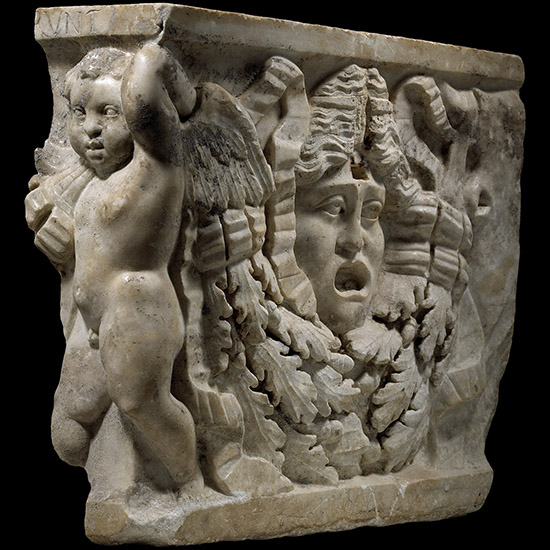
Large Roman Marble Garland Sarcophagus Panel with Theatrical Mask and Eros, the Greek God of Love
Circa 135 A.D.Estimate: £15,000 - 20,000 (+bp*)
Opening Bid: £8,333
From the right end of an ornate sarcophagus, carved dramatic theatrical mask in the centre with open mouth and drilled eyes, the forehead morticed for an attachment, a garland of leaves below; the right end tied to a boukranion, the left supported by a winged Eros; reverse with apsidal recess. 72.95 kg, 48 x 57 cm
Private collection, New York. with Christie's, New York, 7th December 1995, no.118. Christie's, New York, April 29th, 2019, no.189. Acquired at the above sale. with Sotheby's, 17 December 2020, no.80. The opposite short side of the same sarcophagus was sold at Sotheby's, New York, November 28th, 1990, no.104, and is now in a New York private collection. This lot has been checked against the Interpol Database of stolen works of art and is accompanied by search certificate no.13116-249668. -
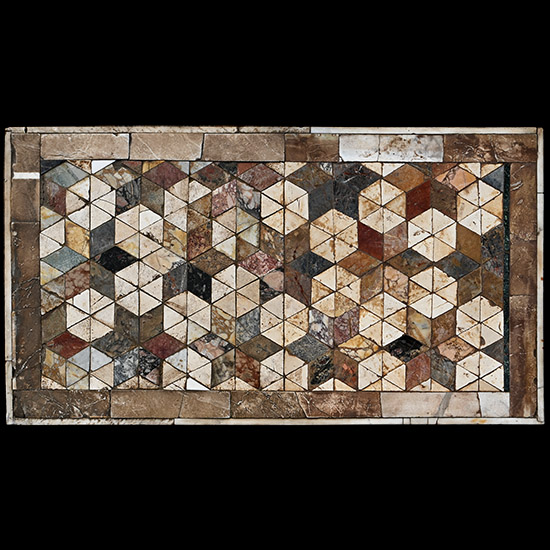
Large Roman Coloured Marble Table Top Formed from a Section of Tessellated Pavement
3rd century A.D.Estimate: £6,000 - 8,000 (+bp*)
Opening Bid: £3,000
A section of opus sectile pavement, composed of an array of various fine ancient Roman marble specimens in the shape of rhombi and hexagons, creating a three-dimensional effect, set in a marble frame, and accompanied by an iron table frame. approx. 300 kg, 235 x 129 x 8.8 cm
UK private collection (Robin Symes), assembled 1970s-90s, and thence to the liquidated estate of above. Accompanied by letters from the relevant Greek and Italian authorities renouncing any current or future claim over this piece.
These 3D patterns were widely popular across the Roman Empire from the 1st century BC to the 4th century AD. Famous original examples of this exact pattern survive intact at the House of the Faun in Pompeii and the National Roman Museum. There is an insert of green serpentine, indicating the piece was reset and repaired in more recent times. -
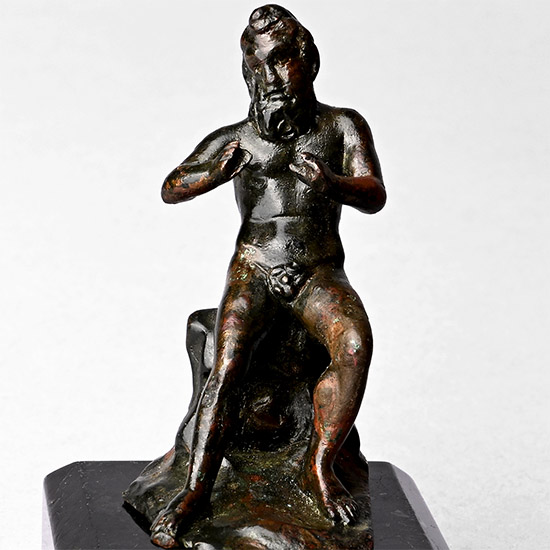
Roman Bronze Statue of Satyr Playing an Aulos
1st-2nd century A.D.Estimate: £2,000 - 3,000 (‡+bp*)
Opening Bid: £1,450
Depicted nude sitting on a rock, his upper body leaning back, playing the double flute (lost); pointed ears, and the hair at the nape of the neck curled inwards; accompanied by a display stand, right knee restored. 254 grams total, statue: 61 mm, 82 mm high including stand
Plinth from the 1970s-1980s. Ex Dr Uwe Dams (1975-2017), Oberpfalz, Germany. with Gorny & Mosch, Munich, Auction 30 June 2017, no.74. Belgian art market, 2022. This lot has been checked against the Interpol Database of stolen works of art and is accompanied by search certificate no.13437-263151.
The figure may represent Marsyas, who, convinced of his mastery of the art, challenged Apollo to a contest, lost and was flayed alive as punishment for his excessive pride. -
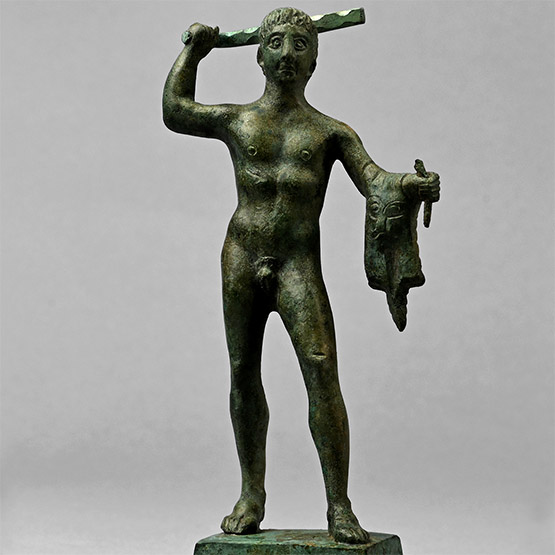
Roman Bronze Statuette of Hercules
Circa 2nd-3rd century A.D.Estimate: £4,000 - 6,000 (‡+bp*)
Opening Bid: £2,222
Modelled in the round with a lion skin mantle over his extended forearm, standing nude with a club raised over his shoulder; provided with a contemporary custom-made stand. 244 grams, 13.5 cm
Private collection, USA and Switzerland, before 1992; thence by descent. This lot has been checked against the Interpol Database of stolen works of art and is accompanied by search certificate no.13195-249254.
This type of representation of Hercules, inspired by Etruscan or Italic models, was widespread in Gallo-Roman sanctuaries dedicated to the god, where several votive statues attributable to this type have been found. The musculature of the back is well-executed, as are the facial features and the details on the Nemean lion's skin. -
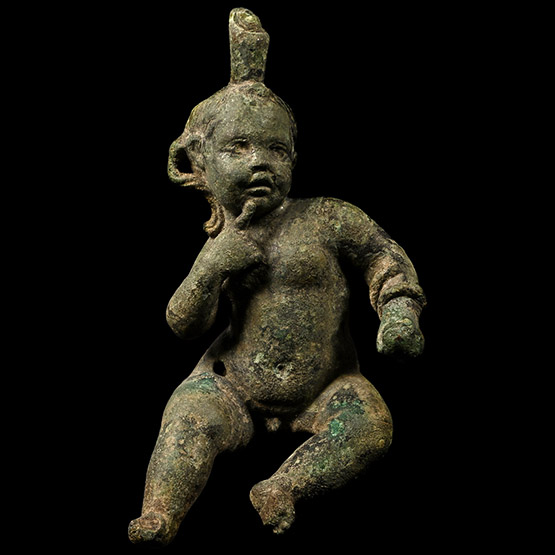
Roman Bronze Figure of Harpocrates, the God of Secrecy
1st century A.D.Estimate: £1,500 - 2,000 (‡+bp*)
Opening Bid: £833
Modelled in the round, sitting with miniature double-crown, serpent arm-ring on left wrist, sidelock; fixing socket to right thigh. 145 grams, 72 mm
Private collection, Me. A., Florida, USA, early 1990s. European private collection, acquired in Germany, September 2000. This lot has been checked against the Interpol Database of stolen works of art and is accompanied by a search certificate no.12683-234609. -
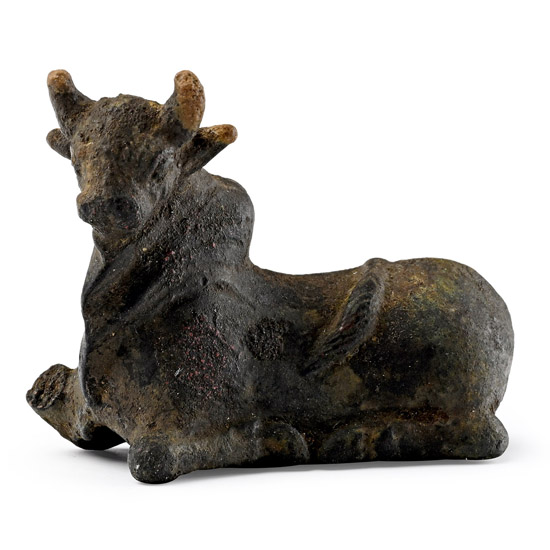
Roman Bronze Zebu Statuette
3rd-4th century A.D.Estimate: £700 - 900 (‡+bp*)
Opening Bid: £375
Hollow-formed in reclining pose with the legs folded beneath the body, tail curled over the rump, hump to rear of neck. 61 grams, 47 mm
Acquired in 1992. Private collection, thence by descent. Private collection, since the late 1990s.

