-
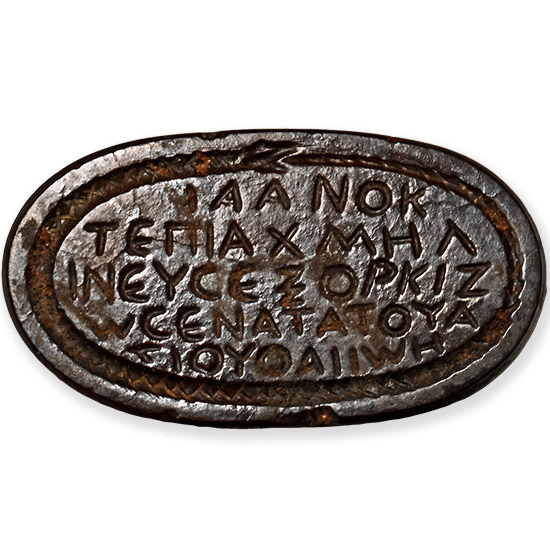
Roman Gnostic Haematite Gemstone with Greek Inscription
Circa 3rd century A.D.Estimate: £500 - 700 (+bp*)
Opening Bid: £250
Ellipsoid in plan with enigmatic legend within a linear border: 'IAA NOK / TEΠIAXMHΛ / INEYCEΞOPKIZ / WCENATATOYA / TIOYOAIIWH'. 1.48 grams, 21 mm
Property of a London, UK, gentleman, 1970-2000. -
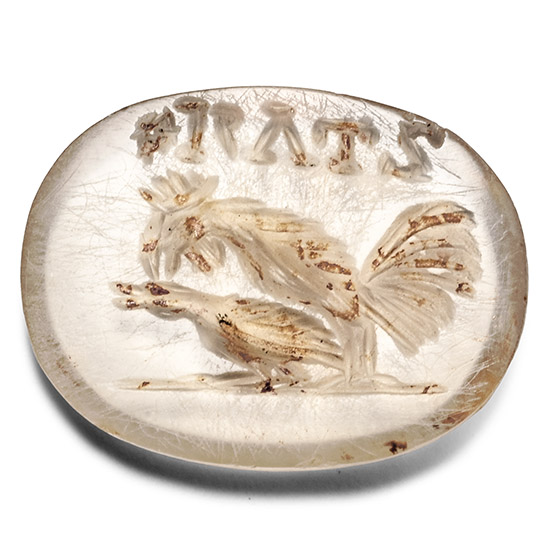
Roman Rock Crystal Gemstone of an Archigallus
Circa 1st century B.C.-1st century A.D.Estimate: £800 - 1,000 (+bp*)
Opening Bid: £250
Ellipsoid in plan with an engraved scene of a cockerel copulating with a hen, inscription above. 0.62 grams, 14 mm
Property of a European gentleman, acquired from the estate of a London collector (formed before 2000).
In ancient Rome, a cockerel, Latin gallus, was a symbol of virility and fertility. But gallus (plural galli) was also the term for a religious devotee and later for a priest of Cybele (Magna Mater). Often eunuchs, they performed ecstatic dances and rituals, sometimes even engaging in sexual acts as part of their religious practices. In Rome, the head of the Cybele priests was the archigallus, chosen by the quindecimviri sacris faciundis. Reliefs show that the archigallus was wearing luxurious and extravagant costumes and jewellery. This unique gemstone can be attributed to such an archigallus. The cult of Cybele/Magna Mater and the presence of galli also spread to Roman Britain, where it is attested, e.g. in Catterick and Corbridge. -
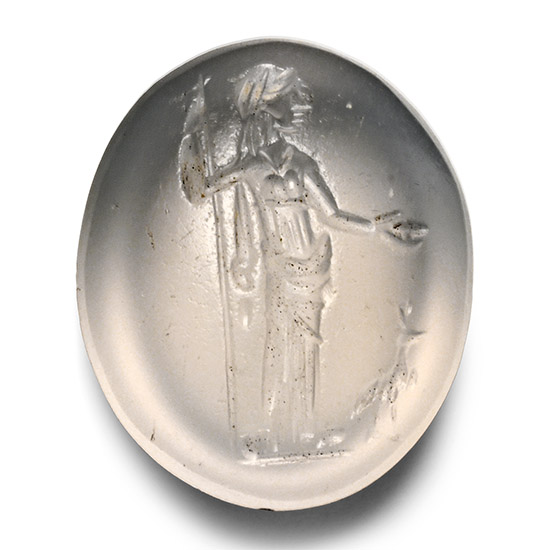
Roman Chalcedony Gemstone with the Goddess Juno
Circa 2nd-3rd century A.D.Estimate: £400 - 600 (+bp*)
Bids: 2 | Current Bid: £10
Oval translucent intaglio with Juno standing right, holding a long sceptre in her right hand and a patera in her other hand, a peacock standing before her. 1.35 grams, 14 mm
Acquired in Greenwich Village, November 1960, for 10 shillings. From the private collection of Peter Clayton, FCILIP, Dip, Arch, FSA, FRNS, Hemel Hempstead, Hertfordshire, UK; formed since the late 1950s. Accompanied by an old handwritten information card by Peter Clayton, collection no.74. -
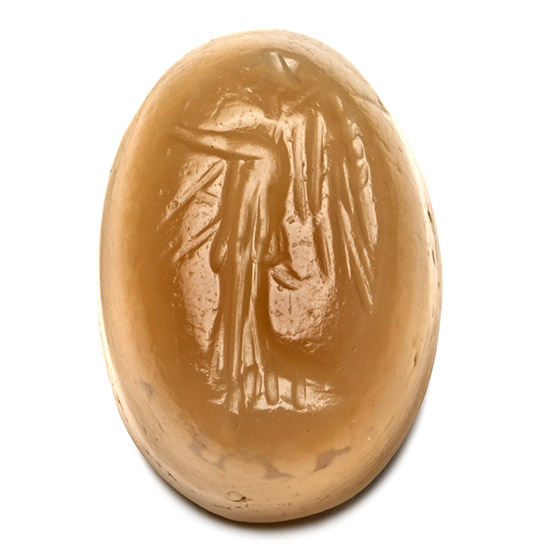
Roman Agate Gemstone with Goddess Victory
2nd century A.D.Estimate: £400 - 600 (‡+bp*)
Opening Bid: £180
Layered agate gemstone with winged Victory in a long robe striding to the left, holding a wreath in her outstretched left hand. 1.06 grams, 13 mm
Ex London art dealer, 1985-1990. with Bonhams Auction, 1 May 2008, no.309 (Part). -
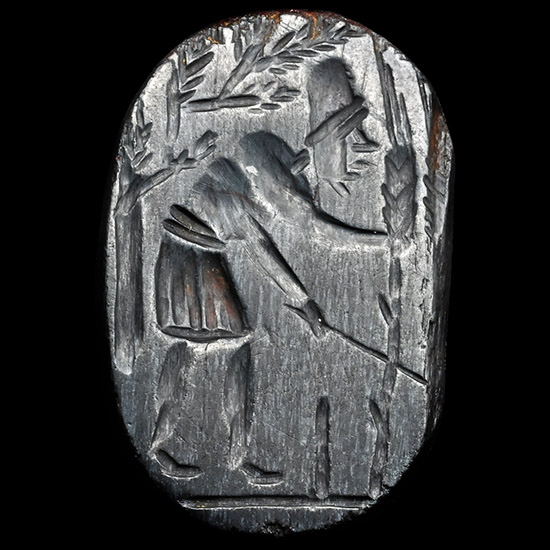
Roman Gnostic Bifacial Hematite Gemstone with Magical Scene and Inscription
Circa 3rd-4th century A.D.Estimate: £800 - 1,000 (+bp*)
Opening Bid: £444
Plano-convex in section with engraved scene to the flat face of a reaper bending to cut stalks of wheat; reverse with legend to centre 'CX/WN' and abraded inscription to the edges. 5.58 grams, 27.3 mm
Private collection, 1980s. Acquired on the UK art market. Private collection, London, UK. -
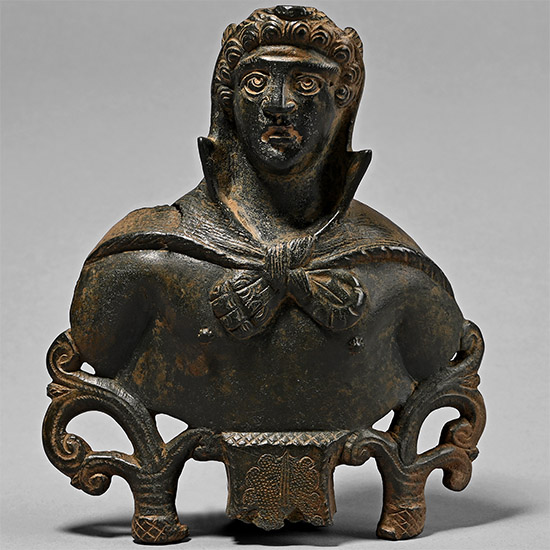
Large Roman Bronze Young Hercules Chariot Mount
3rd century A.D.Estimate: £1,200 - 1,700 (+bp*)
Bids: 1 | Current Bid: £5
Depicted as a bust of youthful Hercules wearing a lion's skin with curly hair, cubical mount with a pair of volutes underneath the body, large attachment loop to the reverse. 414 grams, 14.4 cm
Private collection formed in Europe in the 1980s. Westminster collection, central London, UK. -
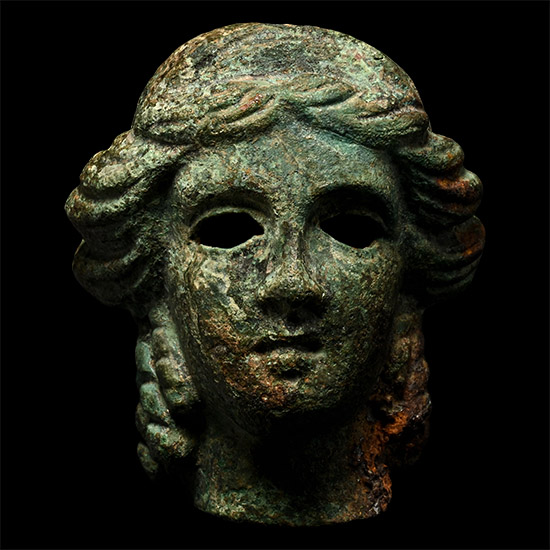
Roman Bronze Head of the Goddess Juno
1st century A.D.Estimate: £800 - 1,000 (+bp*)
Opening Bid: £250
Hollow-form head of a young woman with hollowed-out eyes, wearing a fillet and her hair pulled back into a high chignon with dressed curls framing the face. 180 grams, 52 mm
UK private collection assembled 1970s-1990s, and thence to the liquidated estate of above. -
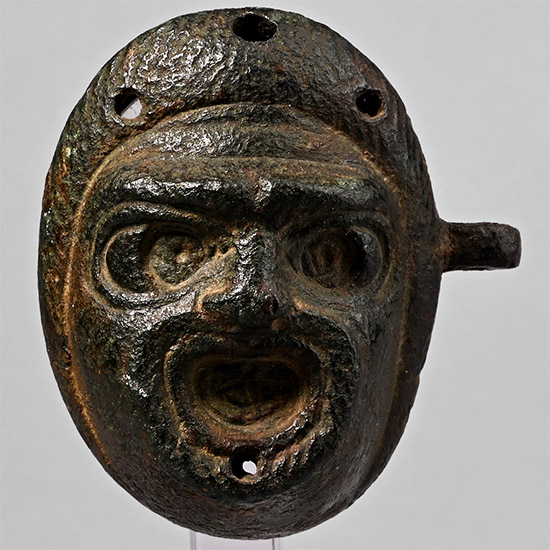
Roman Bronze Theatre Mask Mount
1st-2nd century A.D.Estimate: £1,500 - 2,000 (‡+bp*)
Opening Bid: £825
Comic theatre mask in the form of a bearded man with a furrowed forehead, bulging brows and flat nose; within the mouth opening of the mask, the actor’s mouth visible as if an actor were wearing the mask, likewise the actor’s eyes with drilled pupils seem to peer through the eye openings that are framed by bulges, hair brushed back from the forehead; on the right, a hinge eyelet, and small holes at the top and bottom probably for the air supply; possibly the lid of a lamp; accompanied by a custom-made display stand. 207 grams total, mask: 62 mm, 13.3 cm high including stand
Ex Prof. Hans Dahn (1919-2019), Lausanne, acquired July 1959 from Donati.
Despite the moralising of certain elements of society and the bad reputation they suffered, the actors and their dramatic spectacles remained hugely popular with ordinary Romans. Theatre was important in the life of commoners and had a powerful impact on moulding public opinion. This piece, likely a decorative element, reflects the popularity and prominent place of theatre in Roman culture. -
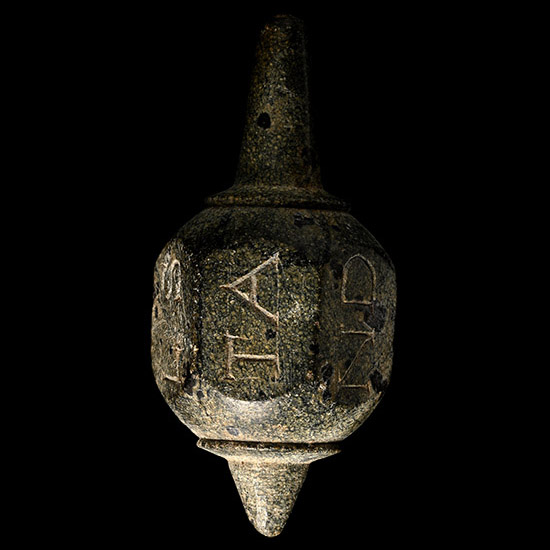
Roman Carved Stone Totum Spinning Gaming Die
2nd-3rd century A.D.Estimate: £1,000 - 1,400 (+bp*)
Bids: 1 | Current Bid: £5
Steatite spinner with conical foot, hexagonal-section body and tapering shank above; facets with incised lettering 'TA, ND, NH, NG, SZ, LS' in serifed Roman capitals. 20.7 grams, 49 mm
From the private collection of a European gentleman (1942-2024), formed since the 1970s.
Instead of the usual dots or ring-and-dot markings found on the dice, the numerical values are here indicated by letters. The letters are engraved into the stone with great care, using a burin with an elongated cutting edge. The value sequence was possibly determined by the position of the letters in the Latin alphabet: TA = 1+19; ND = 13+4; NH = 13+8; NG = 13+7; SZ = 18+25; LS = 11+18. -
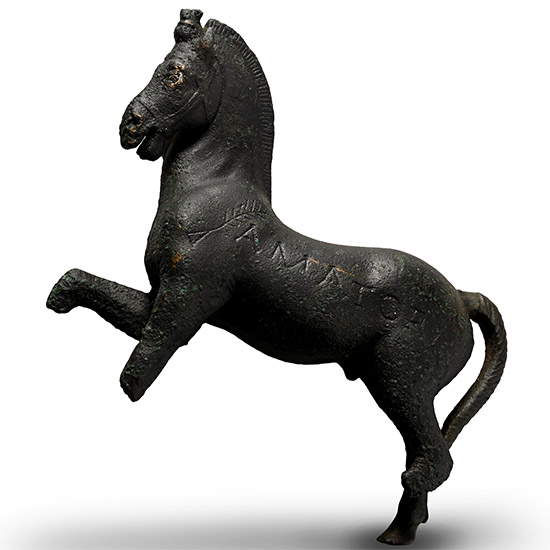
Large Roman 'AMATOR' Bronze Prancing Horse Statue
3rd century A.D.Estimate: £4,000 - 6,000 (+bp*)
Opening Bid: £2,000
Modelled in the round with an elongated neck, right foreleg raised, head turned slightly to the right with open mouth wearing a bridle, short mane and tail with ribbed engraved decoration, inscription 'AMATOR' next to a branch; lower parts of three legs absent. 376 grams, 11.1 cm
Found Norfolk, UK. Acquired on the UK art market in the 1980s. From an East Anglian private collection. Accompanied by an academic report by Dr Raffaele D'Amato. This lot has been checked against the Interpol Database of stolen works of art and is accompanied by search certificate no.13549-262542.
Romans frequently used 'amator' combined with a noun to show a deep dedication to a particular craft or lifestyle. On a freestanding bronze horse statue, it could be a self-dedication by the person who commissioned it. Alternatively, 'amator' could be the name of the person who owned the statue or a demonstration of dedication to a specific horse or craft of horse-breeding. -
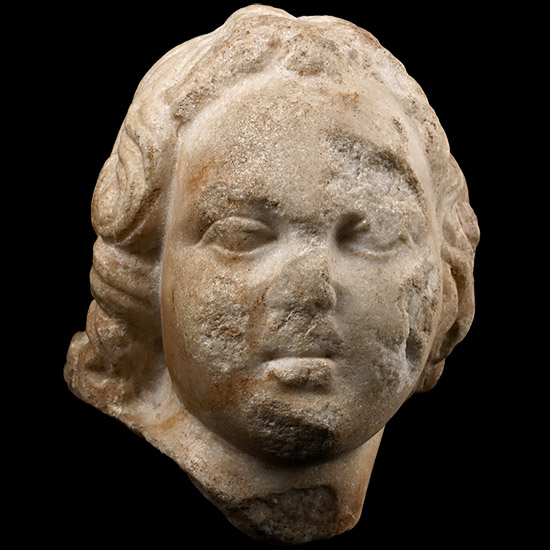
Roman Marble Head of Eros
Early 2nd century A.D.Estimate: £3,000 - 4,000 (‡+bp*)
Opening Bid: £1,650
With long, curly hair braided over the forehead and top of the head, turned to the left and slightly inclined; round fleshy face with narrow, almond-shaped eyes; possibly from a copy of 'Eros Stringing his Bow' by Lysippos (3rd quarter of the 4th cent. B.C.); mounted on a custom-made stand. 1.71 kg total, 23 cm high including stand
Private American collection, circa 1960. with Sotheby's, New York, 6 December 2006, no.128B. This lot has been checked against the Interpol Database of stolen works of art and is accompanied by search certificate no.13538-263101.
The original Greek work that may have inspired the Roman sculptors could be a sculpture by the 4th-century B.C. artist Lysippos, who created the cult statues of Eros at Thespiae. Various copies are preserved of this artwork, like the one in the National Museum of Liverpool (2nd century A.D., inv. no.59.148.93) and the one in the Hermitage Museum (inv. no. Гр. 3102 [А 199]). -
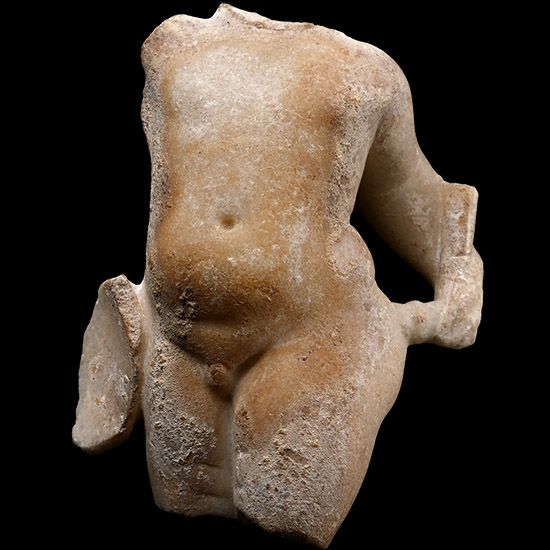
Roman Marble Torso of Eros
1st century A.D.Estimate: £800 - 1,000 (+bp*)
Opening Bid: £400
Carved in the round with the bow supported in the left hand, quiver to the shoulder; mounted on a custom-made stand. 1.07 kg total, 19 cm including stand
From the private collection of Lord and Lady Lloyd of Berwick, UK, since at least the late 20th century.

