-
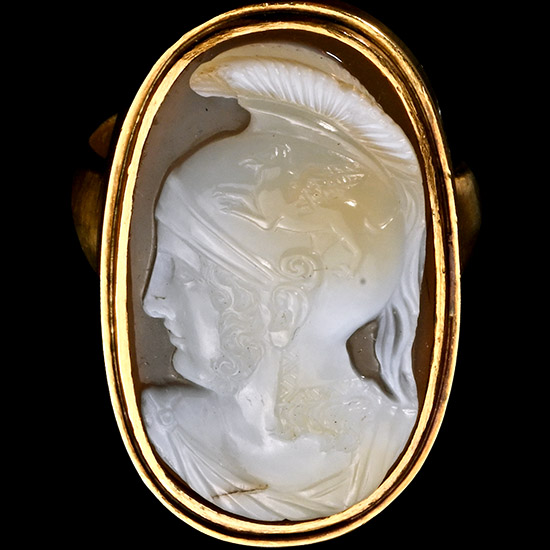
Post Medieval Agate Cameo of a Greek Warrior in Gold Ring
Italy, early 19th century A.D.Estimate: £1,200 - 1,700 (+bp*)
Opening Bid: £600
Carved in high relief with the profile bust of a helmetted Greek warrior, the helmet with a prominent crest, and a leaping gryphon on the side; set within a later ring mount. 13.12 grams, 27.95 mm overall, 17.07 mm internal diameter (approximate size British M 1/2, USA 6 1/4, Europe 13.09, Japan 12)
Acquired on the European art market. UK, private collection. -
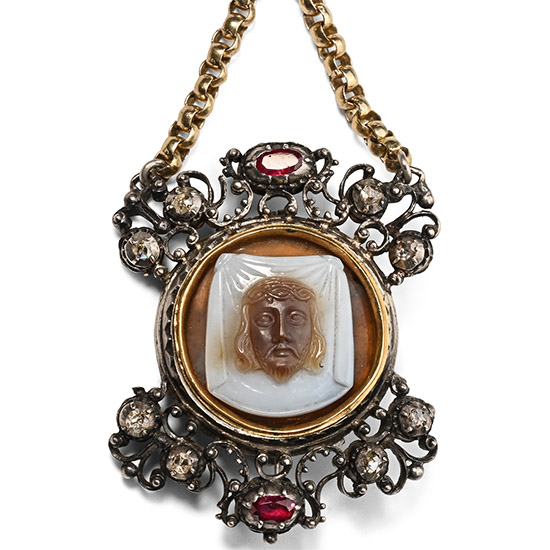
Sardonyx Cameo of Veronica’s Veil in an Eighteenth-Century Pendant
Cameo 17th century A.D.; pendant 18th century A.D.Estimate: £4,000 - 6,000 (+bp*)
Opening Bid: £2,222
Circular cameo depicting the face of Christ wearing the crown of thorns, appearing at the centre of a veil; set in an openwork silver frame with a gold collar surrounding the cameo; the elaborate frame with rose-cut diamonds and rubies in rub-over settings; a pin on the reverse and a later set chain with a suspension loop above for suspension. 13.14 grams, 67 mm long
Acquired on the European art market. UK, private collection. This lot has been checked against the Interpol Database of stolen works of art and is accompanied by search certificate no.13508-263389.
The Veil of Veronica is a sacred Christian relic said to bear the miraculous, unpainted image of the face of Jesus Christ. -
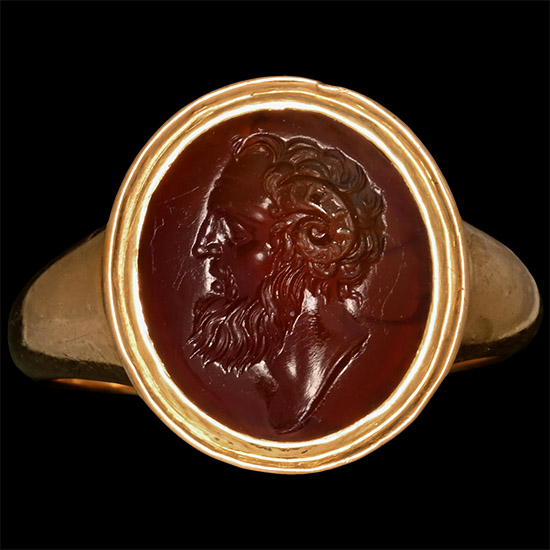
Post Medival Gold Ring with a Carnelian Intaglio of Jupiter Ammon
Circa 19th century A.D.Estimate: £1,500 - 2,000 (+bp*)
Opening Bid: £750
D-section hoop set with an oval carnelian intaglio depicting the mature bearded head of Jupiter Ammon in profile, the face framed by curled hair and a substantial beard, the curling ram’s horn around the ear, the deity’s distinguishing attribute. 4.41 grams, 20.20 mm overall, 16.59 x 15.14 mm internal diameter (approximate size British L 1/2, USA 6, Europe 11.87, Japan 11)
Acquired on the European art market. UK, private collection. -
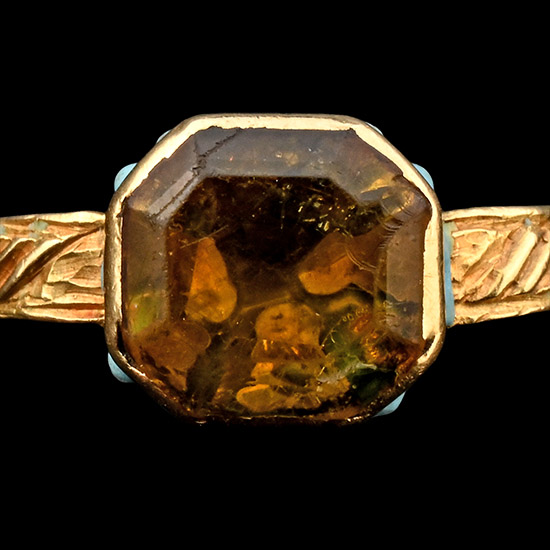
Stuart Period Gold and Enamel Ring with Citrine-Coloured Table-Cut Paste
England, mid-17th century A.D.Estimate: £1,500 - 2,000 (+bp*)
Opening Bid: £750
Set with a vivid orange-yellow table-cut paste in a raised octagonal collet, turquoise-coloured enamel decorating the bezel; the hoop chased with diagonal ornament, with remains of light-blue enamel. 2.58 grams, 22.63 mm overall, 17.40 x 15.66 mm internal diameter (approximate size British N, USA 6 1/2, Europe 13.72, Japan 13)
Acquired on the European art market. UK, private collection.
The projecting collet and table-cut paste belong to the seventeenth-century tradition of enamelled gemstone and imitation gem rings. -
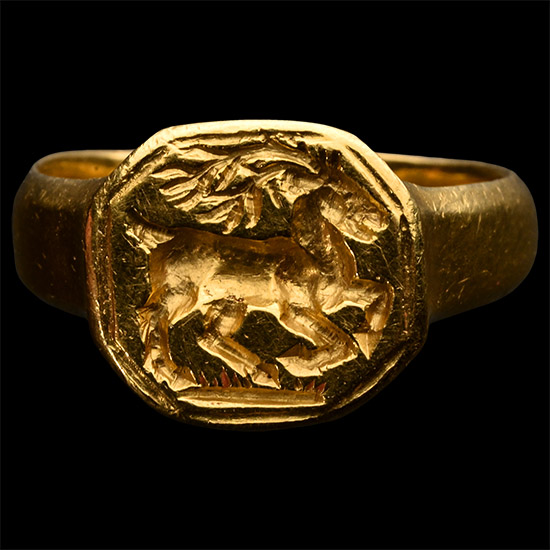
Post Medieval Signet Ring with a Galloping Stag
Germany, mid-17th century A.D.Estimate: £5,000 - 7,000 (+bp*)
Opening Bid: £2,500
Comprising a thick D-section hoop with facetted shoulders, an octagonal bezel with a deeply engraved image of a galloping stag on a baseline. 10.99 grams, 23.27 mm overall, 18.43 x 19.06 mm internal diameter (approximate size British P 1/2, USA 7 3/4, Europe 16.86, Japan 16)
Acquired on the European art market. UK, private collection. This lot has been checked against the Interpol Database of stolen works of art and is accompanied by search certificate no.13506-263461.
The ring's style indicates a 17th-century origin, reflecting the period's fascination with equine motifs in Germany following the publication of Georg Engelhard von Löhneysen’s pioneering equestrian treatise, Die neu eröffnete Hof-, Kriegs- und Reitschul. -
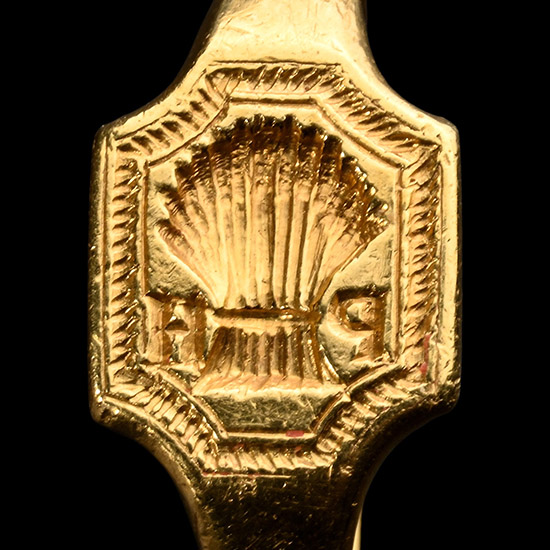
Post Medieval Gold Signet Ring with a Wheat Sheaf
Germany, 15th-16th century A.D.Estimate: £5,000 - 7,000 (+bp*)
Opening Bid: £2,500
Comprising a large hoop with a cut-cornered bezel engraved with a wheat sheaf flanked by the initials P and H. 9.51 grams, 24.71 mm overall, 21.03 x 17.66 mm internal diameter (approximate size British R 1/2, USA 8 3/4, Europe 19.38, Japan 18)
Acquired on the European art market. UK, private collection. This lot has been checked against the Interpol Database of stolen works of art and is accompanied by search certificate no.13488-263468.
The family name of the coat of arms with the owner’s initials P and H cannot be identified, but it is possibly German. The garb of wheat, often simply called a ‘garb’ in heraldry, is a bound sheaf of grain and one of the most recognisable agricultural charges in coats of arms. Its traditional meaning is abundance, fertility, harvest, prosperity, and the honest reward of labour. Because wheat was a staple crop, the garb often points to a family connection with farming, landholding, milling, food supply, or rural prosperity. In heraldic terminology, it may be shown in gold to emphasise wealth and ripeness, or in natural colours to stress its agricultural character. -
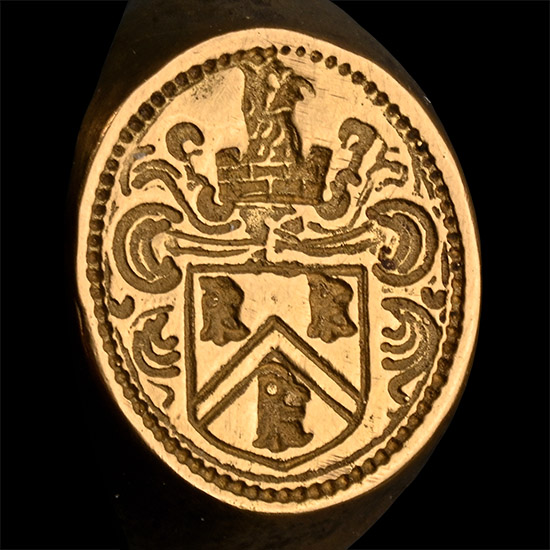
Solid 21 Carat Gold Replica of the Colman Family Armorial Signet Ring
21st century A.D.Estimate: £1,200 - 1,700 (+bp*)
Opening Bid: £600
A copy of a 16th-17th century ring found near Lomond, Scotland, belonginging to the Colman family of Brent Eleigh, Suffolk. 12.68 grams, 21.95 mm overall, 18.86 mm internal diameter (approximate size British R 1/2, USA 8 3/4, Europe 19.38, Japan 18)
From the collection of a London gentleman. -
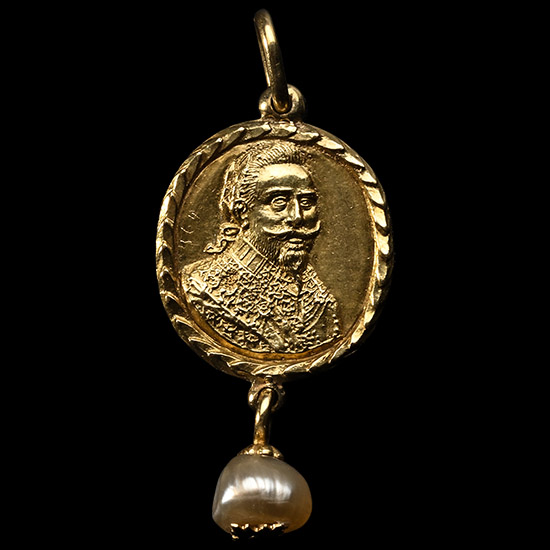
Post Medieval Gold and Enamel Supporters’ Medal of Gustavus II Adolphus of Sweden
German, circa 1631 A.D.Estimate: £1,500 - 2,000 (+bp*)
Bids: 1 | Current Bid: £1,010
Pendant medal with a three-quarter portrait bust of Gustavus II Adolphus wearing royal dress and a laurel crown, enclosed within a laurel border, the reverse decorated in black champlevé enamel and inscribed: 'ADOLPHUS GUSTAVUS, GOTT MIT UNS' meaning 'Adolphus Gustavus, God with us'; a baroque pearl suspended from a loop beneath the medal, with a suspension bail above. 4.32 grams, 37 mm
Acquired on the European art market. UK, private collection.
The pendant belonged to the supporters’ jewellery associated with the Swedish king’s campaigns during the Thirty Years’ War. -
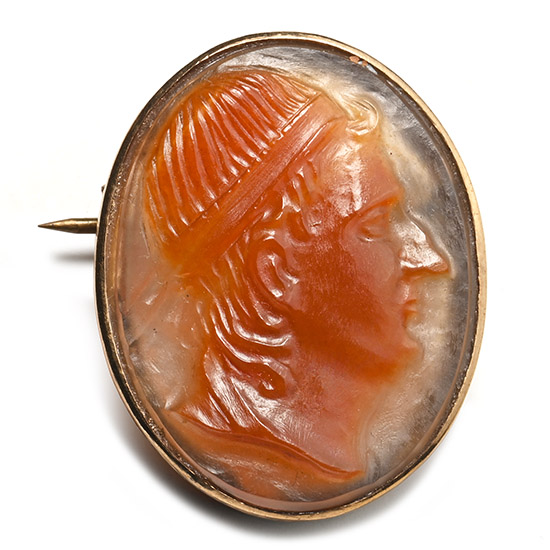
Frederician Agate Cameo of a Man in Brooch
19th century A.D.Estimate: £1,500 - 2,000 (+bp*)
Opening Bid: £750
Translucent oval cameo featuring profile head of a mature man with a Roman nose, his hair arranged neatly and wearing a tainia; set in a gold brooch mount. 6.1 grams, 27 mm
Private collection, London, UK. -
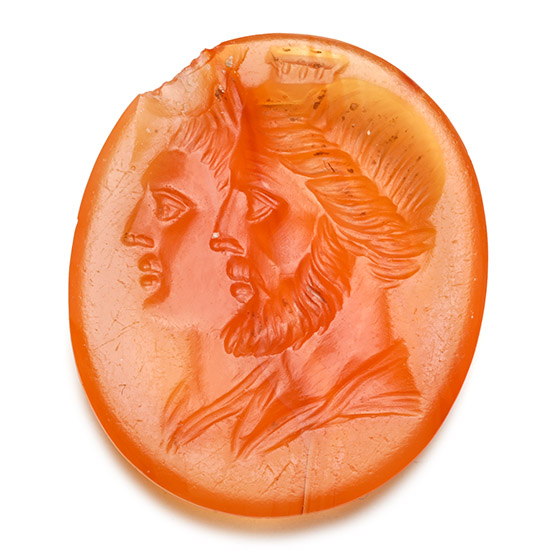
Renaissance Agate Gemstone with Serapis and Isis
16th-17th century A.D.Estimate: £1,000 - 1,400 (+bp*)
Opening Bid: £500
An oval translucent intaglio with conjoined profile busts of Serapis and Isis, the important pair of the gods in Egyptian and Hellenistic-Roman mythology, Serapis presented with a dressed beard and hair, wearing a modius crown and Isis with a lunula. 2.02 grams, 21 mm
Private collection, London, UK. -
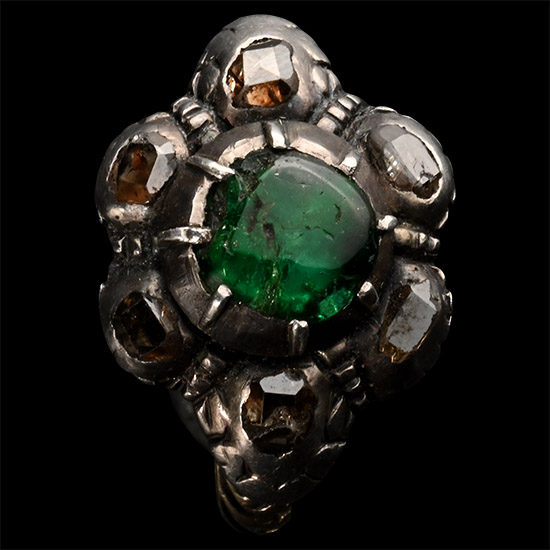
Baroque Gold and Silver Diamond and Emerald Ring
Spain, late 17th century A.D.Estimate: £1,500 - 2,000 (+bp*)
Opening Bid: £750
Comprising a silver cluster bezel centred by an emerald cabochon and surrounded by diamonds, the reverse of the bezel enamelled with white and black enamel, and the setting resting on an engraved gold hoop with remains of black enamel. 4.79 grams, 22.25 mm overall, 15.89 x 14.78 mm internal diameter (approximate size British I 1/2, USA 4 1/2, Europe 8.07, Japan 7)
Acquired on the European art market. UK, private collection. -
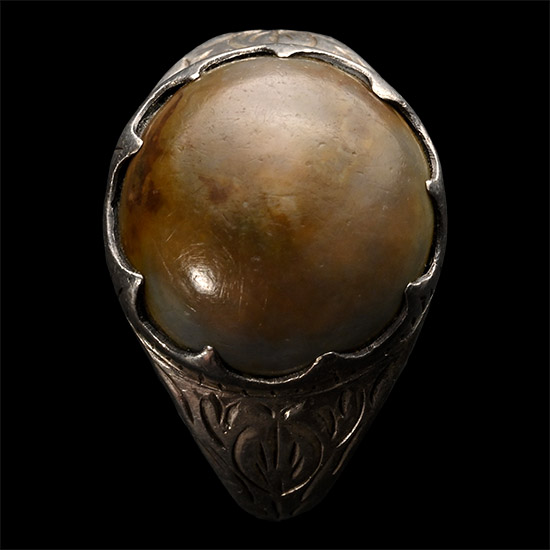
Renaissance Silver Amuletic Toadstone Ring
Western Europe, 16th-17th century A.D.Estimate: £2,000 - 3,000 (+bp*)
Opening Bid: £1,000
Substantial ring set with engraved foliate decoration on the shoulders, set with a large rounded toadstone in a lobed bezel. 9.93 grams, 30.39 mm overall, 20.34 x 19.41 mm internal diameter (approximate size British T, USA 9 1/2, Europe 21.26, Japan 20)
Acquired on the European art market. UK, private collection. This lot has been checked against the Interpol Database of stolen works of art and is accompanied by search certificate no.13490-263465.
Toadstones are fossil fish teeth historically credited with protective properties, particularly the ability to detect or counteract poison.

