-
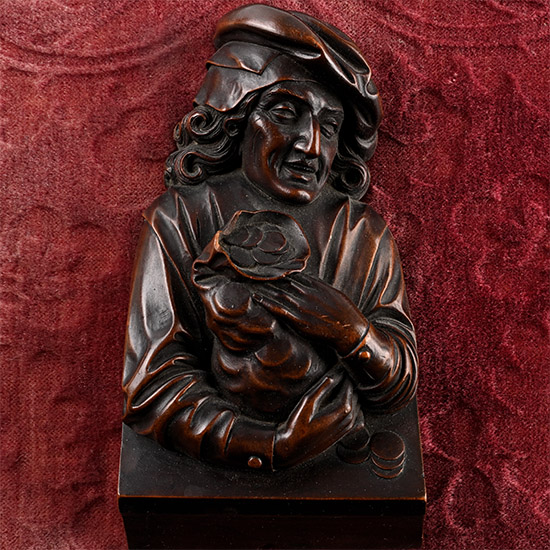
Post Medieval Wooden Bas Relief Representing a Gentleman Illustrating an Allegory of Avarice
Belgium, Antwerp, 17th century A.D.Estimate: £3,000 - 4,000 (+bp*)
Bids: 2 | Current Bid: £10
Carved in the half-round, clean-shaven man with cap and flowing hair clutching a bag of coins to his chest with more coins on the surface of the table; mounted on a velvet-covered board with faux-shell detailing to the frame. 689 grams, 33.5 x 27.1 cm
Private collection, Spain, 2024. This lot has been checked against the Interpol Database of stolen works of art and is accompanied by search certificate no.13546-262841.
In the historical context of the Netherlands and Flanders (particularly during the 16th and 17th centuries), the depiction of the seven deadly sins was a central theme in moralising and satirical art. The allegory of Avarice was frequently represented in paintings, as well as in sculptures and wooden bas-reliefs intended for furnishings, architectural panels, or private collections. -
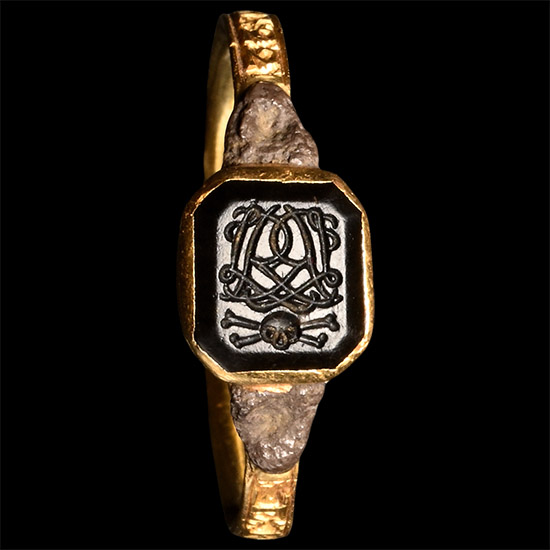
Post Medieval Gold Mourning Ring with Skull
England, dated 1725 A.D.Estimate: £2,500 - 3,500 (+bp*)
Opening Bid: £1,250
With a chased hoop engraved externally: 'L: ROGERS.OB:19.AUG:1725.AET:22', fluted octagonal bezel set with an onyx intaglio engraved with an intertwined LR monogram and a skull and crossbones, triangular shoulders with small silver settings. 2.30 grams, 21.23 mm overall, 18.06 x 15.80 mm internal diameter (approximate size British N 1/2, USA 6 3/4, Europe 14.35, Japan 13)
Acquired on the European art market. UK, private collection. This lot has been checked against the Interpol Database of stolen works of art and is accompanied by search certificate no.13499-263472.
The memento mori jewellery of the 16th-18th centuries served as wearable ‘reminders of mortality’. Typical motifs within this genre included skulls, skeletons, crossbones, hourglasses, coffins, the gravedigger’s pick and shovel, and various other emblems of death and decay. -
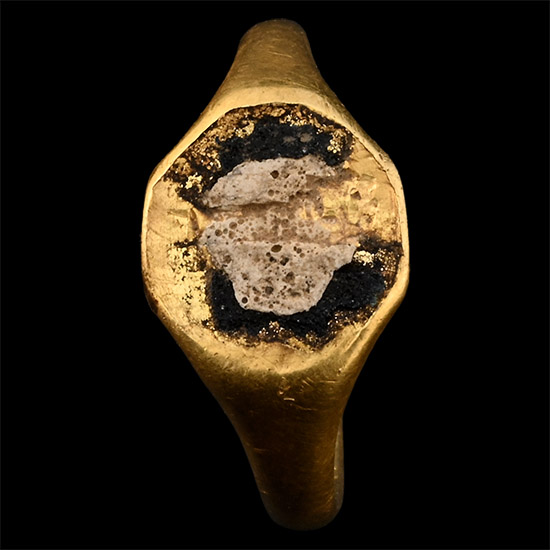
Post Medieval Enamelled Gold Recusant 'Death’s-Head' Memento Mori Ring
England, late 16th–early 17th century A.D.Estimate: £3,500 - 4,500 (+bp*)
Opening Bid: £1,750
With an octagonal bezel centred by a white enamel skull against a black enamel ground, the interior of the hoop engraved in italic script: 'OREMUS PRO FIDELIBUS DEFUNCTIS' for 'Let us pray for the faithful departed'. 3.43 grams, 19.44 mm overall, 16.81 mm internal diameter (approximate size British M, USA 6, Europe 12.46, Japan 12)
Acquired on the European art market. UK, private collection. This lot has been checked against the Interpol Database of stolen works of art and is accompanied by search certificate no.13509-263388.
The prayer for the faithful departed gives the ring its Catholic devotional character. -
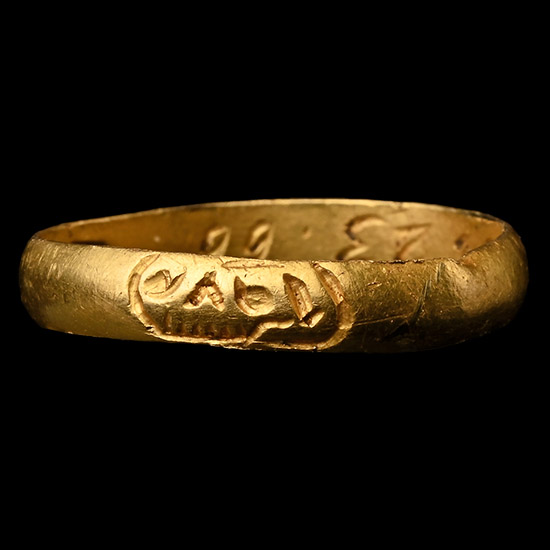
Post Medieval Gold Memento Mori Skull Ring
England, Kent, dated [17]66 A.D.Estimate: £500 - 700 (+bp*)
Opening Bid: £250
The hoop plano-convex in section with impressed stylised skull to the outer face; inscribed to inner face 'EP Jan 23 66' and punched maker's mark 'IV' in an incuse rectangle. 2.01 grams, 18.57 mm overall, 16.70 mm internal diameter (approximate size British L 1/2, USA 6, Europe 11.87, Japan 11)
From a UK collection formed in the 1980s. Property of an Essex, UK, gentleman. -
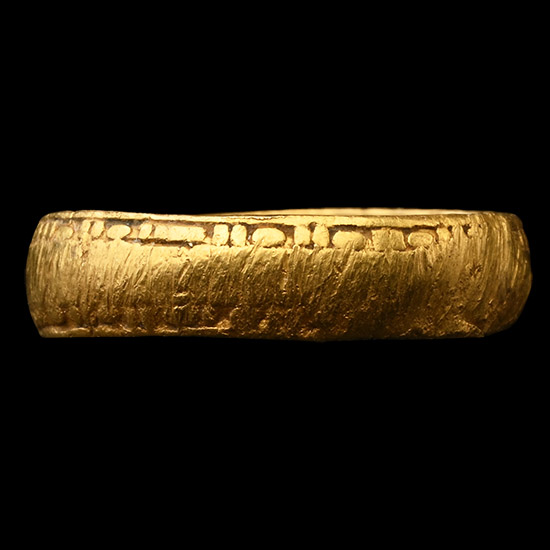
Post Medieval 'My choice is my Delight' Decorated Gold Posy Ring
England, Norfolk, late 17th-early 18th century A.D.Estimate: £500 - 700 (+bp*)
Opening Bid: £250
D-shaped in cross-section, the exterior decorated along each edge with a sunken groove with counter-relief ovals set longitudinally, alternating with pairs of smaller ovals set transversely to the groove, resembling a dotted line, but with hints of classical bead-and-reel ornament; between the two, along the centre of the hoop, a shallowly sunken area filled with closely set counter-relief C-shapes; the interior with a neatly engraved inscription in lower-case italic lettering, reading 'My choice is my delight'; straightened. 1.83 grams, 16.01 mm overall, 14.05 mm internal diameter (approximate size British F, USA 2 3/4, Europe 3.67, Japan 3)
Found whilst searching with a metal detector near Wood Norton, Norfolk, UK, by Steven Leeder, on Tuesday 2nd April 2024; recorded as a find of potential Treasure and subsequently disclaimed by the Crown. Accompanied by a copy of the British Museum's Portable Antiquities Scheme (PAS) report no.NMS-BD2246. Accompanied by a copy of the Report of a find of potential Treasure for H M Coroner no.2025 T169. Accompanied by a copy of a letter from the British Museum stating: 'On behalf of the Secretary of State for Culture, Media and Sport, I am writing to inform you that the Crown's interest in this find has been disclaimed'.
The Portable Antiquities Scheme (PAS) states: 'This precise posy (or motto) does not appear to have been yet recorded on the PAS database, although the variants In thy sight is my delight, In thee my choice I do rejoice and particularly I like my choice are well known. The subtle decoration of several concentric bands of geometric ornament on the outside of the hoop is also very unusual in a posy ring, but can perhaps be paralleled by LEIC-B3CF79, YORYM-B0EB9B and YORYM-2A5351 (all with inscriptions in capitals).' -
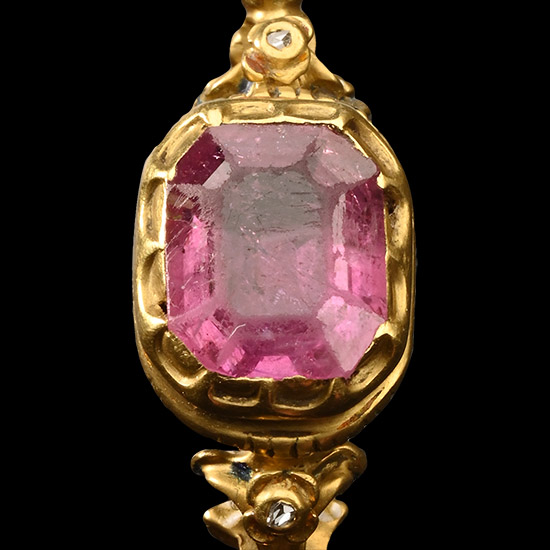
Renaissance Gold Ring with Foiled Ruby Gemstone
France, 16th-17th century A.D.Estimate: £4,000 - 6,000 (+bp*)
Opening Bid: £2,000
D-section slender hoop with openwork floral shoulders set with small diamonds, an octagonal bezel with piecrust edge, set with a foil-backed ruby. 6.00 grams, 23.42 mm overall, 16.64 x 17.76 mm internal diameter (approximate size British L, USA 5 3/4, Europe 11.24, Japan 10)
Private collection of a North London lady before 2000. Property of a London, UK, gentleman. This lot has been checked against the Interpol Database of stolen works of art and is accompanied by search certificate no.13545-263670.
This ring design appeared during the 16th-17th centuries with varying decorative elements. The foliage and the ‘fleurs-de-lis’ motif can be dated to the 2nd half of the 16th century A.D. -
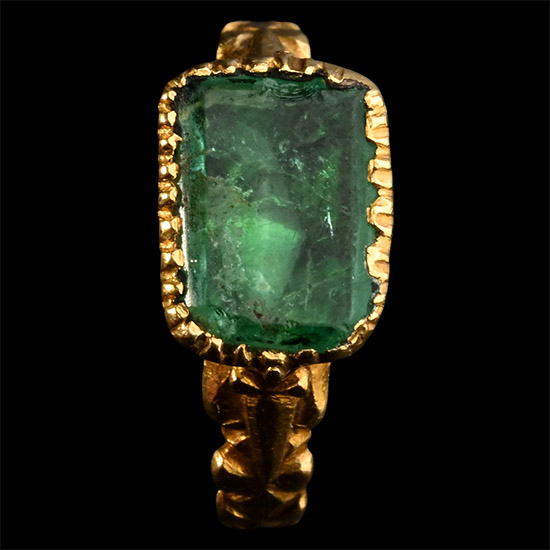
Renaissance Gold Ring with Emerald
Probably South Germany, circa 1570–1590 A.D.Estimate: £1,500 - 2,000 (+bp*)
Opening Bid: £750
Set with a rectangular table-cut emerald in a raised box collet, small petal-shaped projections surrounding the stone, creating a flower-like setting, the bezel supported by chased and pierced foliate scroll shoulders projecting from a slender hoop. 4.26 grams, 26.19 mm overall, 16.36 x 17.38 mm internal diameter (approximate size British L, USA 5 3/4, Europe 11.24, Japan 10)
Acquired on the European art market. UK, private collection.
The combination of the projecting floral collet, table-cut stone and vegetal shoulders corresponds to late sixteenth-century South German rings, including an emerald ring with a Blütenfassung, or flower setting, in the Bayerisches Nationalmuseum. Bayerisches Nationalmuseum, T 4298. -
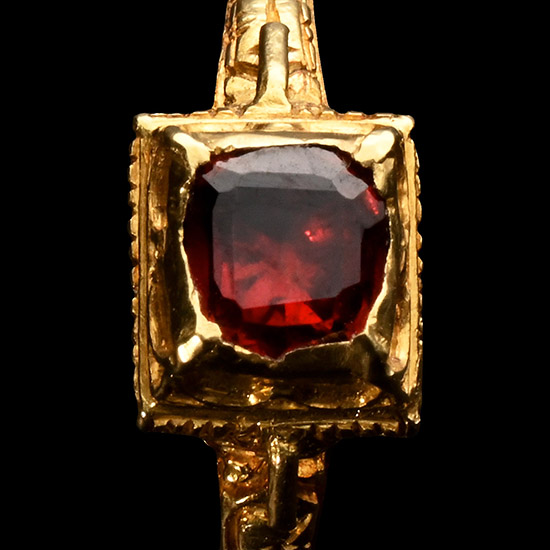
Renaissance Gold Ring with a Table-Cut Garnet
Western Europe, late 16th century A.D.Estimate: £1,500 - 2,000 (+bp*)
Opening Bid: £750
Comprising a slender hoop with fluted shoulders terminating in small plaques, one plaque with the letter 'G' and the other with 'I'; rectangular collet setting with a table-cut deep-red garnet. 4.98 grams, 25.90 mm overall, 19.01 x 18.17 mm internal diameter (approximate size British R, USA 8 1/2, Europe 18 3/4, Japan 18)
Acquired on the European art market. UK, private collection. -
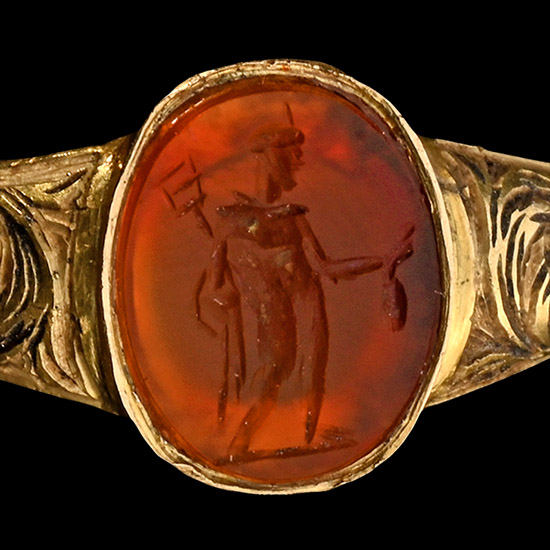
Stuart Period Gold Ring with Roman Carnelian Gemstone of Mercury
Circa 17th century A.D., intaglio 1st-2nd century A.D.Estimate: £1,800 - 2,400 (+bp*)
Opening Bid: £900
With intricately engraved shoulders, with floral design, filled with the remains of black enamel; the bezel with a discoid intaglio standing figure of Mercury in profile, with marsupium in one extended hand and caduceus supported in the crook of the other arm with chlamys draped from the shoulder. 2.87 grams, 24.61 mm overall, 18.76 x 21.81 mm internal diameter (approximate size British T, USA 9 1/2, Europe 21.26, Japan 20)
Ex Peter Szuhay, Mayfair, London, UK. Private collection, 1980s. Acquired on the UK art market. Private collection, London, UK. This lot has been checked against the Interpol Database of stolen works of art and is accompanied by search certificate no.13487-262460.
On such gems, the god is usually depicted standing, with his head in profile and accompanied by his attributes: he holds a purse, a marsupium, in one hand, while the caduceus is tucked under his arm, wrapped in his cloak. Mercury was the patron of commerce and merchants, but also of thieves; the purse represented profit. -
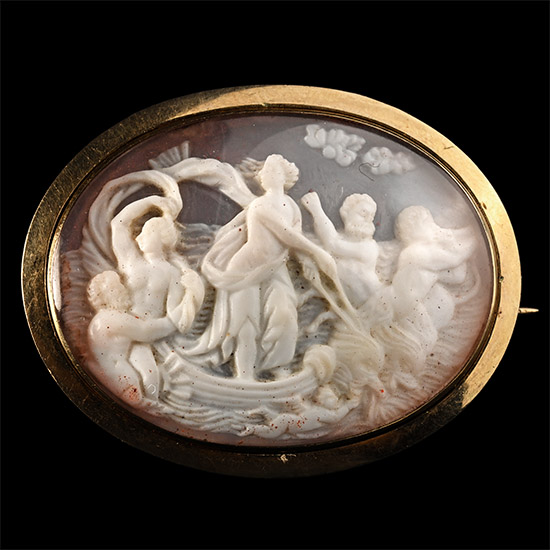
Renaissance Shell Cameo of the Triumph of Galatea, after Raphael, in a Later Gold Brooch
Circa 1530–1560 A.D.Estimate: £1,800 - 2,400 (+bp*)
Opening Bid: £900
An oval cameo carved in high relief in shell, with opaque white figures against a pale greylilac ground, depicting the Triumph of Galatea, the composition centring on the partially draped sea nymph standing in a shell-shaped marine chariot, surrounded by a closely arranged procession of Tritons, Nereids and fantastic sea creatures, on the left, a marine figure and companion incorporated among the curling drapery and sea forms; immediately to the right of Galatea a prominently modelled bearded Triton, while a further male marine figure projecting forwards at the far right, the curved, ribbed vehicle beneath the principal figure represents her shell chariot; the small forms in the upper field may represent remnants of the airborne putti included in the engraved compositions; the cameo enclosed beneath a high convex glass cover in a plain gold brooch mount, a narrow bezel around the oval perimeter, and a long projecting brooch pin, the gold mount probably British, early 19th century. 11.6 grams, 40 mm
Acquired on the European art market. UK, private collection. This lot has been checked against the Interpol Database of stolen works of art and is accompanied by search certificate no.13507-263384.
The subject derives from Raphael’s Triumph of Galatea, painted for Agostino Chigi at the Villa Farnesina in Rome around 1512. Raphael represented Galatea amid a marine procession of Tritons and Nereids, combining classical imagery with a treatment of the subject associated with Angelo Poliziano’s Stanze per la Giostra. The composition was rapidly disseminated through prints, which made it available to artists and craftsmen working beyond Rome. Uffizi Galleries, The Triumph of Galatea. The Royal Collection preserves an Italian cameo, dated to the late 16th century, depicting a putto in a shell-shaped chariot drawn through the waves by a Triton carrying a Nereid. That cameo was subsequently placed in an 18th-century mount. It provides a related example for both Renaissance marine imagery and the later mounting of an earlier carving as a jewel. Royal Collection Trust, Putto, Triton and Nereid, RCIN 43770. The present cameo combines an ambitious multifigure relief with a composition derived from Raphael’s Galatea and its engraved adaptations. -
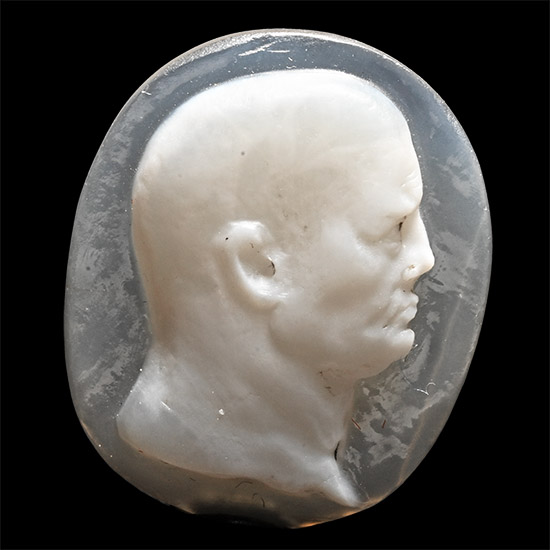
Renaissance Agate Cameo with Male Portrait
16th century A.D.Estimate: £700 - 900 (+bp*)
Opening Bid: £350
Translucent oval cameo with a mature male bust with short hair and deep frown lines on his forehead, stern expression, likely depicting an emperor or a ruler, possibly after Vespasian or Titus models. 1.16 grams, 17 mm
Private collection, London. -
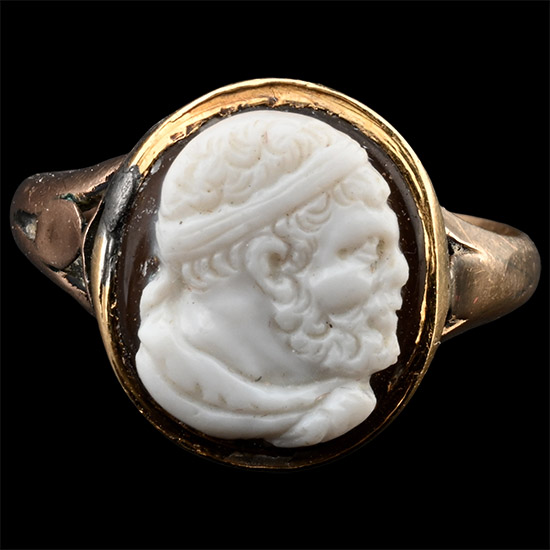
Renaissance Sardonyx Cameo of a Bearded Man in a Later Gold Ring
Probably Europe, circa 16th century A.D.Estimate: £800 - 1,000 (+bp*)
Opening Bid: £400
An oval cameo carved in high relief with the right-facing profile bust of a bearded man wearing a broad fillet or headband, a prominent nose, curled hair and a closely worked beard; the carving using the pale upper layer of the stone for the head and bust, contrasting with the darker ground beneath; set in a later, probably 19th-century, gold ring with a plain oval bezel, tapering shoulders and an openwork underside. 2.27 grams, 20.71 mm overall, 15.61 x 15.46 mm internal diameter (approximate size British I 1/2, USA 4 1/2, Europe 8.07, Japan 7)
Acquired on the European art market. UK, private collection.

