-
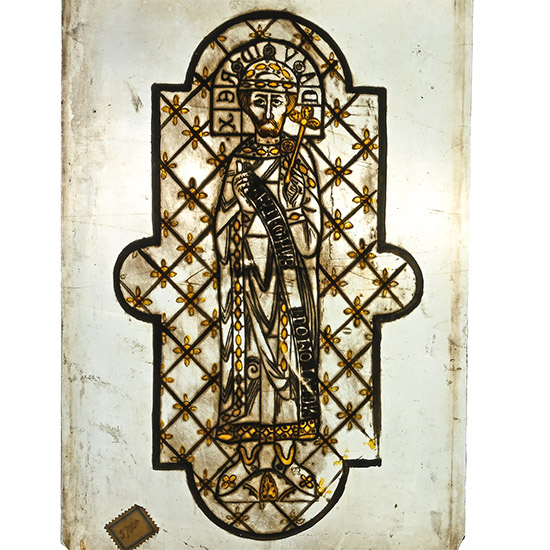
Medieval Stained Glass Panels with Saint Catherine and King David
Circa 1500 A.D.Estimate: £400 - 600 (+bp*)
Bids: 1 | Current Bid: £5
Comprising: one panel depicting Saint Catherine robed, standing and holding a wheel in her raised hand, a field of fretwork with quatrefoils; the other fragmentary panel with a similar background, with King David standing, supporting a scroll bearing the inscription 'Beati qui habitant in domo tua, Domine' Psalm 84:5 (Vulgate: Psalm 83:5), which translates as: 'Blessed are those who dwell in your house, Lord' and an arch around the head with the legend 'DAVID REX'. 380 grams total, 26 cm each
Auktionen in Heildelberg, 9 July 2026. -
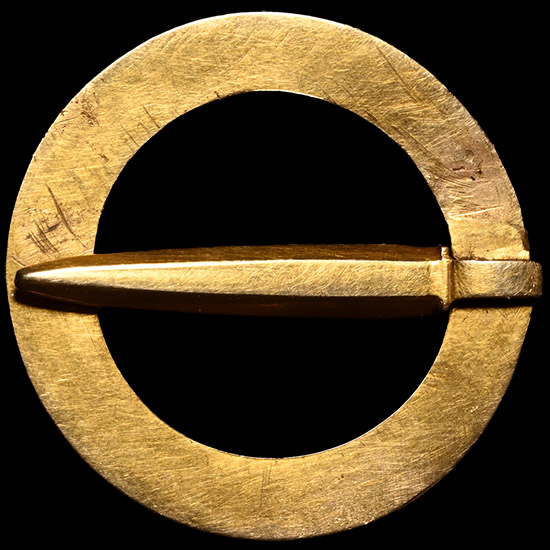
Large Medieval Solid Gold Annular Brooch
1400-1500 A.D.Estimate: £1,800 - 2,400 (+bp*)
Opening Bid: £900
Composed of an annular frame with a rectangular cross-section and flat upper and lower surfaces; the pin retained and in the form of a rectangular loop with a hexagonal-sectioned shaft; on the upper face of the pin, at the junction of the loop and shaft a raised transverse ridge; along the outer edge a visible join where the loop of the pin is folded around the frame, no constriction of the frame to accommodate the pin. 16.16 grams, 29 mm
Found whilst searching with a metal detector in North Northamptonshire, UK, on 6th April 2024; declared as Treasure under the Treasure Act with reference no.2024 T473, subsequently disclaimed by the Crown and returned to the landowner. Accompanied by a copy of the British Museum's Portable Antiquities Scheme (PAS) report no.NARC-2ADEC8. Accompanied by a copy of the Report on Potential Treasure for H M Coroner from Stoke Albany, Northamptonshire. Accompanied by a copy of a letter from The British Museum on behalf of the Secretary of State for Culture, Media and Sport, informing that the Crown's interest in this find has been disclaimed. This lot has been checked against the Interpol Database of stolen works of art and is accompanied by search certificate no.13455-260884.
A similar example has been recorded on the Portable Antiquities Scheme database, IOW-506491(2013-T72), and has been processed as Treasure, dating to the 15th-16th centuries. The thickness of the cross-section of the object is uncommon for Medieval annular frames, and the Isle of Wight example is extensively decorated, while this example is plain. In terms of form, this example is also similar to a copper-alloy example from York (YORYM1458), which, while similar in plan and section, is decorated with an engraved inscription. -
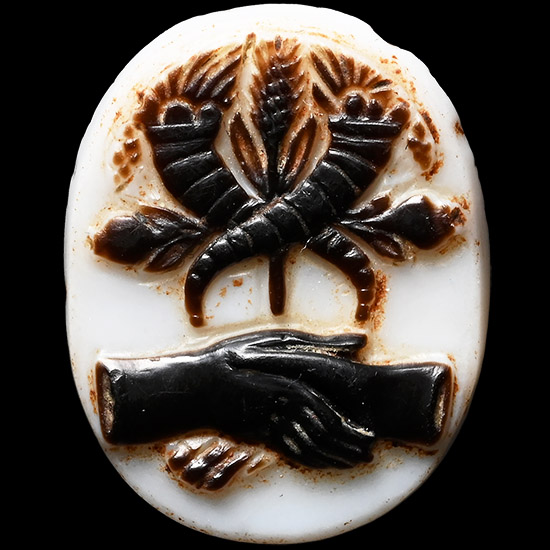
German Hohenstaufen Period Gemstone with Clasped Hands and Cornucopiae
13th century A.D.Estimate: £1,000 - 1,400 (+bp*)
Bids: 1 | Current Bid: £5
Oval intaglio with finely modelled clasped hand motif, dextrarum iunctio, above two cornucopiae crossed in front of an ear of wheat. 0.85 grams, 15 mm
Private European collection, 1990s. -
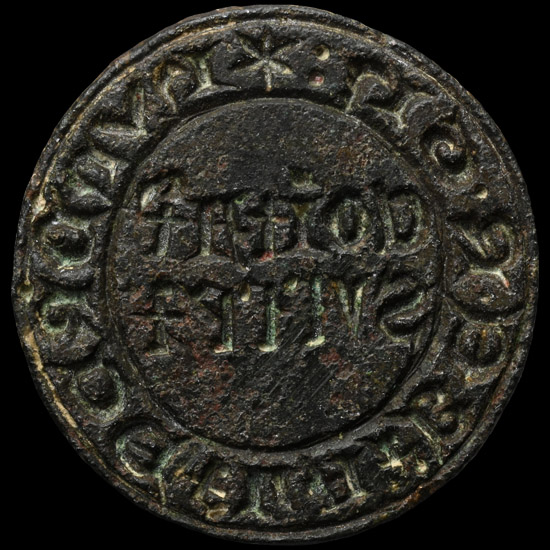
Medieval Bronze Official Flexborough Hundred Constable's Seal Matrix
England, East Sussex, circa 1350-1400 A.D.Estimate: £600 - 800 (+bp*)
Opening Bid: £300
Comprising a pierced trefoil terminal with a drilled circular pit above; flat-topped hexagonal pedestal with collar, the body of the matrix flaring to the circular die with orientation notch; the retrograde legend '* hVnDR DE FLAXBERGh' around the circumference of the die, and tondo with inscription in two registers 'COitat SVSSEX'; file marks on the trefoiled loop. 35.6 grams, 36 mm high
Found near Lewes, East Sussex, UK, in August 2024. Accompanied by a copy of the British Museum's Portable Antiquities Scheme (PAS) report no.SUSS-99E46F.
This is an official seal matrix used for labourers' passes from the hundred of Flexborough in the Rape of Pevensey, Sussex, which incorporated the ancient parishes of East Batchington, South Heighton and Seaford. Another official seal for the hundred of Foxearle in the Rape of Hastings is recorded on the PAS Database (SUSS-D8F8D5), which notes that the seals were probably used by the Constables, amongst whose duties were keeping the peace and, from the 14th century, providing passes for workmen seeking work beyond their own hundred. In 1285, King Edward I of England passed the Statute of Winchester, which 'constituted two constables in every hundred to prevent defaults in towns and highways'. Constables were unpaid and usually elected locally. Harvey and MacGuiness (1996:41) note: 'The Statute of Cambridge in 1388 ordered that labourers moving from the area where they lived should be given a pass sealed by someone appointed by the local justices of the peace, and describing the seal's design - it should name the county around the edge and the hundred, wapentake or town across the centre. (ibid: fig:35). Three years later sheriffs were ordered to have these seals made at once'. They quote 6 examples of surviving matrices (p.42), and others exist including three from Norfolk and two from Suffolk (Ashley and Richardson 1998). This example and the other Sussex example, SUSS-D8F8D5, name the county and hundred as required but reverse the arrangement laid out in the statute and seen on other seals, which have the county in the middle and the hundred around the edge. Research by Christopher Whittick in the archives of Battle Abbey has also identified a document bearing a seal for Battle Hundred which is similar in design to this example, with the county name in the middle and the hundred name around the edge. Unusually, the seal was used on a private charter dated 1361, which suggests Sussex hundreds were using standardised seals a generation before the statute of 1388. It also raises interesting questions about whether the existence of seals such as this influenced the 1388 statute. -
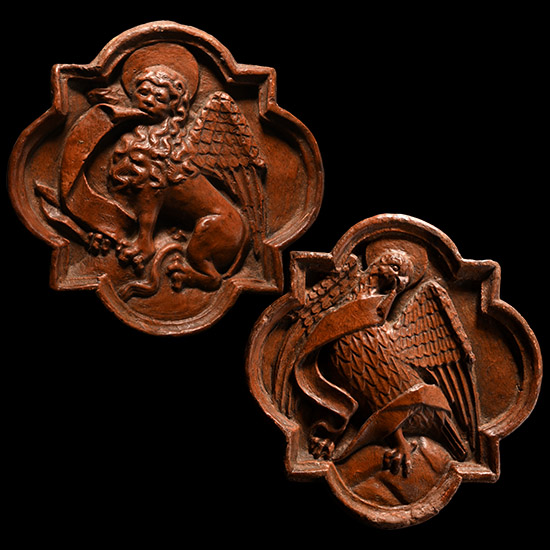
Medieval Red Clay Quatrefoil Tiles Decorated with Symbols of Saint John and Saint Mark
Circa 1500 A.D.Estimate: £1,000 - 1,400 (+bp*)
Opening Bid: £5
Comprising a pair of quatrefoil-shaped tiles, each with raised border and high-relief motif of an animal; one with a seated winged lion with a halo and a scroll representing Saint Mark; other with an eagle with a halo and a scroll representing Saint John. 2.53 kg total, 22.5 cm each
Private collection near Avignon, France. -
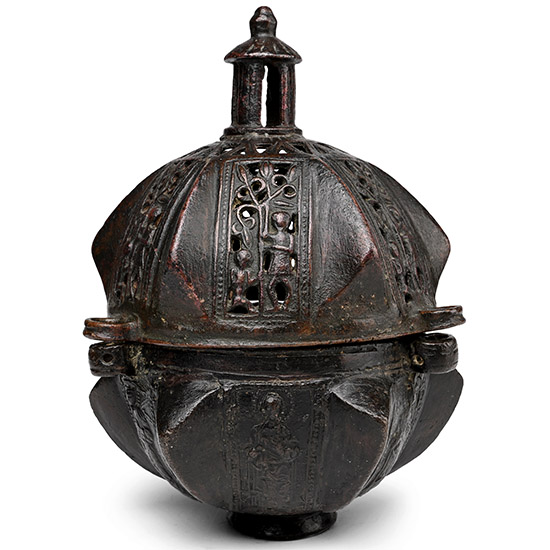
Medieval Bronze Incense Burner
Germany, circa 1200 A.D.Estimate: £2,000 - 3,000 (+bp*)
Bids: 2 | Current Bid: £10
Hollow-formed two-part casting; base cup-shaped with basal ring and six radiating flanges with nimbate figures between, three rings to the rim; cover of similar shape with rings and flanges, openwork interstitial panels each with a tall standing figure beside a shorter one with vegetation, at the apex a slotted tube and knop finial. 686 grams total, 15.3 cm high
Collection of Melissa Minervino Gabardi (1943-2021), Milan. This lot has been checked against the Interpol Database of stolen works of art and is accompanied by search certificate no.13510-262838.
Since early Christian times, the burning of incense during church services has symbolised prayers rising to heaven, which was particularly visible in the Eastern Liturgy. The censer's architectural form is enriched by the animal and human figures that adorn its surface. -
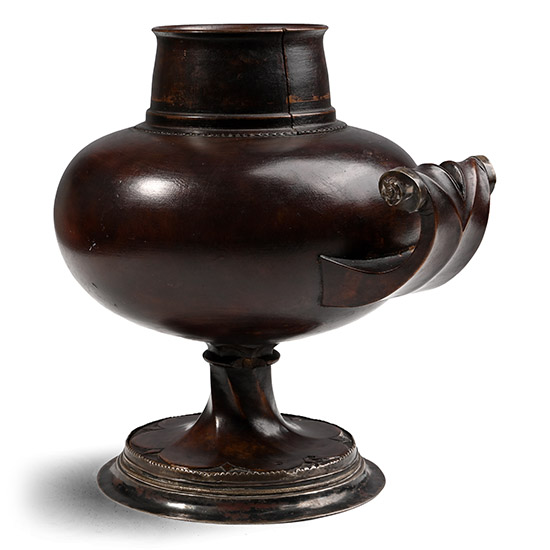
Medieval Boxwood Drinking Cup with Gilt Copper Fittings
Southern Germany, circa 1500 A.D.Estimate: £3,000 - 4,000 (+bp*)
Bids: 2 | Current Bid: £10
Turned wooden vessel with tiered foot, twisted fluting to the stem, globular body with scrolled ledge handle, slightly tapering neck and everted rim to the mouth; with old collector's note in German dated 1914. 440 grams, 20 cm high
Pfyffer von Altishofen (1914), a well known family in central Switzerland. This lot has been checked against the Interpol Database of stolen works of art and is accompanied by search certificate no.13539-262846.
This small wooden cup from Germany, dating to around 1500 AD, represents the fascinating transitional period from the late Gothic to the early Renaissance. During this era, the function of such small cups shifted from that of purely portable, sturdy travel containers to that of prestigious art objects intended for the more settled burgher and noble classes. -
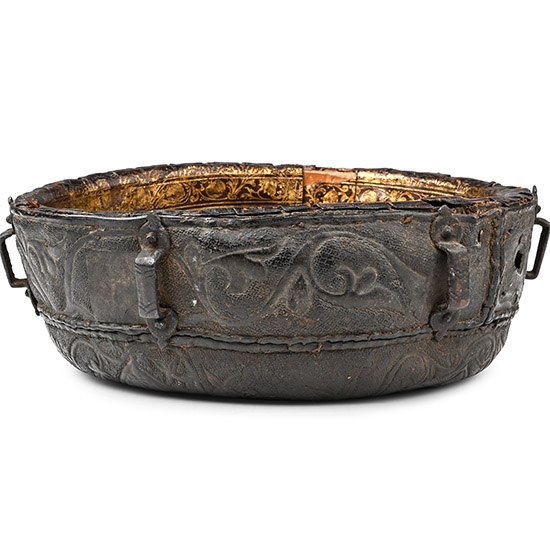
Medieval Part of a Circular Box with Embossed Leather
15th century A.D.Estimate: £600 - 800 (+bp*)
Bids: 1 | Current Bid: £5
Discoid in plan with applied decorative plates to the sidewall; cuir bouilli panels to the outer face with reserved fronds and tendrils on a pounced field, central roundel with agnus dei and four radiating heater-shaped lobes with heraldic designs - crossed keys, field of fleurs-de-lys, lion rampant and plain chief (upper panel); below the rim, six of original seven rectangular brackets; inner face with later sheet-bronze lining bearing printed gilt designs; old collector's label to inner base with indistinct legend end ing '...Lille'. 545 grams, 23 cm wide
By repute, collection of Andre (1875-1949) and Maria (1887-1947) Larminet-Davioud, Lille. By descent to Georges Davioud (1927-2014), Lille. By descent to his heirs, and sold at their sale, Pierre Berge, Paris, 27th January 2021. -
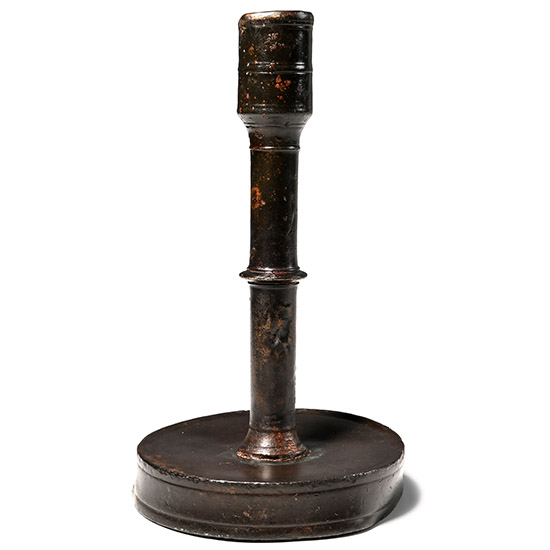
Large Medieval Bronze Candlestick
England, Kent, circa 13th-15th century A.D.Estimate: £800 - 1,000 (+bp*)
Opening Bid: £400
Comprising a squat hollow-formed base with linear detailing to the sidewall, tubular stem with biconvex collar, tubular socket with horizontal linear ornament. 232 grams, 14 cm
Found Romney Marsh area, Kent, 1990-2015. Property of a Kent gentleman, a specialist medieval collector.

