-
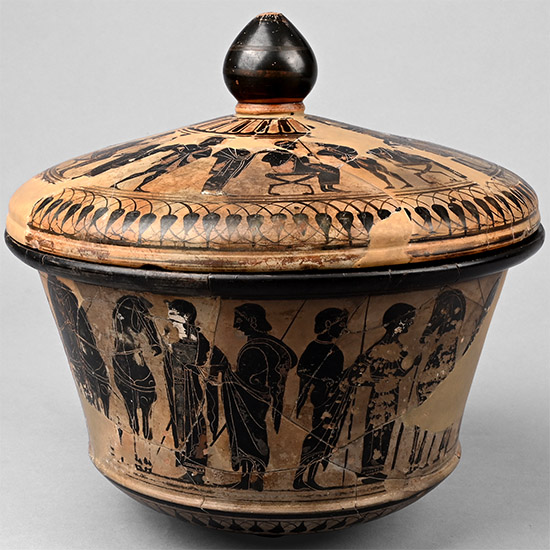
Greek Terracotta Black-Figure Pyxis with Chariot
Attic, 6th century B.C.Estimate: £30,000 - 40,000 (‡+bp*)
Opening Bid: £16,667
Squat vessel with rounded foot and carination with band of tendrils, flared sidewall with carination and rim, broad watchglass lid with central knop handle; blackware frieze to the sidewall, chariot with four horses and attendants carrying spears and dressed in chitons and himatia, among them a noblewoman dressed in a long chiton and chlamys; lid with frieze of profile figures seated on folding chairs with attendants and petitioners, and two women in long robes within a band of coiled tendrils; repaired and restored. 1.05 kg, 22.5 cm wide
Private collection, Mrs Lambelet, Neuchâtel, Switzerland, acquired before 1972; thence by descent. Private collection N.S., acquired in 2012. Accompanied by an academic report by Dr Raffaele D'Amato. This lot has been checked against the Interpol Database of stolen works of art and is accompanied by search certificate no.13223-249242.
Many Athenian vases depict a quadriga, often in racing or military scenes, but in this case, the depicted scene is peaceful and could be linked to a wedding. The painting can be divided into two scenes: the first, on the sides, is the bridal procession, where the bride is conducted in the chariot, which will bring her to the groom, accompanied by her father and relatives; the second, the lid painting, is where the nuptial feast is prepared, and the conversing guests are waiting for the bride. -
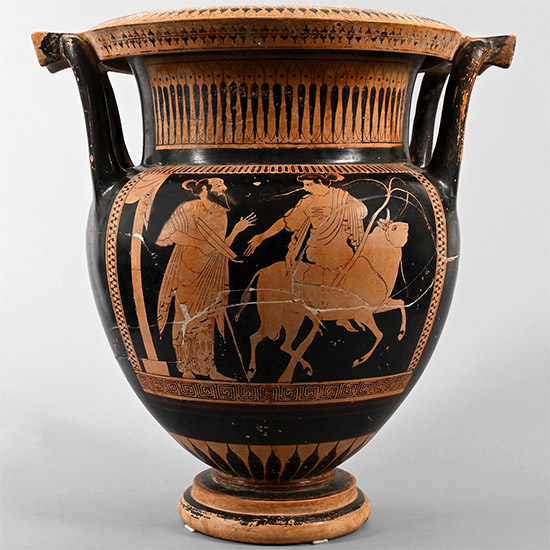
Very Large Greek Red-Figure Column Krater with Bull and Rider
Attic, 5th century B.C.Estimate: £25,000 - 35,000 (‡+bp*)
Opening Bid: £12,500
With a flared and stepped foot, poppy-head border around the lower body and neck, strap handles with palmettes to the upper faces opening to two columnar legs; red-figure scenes to the neck and body: Side A, Europa's abduction: standing bearded figure in profile wearing a loose himation holding the lid of a krater in one hand facing a female figure in draped himation revealing one breast, turning to face the male while mounted on an advancing bull and carrying a frond; Side B, Dionysiac scene: satyr standing nude, playing a lyre beside a standing robed male wearing a laurel wreath in his hair, dancing female in active pose with musical instruments in each hand, turning to face the robed figure; some restoration. 5.85 kg, 44.5 cm high
Red-figure technique, with certain details highlighted in a wine-colored hue. The surface has taken on a light yellow hue throughout. Some cracks, and the varnish is chipped in some place.
German private collection (870632). Anonymous sale, Hampel Fine Arts auction, Munich, 21 September 2012, no.625. Private collection, acquired on the German art market. Accompanied by an academic report by Dr Jacques Chamay. This lot has been checked against the Interpol Database of stolen works of art and is accompanied by search certificate no.13218-249222.
The two figurative scenes are of equal importance. The Dionysian scene depicts the god, in the centre, between a satyr playing a lyre and a dancing maenad. The other scene depicts a well-known subject: the abduction of Europa. This is the daughter of Agenor, king of Tyre in Phoenicia. Of great beauty, she is desired by Zeus. He approaches her in the form of a white bull while she is playing on the beach. Initially frightened, the young woman begins to caress the animal, then becomes more daring and climbs onto its back. Zeus immediately abducts her and rushes out to sea, toward Crete. There, he will be united with Europa, who will bear him three children, including Minos. -
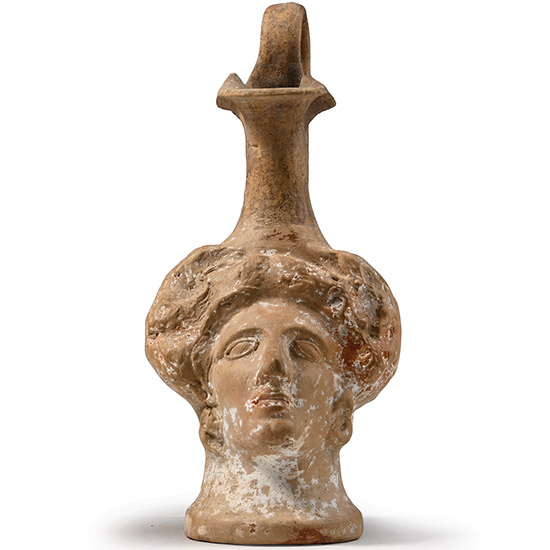
Greek Terracotta Figural Oinochoe
Circa 3rd century B.C.Estimate: £600 - 800 (+bp*)
Opening Bid: £300
The body formed as a female head with neck forming the foot of the vessel; the hair styled in a chignon and piled above the brow; pinched nose and raised lentoid eyes; the surface enhanced with white and salmon-pink pigment; the neck of the vessel emerging from the top of the head, with trefoil mouth and a tall looped handle to the rear; repaired. 443 grams, 22 cm high
From a French private collection since the 1990s. Ex Swiss private collection, Basel-Landschaft. From the Swiss private collection of M.Tritten, Binningen. Accompanied by a copy of a thermoluminescence report by Oxford Authentication no.N125b43. -
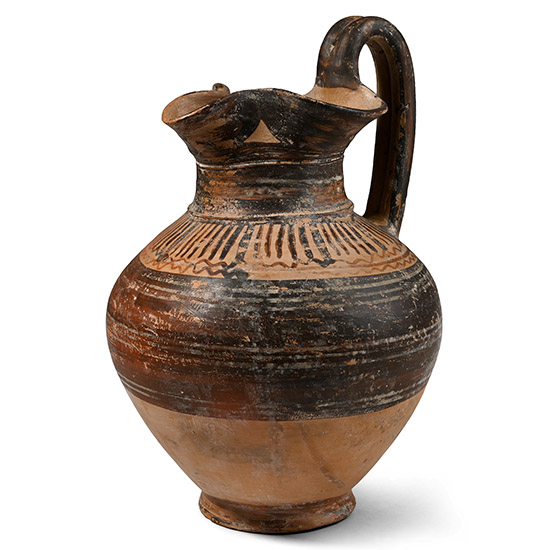
Etruscan Oinochoe with Tongue Frieze
7th-6th century B.C.Estimate: £1,500 - 2,000 (‡+bp*)
Opening Bid: £725
Bulbous in profile with a high, double-ribbed handle from the trefoil mouth to the shoulder; carinated collar above frieze of radiating tongues in glaze on the shoulder; two wavy bands on the neck, lines on the belly in opaque white. 975 grams, 27.5 cm
Ex Prof. Kurt Alder, Riehen, acquired in October 1978, from his uncle Dr Werner Alder, Lugano; thence by descent. -
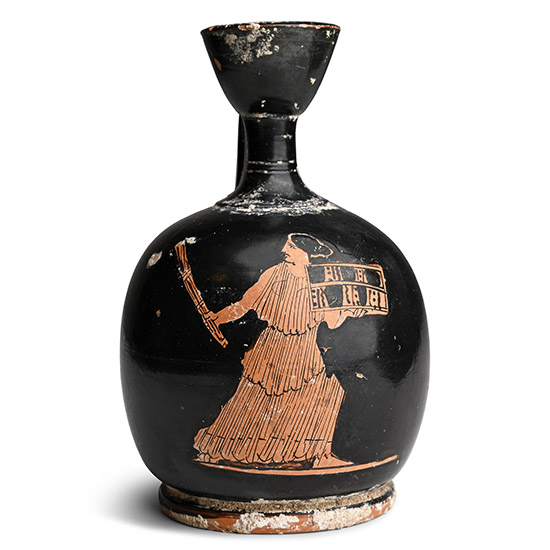
Greek Red-Figure Lekythos
Attic, 5th century B.C.Estimate: £800 - 1,000 (+bp*)
Opening Bid: £444
Squat lekythos with a highly detailed depiction of a woman running to the right, holding a torch and a decorated box, the head turned backwards. 102 grams, 11.5 cm
Property of an European gentleman, acquired before 2005 in Cologne. -
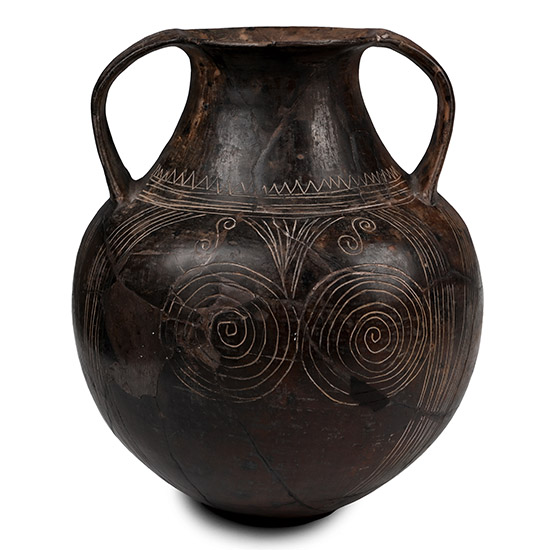
Etruscan Impasto Terracotta Spiral Decorated Amphora
7th-6th century B.C.Estimate: £1,200 - 1,700 (‡+bp*)
Opening Bid: £650
Comprising a squat bulbous body with lateral strap handles from rim to shoulder; incised decoration on both sides of spirals framed by bands of vertical and horizontal lines; a zigzag delineating shoulder and neck; reassembled from fragments with some areas of filling. 816 grams, 22 cm
Acquired from Galerie Koller, Zurich, Auction 32, November 1974, no.3699. Ex Prof. Kurt Alder, Riehen, Switzerland; thence by descent. -
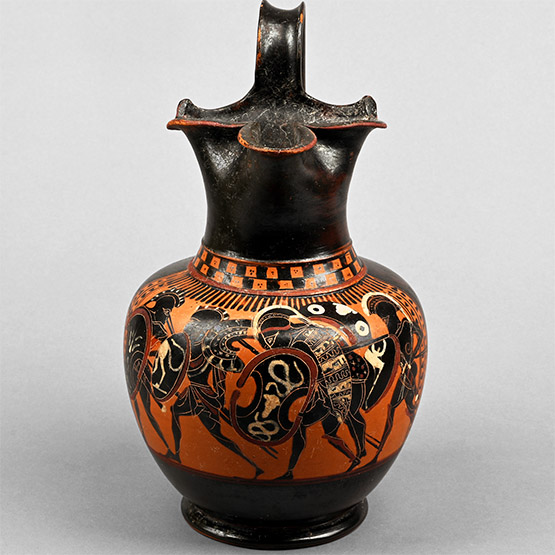
Greek Terracotta Black-Figure Oinochoe with Fighting Warriors
Attic, late 6th century B.C.Estimate: £18,000 - 24,000 (‡+bp*)
Opening Bid: £10,000
With flared foot, ovoid body, tapering neck and scooped trefoil mouth; tall gusseted strap handle to the rear; painted frieze of a phalanx of hoplites wearing crested helmets and bell-shaped armour with round aspis and eight-shaped (Boeotian) shields, knemidai greaves, long spears and scabbarded swords. 487 grams, 23.2 cm
Private Swiss collection, 1980s. Acquired on the European art market, 1992; thence by descent. Accompanied by an academic report by Dr Jacques Chamay. Accompanied by an academic report by Dr Raffaele D'Amato. This lot has been checked against the Interpol Database of stolen works of art and is accompanied by search certificate no.13220-249241.
The scene depicts a succession of warriors, marching to the left at a rapid pace. Closely packed, one behind the other, they are confined within the figurative field and extend well beyond the upper and lower edges. It is a scene taken from the Homeric poems. The style of the oinochoe is characterised by the abundant use of thick white and burgundy highlights, resulting in a striking polychrome effect. There is a tendency to extend the figures beyond the frame, due to the subject being too ambitious for the available surface. The chequerboard motif on the neck is a very rare decorative motif. The vase's importance is reinforced by its exceptional state of preservation. -
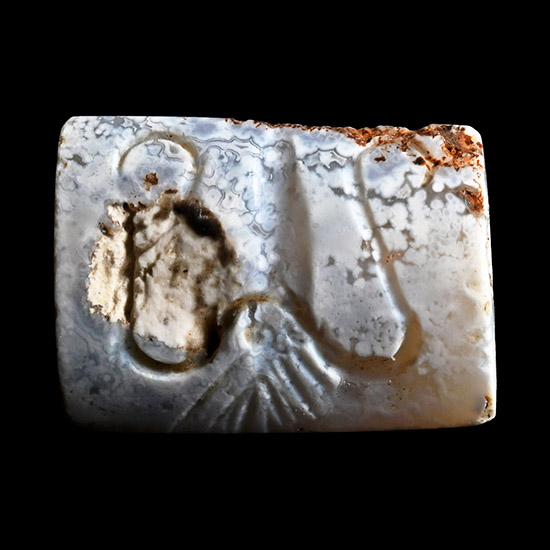
Minoan Agate Seal with Squid
2nd millennium B.C.Estimate: £3,000 - 4,000 (+bp*)
Opening Bid: £1,500
Ellipsoid in section and rectangular in plan with incuse squid motif; pierced for use as a bead, but the end-holes not joined; supplied with a museum-quality impression. 2.53 grams, 19.1 mm
Private collection, 1980s. Acquired on the UK art market. Private collection, London, UK. This lot has been checked against the Interpol Database of stolen works of art and is accompanied by search certificate no.13484-262458.
In a relatively large number of Minoan seals, it is difficult to determine unequivocally the exact type of animal depicted. Some are hybrid figures with hooves, animal legs or are posed with a frontal face. Some figures are crudely scratched in the field; others are more carefully modelled. -
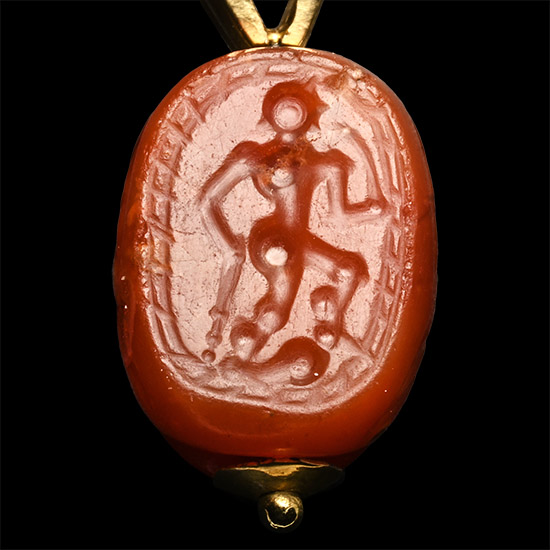
Greek Carnelian Scarab Engraved with Hercules with Later Gold Setting
Etruscan, 3rd century B.C.Estimate: £1,200 - 1,700 (+bp*)
Opening Bid: £625
With incised anatomical detailing, underside with a standing figure of Hercules, resting his hand on his club; with a later gold bar and suspension loop. 4.08 grams, 25 mm
Private collection, London. -
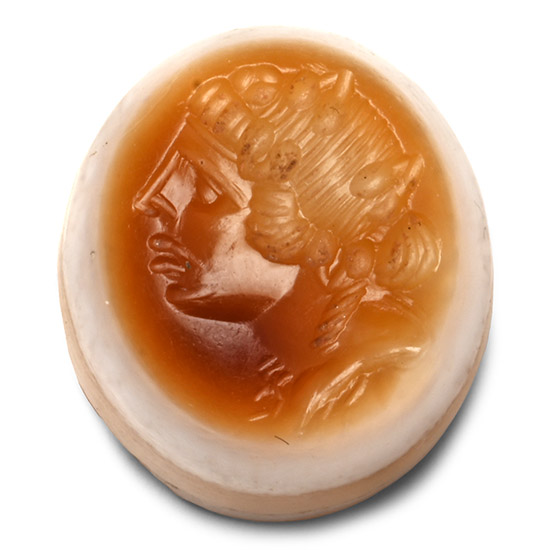
Greek Agate Gemstone with Maenad
Late Hellenistic, 1st century B.C.Estimate: £400 - 600 (‡+bp*)
Opening Bid: £180
Ellipsoid type with intaglio profile female head facing left, with parted lips and face looking slightly upwards, wearing an ivy wreath in a wavy hair bundled at the temple; supplied with a museum-quality impression. 1.25 grams, 12 mm
French art market, 2016. -
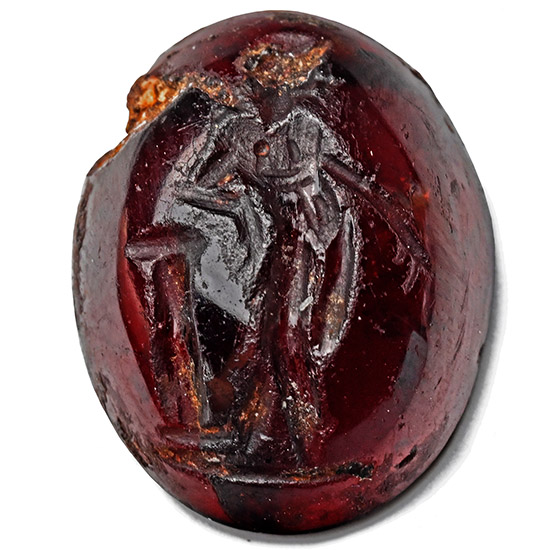
Greek Garnet Gemstone with Apollo Standing
Hellenistic, 3rd-2nd century B.C.Estimate: £600 - 800 (+bp*)
Opening Bid: £300
Ellipsoid in plan, domed with a hollow reverse; incuse figure of Hercules standing and leaning on his club. 1.21 grams, 14 mm
Private collection, 1980s. Acquired on the UK art market. Private collection, London, UK. -
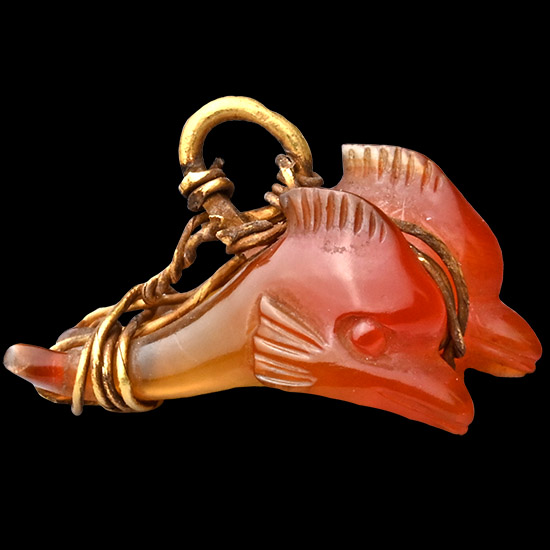
Greek Carnelian Dolphin Amulet with Gold Loops
Circa 5th-3rd century B.C.Estimate: £800 - 1,000 (+bp*)
Opening Bid: £400
Modelled in the round as two connected dolphins with finely carved facial details and fins, with a golden wire twisted around their bodies forming an attachment loop to the top. 1.73 grams, 19 mm
From the collection of a UK gentleman, London, UK, by descent from his family collection, 1970s.

