-
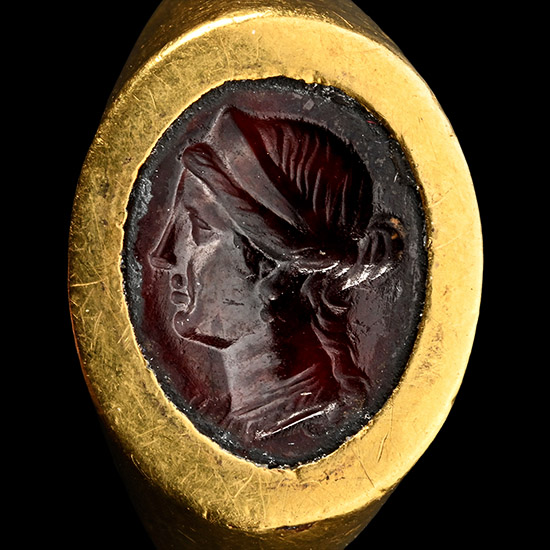
Greek Gold Ring with Garnet Gemstone with Portrait
Hellenistic, circa 1st century B.C.Estimate: £3,000 - 4,000 (+bp*)
Opening Bid: £1,400
Hollow-formed ellipsoid-section bezel and D-section hoop; inset intaglio portrait bust in profile of a young female with her hair dressed in a chignon. 4.44 grams, 22.75 mm overall, 18.40 x 16.38 mm internal diameter (approximate size British N, USA 6 1/2, Europe 13.72, Japan 13)
Private collection, 1980s. Acquired on the UK art market. Private collection, London, UK. This lot has been checked against the Interpol Database of stolen works of art and is accompanied by search certificate no.13486-262459.
The prototypes of this ring date back to the 3rd-2nd centuries B.C., as shown by dated examples from Hellenistic graves in Taranto. The type was still in use in the early centuries of the Roman era. -
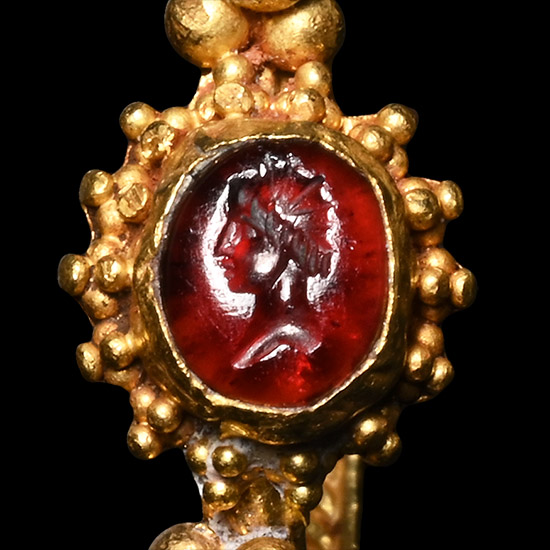
Greek Gold Ring with Garnet Gemstone with Helios
Hellenistic, 1st century B.C.Estimate: £1,500 - 2,000 (+bp*)
Opening Bid: £750
Comprising a hoop with applied twisted filigree band to the outer face, granule clusters to the shoulders, cell with granulated collar, inset cabochon with intaglio bust of Sol (Helios). 3.58 grams, 24.37 mm overall, 17.95 x 18.69 mm internal diameter (approximate size British P, USA 7 1/2, Europe 16.23, Japan 15)
Private collection, 1980s. Acquired on the UK art market. Private collection, London, UK. -
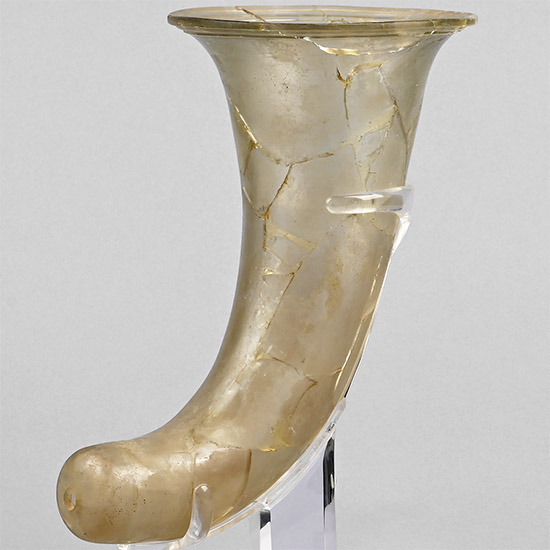
Very Large Parthian Glass Rhyton
1st century B.C.-1st century A.D.Estimate: £10,000 - 14,000 (+bp*)
Opening Bid: £5,000
With a trumpet-shaped broad end, tapering sidewalls and a thick pierced finial, accompanied by a custom-made wooden case. 718 grams, 25.5 cm
Japanese private collection, with a Japanese custom wooden box, prior to 1979. Aaron Gallery, Iran prior to 1970. Aaron Gallery, 19 September 1980. This lot has been checked against the Interpol Database of stolen works of art and is accompanied by search certificate no.12798-241349.
Rhyta, typically terminating in a zoomorphic or divine protome, were used as ceremonial drinking vessels, reflecting a close association with libation and purification rites. -
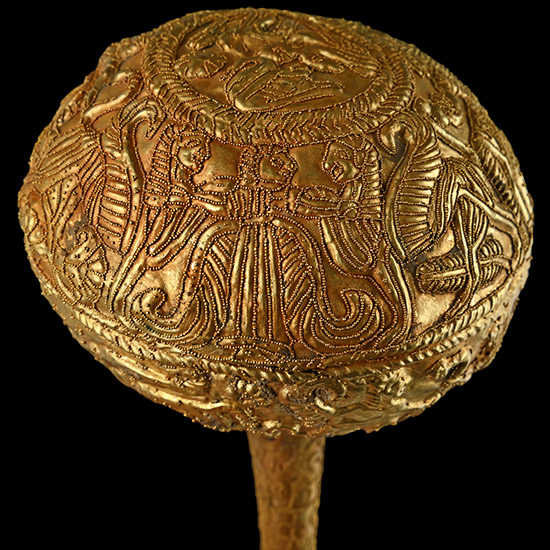
Large Greek Gold Repoussé Dress Pin with Figural Scenes
Archaic, circa 6th century B.C.Estimate: £5,000 - 7,000 (+bp*)
Bids: 5 | Current Bid: £50
Composed of a round-section stem tapering to a point (chipped), the upper section with five figural panels separated by horizontal bands of granulation; each panel with figures executed in granulation including opposed pairs of rearing lions, perching bird, dancing humans, two-headed figure with fronds; below these panels, an applied gold wire loop with recurved end; above, a hollow-formed bulbous finial with a repoussé frieze in two registers: below - winged heroes grappling with gryphons and other beasts in a landscape with granulated detailing, with ropework bands to the equator; above - opposed gryphons flanking a facing master of beasts with head turned, and horsemen advancing towards an anguiped; disc finial to the apex with three repoussé swans in profile. 71.1 grams, 28 cm
Acquired at auction in Geneva or Basel circa 1989. From the private collection of a Swiss gentleman collector, thence by descent 2018. Accompanied by an academic report by Dr Raffaele D'Amato. This lot has been checked against the Interpol Database of stolen works of art and is accompanied by search certificate no.13409- 259878.
Since Greek clothing was not sewn, straight pins and fibulae (safety pins) were used to fasten a garment at the shoulders, the sleeves, over the chest, and at other critical points. Pins were already in use in the Early Bronze Age, but highly decorated pins were in use from the 7th- 6th centuries B.C., when vertical incisions, grooves and mythical figures appeared on the spherical beads, pendants and heads of the pins. Gold pins with disc-shaped terminals and spherical heads have been recovered from the archaic tombs of Macedonia, where the decoration was developed on the surface of the spheres in filigree and repoussé techniques. -
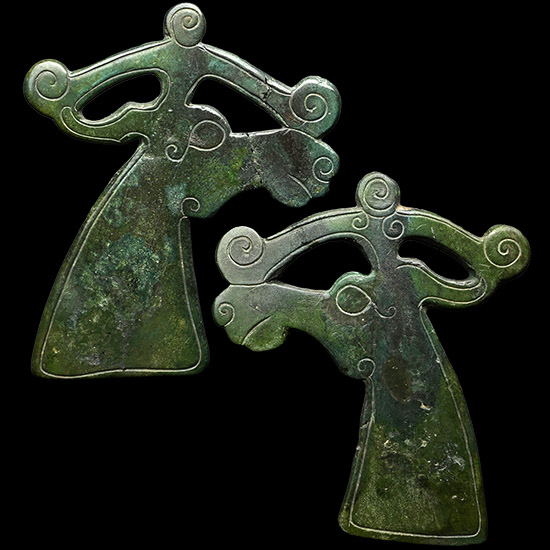
Scythian Bronze Stag's Head Mount Pair
Circa 5th-3rd century B.C.Estimate: £500 - 700 (+bp*)
Bids: 1 | Current Bid: £5
Each an openwork appliqué formed as the head and neck of an elk, incised eye with curled browline; above, three roundels with spiral detailing connected by lateral arms forming antlers; thick attachment loop to reverse. 64.5 grams total, 57 mm each
Private collection formed in Europe in the 1980s. Westminster collection, central London, UK -
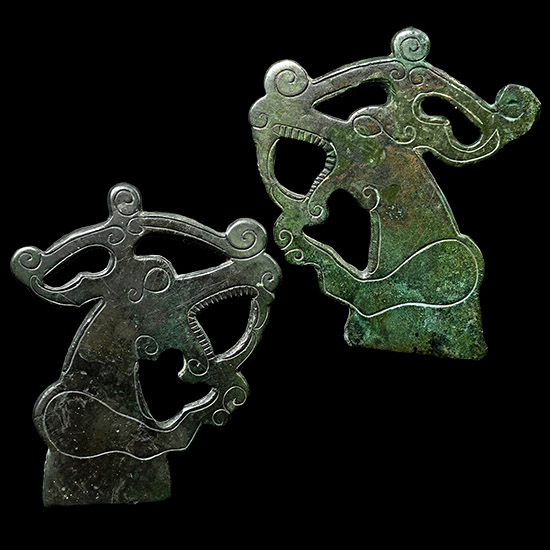
Scythian Bronze Howling Stag Protome Mount Pair
Circa 5th-3rd century B.C.Estimate: £600 - 800 (+bp*)
Bids: 1 | Current Bid: £5
Each an openwork appliqué formed as the head and upper body of a ravening predator with gaping mouth and carefully notched teeth, one forepaw extended, eye with curled browline; above, a 'headdress' of three roundels with spiral detailing connected by lateral arms; thick attachment loop to reverse. 56 grams total, 55-56 mm
Private collection formed in Europe in the 1980s. Westminster collection, central London, UK.
The depiction is unusual, since the superstructure above the head resembles an elk's antlers in some respects, but the teeth indicate that it is a carnivore. The Scythian artistic tradition could combine fantastical beasts with realistic representations drawn from nature, all in a single object. -
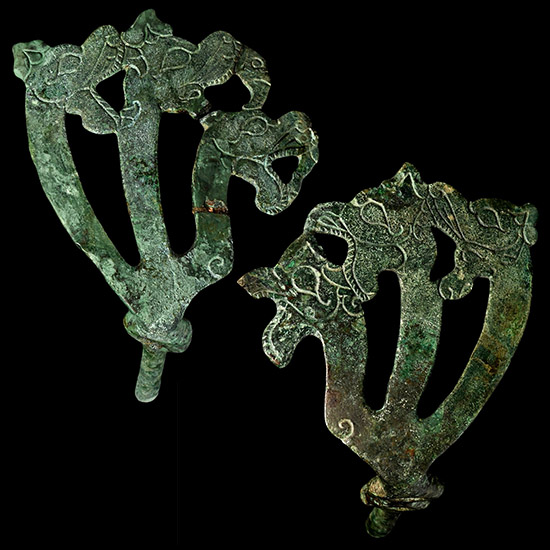
Scythian Bronze Horse Cheekpiece Pair Each with Three Dragons
Circa 5th-3rd century B.C.Estimate: £800 - 1,000 (+bp*)
Bids: 1 | Current Bid: £5
Matched pair, each comprising a round-section shank with two pierced bulbs and a perpendicular flange formed as three openwork profile beast-heads on long necks, each biting its neighbour. 183 grams total, 10.7-11.5 cm
Private collection formed in Europe in the 1980s. Westminster collection, central London, UK. -
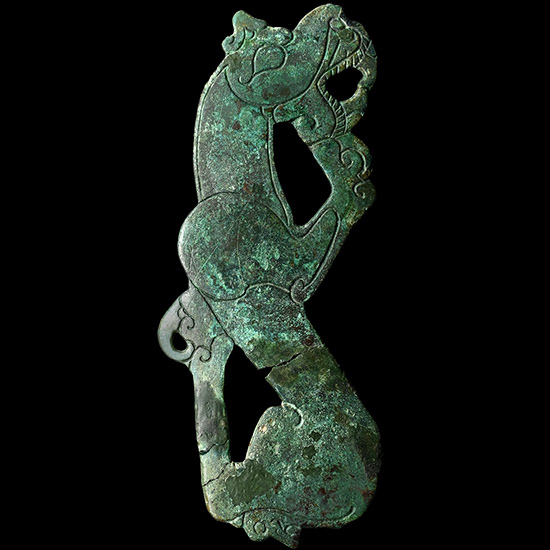
Large Scythian Bronze Contorted Beast Mount
Circa 5th-3rd century B.C.Estimate: £500 - 700 (+bp*)
Bids: 1 | Current Bid: £5
Of openwork construction with flat-section loop to the reverse; a monstrous pouncing carnivore in profile with gaping mouth, its teeth and fangs emphasised; the forelimb with powerful muscles to the shoulder; the hind leg shown rotated so that the foot connects at the rear of the shoulder; small profile beast-head beneath the rump. 72 grams, 13.2 cm
Private collection formed in Europe in the 1980s. Westminster collection, central London, UK. -
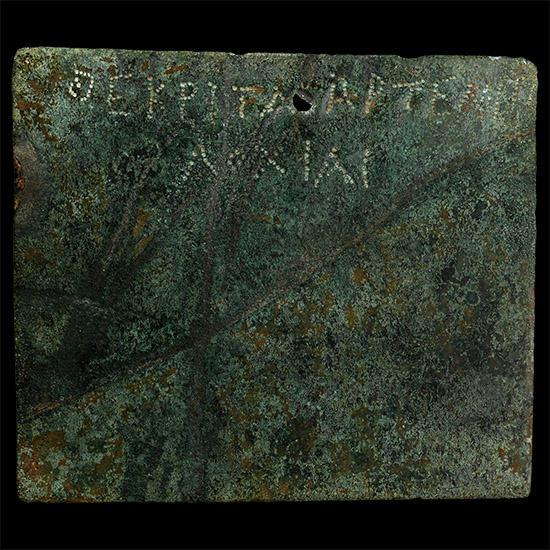
Greek Bronze Votive Plaque with Inscription for Artemis Lochia
4th-3rd century B.C.Estimate: £1,000 - 1,400 (‡+bp*)
Opening Bid: £550
A flat rectangular plaque with a punched dotted inscription 'ΘΕΚΡΙΤΑ ΑΡΤΕΜΙ… ΛΟΧΙΑΙ' to one face, pierced to the top for suspension; an inked inscription to the reverse 'Afort 3024'. 107 grams, 12.2 cm
Collection J.R., New York, 1981. with Artemis Gallery Auction, USA, 14 October 2015, no.55.
The inscription at the top of the plaque, ΘΕΚΡΙΤΑ ΑΡΤΕΜΙ… ΛΟΧΙΑΙ, identifies it as a votive pinax dedicated to the goddess Artemis Lochia, the protector of pregnant women and women giving birth. Sanctuaries of Artemis Lochia are attested in Brauron and Pergamon. The plaque was folded several times in Antiquity. On the reverse, a ledge at the edge, indicating that the plaque was soldered onto something in antiquity. -
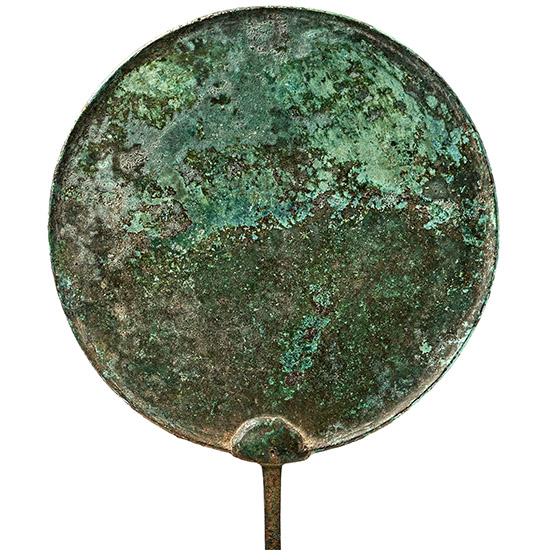
Greek Bronze Mirror
5th-4th century B.C.Estimate: £600 - 800 (‡+bp*)
Opening Bid: £320
Discoid with slightly raised rim and square-section tang, mounted on a custom-made stand. 210 grams total, 20.1 cm high including stand
Ex André Lorenceau (1930-2019), Baselland, circa 1960s-2000. -
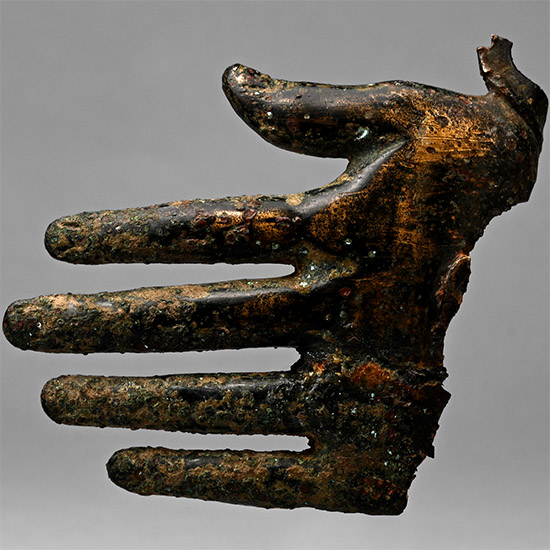
Etruscan Votive Bronze Hand
Circa 7th-6th century B.C.Estimate: £1,800 - 2,400 (‡+bp*)
Opening Bid: £900
Modelled in the half-round with D-section fingers, portion of cuff behind the thumb; mounted on a custom-made display stand. 187 grams total, 11.8 cm high including stand
Acquired on the German art market before 1992; thence by descent. This lot has been checked against the Interpol Database of stolen works of art and is accompanied by search certificate no.13191-249245.
Votive offerings gained increasing popularity throughout Etruria, southern Latium and later northern Campania from the 7th century B.C. onwards. Most gods were thought to possess the power to heal, and the sick flocked to their sanctuaries for a cure or to pray for future health. Usually, these dedications depicted the parts of the human anatomy that needed healing. The area of Vulci offered many graves in which pairs of hands cut from a sheet of bronze, rolled up at the base to form the wrist, have been found. -
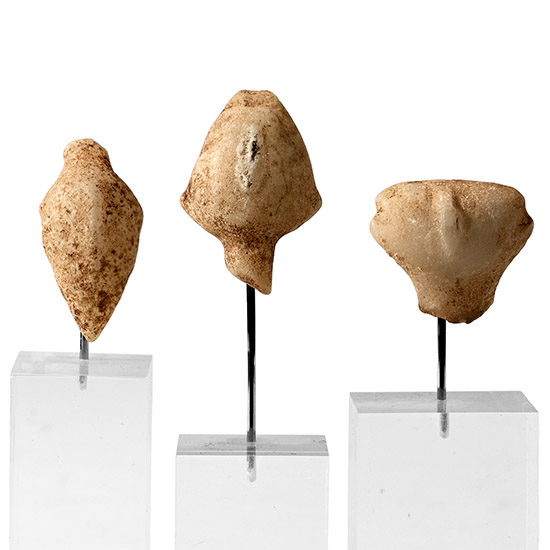
Kiliya Idol Head Collection
4th-3rd millennium B.C.Estimate: £1,000 - 1,400 (‡+bp*)
Opening Bid: £550
Group comprising: (a) horizontal oval face with long, straight nose and small ears; back of head flat, very slender neck; (b) pointed top of head, long straight nose, ears positioned low on the head, nose and top of head slightly worn; (c) head with pointed top curving backwards; slender neck and long straight nose, small ears; mounted on custom-made display stand. 79.7 grams total, 76-87 mm including stand
with Gorny & Mosch Auction, Munich, 11 July 2006, nos.612.1, 613.1 & 613.2.

