-
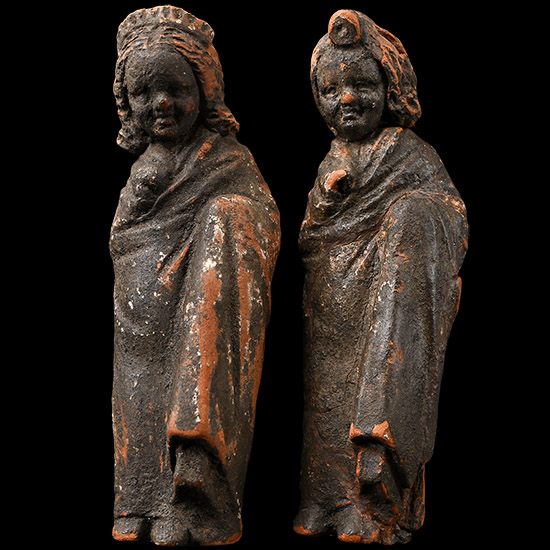
Greek Terracotta Statuettes of Robed Children
Hellenistic, 3rd-2nd century B.C.Estimate: £1,800 - 2,400 (‡+bp*)
Opening Bid: £900
Comprising two figures modelled in the round and dressed in long robes, one of a girl with shoulder-long locks wearing a headdress, one of a boy with a hair knot on top; repaired, some parts absent. 85 grams total, 90-95 mm
Ex E.S., Southern Germany, collected between 1970-1990. with Helios Numismatik, prior to 2010. -
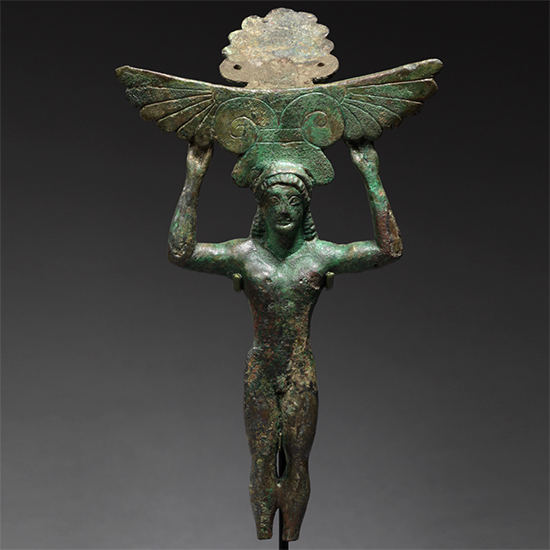
Greek Bronze Patera Handle in the form of a Naked Youth
5th century B.C.Estimate: £4,000 - 6,000 (+bp*)
Opening Bid: £2,000
Formed as a nude kouros, hands raised to touch the elaborate palmette sitting atop the boy's head, his face framed by a thick fringe, his hair, held by a band, falling down his back in serpentine waves; the figure standing with legs held close together, broken at mid-shin; a palmette-shaped fixing plate projecting at the back with two holes for rivets to attach to the broad, shallow dish which would have been used for libations. 178 grams total, handle: 17.3 cm high, 23.5 cm high including stand
Private collection UK (N.E.), acquired prior to 1970, and thence by descent. This lot has been checked against the Interpol Database of stolen works of art and is accompanied by search certificate no.13550-263433.
Anthropomorphic handles with images of young naked boys connected with animals were widespread and used for mirrors. The object, in particular, is part of the group of mirrors and paterae with standing youths (male and female, probably symbolising athletes) and nude female mirror caryatids (Mitten-Doeringer, 1968, figs.87-88) serving as vertical handles. -
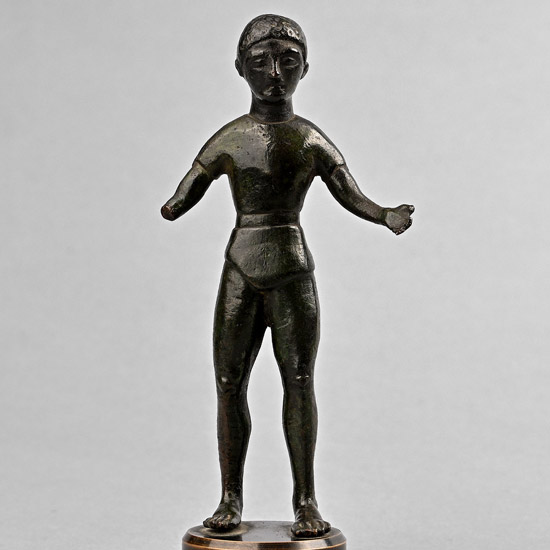
Iberian Bronze Statuette of Youth
6th-4th century B.C.Estimate: £3,000 - 4,000 (‡+bp*)
Opening Bid: £1,500
Youthful male standing, wearing a belted tunic with apron, arms spread wide, barefoot, bare-headed with short textured hair; mounted on a custom-made base. 215 grams total, 11.8 cm high including stand
Private collection, Paris, France, assembled in the 1950s-1960s. with Tessier-Sarrou & Associés, Paris, 2015. European private collection. Accompanied by a copy of an Art Loss Register certificate, no.S00107108. Accompanied by a copy of French cultural export passport no.167803. This lot has been checked against the Interpol Database of stolen works of art and is accompanied by a search certificate no.12650-264612.
This type of statuette demonstrates Phoenician influence on the Iberian Peninsula and relates to the 'warrior deity' type of Levantine origin, while also incorporating purely Iberian stylistic traits. Such works form part of the broader context of Near Eastern craftsmanship introduced to the Iberian Peninsula by the Phoenicians. -
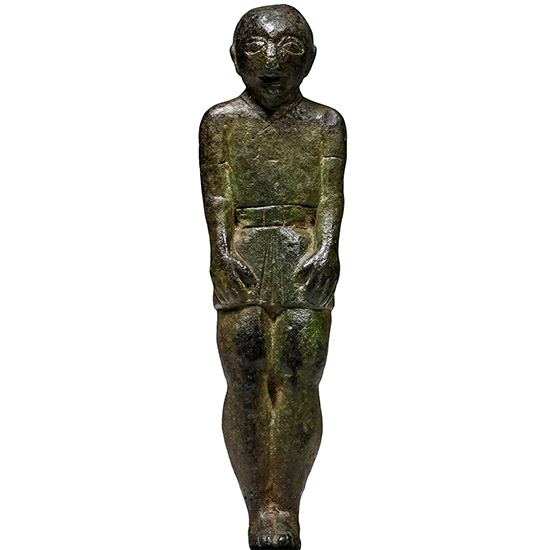
Iberian Bronze Figurine of a Man in Egyptianizing Dress
4th-2nd century B.C.Estimate: £2,000 - 3,000 (‡+bp*)
Opening Bid: £1,111
Standing with arms held straight at the sides, short hair with neck-ring to rear, short-sleeved tunic with pleats to centre-front and rear, wide belt; perhaps a monumental fitting; gas permeation to rear right leg; mounted on a custom-made stand. 77.8 grams total, 10 cm including stand
Private collection, Paris, France, assembled in the 1950s-1960s. with Tessier-Sarrou & Associés, Paris, 2015. European private collection. Accompanied by a copy of an Art Loss Register certificate, no.S00107108. Accompanied by a copy of French cultural export passport no.167803. This lot has been checked against the Interpol Database of stolen works of art and is accompanied by a search certificate no.12651-234613.
The youth’s broad shoulders are reminiscent of archaic Greek kouros figures, here in a specifically Iberian expression. The broad egg-shaped head has widely spaced, deep-set, flat oval eyes and lips of similar form. -
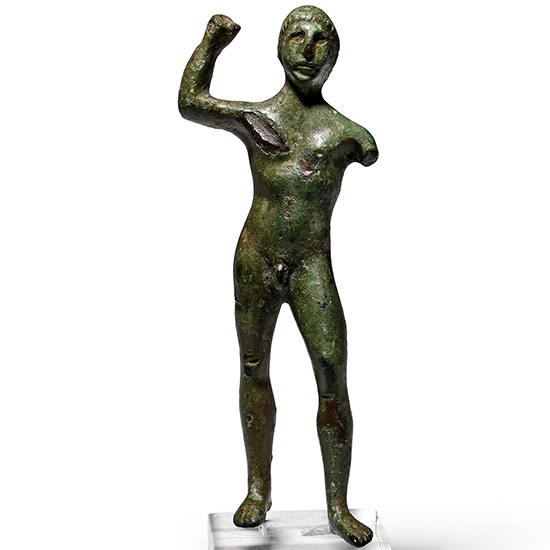
Sabellian Bronze Statuette of Attacking Herakles
8th-4th century B.C.Estimate: £400 - 600 (‡+bp*)
Opening Bid: £205
The nude hero depicted with a slender yet muscular body, the right arm angled and raised, the pierced hand probably once held a club, the left leg thrust forward energetically, lowering the hip line and emphasising the dynamic movement of the composition, the navel indicated by an engraved circular line, the knees marked by vertical incisions; the oval face characterised by eyes represented by triangular depressions, a narrow nose, a wide mouth whose slightly irregularly shaped lips separated by an incision, and a pointed chin; the short, cap-like hair detailed with fine incisions. 146 grams total, 12.6 cm high including stand
Ex Erika (1934-2025) and Jakob (1927-2025) Binkert, Binningen, Switzerland; inherited from Jakob's father, August Binkert-Textor (1896-1979), between 1940-1970, Basel. with Jean-David Cahn AG, Basel, Auction 2, 26 June 2000, no.239B; thence by descent.
Votive bronze from a Sabellian workshop in the typical local style. The Sabelli lived in the Samnium region (southern Apennines), where the cult of Heracles, as in Etruria, was widespread. -
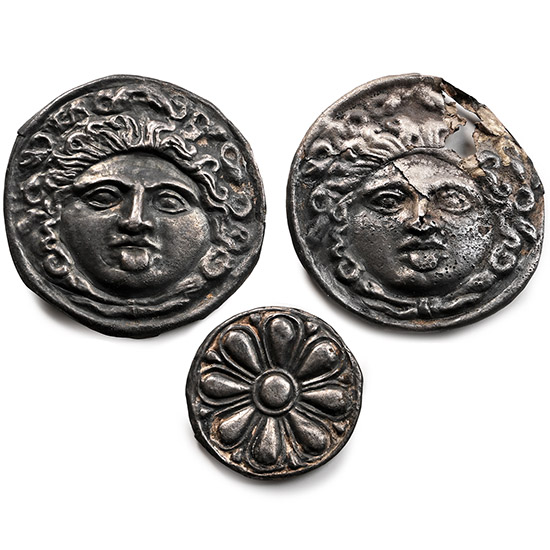
Greek Silver Medusa Repoussé Horse Harness Phalera Group
Circa 2nd-1st century B.C.Estimate: £600 - 800 (+bp*)
Bids: 4 | Current Bid: £31
Comprising: two sheet silver phalerae, each with a facing gorgoneion motif and fragments of a third; sheet-silver roundel with a lotiform rosette motif. 14.2 grams total, 31-50 mm
Private collection formed in Europe in the 1980s. Westminster collection, central London, UK
Similar phalerae were manufactured in the Greek workshops of Olbia or the northwestern Black Sea Region, including the Bosphorus and Asia Minor. These pieces were the top decorations of domed phalerae, used by Hellenistic horsemen, Thracians and Sarmatians. They were characterised by a variety of border designs, while, although rare, some of them have the upper part decorated with a frieze of horizontally arranged floral patterns. The image of Gorgon-Medusa is very common. -

Eastern Greek Parcel-Gilt Bowl with Inscription
Hellenistic, late 2nd-early 1st century B.C.Estimate: £5,000 - 7,000 (‡+bp*)
Opening Bid: £2,500
Broad and shallow with thick rolled rim; parcel-gilt band to the inner face below the rim of running scrolls on a pounced field; to the centre, a hexafoil reserved on a pounced field with border of running scrolls; pointillé cursive Aramaic inscription to the outer face. 413 grams, 20.6 cm wide
Private collection, London, 1990s or earlier. with Gorny & Mosch, 22 June 2007, no.37. with Christie's, New York, 5 December 2012, no.52. Accompanied by copies of the relevant Gorny & Mosch and Christie's catalogue pages. Accompanied by an academic report by Dr Raffaele D'Amato. This lot has been checked against the Interpol Database of stolen works of art and is accompanied by search certificate number no.13217-250131.
The bowl is related to a large group of Hellenistic silver vessels of similar shape, some with Aramaic inscriptions on the exterior beneath the rim, all thought to be of eastern origin, produced within the Seleucid Empire. Here, the Aramaic inscription, now mostly unreadable, reports the name of the maker and the weight of the bowl as 118 zuzim. -
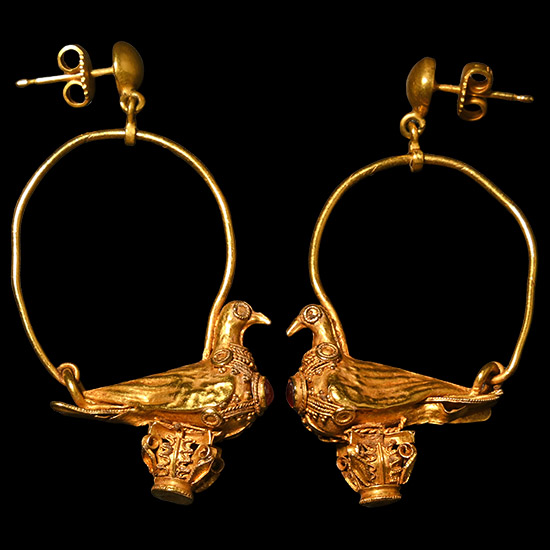
Greek Gold Earring Pair with a Dove above a Corinthian Capital
Hellenistic, circa 3rd-2nd century B.C.Estimate: £3,000 - 4,000 (‡+bp*)
Opening Bid: £1,000
Each a filigree hoop with free-running ring and articulated joint to the domed stud; hollow-formed sheet gold dove with applied filigree and granulation collar, cell to the chest with inset garnet cabochon, perching on the scrolled capital of a column; supplied in a presentation box. 10.08 grams total, 51-52 mm
Acquired from Derek Content, 8 July 1976 ($3,800). Private collection of Kal Noselson, New York, acquired between 1976 and the late 1990s; thence by descent. Accompanied by a handwritten invoice/letter with references from Derek Content for the piece, dated 8 July 1976. This lot has been checked against the Interpol Database of stolen works of art and is accompanied by search certificate no.13421-259832.
The earrings belong to the class of figure-pendant type, which was popular in Greece from the 4th century B.C. The Hellenistic period shows a distinctive spirit in the varied designs of these little earrings. One of the most employed motifs was that of the dove, which owed its popularity in close connection with the cult of Aphrodite. -

Greek Gold and Bead Drop Earrings
Hellenistic, 2nd-1st century B.C.Estimate: £7,000 - 9,000 (‡+bp*)
Opening Bid: £3,500
Matched pair of hooked wire earrings, each with an inset cabochon, articulated dangles and other ornaments. 5.15 grams total, 46 mm each
Private American collection, 1970s-1980s. with Robert Haber, New York, USA, circa 1990s. Private collection, Europe. Accompanied by a copy of an Art Loss Register certificate, 8 September 2004. This lot has been checked against the Interpol Database of stolen works of art and is accompanied by search certificate number no.13187-249264.
This pair belongs to the Hellenistic group of earrings with pendants, a broad group including pendants shaped as amphorae, birds, erotes and other exotic elements. Most of them come from sites around the Aegean or the Eastern Mediterranean and were probably produced in workshops in these regions. They usually date from the 2nd to the 1st centuries B.C. -

Graeco-Persian Gold Ram-Shaped Amulet
3rd-2nd century B.C.Estimate: £12,000 - 17,000 (‡+bp*)
Opening Bid: £6,000
Modelled in the round in the form of a ram lying with its legs folded beneath the body, head turned with hooked horns, collar to the neck with a large pellet pendant; ribbed suspension loop behind the shoulders, mounting lug beneath the trunk. 12.87 grams, 30 mm
Private collection, acquired on the European art market in 2002. Accompanied by a copy of an Art Loss Register certificate, 8 June 2004. This lot has been checked against the Interpol Database of stolen works of art and is accompanied by search certificate number no.13204-249215.
The ram, a male symbol, was associated with various divinities. Turned into a ram as a child by Zeus, and a common sacrifice to the god, the ram was a symbol of Dionysus, which he shared with Aphrodite. Ram heads and pendants frequently occur in jewellery. In the animal kingdom, Eros favours the cockerel and the ram, both of which are indicative of sexual potency. -
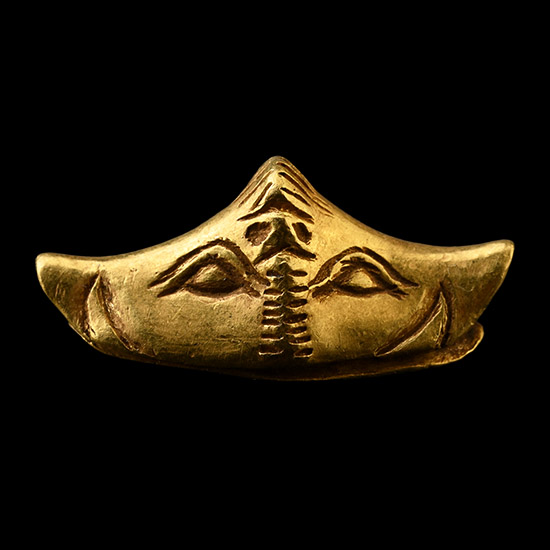
Greek Gold Double Boar Seal with Inscription
Circa 5th-3rd century B.C.Estimate: £1,200 - 1,700 (+bp*)
Opening Bid: £600
Hollow pendant formed as two triangular-section boar heads with finely carved tusks and eyes, ribbed bristles to the top of their heads; inscription to the bottom 'AHO?'. 2.37 grams, 18 mm
From the collection of a UK gentleman, London, UK, by descent from his family collection, 1970s. -

Greek Solid Gold Earring Pair
4th-2nd century B.C.Estimate: £2,500 - 3,500 (‡+bp*)
Opening Bid: £1,389
Each a thick braided hoop with a collar of twisted filigree and a lion's mask finial. 18.43 grams total, 27 mm each
Private London collection, 1980s. Private collection, acquired on the British art market in 1993. This lot has been checked against the Interpol Database of stolen works of art and is accompanied by search certificate no.13185-249263.
The earrings belong to the hoop-type earrings, in which animal and human heads form the terminals as small miniature sculptures modelled in the round. The heads were attached to collars made from a single piece of gold. The group is characterised by lion heads.

