-
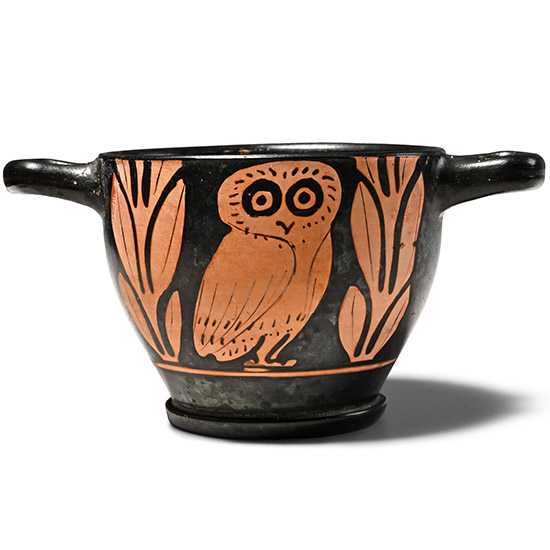
Greek Red-Figure Skyphos with Owl
Attic, 5th century B.C.Estimate: £500 - 700 (+bp*)
Bids: 1 | Current Bid: £5
Mammiform body with flared pedestal base and two loop handles to the rim; each side with a facing image of an owl between laurel fronds; concentric circles to the base, Attic workmanship. 115 grams, 13.7 cm
From the private collection of Peter Clayton, FCILIP, Dip, Arch, FSA, FRNS, Hemel Hempstead, Hertfordshire, UK; formed since the late 1950s. -
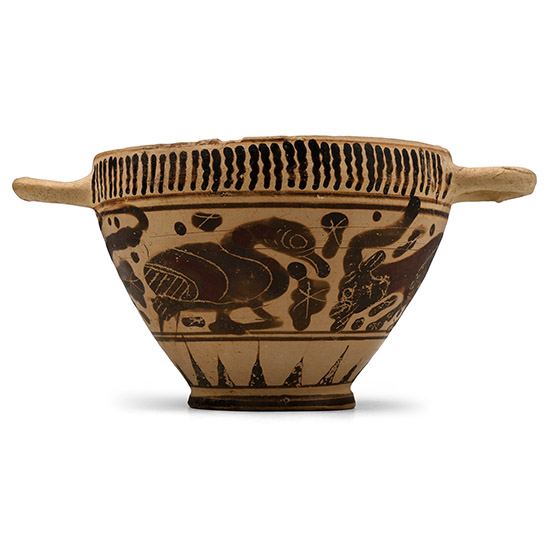
Greek White-Ground Kotyle with Panther, Goat and Swan
Corinthian, 6th century B.C.Estimate: £2,500 - 3,500 (‡+bp*)
Opening Bid: £1,250
Squat in profile with lateral loop handles, vertical stripes to the rim, frieze with a grazing goat, a panther to its rear and a perching swan. 102 grams, 15.1 cm
Ex private collection, Tokyo, Japan, since the 1980s. Private European collection, acquired in 2010. This lot has been checked against the Interpol Database of stolen works of art and is accompanied by a search certificate no.13227-249320.
In agreement with most scholars of the Corinthian pottery, Amyx and Payne used the term kotyle, rather than skyphos, to designate the distinctive group of deep cups with no offset lip, horizontal handles set near the rim, a convex tapering body and a narrow, echinoid foot. -
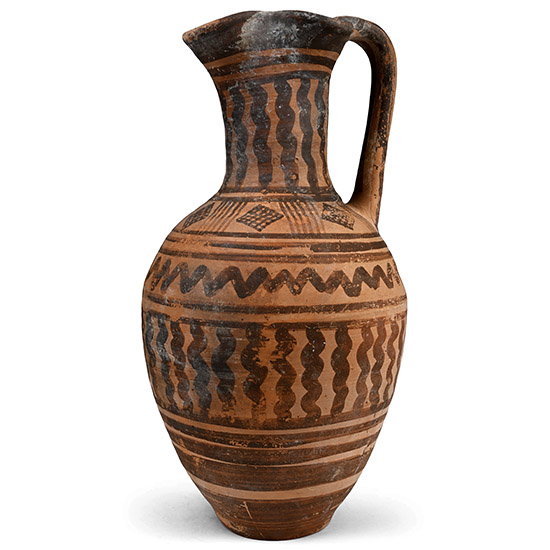
Boeotian Late Geometric Oinochoe
Late 8th century B.C.Estimate: £2,000 - 3,000 (‡+bp*)
Opening Bid: £1,000
Ovoid body with tall neck and trefoil mouth, ribbed strap handle; body decorated with broad parallel bands and vertical zig-zags, with hatched lozenges along the shoulder. 1.23 kg, 34 cm
Ex Prof. Kurt Alder, Riehen, November 1978, from his uncle Dr Werner Alder, Lugano; thence by descent. This lot has been checked against the Interpol Database of stolen works of art and is accompanied by search certificate no.13531-263113.
Vessels of the Geometric period (900-700 BCE) are easily recognisable by their abstract decorative designs, which originate from woven textiles and baskets. While early period pottery typically had sparse geometric motifs on a black background, the amount of decoration increased progressively to the point that the objects from the late Geometric period are often entirely covered - in this example, even the strap handle is decorated. -
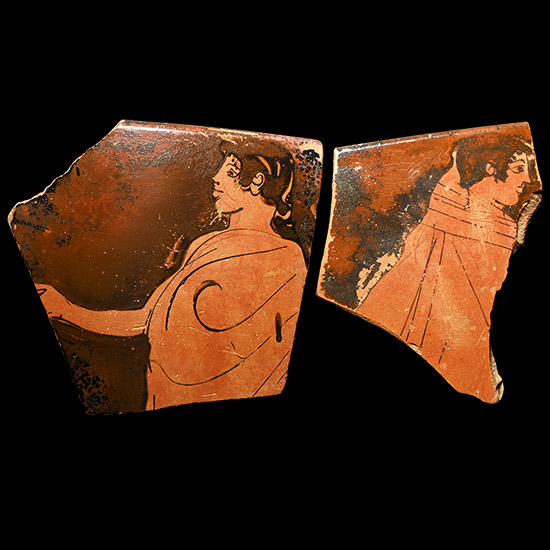
Greek Terracotta Red-Figure Skyphos Fragments Attributed to the Akridion Painter
Attic, 4th century B.C.Estimate: £1,000 - 1,400 (‡+bp*)
Opening Bid: £550
Comprising two irregular curved sidewall fragments, each with a finely painted youth in profile draped in a himation, attributed to the Akridion Painter; accompanied by a plate with previous auction listing information. 84 grams total, 54-58 mm
Acquired from Münzen und Medaillen AG, Basel, 1976. Ex Xavier Pasche, Lausanne. with Dobiaschofsky Auction, 14-17 May 2014, no.2519. -
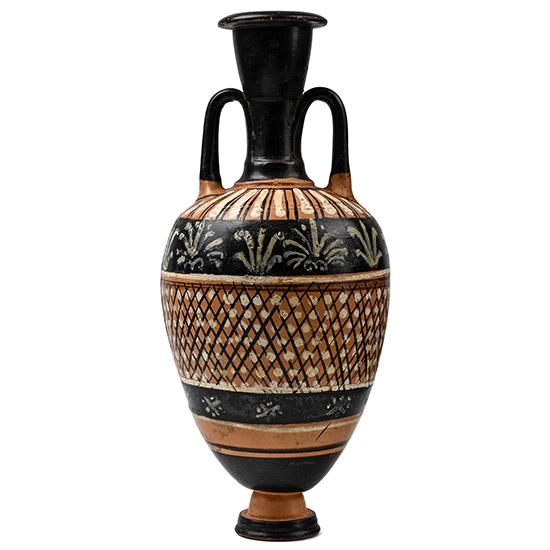
Greek Terracotta Amphoriskos with Fishnet Pattern
Attic, 4th century B.C.Estimate: £2,500 - 3,500 (‡+bp*)
Opening Bid: £1,275
Elongated piriform amphora shape with short pedestal foot, tubular neck and everted rim, applied round-section handles to the neck and body; decorated with polychrome palmettes, cross and net motif. 98 grams, 14.9 cm
Private collection, France, 1970s. with Marta Bryl, Galerie Keramion, Paris, 2019. -
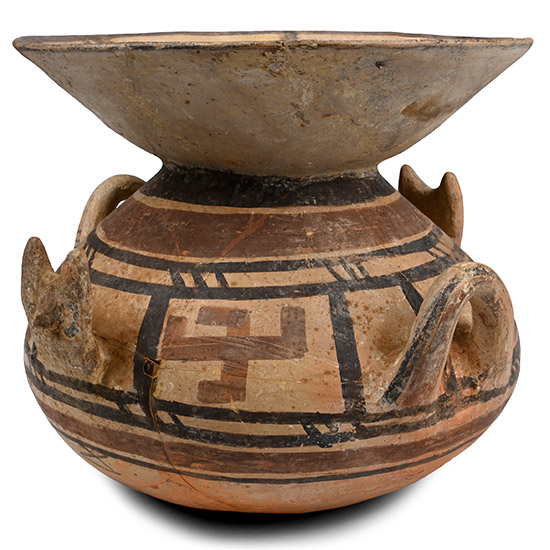
Large Daunian Olla with Flaring Mouth
5th century B.C.Estimate: £1,000 - 1,400 (‡+bp*)
Opening Bid: £550
With squat body on a flat base, two short loop handles to the equator and two animal-head protomes; painted pendant circle segments above concentric circles to the interior of the mouth; shoulder and body decorated with metopes, horizontal bands and vertical lines of differing colour and width; rectangle and swastika motifs in the metopes; pendant hourglass motifs in the lowest band; the vessel reassembled and some fragments replaced; bichrome ware. 1.74 kg, 20.3 cm high
From the estate of Hans-Ulrich Rutschmann, Switzerland, circa 1950s-1970s. -
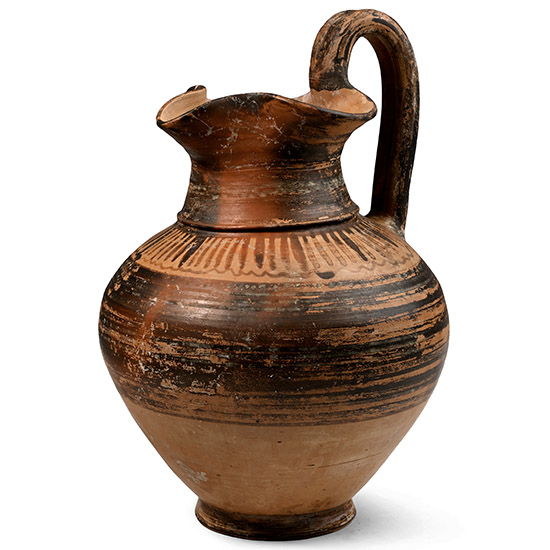
Etruscan Oinochoe with Tongue Frieze
7th-6th century B.C.Estimate: £1,800 - 2,400 (‡+bp*)
Opening Bid: £825
Bulbous in profile with a high, double-ribbed handle from the trefoil mouth to the shoulder; carinated collar above frieze of radiating tongues in glaze on the shoulder; two wavy bands on the neck, lines on the belly in opaque white. 1.04 kg, 28 cm
Ex Prof. A., Basel, Switzerland; thence by descent. This lot has been checked against the Interpol Database of stolen works of art and is accompanied by search certificate no.13535-263127.
Greek influence in the Etruscan world emerged during the Orientalizing period with the introduction of wine, likely an Eastern variety, following the tradition of spiced Syro-Phoenician wines that had been significant in the preceding era. This involved not merely the importation of the product itself, but also the introduction and subsequent local production of the associated ceramic vessels used for its consumption, such as this oinochoe. This is significant, given that the banquet custom and the ritual of the symposium,in which participants reclined while dining, would not emerge in Etruria until later. -
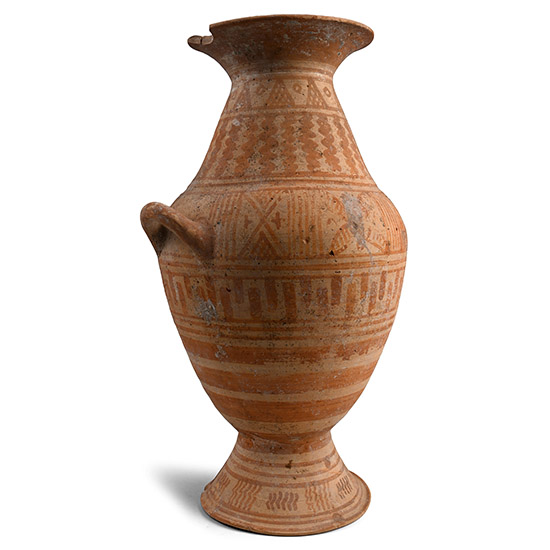
Very Large Italo-Geometric Amphora with Two Handles
7th century B.C.Estimate: £2,500 - 3,500 (‡+bp*)
Opening Bid: £1,275
With ovoid body on a tall conical foot, ovoid body sloping steeply towards the neck with wide everted rim; applied geometric decoration in clusters of lines, broad stripes, dentil patterns, vertical zig-zags and hatched lozenges; at the shoulder, alternating metopes of saltires, quatrefoils and swastikas; one handle largely absent. 2.58 kg, 43.5 cm
Ex Prof. Kurt Alder, Riehen, acquired in October 1978; thence by descent. This lot has been checked against the Interpol Database of stolen works of art and is accompanied by search certificate no.13512-263122.
By the last quarter of the 8th century B.C., the Oinotrian-Euboean production was diffused in the Greek Italic Colonies, characterised by larger vessels with elaborate figurative decoration similar to decoration known from Eretria. A detailed stylistic correspondence can be observed between the Cesnola-inspired fragments from the area north of the Daphnéphoros sanctuary of Apollo in Eretria and a decorated stand from the Timpone della Motta. With this elaborate series, the Oinotrian-Euboean production is consistent with the high craft specialisation observed in the local Euboeanizing production on Ischia. -
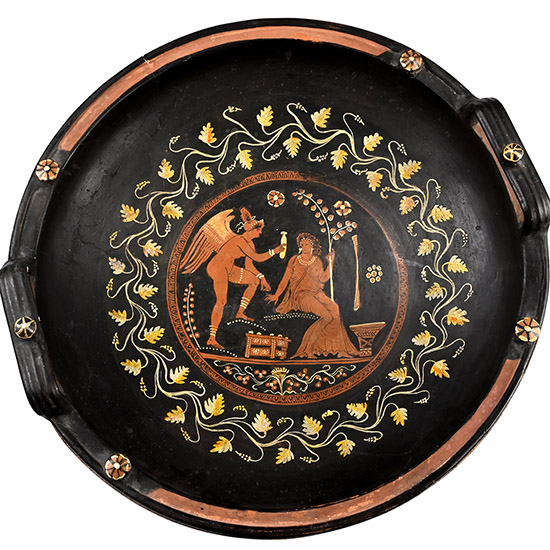
Very Large Greek Terracotta Kylix with Mythological Scene Attributed to the Darius Painter and His Circle
4th century B.C.Estimate: £20,000 - 30,000 (‡+bp*)
Opening Bid: £10,000
Featuring a monumental shallow bowl with two strap handles on the rim and a low foot; the inside of the bowl with a central scene featuring a nude winged male figure offering a lekythos to the woman seated before him; the woman dressed in a chiton and wearing a double-row necklace, large earrings and a diadem indicated by pellets, holding a double branch with leaves in her left hand; a low altar on the foreground and foliate and floral decoration beneath the scene; the scene enclosed within a painted grapevine border; four raised conical bosses on the rim and one on top of each handle; the lower part of the rim decorated with ovules; underside with a band of Greek key motifs and large palmettes on the sides, Side A: mythological scene with a satyr standing on the left, a seated woman at the centre holding a wreath and an open cista, her head turned towards another woman behind her, holding a fan and a ritual object in her hands; Side B: a draped female on the left, holding a stalk and a cista, advancing to the left while gazing back towards an advancing nude winged figure; restored. 3.1 kg, 49.5 cm wide
Private collection, South of France, acquired in 1999. Accompanied by a printed copy of the Spanish cultural export licence no.1775-3178156. Accompanied by a copy of a thermoluminescence report issued by Alliance Science Art, no.612151. Accompanied by an academic report by Dr Raffaele D'Amato. This lot has been checked against the Interpol Database of stolen works of art and is accompanied by search certificate no.13460-261208.
The intricate designs and stylistic features of this kylix suggest it may belong to the followers of the renowned Darius Painter. The Darius Painter, active in Apulia (modern-day Southern Italy) during the late 4th century B.C., is known for his elaborate and finely detailed red-figure pottery. His works often depict complex mythological scenes and demonstrate a high level of artistic sophistication and technical skill. Key features that align this vessel with the Darius Painter and his workshop include the detailed mythological scene in the central medallion, the refined use of additional white and yellow pigments to highlight key elements, and the balanced composition of figures and decorative motifs. The presence of Eros and other mythological elements is also characteristic of the themes favoured by the Darius Painter. -
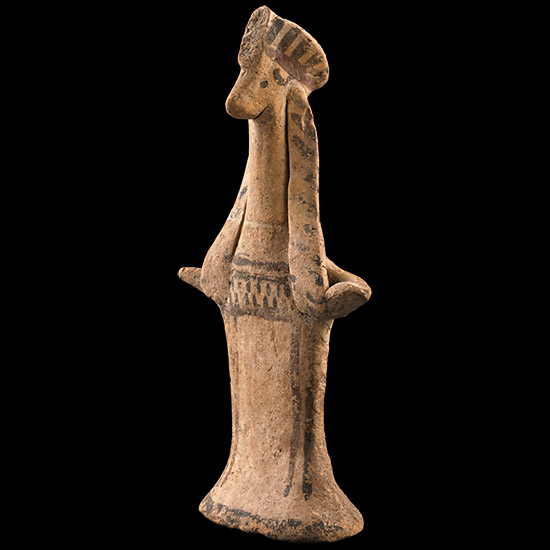
Boeotian Terracotta Idol
6th century B.C.Estimate: £1,500 - 2,000 (‡+bp*)
Opening Bid: £825
Formed with pinched stub arms, a pinched head crowned with a headpiece and two strands of hair framing an elongated neck; remains of geometric detailing in painted pigment; repaired. 100 grams, 14.5 cm
Ex Prof. Hans Dahn (1919-2019), Swiss Chemist, Lausanne; acquired 15 July 1958 in Basel (Inventory Inv.GT 5). -
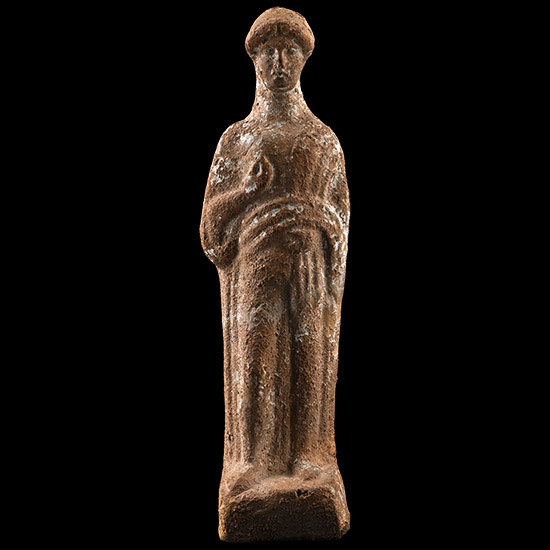
Greek Terracotta Statuette of a Kore
5th century B.C.Estimate: £500 - 700 (‡+bp*)
Opening Bid: £275
Modelled as a standing female figure on a raised rectangular base, wearing a peplos with the left foot stepping forward, one hand holding a flower(?). 196 grams, 18.5 cm
Ex Prof. Hans Dahn (1919-2019), Lausanne; acquired 15 July 1958, from Roussos, Basel; Dahn's list no.205. -
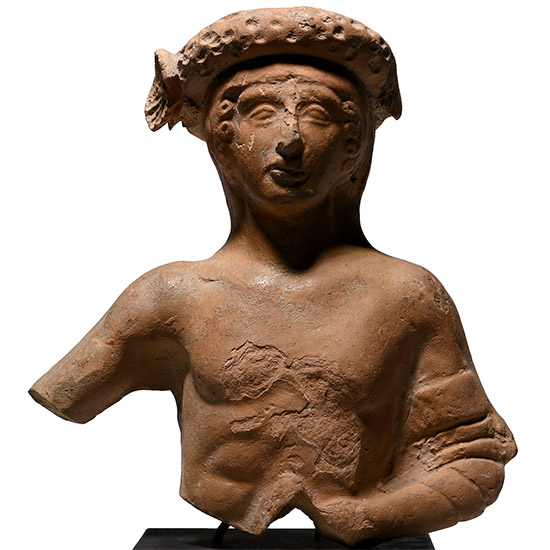
Greek Terracotta Figure of Young Dionysos
5th century B.C.Estimate: £1,200 - 1,700 (‡+bp*)
Opening Bid: £675
Modelled as a hollow torso nude of a youthful male, with a beardless face, full lips, tall nose and almond-shaped eyes; short curly hair with a thick wreath including a rosette, folded fabric draped over the right hand; mounted on a custom-made stand. 327 grams total, 15 cm including stand
Ex Prof. Hans Dahn (1919-2019), Lausanne; acquired 12 March 1954 from Donati in Basel (Dahn's list no.105).
It remains a matter of debate who these clay symposiasts- characterised by their specific, sometimes very imaginative headdresses- represent. They have been variously interpreted as Dionysos, heroised deceased persons or representative images of the urban elite. The type was particularly popular in Taranto. The recumbent man probably held a kantharos in his left hand and wore a coat that was tightly wrapped around his left arm.

