-
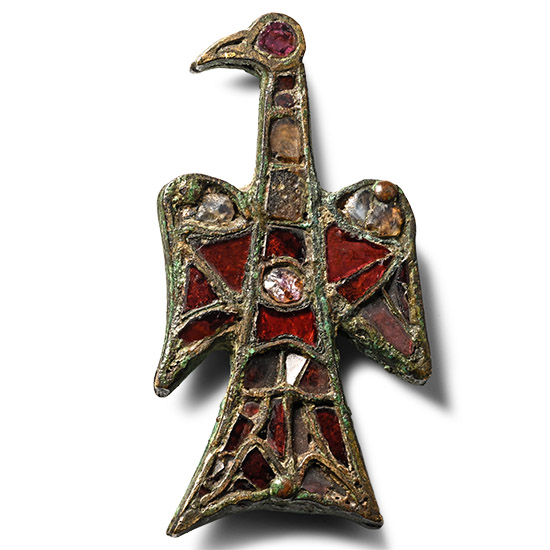
Visigothic Bronze Eagle Pendant with Garnets
Circa 5th-6th century A.D.Estimate: £2,000 - 3,000 (+bp*)
Bids: 1 | Current Bid: £5
Comprising a bronze backing plate with three attachment loops and cellwork to the obverse including inlaid garnet cloisons to the neck and body, with a cabochon at the centre of the chest and domed rivet-heads corresponding to the loops on the reverse. 35.29 grams, 68 mm
Important Medieval works of art from the collection of the late Ernst Boehlen, Adolphe Stoclet (1871-1949), Palais Stoclet, Brussels, acquired in 1931; thence by descent. Sotheby's London, 3 July 2018, no.1. Acquired by Dr Ernst Boehlen, Bern. This lot has been checked against the Interpol Database of stolen works of art and is accompanied by search certificate no.13475-262837.
The style of the piece is Visigothic; possibly a saddle applique, similar to the examples found at Apahida in Romania from the 5th century. -
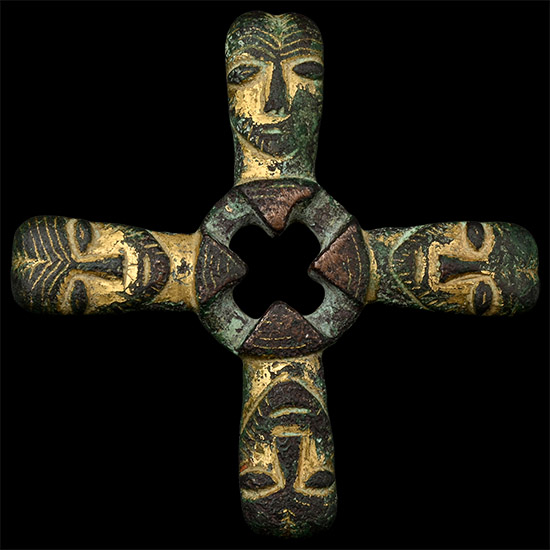
Hunnish Gilt Strap Attachment with Four Stylised Heads
6th century A.D.Estimate: £1,000 - 1,400 (+bp*)
Bids: 2 | Current Bid: £10
Cruciform in plan with central disc pierced with a saltire-shaped void and crenellated border; each radiating arm ending in a mask with centre-parted hair and short beard. 35.7 grams, 60 mm
Private collection, London.
The size and shape of this ornamental cross are evocative of metalwork that would have decorated clothing. However, the fact that the cross does not have a loop on the back suggests that it may not necessarily have been worn, while the ring in the centre and the grooves along that ring suggest that a rope of some sort may have been threaded through. One possibility is that this was a harness mount. -
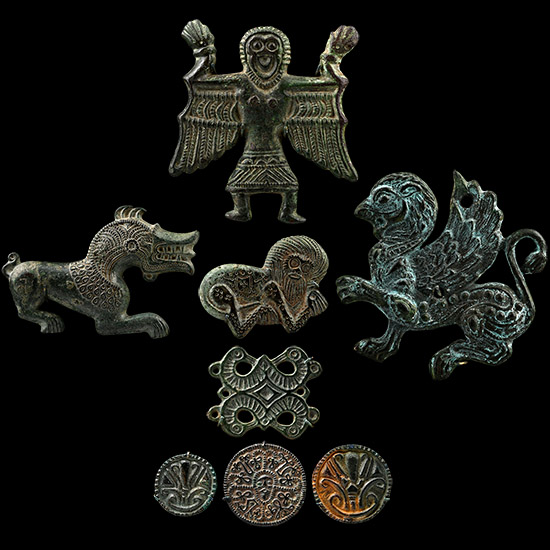
Migration Period Bronze Animal Mounts
Northern Greece, 7th-9th century A.D.Estimate: £2,000 - 3,000 (+bp*)
Bids: 1 | Current Bid: £1,000
Comprising seven Migration period mounts and one of a later date: a mould with scrolling palmettes within a roped border, possibly used as a model or die for producing repoussé mounts; a mould of a winged figure with human body and lion-like head, with short mane, wide circular eyes, and a gaping mouth, standing with legs akimbo and arms upraised, wearing a kilt with two registers of incised linear decoration, the bare torso with circular nipples, a pair of wings extending from beneath the arms, the feathers demarcated with incised stripes and dots; a mould of a dog crouching in right profile, with fore- and hind-legs bent forward beneath his body, a collar of teardrop-shaped curls across his breast and shoulders, and a short curling tail, the large schematised head, with wide flaring muzzle revealing two rows of sharp teeth and a pointed tongue, decorated with a sweeping pattern of dots and lines; a disc cast with face mask and four arms; a mould of a lion with a human-head in right profile, his long legs tucked forward beneath his body, each with large incised claws, the body and legs decorated with stamped dots, while the head, which is turned frontally, framed by a broad striated mane and long pointed beard, the face with wide circular eyes and open mouth; a belt mount in the form of a pair of addorsed animals with snake ends, with a lozenge in the centre and attachment loops; a mould with scrolling palmettes within a roped border; a mount in the form of a winged lion facing left, its paw upraised, attachment hole at top of wing, of a later date; mounted on a custom-made display stand. 2.66 kg total, 24.5 x 27.8 cm including stand
UK collection, acquired 1970s-1990s. This lot has been checked against the Interpol Database of stolen works of art and is accompanied by search certificate no.13445-263434.
A mounted group of eight Northern Greek attachments, seven from the Migration period, 7th to 9th century AD, and one probably from a later date. The group of seven was found in Thessalonika around 1911/12. The original group is called the Velestino hoard. The group now owned by a UK private collector (about 60 in total) was owned by the family whose land straddled the Northern Macedonia/ Greece area. They were probably shield mounts, belt mounts or horse harness mounts used by the Eastern Roman army, copying or imitating iconography of the early Slavs who invaded the Balkans in the 7th century A.D. -
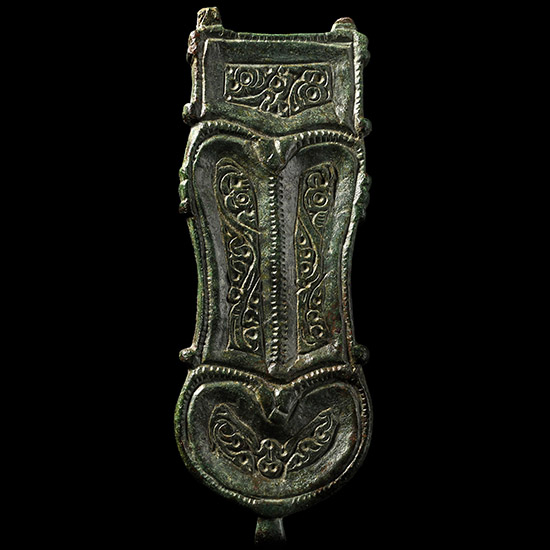
Visigothic Bronze Lyre-Shaped Buckle Plate
7th century A.D.Estimate: £600 - 800 (+bp*)
Opening Bid: £300
Formed in the shape of a stylised horse’s head, or as a tongue-shaped buckle plate with decorative moulded panels, the moulded panels enlivened with a finely detailed incised scroll motif and bordered with beading; four complete and one partially damaged vertical loops on the reverse, along with one surviving vertical loop on the end; accompanied by a custom-made display stand. 148 grams total, 14.5 cm high including stand
UK collection, acquired 1970s-1990s.

