
Ancient Art, Antiquities, Books, Natural History, Stamps & Coins

-
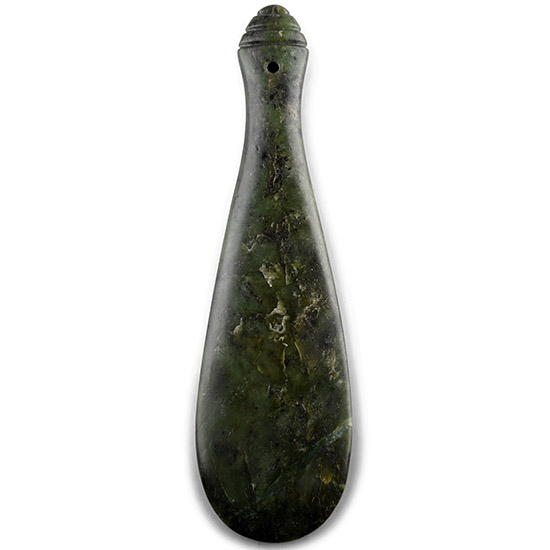
Massive Oceanic Polished Green Nephrite Jade Maori Hand War Club Mere Pounamu
New Zealand, early-mid 20th century A.D.Estimate: £800 - 1,000 (+bp*)
Opening Bid: £400
Polished and of flattened spatulate form with a ribbed terminal pierced for attachment. 1.33 kg, 37 cm
From the collection of Mr Carlos Bahamonde, Manchester, UK.
Pounamu was highly prized by Māori, and the mere pounamu, as the weapon of a chief or rangatira, was the most revered of all Māori weapons. These mere were passed down through generations. The mere was a type of Māori fighting mace also used as a symbol of authority. The mere is one of the three types of patu fighting mace. It is the simplest of the three. It is paddle-shaped and flat and wide at the striking end. It has three or four grooves in the handle, along with a hole through which a cord or strap passes to attach it to the wrist. -
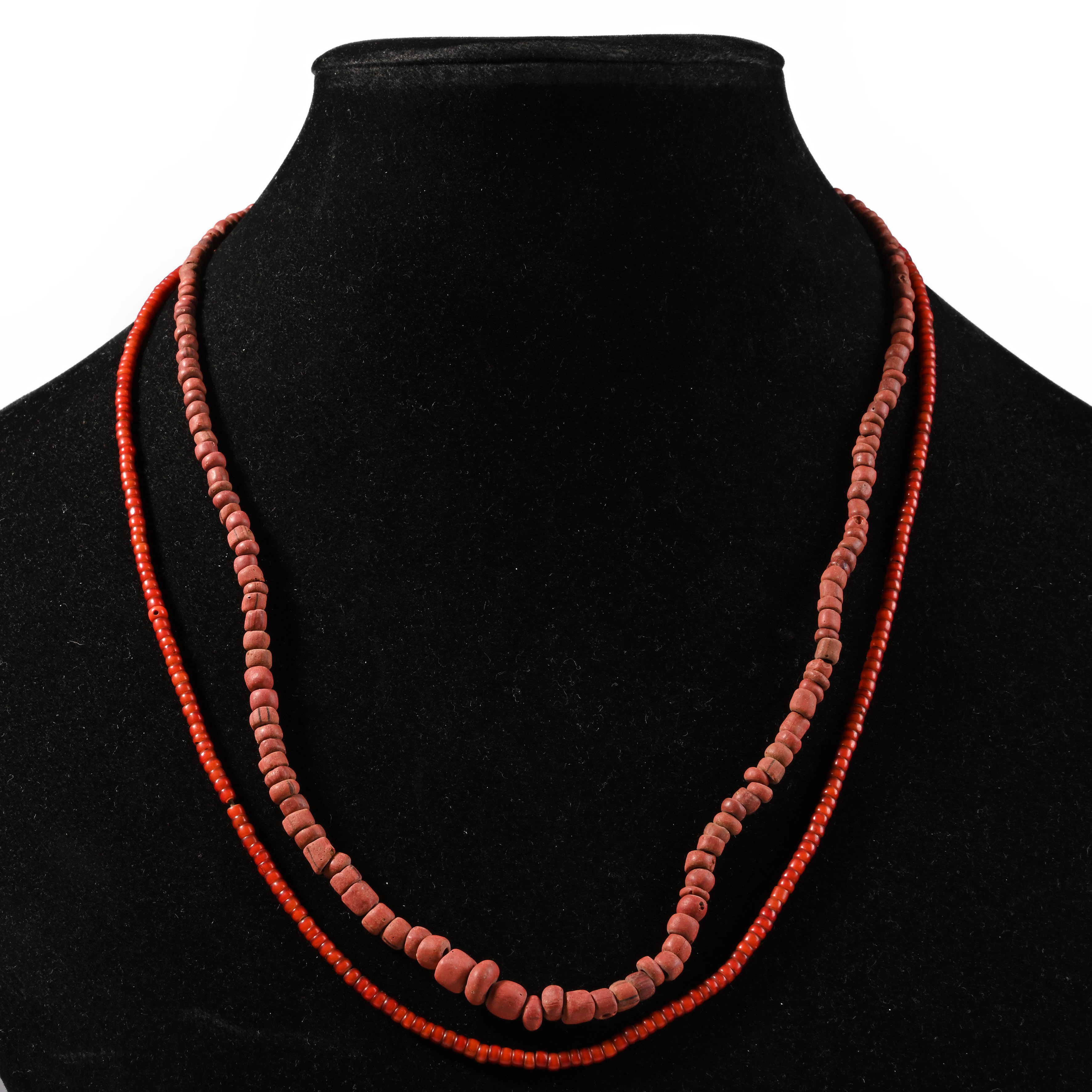
Javanese Trade Beads
Majopahit, circa 13th century A.D.Estimate: £20 - 30 (+bp*)
Opening Bid: £5
Two strings of red glass beads; old collector's cards: 'Majopahit 13th c. opaque red glass beads. Java 1293-1520 and its maritime empire. Beads used trading in E. Indies' and 'Majopahit 1293-1520 Kingdom of East Java (Sumatra, S. Malaysia = coastal Borneo.) These 13 c.' 23.7 grams total, 58-59 cm
From a specialised collection of trade items and money formed in the 1970s. -
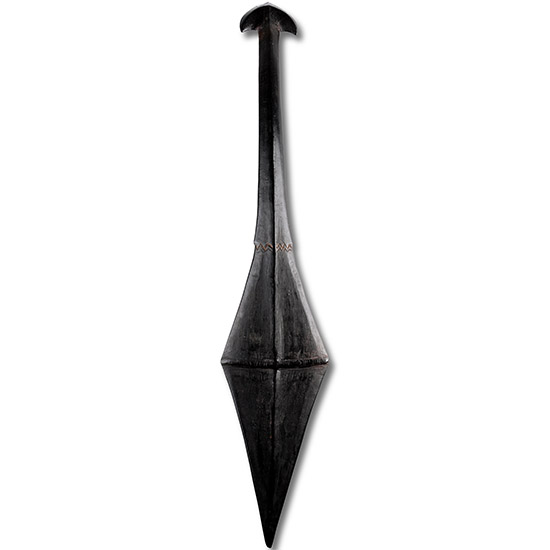
Oceanic Malaita Island Wooden War Club Supe
Solomon Islands, Melensia, early-mid 20th century A.D.Estimate: £400 - 600 (+bp*)
Opening Bid: £100
The blade with a raised medial cross, zig-zag carving above and a tapered handle ending in a fish-tail terminal; a collection sticker: 'MHMC-169'. 925 grams, 86 cm
From the collection of Mr Carlos Bahamonde, Manchester, UK.
These weapons come from Malaita Island and originally had a coir string binding on the handle. Hundreds of these were made for sale and barter to servicemen in World War II. Old ones are quite rare, but World War II examples are very common. -
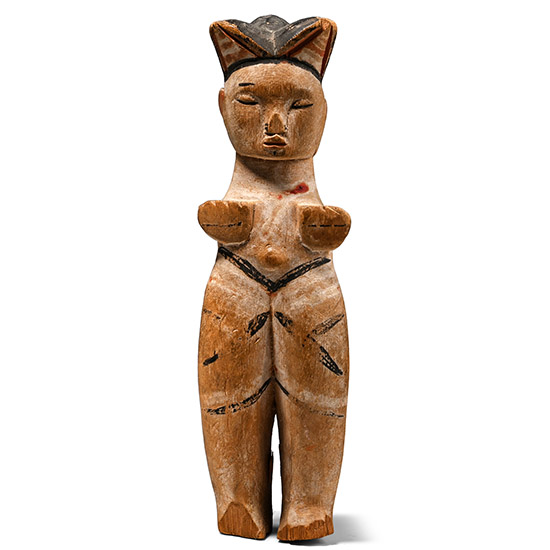
African Wooden Ibibio Doll Figurine
19th century A.D.Estimate: £40 - 60 (+bp*)
Opening Bid: £5
Carved in the round with three-lobed headdress, painted hatched detailing to the body. 105 grams, 20.3 cm
Acquired on the UK art market. Property of a Suffolk, UK, gentleman. -
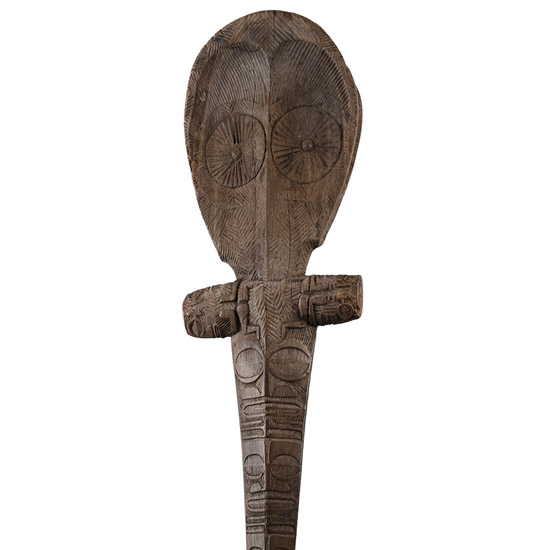
Oceanic Wooden Marquesas Islands U'u War Club
French Polynesia, South Pacific, late 19th-early 20th century A.D.Estimate: £400 - 600 (+bp*)
Opening Bid: £200
Heavy striking club with a saddle-shaped head with ancestral faces, the lateral extensions with two seated figures back-to-back. 1.46 kg, 81 cm
From the collection of Mr Carlos Bahamonde, Manchester, UK.
The striking club was designed for heavy impact in tribal warfare and territorial disputes, also serving as an emblem of leadership, an ancestral guardian, and a vessel for spiritual power. -
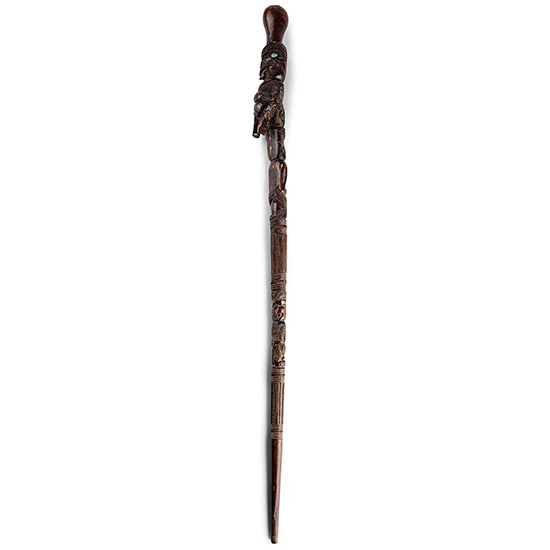
Oceanic Wooden Maori Walking Stick Tokotoko
New Zealand, early 20th century A.D.Estimate: £500 - 700 (+bp*)
Opening Bid: £200
Carved with a seated tiki and two kneeling tiki figures, with inset abalone shell eyes and bands of linear and notch carving, the pear-shaped handle with a metal plaque inscribed: 'J.L. LD. N.Z. 1903'. 545 grams, 93.8 cm
From the collection of Mr Carlos Bahamonde, Manchester, UK.
A tokotoko is a traditional Māori carved ceremonial walking stick, and a symbol of authority and status for the speaker holding it. The tokotoko were beautifully carved. The most elaborate, like this one, shows a well-nourished, naked Paikea-type male figure lying flat, with his legs in the air to form a handle. The sticks have two distinctive female faces further down, one with a moko on the lips and the other with a moko kauae. All faces have pāua-shell eyes. The body of the tokotoko is intricately carved with a three-dimensional curved shape. It is less than a metre in length, pointing to its use as a ‘talking stick’ rather than an aid to walking. -
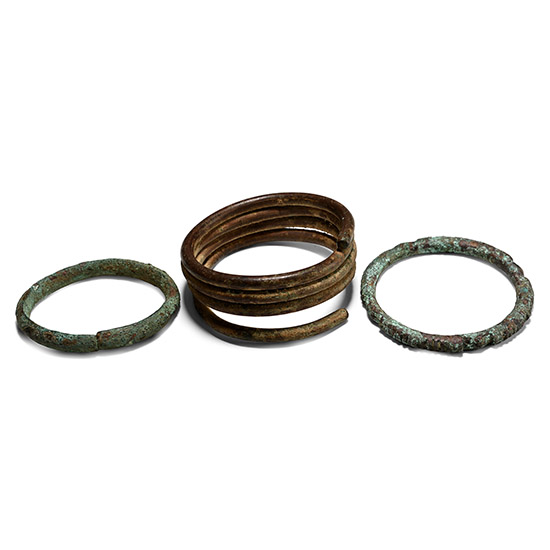
African Trade Bracelet Group
19th-20th century A.D.Estimate: £20 - 30 (+bp*)
Opening Bid: £5
Comprising: spiral round-section bracelet of four coils; round-section ring with segmented outer face; ellipsoid type with butted ends; each with a handwritten collector's note. 360 grams total, 70-86 mm wide
Ex Robert Tye collection. From a specialised collection of trade items and money formed in the 1970s. Accompanied by three handwritten catalogue slips. -
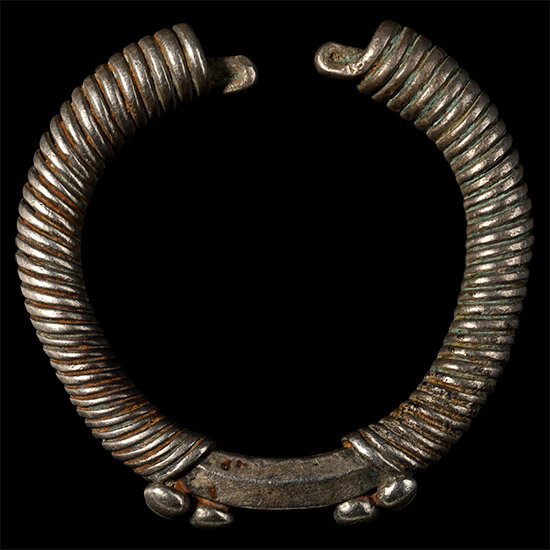
Ethnographic Silver Coiled Bracelet
19th-20th century A.D.Estimate: £400 - 600 (+bp*)
Opening Bid: £200
Penannular in plan, hexagonal in section with a pair of applied coiled rods on each arm and six bosses. 96 grams, 73 mm
London gentleman's collection, 1970-1990s, by descent. -
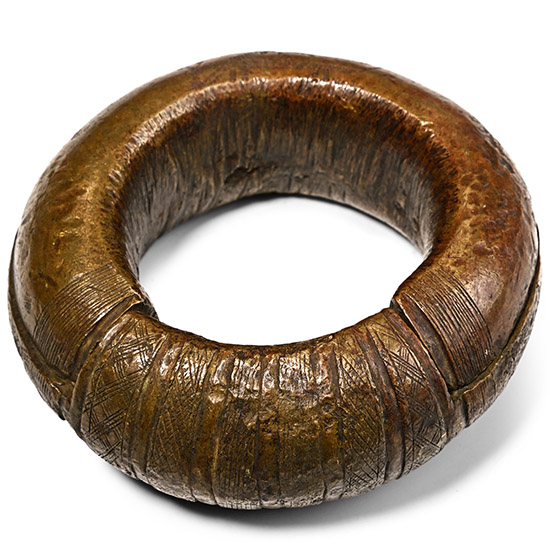
Huge African Bronze Decorated Slave Bracelet
19th century A.D.Estimate: £40 - 60 (+bp*)
Opening Bid: £5
Penannular in profile and D-shaped in section with hinged quadrant bearing hatched segments. 1.76 kg, 11.3 cm
From a UK collection formed in the 1980s. Property of an Essex, UK, gentleman. -
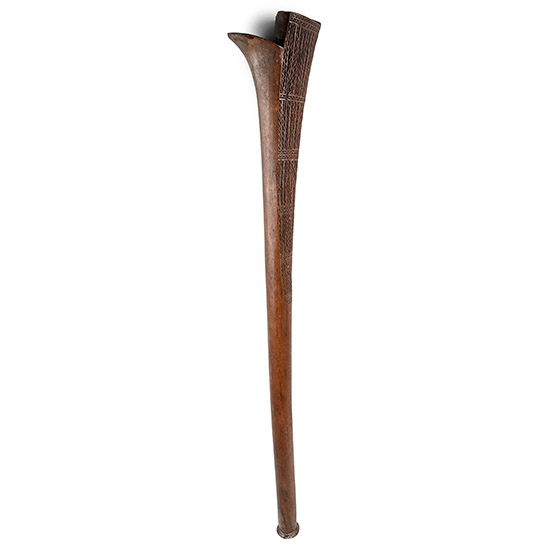
Oceanic Honey-Coloured Wooden 'Gunstock' Sali War Club
Melanesia, Fiji, late 19th-early 20th century A.D.Estimate: £500 - 700 (+bp*)
Opening Bid: £200
Comprising a round-section haft with a flanged butt, a lozenge-section head with a stepped beak on one face, panels of dense chip-carved geometric ornament to the rear. 1.61 kg, 95 cm
From the collection of Mr Carlos Bahamonde, Manchester, UK. -
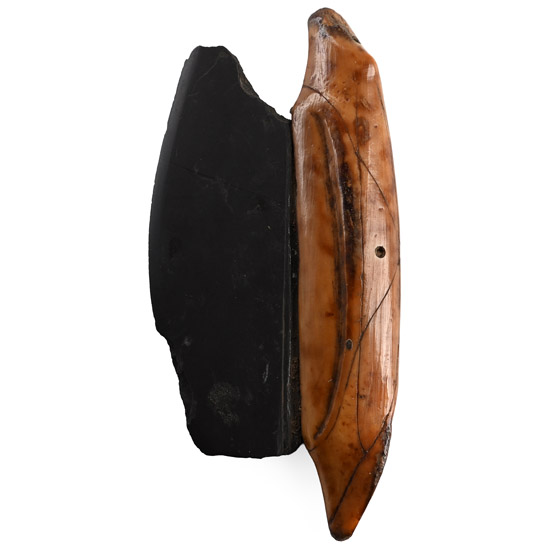
Native North American Punuk Carved Fossilized Bone Knife Handle
Alaska, circa 500-1000 A.D.Estimate: £300 - 400 (+bp*)
Opening Bid: £150
Modelled as a finely carved zoomorphic body with circular eyes and a rounded mouth, lines and dots decoration to the body, securing a smooth black stone blade. 43.1 grams, 10.1 cm
Excavated on St Lawrence Island, Alaska. Ex John and Valerie Arieta, 1996. Dr Alan Black collection. From the collection of Mr Carlos Bahamonde, Manchester, UK. -
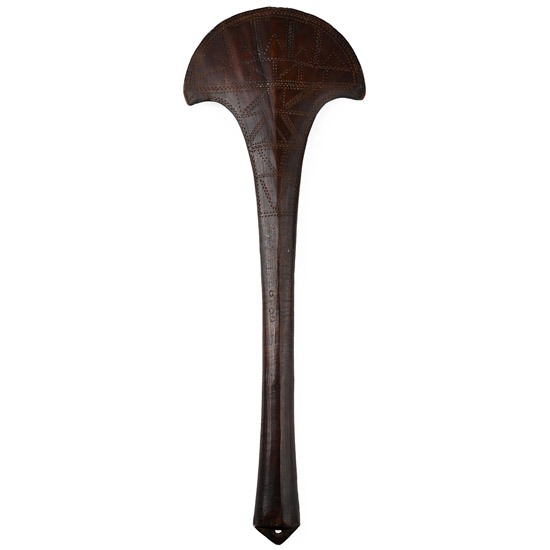
Oceanic Wooden Samoan War Club
Tonga, Polynesia, early-mid 20th century A.D.Estimate: £400 - 600 (+bp*)
Opening Bid: £150
Paddle-shaped in plan with ellipsoid-section shaft and pierced tab finial; flared pelta-shaped head with restrained chip-carved geometric ornament; with incised legends to one face: 'LALAIFOOPOO / MATAPVA' with some letters inverted. 605 grams, 58 cm
From the collection of Mr Carlos Bahamonde, Manchester, UK.
