
Ancient Art, Antiquities, Books, Natural History, Stamps & Coins

-
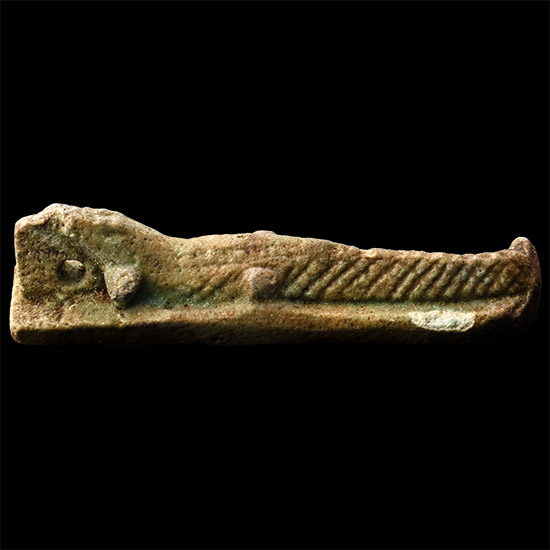
Egyptian Green Glazed Faience Crocodile God Amulet
Late-Ptolemaic Period, 664-30 B.C.Estimate: £80 - 100 (+bp*)
Bids: 1 | Current Bid: £5
An amulet featuring a crocodile with its tail curled, resting on a long, rectangular plinth; the reptile's scales are finely rendered, with an integral suspension hole beneath its chin. 3.07 grams, 41 mm
From the private collection of Peter Clayton, FCILIP, Dip, Arch, FSA, FRNS, Hemel Hempstead, Hertfordshire, UK; formed since the late 1950s.
Although crocodiles were fearsome creatures, the Egyptian crocodile god Sobek was a benevolent god of water, fertility and rebirth in the afterlife. -
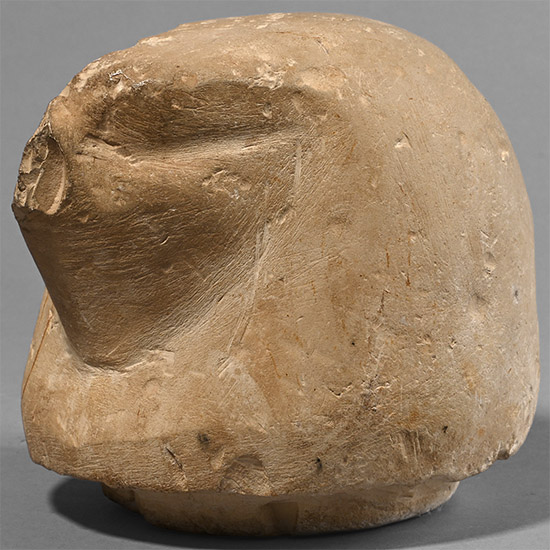
Large Egyptian Limestone Qebehsenuef Canopic Jar Lid
New Kingdom, 18th Dynasty, 1550-1292 B.C.Estimate: £200 - 300 (+bp*)
Bids: 3 | Current Bid: £30
Carved as an avian head with a discoid base to accept the rim of the canopic jar; old handwritten collector's note attached to the back of the head 'Found in rubble, literally tripped over, in tombs on West Bank, March 1963, group with Dr Veronica Seton-Williams'; old collector's card: 'Lid of hawk headed canopic jar. Duamutef (sic), guardian of the lungs and deity of the east in their general arrangement to the cardinal [?]. Made of white limestone, the right hand side much damaged...'; chipped. 2.74 kg, 14.6 cm wide
From the private collection of Peter Clayton, FCILIP, Dip, Arch, FSA, FRNS, Hemel Hempstead, Hertfordshire, UK; formed since the late 1950s. Accompanied by an old handwritten identification card written by Peter Clayton.
The Four Sons of Horus safeguarded the deceased's internal organs. The human-headed Imsety protected the liver; the baboon-headed Hapy, the lungs; the jackal-headed Duamutef, the stomach; and the falcon-headed Qebehsenuef, the intestines. They often placed the viscera in canopic jars with the head of the respective Son of Horus. -
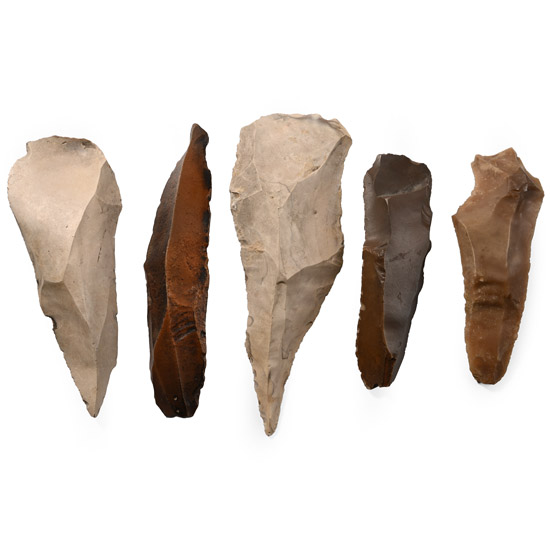
Egyptian Stone Age Knapped Knife Blades from Thebes
Neolithic Period, 11,000-5,200 B.P.Estimate: £300 - 400 (+bp*)
Bids: 1 | Current Bid: £5
Each of curved profile with broad cutting edge; old inked findspots 'Desert W. of Thebes 1912' (2 examples), 'W. of Thebes 1912' (2 examples), 'W. Thebes 1912'. 279 grams total, 10.6-14.3 cm
Found in the desert west of Thebes, Egypt, 1912. From the private collection of Peter Clayton, FCILIP, Dip, Arch, FSA, FRNS, Hemel Hempstead, Hertfordshire, UK; formed since the late 1950s. -
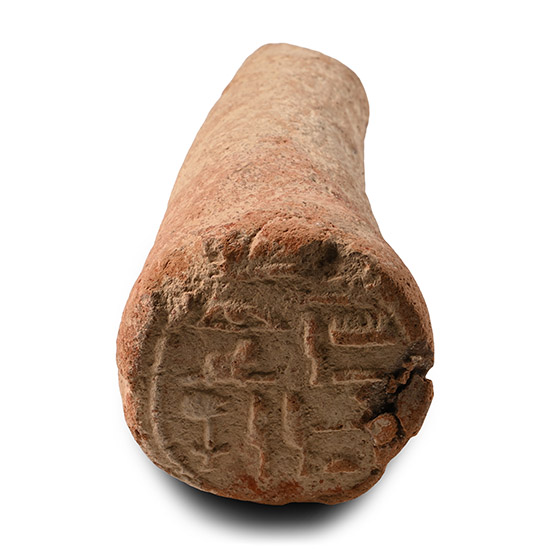
Egyptian Terracotta Funerary Cone for Hat
New Kingdom, 18th Dynasty, circa 15th-14th century B.C.Estimate: £400 - 600 (+bp*)
Bids: 4 | Current Bid: £135
Almost complete funerary cone of typical tapering form, with the circular flat end impressed with two unbordered horizontal lines of hieroglyphic text, reading: "The Osiris, corn measurer of Amun, Hat (or Hat-Amun)". 365 grams, 16 cm
Acquired from Abdoul Rassoul on the West Bank at Luxor, 1974-1980 when a guest lecturer. From the private collection of Peter Clayton, FCILIP, Dip, Arch, FSA, FRNS, Hemel Hempstead, Hertfordshire, UK; formed since the late 1950s.
This individual's tomb remains unknown. -
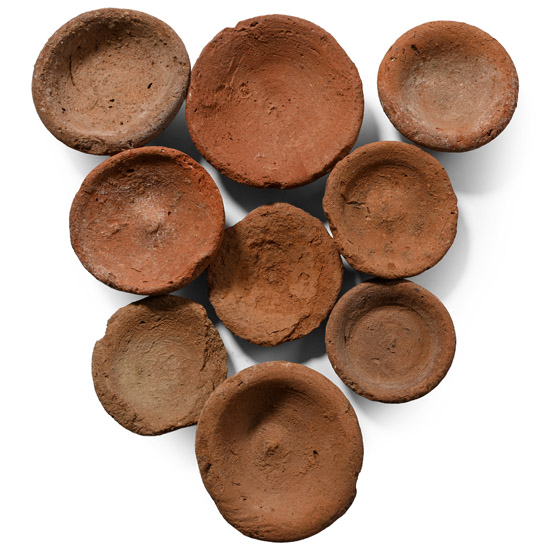
Romano-Egyptian Miniature Pottery Offering Bowl Collection
Roman Period, 30 B.C.-323 A.D.Estimate: £80 - 100 (+bp*)
Bids: 1 | Current Bid: £5
Comprising nine shallow discoid dishes with rounded rims. 125 grams total, 35-50 mm
From the private collection of Peter Clayton, FCILIP, Dip, Arch, FSA, FRNS, Hemel Hempstead, Hertfordshire, UK; formed since the late 1950s. -
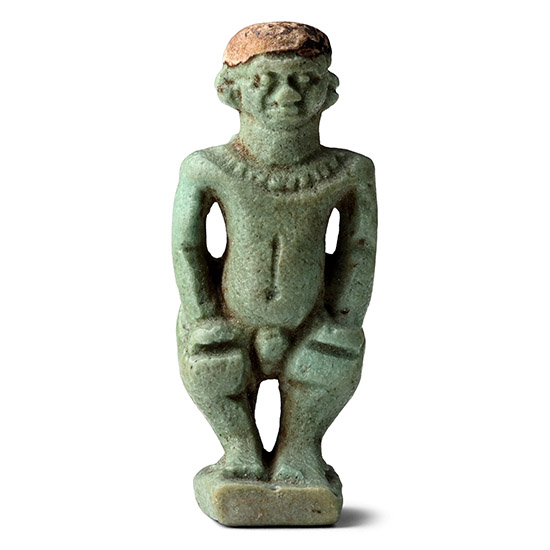
Egyptian Green Glazed Faience Pataikos Amulet
Late Period-Ptolemaic Period, 664-30 B.C.Estimate: £100 - 140 (+bp*)
Bids: 1 | Current Bid: £5
Typical nude, bandy-legged figure wearing a beaded collar, with a suspension loop at the back of the head. 5.7 grams, 39 mm
From the private collection of Peter Clayton, FCILIP, Dip, Arch, FSA, FRNS, Hemel Hempstead, Hertfordshire, UK; formed since the late 1950s. -
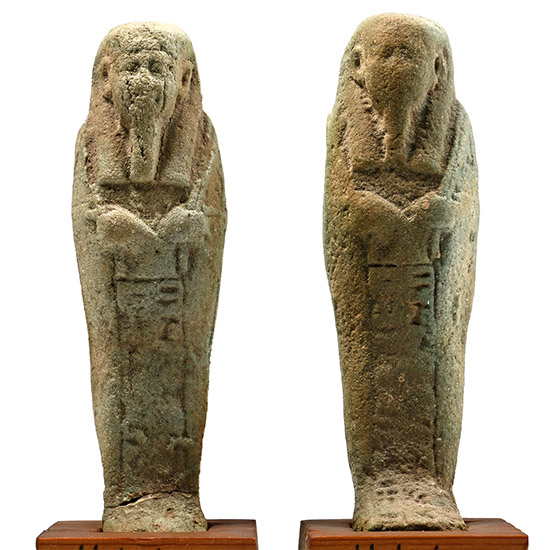
Egyptian Blue Faience Palestinian Shabti Pair
Late Period, 664-332 B.C.Estimate: £400 - 600 (+bp*)
Bids: 2 | Current Bid: £25
Two mummiform figures, produced from the same mould, wearing lappet wigs, with arms crossed and hands holding agricultural implements; illegible hieroglyphic text on the lower body; display stand marked 'Ushabti Palestinian 1000-800 B.C.'. 120 grams total, 11.5-11.6 cm
Acquired near the British Museum, circa 1949, at 3 shillings each. From the private collection of Peter Clayton, FCILIP, Dip, Arch, FSA, FRNS, Hemel Hempstead, Hertfordshire, UK; formed since the late 1950s. Accompanied by an old handwritten information card by Peter Clayton, collection nos.7,7a. -
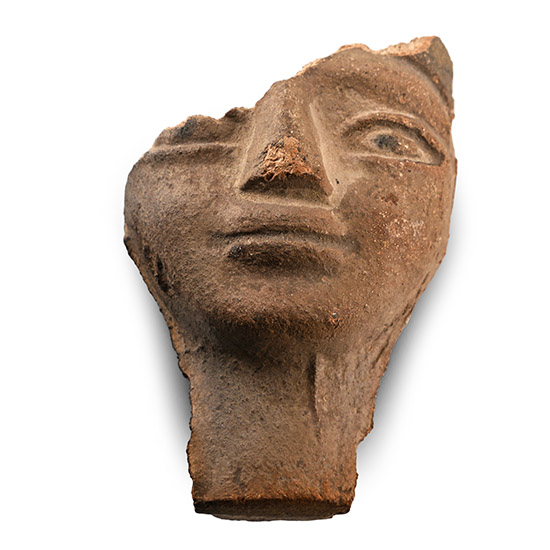
Graeco-Egyptian Terracotta Head of a Lady
Hellenistic Period, circa 2nd century B.C.Estimate: £100 - 140 (+bp*)
Bids: 1 | Current Bid: £5
Moulded in the half-round with fine facial detailing. 35.4 grams, 62 mm
Acquired 21st March 1965. From the private collection of Peter Clayton, FCILIP, Dip, Arch, FSA, FRNS, Hemel Hempstead, Hertfordshire, UK; formed since the late 1950s. Accompanied by an old handwritten information card by Peter Clayton, collection no.109. -
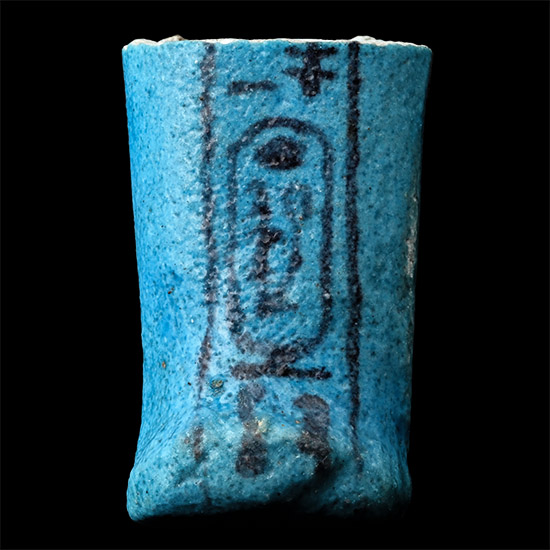
Egyptian Royal Bright Blue Glazed Shabti Fragment with Cartouche
New Kingdom, circa early 13th century B.C.Estimate: £150 - 200 (+bp*)
Opening Bid: £5
The lower legs and feet are preserved, bearing a portion of the central frontal column of inscription in black, with the sign of royalty followed by a cartouche containing a sun disc with a seated divinity beneath, wearing a feather headdress; below the cartouche are the two signs meaning 'true of voice'. 35 grams, 50 mm
From the private collection of Peter Clayton, FCILIP, Dip, Arch, FSA, FRNS, Hemel Hempstead, Hertfordshire, UK; formed since the late 1950s.
An intriguing fragment. The brilliant blue colour suggests shabtis for Seti I, although the cartouche lacks the men sign that would correctly spell his name. It seems possible that this was an artisan's mistake - after all, Seti I was buried with at least 700 shabtis. -
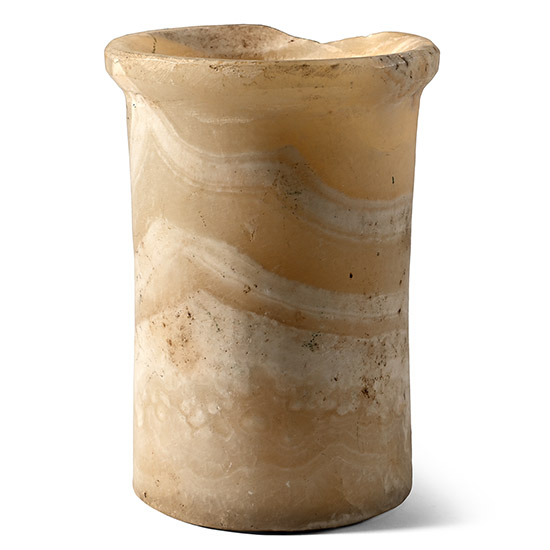
Egyptian Alabaster Cylindrical Storage Vessel
Old Kingdom, 5th-6th Dynasty, circa 2300-2100 B.C.Estimate: £200 - 300 (+bp*)
Bids: 1 | Current Bid: £5
Tubular type with an everted rounded rim; old dealer's note 'Alabaster cylindrical storage vessel, semi-translucent and with veining. Small abrasion to outturned flattened rim. Probably alabaster quarries at Hatnub, to north of el-Amarna. Egypt, early Dynastic, Vth-VIth Dynasties, c.2300-2100 BC. Bought Spitalfields Market, Thursday 12/1/19'. 508 grams, 11.8 cm
From the private collection of Peter Clayton, FCILIP, Dip, Arch, FSA, FRNS, Hemel Hempstead, Hertfordshire, UK; formed since the late 1950s. -
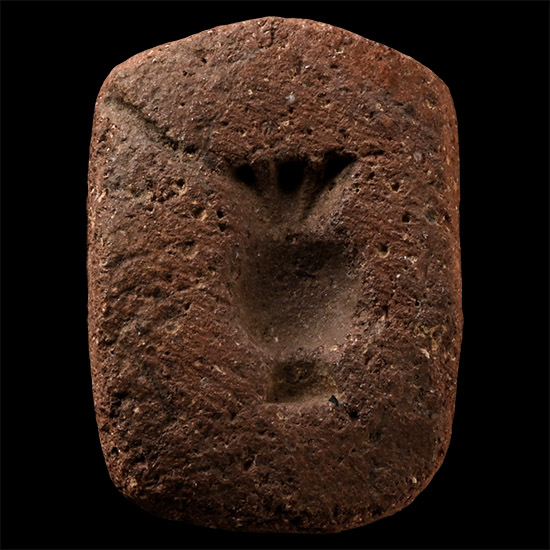
Egyptian Terracotta Mould for a Pomegranate Amulet
New Kingdom, 18th Dynasty, Amarna Period, 1379-1362 B.C.Estimate: £40 - 60 (+bp*)
Opening Bid: £5
Rectangular mould with incuse pomegranate motif on one side; with old collector's record card detailing findspot, place of purchase and other details. 3.22 grams, 21 mm
Acquired April 1980. From the private collection of Peter Clayton, FCILIP, Dip, Arch, FSA, FRNS, Hemel Hempstead, Hertfordshire, UK; formed since the late 1950s. Accompanied by an old handwritten information card by Peter Clayton, collection no.149. -
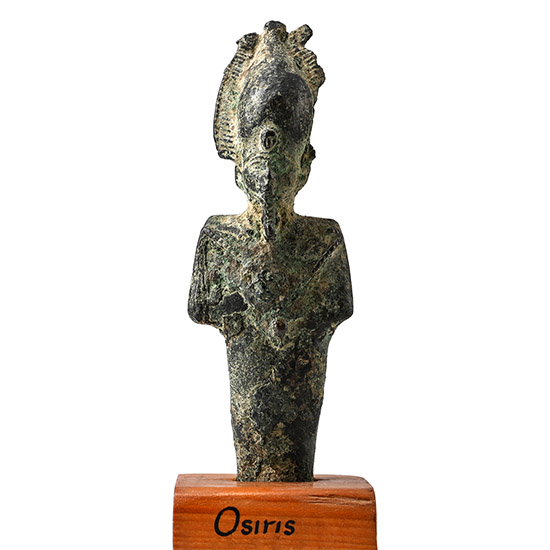
Egyptian Bronze Figure of the God Osiris
Late Period-Ptolemaic Period, 664-30 B.C.Estimate: £150 - 200 (+bp*)
Bids: 3 | Current Bid: £15
Modelled in the round with a tall feathered atef crown and uraeus, arms set one above the other at the chest, hands holding Osiris's royal regalia, lower legs absent, with a custom-made display stand. 95.6 grams total, 12 cm high including stand
Acquired Herne Bay High Street, June 1957. From the private collection of Peter Clayton, FCILIP, Dip, Arch, FSA, FRNS, Hemel Hempstead, Hertfordshire, UK; formed since the late 1950s. Accompanied by an old handwritten information card by Peter Clayton, collection no.9.
