
Ancient Art, Antiquities, Books, Natural History, Stamps & Coins

-
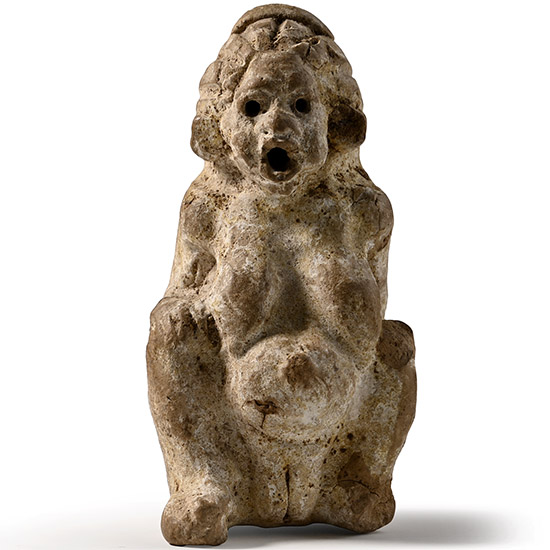
Egyptian Libation Vessel in the Form of a Squatting Woman
3rd century B.C.-2nd century A.D.Estimate: £1,200 - 1,700 (‡+bp*)
Opening Bid: £675
Formed as a naked pregnant woman in a squatting position, with sagging breasts and a strongly bulging belly; pubis clearly visible between the legs, which are spread wide apart; eyes and mouth perforated to serve as a spout; filling hole at the back of the head; left foot partly absent. 161 grams, 10 cm
Hans Jurgen Döpp (1940), Frankfurt. From The Erotica Collection of Christian von Faber-Castell, Küsnacht ZH, Switzerland; acquired from Bernd Gackstätter, Antikenkabinett Frankfurt. -
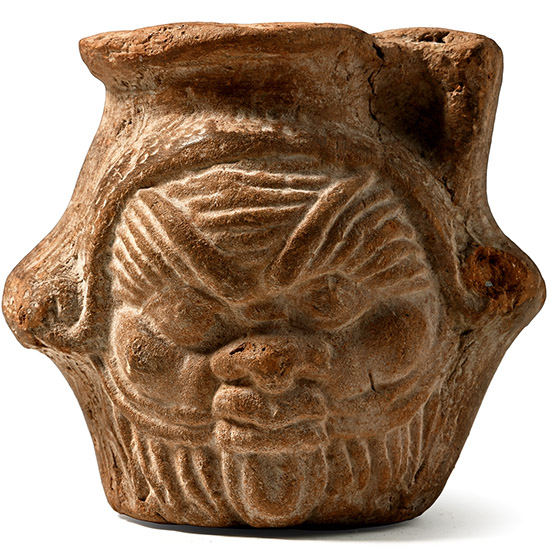
Egyptian Terracotta Bes Vessel
Graeco-Roman Period, 332 B.C.-323 A.D.Estimate: £500 - 700 (+bp*)
Opening Bid: £250
Bulbous in profile, with a short, broad neck, a rolled rim, and an angled handle; obverse with a moulded mask of Bes, with lentoid eyes and a hatched face. 140 grams, 68 mm
From the private collection of Peter Clayton, FCILIP, Dip, Arch, FSA, FRNS, Hemel Hempstead, Hertfordshire, UK; formed since the late 1950s.
Bes, a dwarf deity primarily of the household, was a powerful apotropaic entity who warded off evil spirits, guarded homes, and protected vulnerable family members, especially pregnant women and infants. Bes vessels were thought to imbue their contents with healing properties. Chemical analysis of some Graeco-Roman Bes vessels shows they held hallucinogenic, medicinal, and alcoholic blends explicitly tied to pregnancy rituals and ritual intoxication. During the Graeco-Roman period, mould-made figure vessels and terracotta figurines became very common. By contrast, earlier eras produced almost none of these vessels; only one ceramic example is known from the New Kingdom, and none from the Third Intermediate or Late periods. These mass-produced terracottas allowed non-elites to venerate cult images at home altars or leave them as accessible votive offerings at local sanctuaries. -
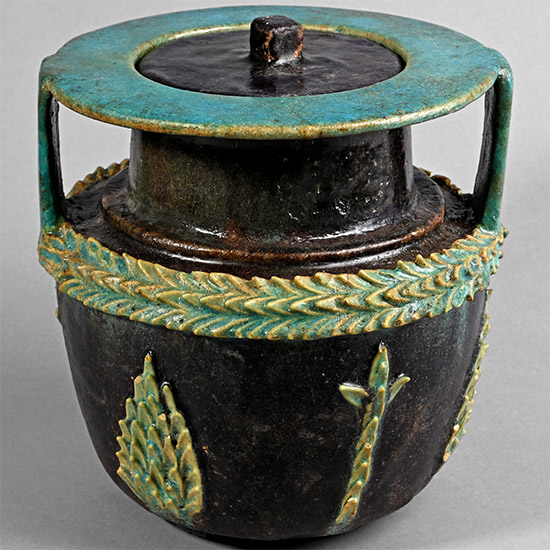
Egyptian Turquoise and Cobalt Blue Faience Amphora
Roman Period, circa 2nd century A.D.Estimate: £8,000 - 10,000 (+bp*)
Opening Bid: £4,000
Barrel-shaped in profile, with a stepped shoulder, wide neck, and broad, flared flange rim at the mouth, supported by two lateral strap handles; applied wreath decoration to the outer edge of the shoulder and vertical fronds to the lower body; restored. 1.48 kg, 17.8 cm high
Stift Neuberg (Neuberg Abbey) collection, Heidelberg, Germany, by 1893 and into the 20th century. Anonymous sale; Münzen und Medaillen, Auktion 41, 1972, no.151. Fiorella Cottier-Angeli collection, Geneva, 1981-2007. Herbert A. Cahn, acquired from the above. With Galerie Günter Puhze, Freiburg, 2007. Private collection, Midwest USA, acquired in 2007. This lot has been checked against the Interpol Database of stolen works of art and is accompanied by search certificate no.13477-262436.
Stift Neuberg was privately owned from 1798 until 1926. By 1893, a collection of antiquities had been assembled there, and its Greek and Roman holdings were published. It is believed that the amphora was acquired as part of this collection by Friedrich Alexander von Bernus (1838–1908), who inherited Stift Neuberg from his relative Johann Friedrich Schlosser (1780-1851), a nephew of Goethe. In 1926, the abbey was sold to the Benedictines and has remained a religious establishment ever since. -
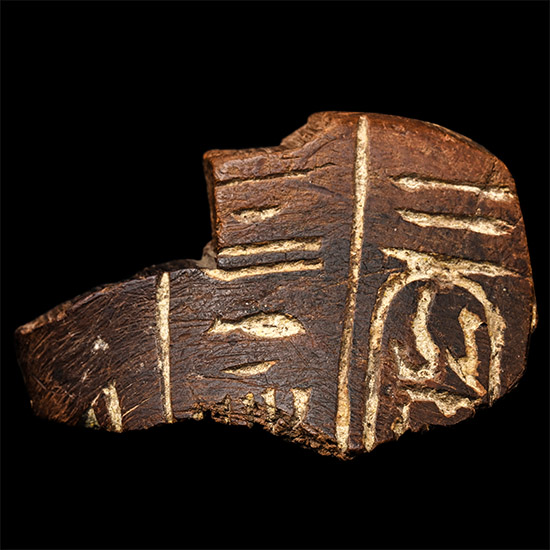
Egyptian Fragment from a Wooden Shabti of Pharaoh Amenhotep III
New Kingdom, 18th Dynasty, 1386-1349 B.C.Estimate: £100 - 140 (+bp*)
Bids: 1 | Current Bid: £5
Fragment of chocolate-coloured wood with incised hieroglyphs inlaid with white paste, preserving the lower part of a cartouche containing Amenhotep III's birth name, with the epithet "Ruler of Thebes" still legible, and two fragmentary columns of hieroglyphs to the right, belonging to a version of the shabti spell. 8.41 grams, 42 mm
From the private collection of Peter Clayton, FCILIP, Dip, Arch, FSA, FRNS, Hemel Hempstead, Hertfordshire, UK; formed since the late 1950s.
Amenhotep III was buried at Thebes in the Valley of the Kings (tomb KV22). His funerary equipment included shabtis in various hardstones and wood. The preserved text, ...ḫnt sḏm.t[n]... ('...forefront; and when you hear...'), belongs to a less common variant of the shabti spell found on other examples of Amenhotep III's shabtis. -
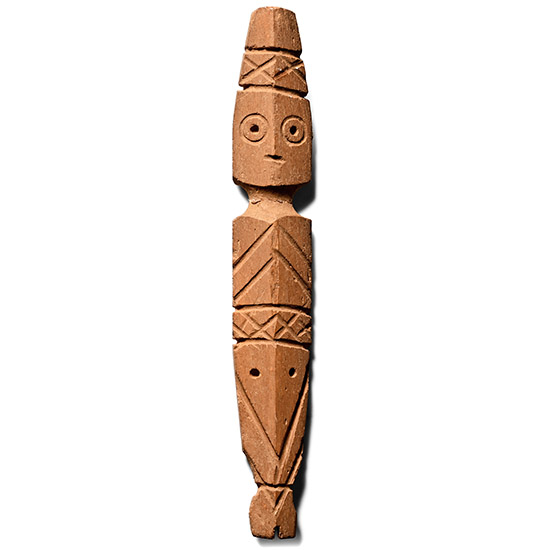
Coptic Carved Bone Doll
Circa 4th-7th century A.D.Estimate: £60 - 80 (+bp*)
Bids: 2 | Current Bid: £15
Plano-convex in section with carinated upper face, incised linear and drilled detailing. 7.92 grams, 10.3 cm
From the private collection of Peter Clayton, FCILIP, Dip, Arch, FSA, FRNS, Hemel Hempstead, Hertfordshire, UK; formed since the late 1950s. -
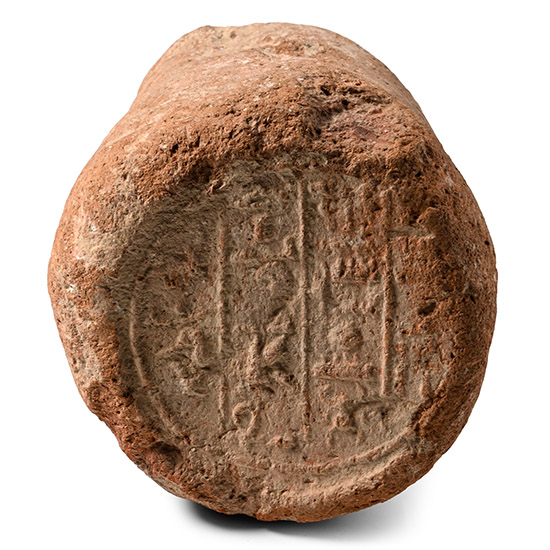
Egyptian Terracotta Funerary Cone of Menkheperreseneb
New Kingdom, 18th Dynasty, 15th century B.C.Estimate: £400 - 600 (+bp*)
Bids: 4 | Current Bid: £150
Front portion of a tapering funerary cone, with the circular flat surface impressed with four vertical columns of hieroglyphs, reading: 'The Osiris, hereditary prince, count, chancellor of the king of Lower Egypt, first god's servant of Amun, Menkheperreseneb, true of voice.' 554 grams, 10.4 cm
Acquired from Abdoul Rassoul on the West Bank at Luxor, 1974-1980 when a guest lecturer. From the private collection of Peter Clayton, FCILIP, Dip, Arch, FSA, FRNS, Hemel Hempstead, Hertfordshire, UK; formed since the late 1950s.
Menkheperreseneb served under the 18th Dynasty pharaoh Thutmosis III. His tomb (TT 86) is in the Theban necropolis at Sheikh Abd el-Qurna. -
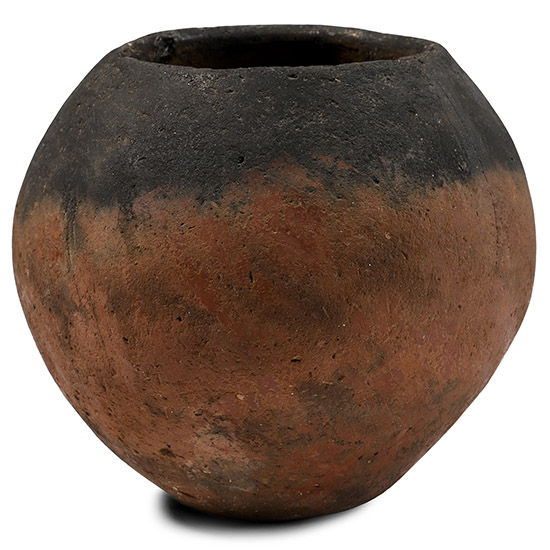
Egyptian Black-Topped Vase
Predynastic Period, Naqada II, circa 4000 B.C.Estimate: £300 - 400 (+bp*)
Bids: 3 | Current Bid: £95
Squat, spherical black-topped storage vase with a flattened base; old collector's ticket: 'Small predynastic Egyptian pot. Round form, flat bottom, usual black top and red body. From Naqada, c. 4000 B.C. Richardson St. Christopher's Mail(?), 27/10/61'. 391 grams, 10.5 cm
From the private collection of Peter Clayton, FCILIP, Dip, Arch, FSA, FRNS, Hemel Hempstead, Hertfordshire, UK; formed since the late 1950s. Accompanied by an old handwritten identification card written by Peter Clayton.
This decorative style's distinctive appearance came from an open-fire or pit-firing method in which the vessel was inverted into ash, organic matter, or smoke-heavy fuel. The buried or inverted top was starved of oxygen and turned black, while the exposed lower portion oxidised to red. -
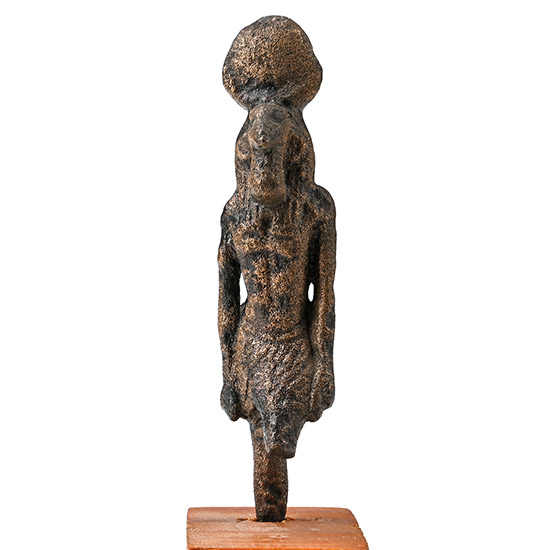
Egyptian Bronze Figure of the God Thoth
Late Period, circa 664-332 B.C.Estimate: £80 - 100 (+bp*)
Bids: 2 | Current Bid: £15
Modelled in the round in advancing pose with ibis head and sun-disc headdress, loop to rear, lower legs absent, display stand; restored in the Institute of Archaeology laboratory. 32.8 grams total, 80 mm including stand
Acquired from Caledonian market, January 1960, for 4 shillings. From the private collection of Peter Clayton, FCILIP, Dip, Arch, FSA, FRNS, Hemel Hempstead, Hertfordshire, UK; formed since the late 1950s. Accompanied by an old handwritten information card by Peter Clayton, collection no.90. -
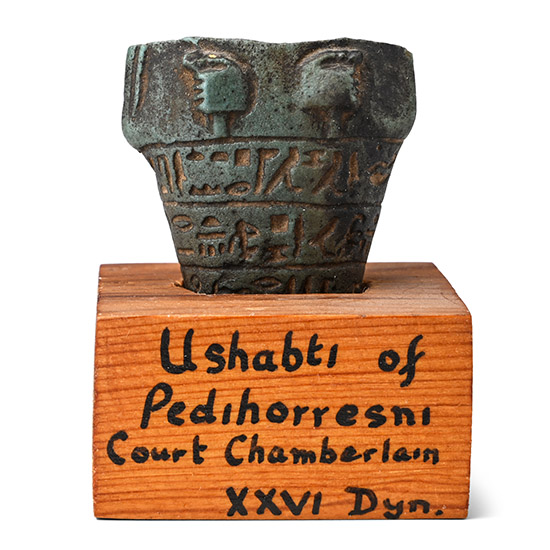
Egyptian Green Stone Shabti Fragment of Padihorresnet, Chief Steward of Amun
Late Period, Reign of Necho, 26th Dynasty, 609-593 B.C.Estimate: £100 - 140 (+bp*)
Bids: 1 | Current Bid: £5
Upper torso fragment with crossed hands, horizontal bands of hieroglyphic text to back and front, display stand with legend 'Ushabti of Pedihorresni, Court Chamberlain XXVI Dyn.'; son of Akhanenru. 30.6 grmas total, 48 mm including stand
Acquired Portabello Road, 14 December 1957, for 5 shillings. From the private collection of Peter Clayton, FCILIP, Dip, Arch, FSA, FRNS, Hemel Hempstead, Hertfordshire, UK; formed since the late 1950s. Accompanied by an old handwritten information card by Peter Clayton, collection no.5.
Padihorresnet served as the chief steward of the God’s Wife of Amun, Nitokris, during the reign of Necho. His monumental tomb (TT 196) is in the Asasif necropolis at Thebes alongside other high officials of the early 26th Dynasty. Padihorresnet's hardstone shabtis lack a back pillar, linking them more closely to the previous 25th Dynasty than to those of the 26th. -
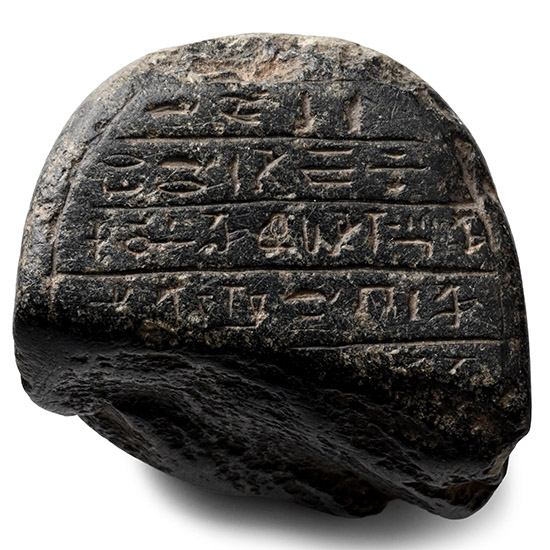
Large Egyptian Black Stone Heart Scarab Fragment
New Kingdom, 1580-1077 B.C.Estimate: £300 - 400 (+bp*)
Bids: 3 | Current Bid: £25
Upper half modelled as a scarab beetle with midlegs and hindlegs, and plain elytra separated from the prothorax by double border lines; the underside bearing five lines of hieroglyphic inscription. 70 grams, 45 mm
From the private collection of Peter Clayton, FCILIP, Dip, Arch, FSA, FRNS, Hemel Hempstead, Hertfordshire, UK; formed since the late 1950s.
The hieroglyphic text presents the final part of Chapter 30b of the Book of the Dead, a spell designed to prevent the deceased's heart from betraying them during the Weighing of the Heart judgment before Osiris. -
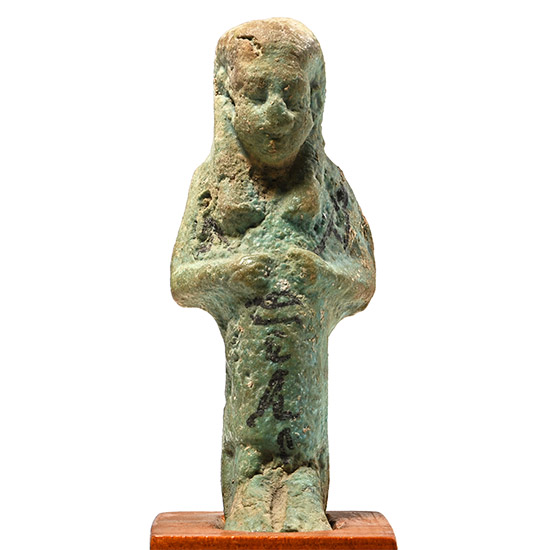
Egyptian Green Glazed Faience Shabti of the Osiris Hori
Third Intermediate Period, 1069-860 B.C.Estimate: £400 - 600 (+bp*)
Bids: 6 | Current Bid: £45
Mummiform figure wearing a lappet wig, hands placed knuckle-to-knuckle at the chest, holding black-painted hoes and a rudimentary seed bag on the back; a column of hieroglyphic inscription on the lower body: 'The Osiris. Hori(?)'; feet modelled in detail; mounted on a custom-made stand. 102 grams total, 12 cm including stand
Acquired from the Egyptian Exploration Society, 30th June 1965, for 2 shillings and sixpence. From the private collection of Peter Clayton, FCILIP, Dip, Arch, FSA, FRNS, Hemel Hempstead, Hertfordshire, UK; formed since the late 1950s. Accompanied by an old handwritten information card by Peter Clayton, collection no.117. -
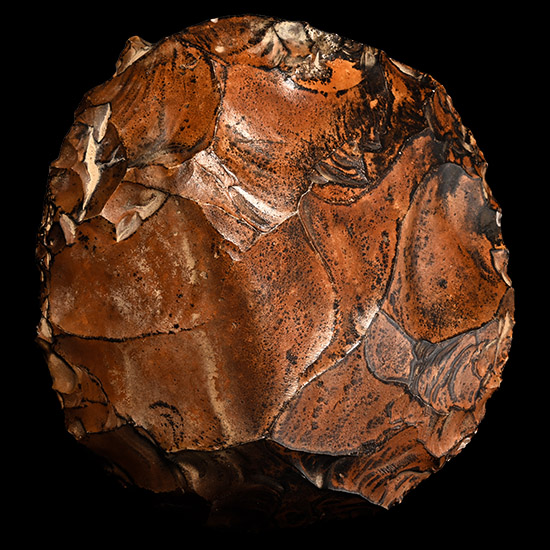
Egyptian Stone Age Knapped Ovate Hand Axe from Thebes
Lower Palaeolithic Period, circa 40,000-35,000 B.P.Estimate: £300 - 400 (+bp*)
Bids: 1 | Current Bid: £5
Biconvex in profile with inked findspot to the butt: 'Desert West of Thebes 1912'. 385 grams, 10.4 cm
Found in the desert west of Thebes, Egypt, 1912. Acquired from Sotheby's, 16 June 1959 (part), £4.10. From the private collection of Peter Clayton, FCILIP, Dip, Arch, FSA, FRNS, Hemel Hempstead, Hertfordshire, UK; formed since the late 1950s. Accompanied by a copy of an old handwritten identification card written by Peter Clayton.
