-

Egyptian Bronze Kneeling Figure of a King
Late Period-Ptolemaic Period, circa 664-30 B.C.Estimate: £25,000 - 35,000 (‡+bp*)
Opening Bid: £13,000
A solid cast statuette modelled in the round as a kneeling pharaoh wearing a thigh-length shendyt kilt, a broad collar and a nemes headdress adorned with a uraeus to the brow; with open hands positioned as though they once held an object, palms facing inward; mounted on a custom-made stand. 1.62 kg total, 16.7 cm high including stand
Private collection, E.M. (1880-1954), since the 1930s. Accompanied by an academic report by Egyptologist Paul Whelan. This lot has been checked against the Interpol Database of stolen works of art and is accompanied by search certificate no.13196-249244.
The figure's overall appearance, particularly the muscular upper body, resembles two kneeling bronze figures – Brooklyn Museum 71.11 and Pennsylvania Museum E.13004 – both bearing the cartouche of 26th Dynasty pharaoh Necho II (610-595 BC). Unlike the varied poses of kneeling stone statues, those in bronze consistently rest on their knees and toes, with heels positioned under their buttocks. Figures with this hand gesture are often thought to have originally held an offering vessel or ritual object. However, none of the existing examples shows signs of having held an object. Instead, the gesture may symbolise both giving and receiving, representing veneration, offering, and a plea for protection to a particular deity. -
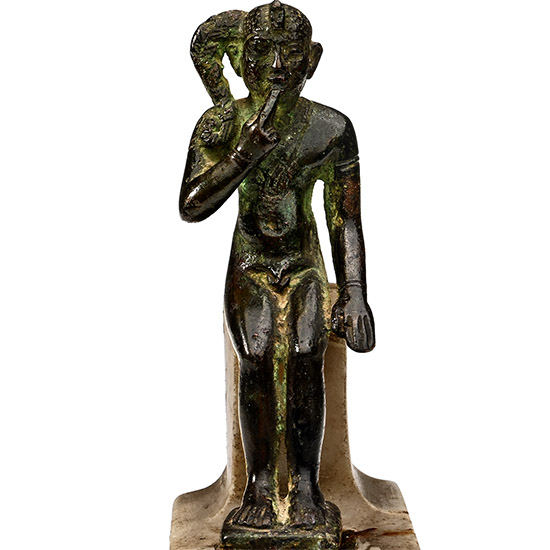
Egyptian Bronze Statuette of Harpocrates
3rd century B.C.Estimate: £2,000 - 3,000 (‡+bp*)
Opening Bid: £1,100
Votive statuette with youthful locks and a uraeus on his forehead; wearing the heart amulet around his neck; depicted nude, holding his finger to his mouth, a gesture identifying him as a child god; feet resting on a plinth. 281 grams, 10.7 cm high
Ex Tschudi Carlin, circa 1920. with Cahn Auktionen AG, Basel, Young Collectors Auction, 2015, no.147. This lot has been checked against the Interpol Database of stolen works of art and is accompanied by search certificate no.13472-263066.
Harpocrates is the Greek equivalent of the Egyptian name Hor-pa-khered, which means ‘Horus the Child’. This name refers to Horus as the divine infant of Isis and Osiris. Wearing an amulet of Harpocrates was believed to provide the same protection that Isis granted to her beloved son. Larger bronze statuettes were probably votive offerings to Harpocrates, intended to secure his favour and protection. -
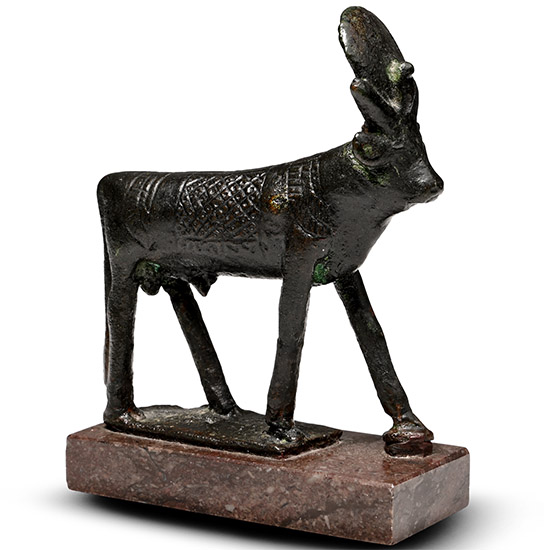
Egyptian Bronze Votive Apis Bull Statue
Ptolemaic Period, 2nd-1st century B.C.Estimate: £1,200 - 1,700 (‡+bp*)
Opening Bid: £650
Small votive statuette of a bull advancing with a sun disc and uraeus between the horns, on a rectangular plinth; incised caparison and two falcons with outstretched wings on its back; phallus and testicles present; mounted on a custom-made stand. 90 grams total, 72 mm high including stand
Ex Zurich art market, 1980s. Private collection Brigitte Leu, Zurich, between 1980 and 2003.
In Ancient Egypt, bull deities embodied aspects of fertility or the creative power of certain gods, such as Ra. Originally, the Apis bull was a fertility god in his own right, but he could also merge syncretically with other deities. For example, the creator god Ptah of Memphis found his "living repetition" in the Apis bull. When an Apis bull died, it was given a lavish funeral and interred in a magnificent hard-stone sarcophagus within the dedicated catacombs at Saqqara known as the Serapeum. -
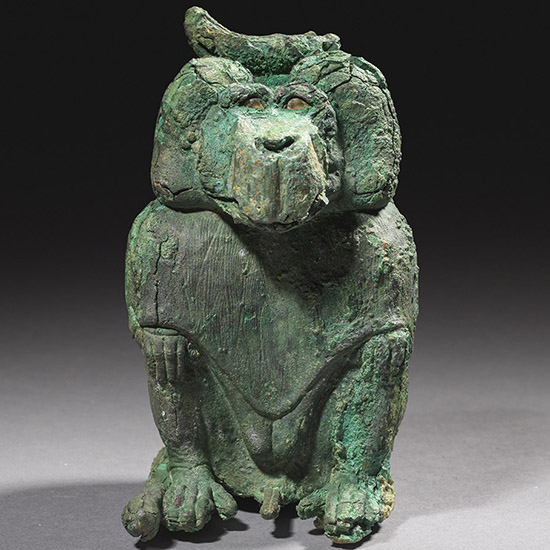
Large Egyptian Bronze Figure of Thoth
Late Period, 26th-30th Dynasty, 664-343 B.C.Estimate: £8,000 - 10,000 (+bp*)
Opening Bid: £4,000
Hollow-cast depiction of the baboon manifestation of the god Thoth, seated on its haunches, front paws resting on the knees of its back legs, genitalia exposed, a thick cowl of fur around its shoulders, and a long tail curling from the back; remains of a crescent moon sit on the crown of its head, preserving traces of gilding (this may originally have been surmounted by a full moon disc); the animal’s coat is rendered naturalistically with fine incised detailing, and the hands and feet are delicately portrayed, with knuckles and nails accurately defined; facial features are strongly modelled; the eye inlays, most likely glass or quartz, survive, with pupil and white differentiated; stabilised. 810 grams, 11.8 cm (1.59 kg total, 22.1 cm high including stand)
Condition: Some cracking of the original metal, particularly around the head, shoulders, and tail; much of the crown now lost; heavy corrosion and oxidisation, now stabilised.
Collection of Max Willborg (1933-2001), Stockholm, Sweden, acquired 1981. This lot has been checked against the Interpol Database of stolen works of art and is accompanied by search certificate no.13521-263440.
Because of its curious behaviour at dawn, when it sits upright on its hind legs, waves its front paws in the air, and screeches, the baboon was regarded as a creature of the sun god, as if it had foreknowledge of the sun’s arrival. More commonly, however, it was associated with the moon, under whose light this performance takes place. As a result, the baboon (both Papio cynocephalus, the dog-headed baboon, and P. hamadryas) was the form adopted by the Egyptian lunar gods Khonsu of Thebes and Thoth of Hermopolis in Middle Egypt. Images such as this are assumed to represent Thoth unless an inscription specifically names Khonsu. Thoth was Lord of Time, inventor of writing, and patron of scribes. The original animal manifestation associated with Thoth may have been the ibis, and his baboon form may have been adopted only when the cult of the god was extended to Hermopolis, where a baboon known as the Great White was already adored. -
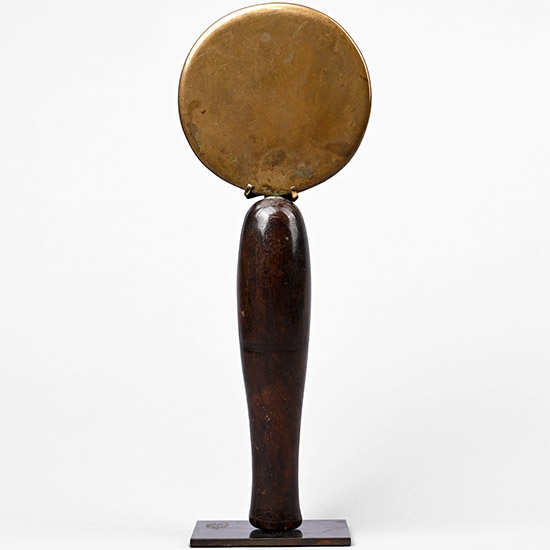
Egyptian Bronze Mirror with Wooden Handle
New Kingdom, 18th-20th Dynasty, 1550-1070 B.C.Estimate: £4,000 - 6,000 (+bp*)
Opening Bid: £2,000
The rounded cylindrical handle narrowing towards the base and decorated with three horizontal bands; the circular, heavy bronze mirror highly polished and relatively small; accompanied by a custom-made display stand. 766 grams total, 29 cm high including stand
with Rupert Wace, Ancient Art, 2003. Private collection, UK. This lot has been checked against the Interpol Database of stolen works of art and is accompanied by search certificate no.13517-263432.
The club-type handle resembles the hieroglyph hem, which can mean 'servant'. Therefore, the handle is thought to represent the mirror disc's servant. This type appears in pictorial scenes; for example, a similar smaller disc mirror with a hem handle is depicted in the Theban tomb (TT 60) of Senet (Davies, N.de G., The Tomb of Antefoker, Vizier of Sesostris I, and of His Wife, Senet, London 1930, pl. 30), and another with a larger disc and a shorter hem handle is depicted on the inside of the coffin of Sebeka (Steindorff, G., Grabfunde des mittleren Reichs in den königlichen Museen zu Berlin. Part 2: Der Sarg des Sebk.-o.- ein Grabfund aus Gebelen, Berlin, 1896, 2, pl. 2). -
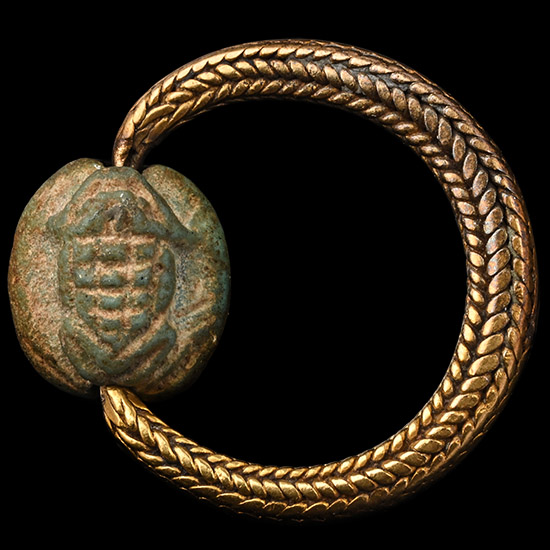
Egyptian Gold Ring with Faience Frog Amulet
Third Intermediate Period, 21st-22nd Dynasty, circa 1085-713 B.C.Estimate: £1,800 - 2,400 (‡+bp*)
Opening Bid: £900
Glazed composition discoid panel with high-relief frog motif, pierced; mounted on a finger ring of braided gold wire. 6.69 grams, 25.25 mm overall, 17.68 x 15.08 mm internal diameter (approximate size British L 1/2, USA 6, Europe 11.87, Japan 11)
Acquired from Derek Content, 13 February 1976. Private collection of Kal Noselson, New York, acquired between 1976 and the late 1990s; thence by descent. Accompanied by an original handwritten invoice from Derek Content, 13 February 1976. This lot has been checked against the Interpol Database of stolen works of art and is accompanied by search certificate no.13454-259917. -
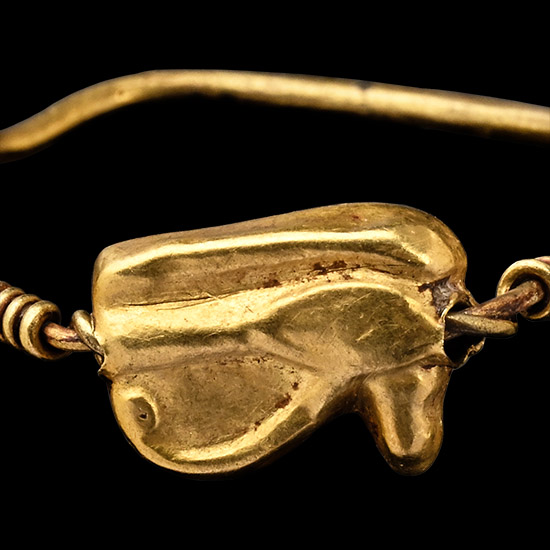
Graeco-Egyptian Gold Swivel Ring with Wedjat-eye
Circa 2nd-1st century B.C.Estimate: £1,000 - 1,400 (‡+bp*)
Opening Bid: £500
Slender wire hoop with ends coiled round the shank; swivel-mounted hollow-formed wedjat-eye forming the bezel. 1.10 grams, 22.15 mm overall, 18.22 x 18.65 mm internal diameter (approximate size British O 1/2, USA 7 1/4, Europe 15.61, Japan 15)
Acquired from Derek Content, 1 October 1983. Private collection of Kal Noselson, New York, acquired between 1976 and the late 1990s; thence by descent. Accompanied by an original invoice from Derek Content, dated 1 October 1983.
The wedjat-eye amulet represents the healed eye of the god Horus and embodies both human and falcon features. The name wedjat in ancient Egyptian means ‘the one that is sound’. According to Egyptian mythology, the god Seth wounded or took Horus' eye, and Thoth later restored it. The wedjat-eye amulet was believed to protect its wearer and bestow healing and regenerative qualities. It was a popular amuletic symbol worn by both the living and the dead and was reproduced in precious metals, stone, and faience. -
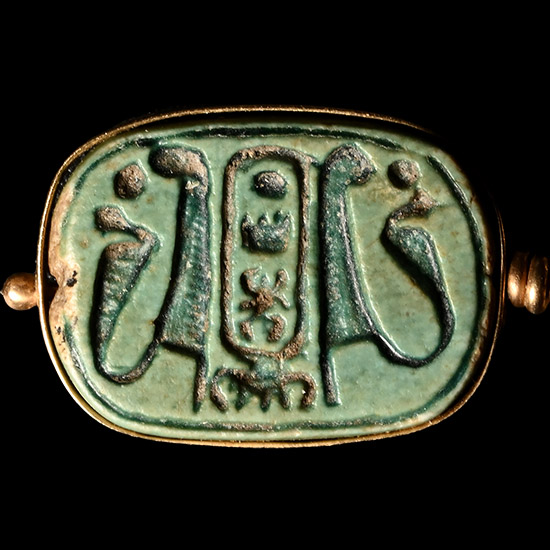
Egyptian Blue Faience Scarab with Cartouche in Gold Loop
Late Period, 664-332 B.C.Estimate: £600 - 800 (‡+bp*)
Opening Bid: £300
Ellipsoid in plan, with a gold frame to the edge, a mounting loop, and a granule finial; obverse with a cartouche of Thutmosis III flanked by addorsed uraei attached to Maat feathers; reverse with an advancing lion, with the hieroglyphs for 'lord of the two lands' behind it and those for 'good god' over its body, facing another cartouche of Thutmosis III. 2.43 grams, 29 mm
Private collection of Kal Noselson, New York, acquired between 1976 and the late 1990s; thence by descent. Accompanied by the collector's original inked images. -
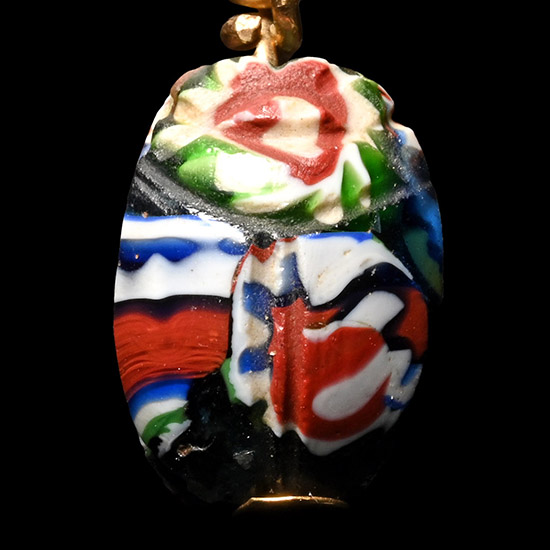
Egyptian Millefiori Glass Scarab
Late Period, 664-332 B.C.Estimate: £500 - 700 (‡+bp*)
Opening Bid: £250
With a gold pin and suspension ring, polychrome glass body, plain underside; mounted in an 18ct gold bezel for hanging as a pendant, by BERJ, at Cluster Jewellers. 2.24 grams, 24 mm
Acquired from Derek Content, September 1974. Private collection of Kal Noselson, New York, acquired between 1976 and the late 1990s; thence by descent. Accompanied by an original handwritten invoice from Derek Content; a typed collector's note recording the purchase from Derek Content in September 1974; and the collector's original inked images. -
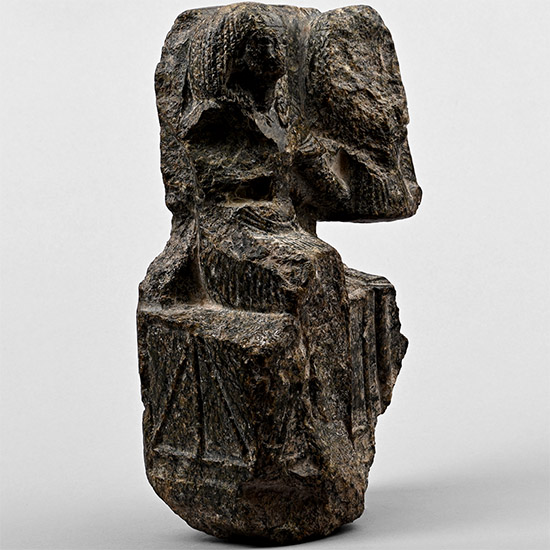
Egyptian Serpentine Statuette of a Seated Couple
New Kingdom, 19th Dynasty, 1290-1279 B.C.Estimate: £15,000 - 20,000 (‡+bp*)
Opening Bid: £8,200
Depicting a husband and wife seated side-by-side on chairs, each with an arm around the spouse's waist as a sign of intimacy; both wearing richly pleated robes, the man sporting a duplex wig and earrings, the woman with a longer wig with tassel ends, both composed of long rows of tight curls; the back slab with low-relief depictions of a standing man and woman facing each other, with traces of a hieroglyphic inscription; the surface slightly worn and abraded in places; reassembled from two parts. 3.89 kg, 24.5 cm
From the estate of the artist Margo Veillon (1907-2003), Lausanne, Switzerland.
The statuette is delicately sculpted and of high quality. The fine facial features of the official, the individual strands of the wigs and the pleats of the robes exhibit exquisite craftsmanship. Remarkably, the reverse of the sculpture is decorated with a fragmentarily preserved scene, most likely of the couple, with traces of inscription. -
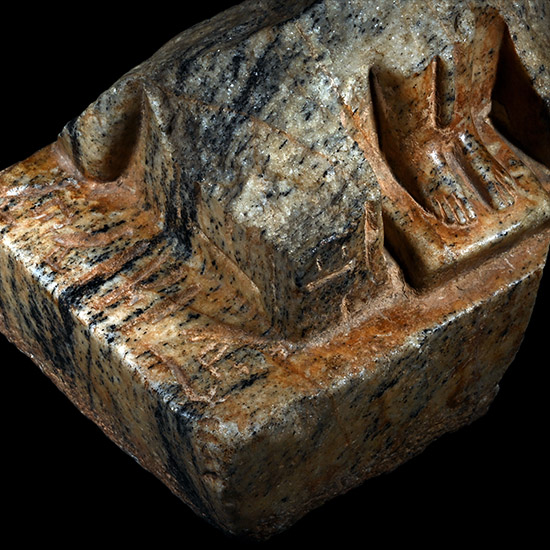
Egyptian Fragment of a Naophorus Statue
New Kingdom, 18th-20th Dynasty, 1540-1069 B.C.Estimate: £1,800 - 2,400 (+bp*)
Opening Bid: £900
Fragment of a kneeling figure offering a naos (shrine) before him, on a substantial plinth; preserving both knees of the main figure, a lower portion of the naos containing the lower legs of a seated deity holding a staff or sceptre, with traces of hieroglyphic inscription on the naos front and sides, and on the preserved top edge of the plinth. 5.75 kg total including stand, 16.5 cm wide
UK collection, acquired 1970s-1990s. This lot has been checked against the Interpol Database of stolen works of art and is accompanied by search certificate no.13520-263439. -
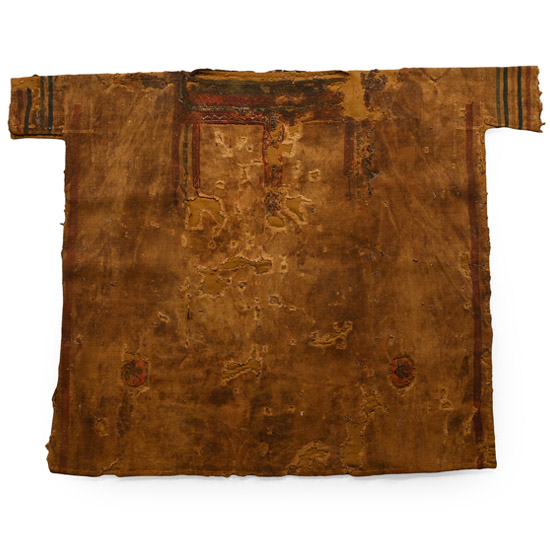
Large Egyptian Coptic Male Textile Tunic Embroided with Segmenta, Clavi, and Orbiculi with Human Figures
Circa 7th-9th century A.D.Estimate: £1,200 - 1,700 (+bp*)
Bids: 1 | Current Bid: £5
Complete tunic patterned with a large tapestry-woven neck panel in red and green wool, with three descending clavi divided into three pendant terminals, the inside ornamented with geometric patterns; the red wool used as twining to outline the edge of the neck and the clavi; two small orbiculi visible on the shoulders in dark blue wool, two other orbiculi applied on the thighs, on both sides of the tunic, two of them decorated with a warrior dwarf holding a shield in green, red and yellow wool; the short sleeves ornamented with four stripes (loroi) in dark red, dark blue, blue-purple and green wool; lateral red clavi running along the sides; the sides and the sleeves finished with short fringes of twisted loops. 1.03 kg total including paper folder, 102 x 76 cm
Acquired 1970s-1996. Property of a North American collector. London collection, 2016. Accompanied by an academic report by Dr Raffaele D'Amato.

