-
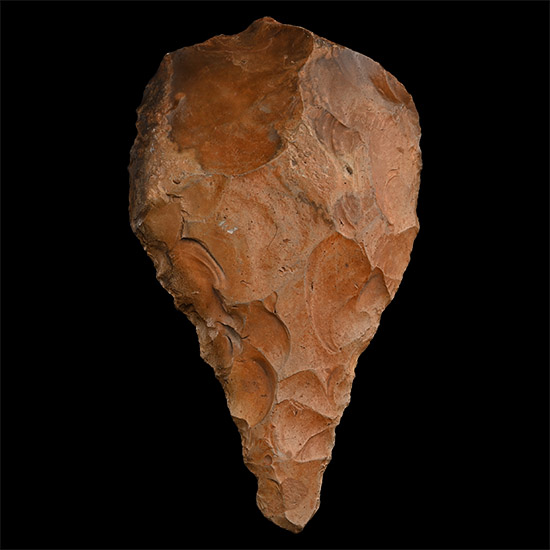
Egyptian Stone Age Knapped Classic Ficron Handaxe
Lower Palaeolithic Period, Acheulean, circa 200,000 B.P.Estimate: £400 - 600 (+bp*)
Bids: 1 | Current Bid: £5
Classic bifacial, teardrop- or pear-shaped form, with a broad, rounded butt and tapering sides that terminate in a pointed tip. 399 grams, 16.5 cm
From the collection of A.D. Passmore (1879-1958); his collection of flints from the area of Stonehenge was donated to the Ashmolean Museum in the 1950s. From the private collection of Peter Clayton, FCILIP, Dip, Arch, FSA, FRNS, Hemel Hempstead, Hertfordshire, UK; formed since the late 1950s. Accompanied by a copy of an old handwritten information card by Peter Clayton. -
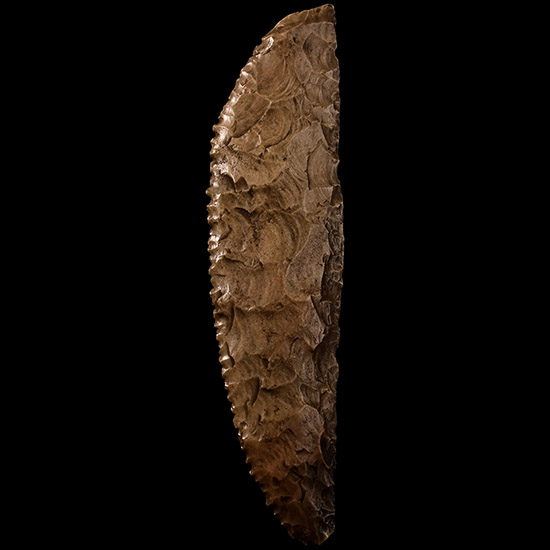
Large Egyptian Stone Age Knapped Curved Saw Blade from Thebes
Neolithic Period, 11,000-5,200 B.P.Estimate: £400 - 600 (+bp*)
Bids: 9 | Current Bid: £95
Large ripple-flaked blade with a curving, serrated cutting edge. 80.5 grams, 17 cm
Found Thebes. From the collection of A.D. Passmore (1879-1958); his collection of flints for the area of Stonehenge was donated to the Ashmolean Museum in the 1950s. From the private collection of Peter Clayton, FCILIP, Dip, Arch, FSA, FRNS, Hemel Hempstead, Hertfordshire, UK; formed since the late 1950s. Accompanied by a copy of an old handwritten information card by Peter Clayton. -
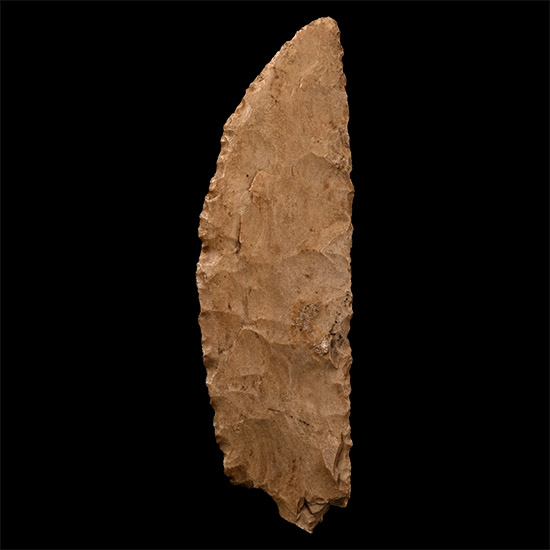
Egyptian Stone Age Knapped Honey-Coloured Flint Knife
Predynastic Period, circa 3500-3000 B.C.Estimate: £400 - 600 (+bp*)
Bids: 2 | Current Bid: £10
Knapped knife with curved edge; with old collector's record card detailing place of purchase and other details. 41.1 grams, 12.3 cm
Ex Puys-Aubert collection, Alexandria, March 1963, for 6 shillings. From the private collection of Peter Clayton, FCILIP, Dip, Arch, FSA, FRNS, Hemel Hempstead, Hertfordshire, UK; formed since the late 1950s. Accompanied by an old typed information card by Peter Clayton, collection no.106. -
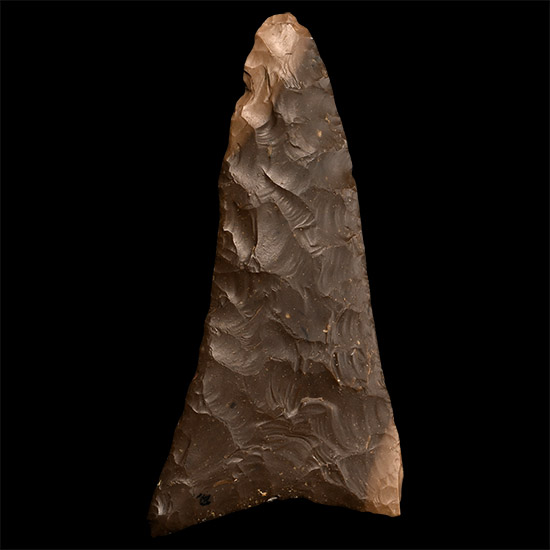
Egyptian Knapped Stone Fish-Tailed Knife
Predynastic Period, circa 3,500-3,000 B.C.Estimate: £500 - 700 (+bp*)
Bids: 2 | Current Bid: £10
With long edges knapped, a rounded point, a forked end, and a rippled surface; with an old collector's record card detailing place of purchase and other details. 38.6 grams, 11.5 cm
Acquired from Elgin Antiques, Portobello Road, 26th November 1960, for £2.00. From the private collection of Peter Clayton, FCILIP, Dip, Arch, FSA, FRNS, Hemel Hempstead, Hertfordshire, UK; formed since the late 1950s. Accompanied by an old handwritten information card by Peter Clayton, collection no.77.
These objects were crafted from fine flint and featured a narrow, pointed handle end, once hafted into wood, ivory, bone, or gold, and a broad, serrated, forked blade. Originally used during life, possibly to cut an infant's umbilical cord, they were later placed in male graves as elite ceremonial or funerary objects. Egyptologists often associate them with the pesesh-kef tool used in the funerary 'Opening of the Mouth' ceremony, which symbolically restored breath and the senses to a mummy or statue. -
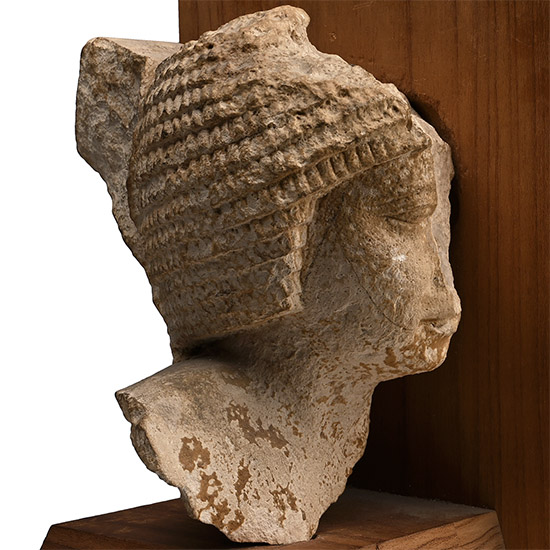
Egyptian Limestone Head of a Noble Wearing a Curled Wig
Old Kingdom, 5th-6th Dynasty, circa 2498-2181 B.C.Estimate: £2,000 - 3,000 (+bp*)
Bids: 2 | Current Bid: £10
Fragmentary limestone head of an elite official carved in the round, wearing a characteristic short wig composed of rows of small, tight concentric curls that completely cover the ears and terminate evenly at the brow; the rounded right side of the face preserves a carefully rendered almond-shaped eye, a raised relief eyebrow, and small yet prominent lips, with a custom wooden mount. 2.91 kg total, 25.4 cm high including stand
From the private collection of Norman Davis, Seattle, U.S.A. Received as a gift from Norman Davis in 1973. From the private collection of Peter Clayton, FCILIP, Dip, Arch, FSA, FRNS, Hemel Hempstead, Hertfordshire, UK; formed since the late 1950s. This lot has been checked against the Interpol Database of stolen works of art and is accompanied by search certificate no.13519-262983. -
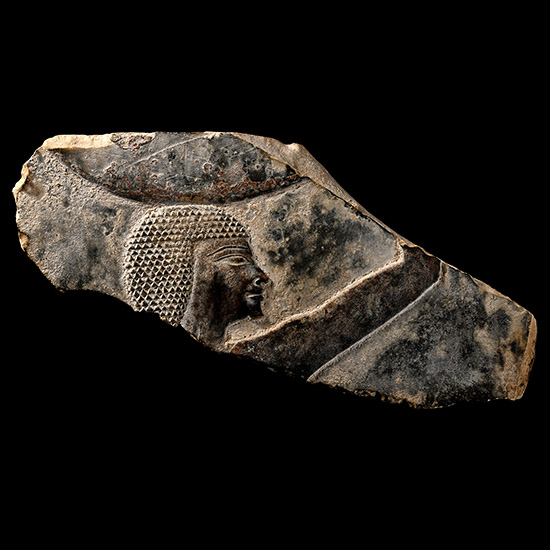
Egyptian Limestone Relief Fragment of a Man
26th Dynasty, 664-525 B.C.Estimate: £1,000 - 1,400 (+bp*)
Bids: 4 | Current Bid: £160
An irregular, elongated limestone fragment intricately carved in low, raised relief, depicting the head and neck of a male figure facing right, wearing a tightly curled wig and a short beard, his arm extended upwards, likely to support the large basket resting on his head. 180 grams total including stand, fragment: 14.5 cm wide
From the private collection of Peter Clayton, FCILIP, Dip, Arch, FSA, FRNS, Hemel Hempstead, Hertfordshire, UK; formed since the late 1950s.
The downturned eyebrow above an almond-shaped eye with a sharply defined eyelid and a long, thin cosmetic line, the small, fairly rounded nose with a lightly drilled nostril above rather thick lips, and the chin below obscured by the short beard are characteristic of the archaising style of the early 26th Dynasty. Artisans of that period adapted and refined earlier Old Kingdom artistic traditions, most apparent in the tomb scenes of high officials at Thebes, particularly those of Montuemhat (see the discussion: der Manuelian, P., 'Two Fragments of Relief and a New Model for the Tomb of Montuemhet at Thebes', Journal of Egyptian Archaeology 71 (1985), pp. 98–121). -
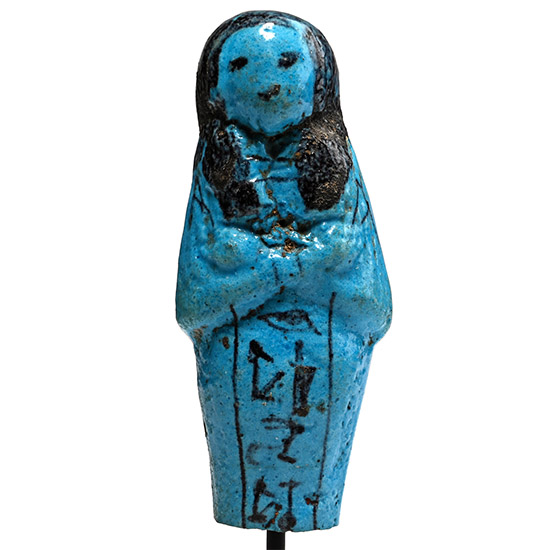
Egyptian Bright Blue Glazed Faience Shabti of Wennefer
New Kingdom, circa 1292-1069 B.C.Estimate: £600 - 800 (+bp*)
Opening Bid: £5
Upper half of a mummiform figure (feet missing), with a black-painted tripartite wig, crossed arms subtly modelled in relief, and hands holding hoes rendered in black; two globular water pots (?) on the back, with a bold black line beneath; a hieroglyphic text on the lower body, reading: 'The Osiris Wennefer'; mounted on a display stand. 61 grams total, 11 cm including stand
Acquired from the Egyptian Exploration Society, 30th June 1965, for 2 shillings and sixpence. From the private collection of Peter Clayton, FCILIP, Dip, Arch, FSA, FRNS, Hemel Hempstead, Hertfordshire, UK; formed since the late 1950s. Accompanied by an old handwritten information card by Peter Clayton, collection no.118.
Wennefer, a common name, particularly in the New Kingdom and the Third Intermediate Period, which loosely translates as 'the perfect being', was also an epithet of Osiris. -
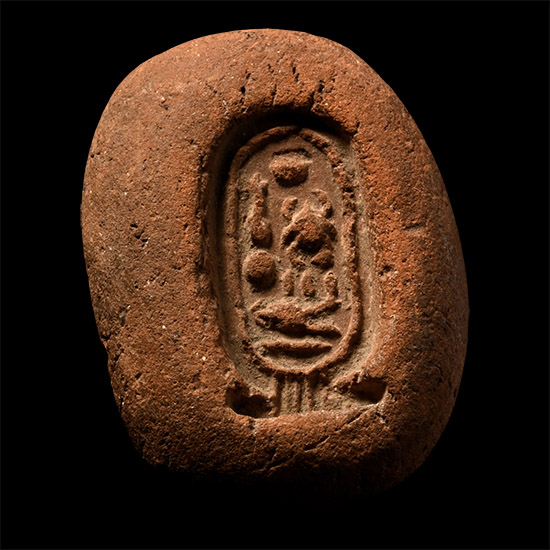
Egyptian Terracotta Mould with Impression of the Cartouche of Pharaoh Akhenaten
New Kingdom, 18th Dynasty, Amarna Period, 1353-1332 B.C.Estimate: £400 - 600 (+bp*)
Opening Bid: £5
Rounded tongue-shaped mould with an impressed cartouche containing the throne name of Akhenaten, Nefer-kheperu-Re (meaning 'Beautiful are the Manifestations of Re'). 4.26 grams, 25 mm
Acquired 7th February 1962, for 5 shillings. From the private collection of Peter Clayton, FCILIP, Dip, Arch, FSA, FRNS, Hemel Hempstead, Hertfordshire, UK; formed since the late 1950s. Accompanied by an old handwritten information card by Peter Clayton, collection no.86.
Moulds like this were used to produce faience amulets or inlays bearing the pharaoh's cartouche. Akhenaten's throne name, Nefer-kheperu-Re, remained unchanged throughout his reign, while his birth name changed from Amenhotep IV ('Amun is satisfied') to Akhenaten ('Servant of the Aten'). -
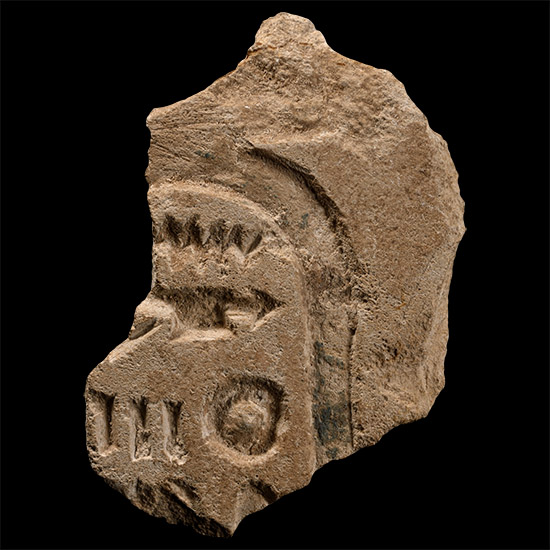
Egyptian Limestone Fragment with Cartouche of Pharaoh Akhenaten
New Kingdom, 18th Dynasty, Amarna Period, 1353-1332 B.C.Estimate: £800 - 1,000 (+bp*)
Bids: 1 | Current Bid: £5
Irregular fragment with a partial cartouche in sunk relief, containing the final part of Akhenaten's throne name, Nefer-kheperu-Re (meaning 'Beautiful are the Manifestations of Re'), with traces of blue and white pigment. 157 grams, 10.5 cm
Acquired in March 1977. From the private collection of Peter Clayton, FCILIP, Dip, Arch, FSA, FRNS, Hemel Hempstead, Hertfordshire, UK; formed since the late 1950s. Accompanied by an old handwritten information card by Peter Clayton, collection no.128.
Due to the destruction of Akhenaten's royal city, Akhetaten, most monuments and statuary were recovered in fragmentary condition (for example, Peet, T.E., Woolley, C.L., The City of Akhenaten, Part I, Excavations of 1921 and 1922 at el-'Amarneh, London, 1923, pls. XXXII-XXXIV, for several fragmentary architectural elements bearing Akhenaten's cartouches). -
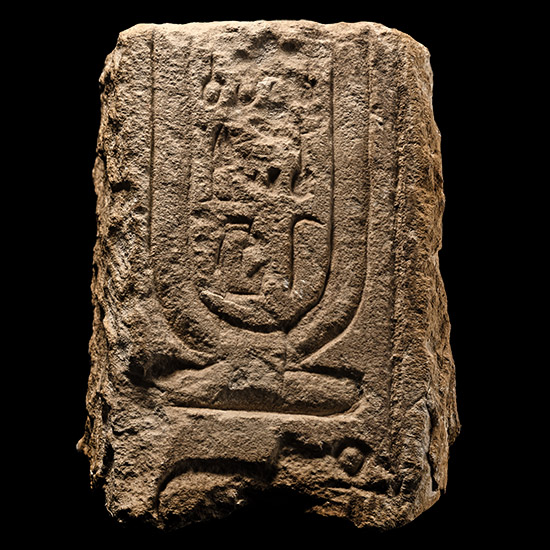
Egyptian Limestone Block from a Tomb with Cartouche of Queen Nefertiti
New Kingdom, 18th Dynasty, Amarna Period, 1353-1332 B.C.Estimate: £4,000 - 6,000 (+bp*)
Opening Bid: £5
Rectangular block with a dressed face, preserving most of a low-relief cartouche containing Nefertiti's name, 'Neferneferu[aten] Nefertiti'. 1.13 kg, 11.2 cm
Acquired in March 1977. From the private collection of Peter Clayton, FCILIP, Dip, Arch, FSA, FRNS, Hemel Hempstead, Hertfordshire, UK; formed since the late 1950s. Accompanied by an old handwritten information card by Peter Clayton, collection no.129. This lot has been checked against the Interpol Database of stolen works of art and is accompanied by search certificate no.13493-262901.
Most inscribed objects related to Akhenaten or his family were systematically smashed or defaced after his death. Some scholars think that Nefertiti then took the royal name Neferneferuaten and may have served as a co-regent or an independent ruler. -
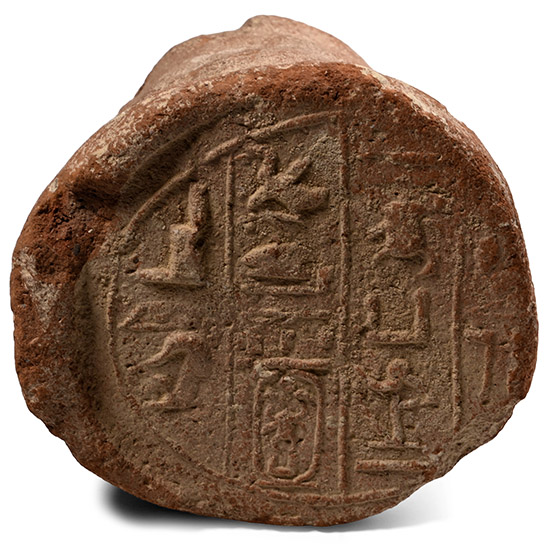
Egyptian Terracotta Funerary Cone of Aakheperka
New Kingdom, 18th Dynasty, circa 1400 B.C.Estimate: £500 - 700 (+bp*)
Opening Bid: £5
The front portion of a tapering funerary cone with the flat circular end impressed with three complete and one partial column of hieroglyphic text, reading: 'The Osiris, weapons bearer of Thutmose I, Aakheperka, true of voice [before the great] god'. 413 grams, 93 mm
Acquired from Abdoul Rassoul on the West Bank at Luxor, 1974-1980, when a guest lecturer. From the private collection of Peter Clayton, FCILIP, Dip, Arch, FSA, FRNS, Hemel Hempstead, Hertfordshire, UK; formed since the late 1950s.
Aakheperka's tomb remains unknown. -
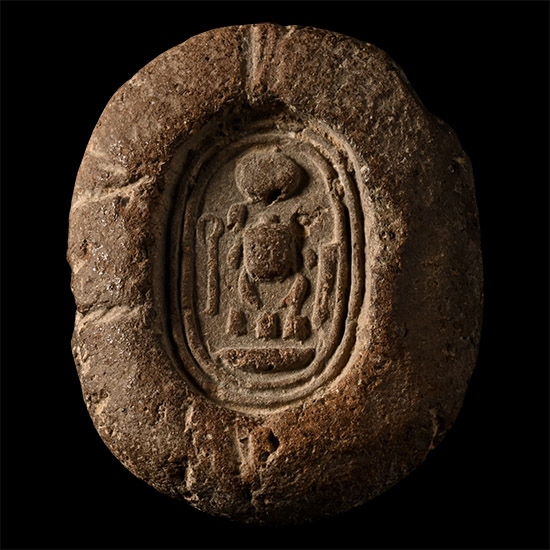
Egyptian Terracotta Mould with Impression of the Cartouche of Pharaoh Tutankhamun
New Kingdom, 18th Dynasty, circa 1342-1323 B.C.Estimate: £500 - 700 (+bp*)
Bids: 5 | Current Bid: £190
Ellipsoid in plan with an impressed cartouche for 'Tutankhamun, ruler of Hermonthis'. 6.5 grams, 29 mm
Acquired Caledonian market, November 1958, for 2 shillings and sixpence. From the private collection of Peter Clayton, FCILIP, Dip, Arch, FSA, FRNS, Hemel Hempstead, Hertfordshire, UK; formed since the late 1950s. Accompanied by an old handwritten information card by Peter Clayton, collection no.50.
Moulds like this were often used to produce faience ring bezels (cf. Seyfried, F. (ed.), In the Light of Amarna: 100 Years of the Nefertiti Discovery, Berlin, 2012, p. 100, fig. 2, for an example of a similar mould and a faience ring bezel for Akhenaten). Hermonthis, also known as Armant, was called ı͗wnu-šmꜤw by the ancient Egyptians and regarded as the southern counterpart to the solar temple complex at Heliopolis.

