-
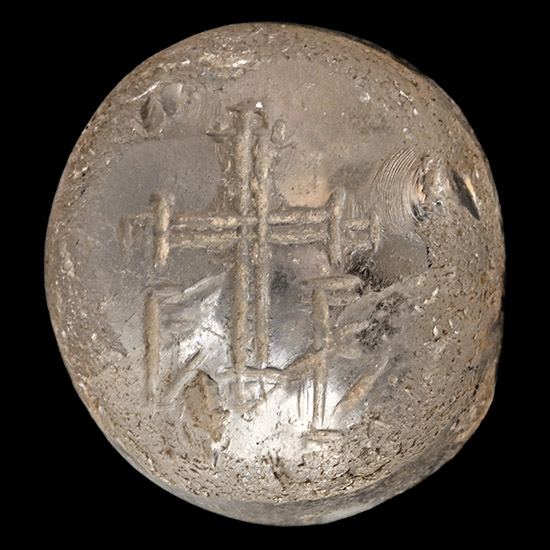
Byzantine Rock Crystal Stamp Seal with Cross
7th-8th century A.D.Estimate: £500 - 700 (‡+bp*)
Opening Bid: £250
Bullet-shaped with domed top and transverse piercing; underside with incuse cross potent and flanking figures; supplied with an impression. 9.54 grams, 23 mm
Private collection of Kal Noselson, New York, acquired between 1976 and the late 1990s; thence by descent. -
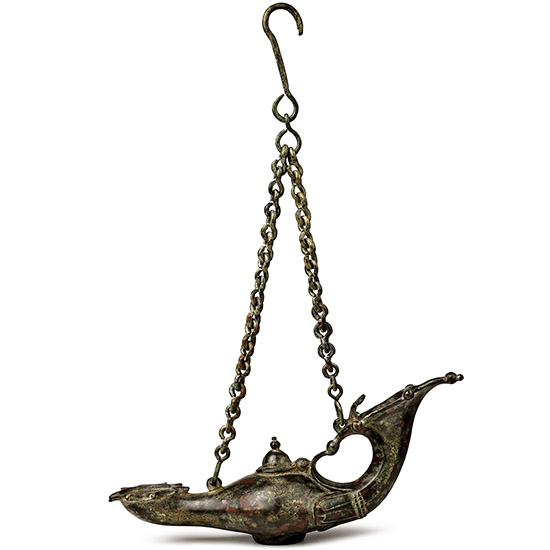
Byzantine Bronze Oil Lamp with Chain and Chi Rho
Circa 5th-6th century A.D.Estimate: £3,500 - 4,500 (‡+bp*)
Opening Bid: £1,750
With a carinated, round body and long, narrow nozzle with a flaring finial, a scalloped rim around the circular wick hole; small circular filling hole with a hinged, domed lid; the elaborate trumpet-shaped handle with a hexagonal lotus flower finial with knops, and a raised Chi Rho at the forward edge; looped suspension chain with a hook, and a square socket at the base to accommodate a stand pricket. 1.08 kg, 40 cm
Private collection, Stortford, England, 1982. with Christie's, New York, 9 June 2011, no.203. Accompanied by an academic report by Dr Raffaele D'Amato. This lot has been checked against the Interpol Database of stolen works of art and is accompanied by search certificate no.13194-250130.
These lamps were produced in the Eastern Mediterranean, possibly in more than one centre (one was certainly in Syracuse, Benevento, another probably in Asia Minor, but some specimens come from Rome and Constantinople). -
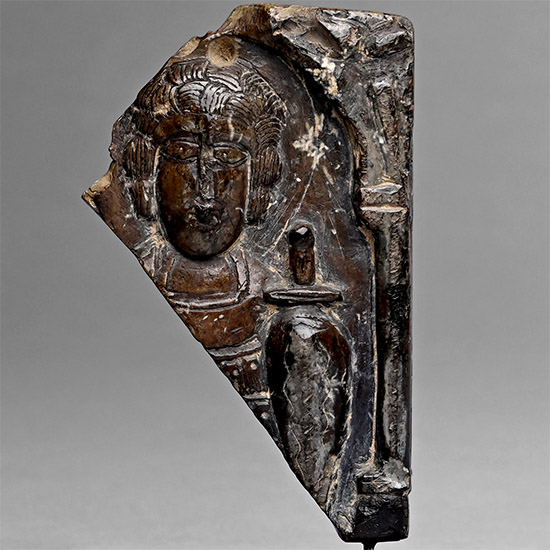
Byzantine Steatite Icon with Military Saint
10th-12th century A.D.Estimate: £6,000 - 8,000 (‡+bp*)
Opening Bid: £2,900
Fragment of an icon depicting a facing saint modelled in the half-round within an arch; an ellipsoid low-relief face with hatched collar-length hair, lentoid eyes with pointillé pupils flanking a long nose; wearing a lamellar cuirass (klivanion); stylised sword (spathion) to the shoulder with lobe pommel, piriform blade with hatched median bar and undulations to the flanks (simulating damascening); arch resting on a balustered column with shallow fixing socket above the saint's head; mounted on a custom-made stand. 60 grams total, icon: 72 mm high
Jacques and Henriette Schumann collection, Paris, France. with Christie's, Paris, France, 30 September 2003, no.248. European private collection. Accompanied by a copy of French passport no.061301, dated 3 September 2003. Accompanied by an academic report by Dr Raffaele D'Amato. This lot has been checked against the Interpol Database of stolen works of art and is accompanied by a search certificate no.12690-234660.
Jacques and Henriette Schumann were distinguished Parisian collectors known for their discerning taste and passion for antiquities and decorative arts. Their collection, assembled over several decades, reflected a deep appreciation for cultural heritage and historical significance. Works from their collection have been included in major European auctions and are recognised for their provenance and quality. -
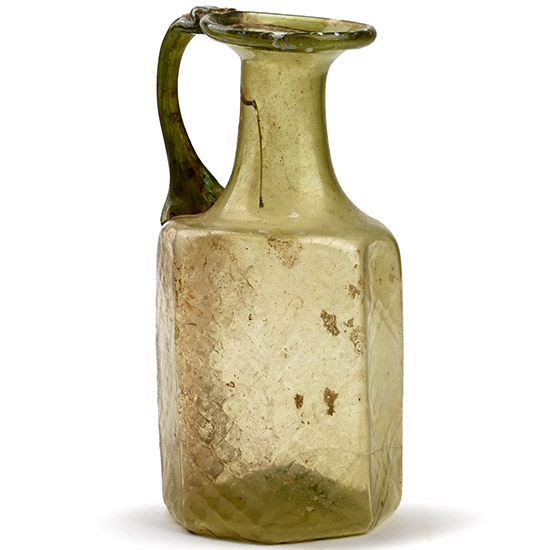
Byzantine Mould-Blown Octagonal Green Glass Jug
5th-7th century A.D.Estimate: £1,500 - 2,000 (+bp*)
Opening Bid: £750
Featuring an octagonal body with a flattened shoulder and a cylindrical neck with a funnel-shaped mouth and a folded rim, a tooled single handle drawn up and outward from the shoulder to the rim, the sides mould-blown and displaying four types of lozenge motifs, each repeated twice, a concave base with a six-petalled flower with a pontil mark at the centre. 138 grams, 16.7 cm
Ex Mayfair, London, UK, gallery, 1990s-2000s. From an important collection of glass, the property of a London gentleman. Roman glass from an important London collection, acquired from the early 1980s. Accompanied by a typed previous catalogue information page with provenance.
Hexagonal and octagonal jars or jugs, decorated with Christian or Jewish symbols or neutral geometric patterns, were mass-produced in moulds for the pilgrims visiting the Holy Land during the Late Roman Empire. These “pilgrim vessels” are also recorded from Cyprus, an island that was on the sea route that brought pilgrims to and from Jerusalem. -
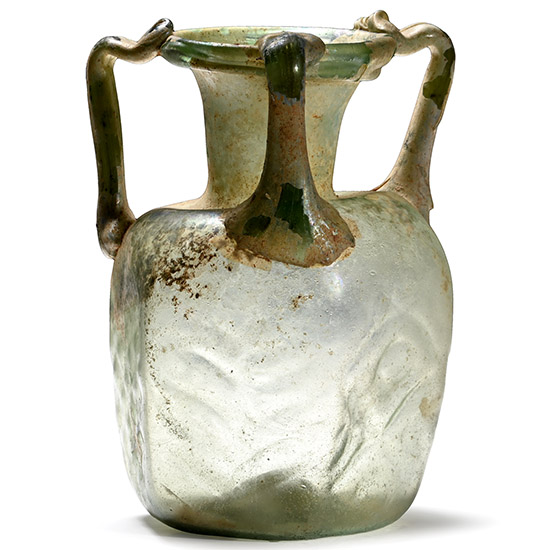
Byzantine Mould-Blown Translucent Pale Green Glass Three-Handled Jug
5th-8th century A.D.Estimate: £1,000 - 1,400 (+bp*)
Opening Bid: £550
Hexagonal body with a short cylindrical neck and a flaring rim, three applied handles extending from the rim to the shoulders, geometric decoration on the panels. 58 grams, 93 mm high
Roman glass from an important London collection, acquired from the early 1980s. From an important London glass collection, 1990s. Accompanied by a typed previous catalogue information page with provenance.
These octagonal or hexagonal jugs or jars were possibly made as tokens for pilgrims visiting the holy sites in Jerusalem or for use in burial rites. In the late 6th and early 7th century A.D., they were mass-produced in moulds for the pilgrim trade in the Holy Land, in the vicinity of the holy city, but they were found all around the Mediterranean, especially in islands like Cyprus, an important place on the sea route that brought pilgrims to Jerusalem. Such vessels were probably filled with oil from holy sites and sold to pilgrims. -
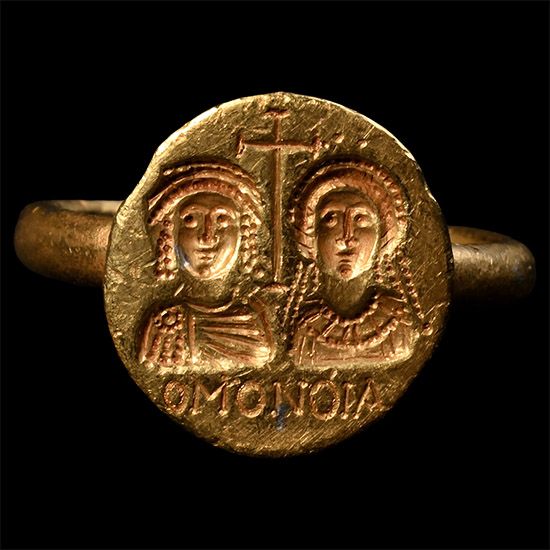
Byzantine Gold Marriage Ring with Inscription
Circa 6th-7th century A.D.Estimate: £5,000 - 7,000 (+bp*)
Opening Bid: £2,500
Round-section hoop with discoid bezel incuse image of two front-facing busts wearing beaded headdresses between a cross, legend 'ΟΜΟΝΟΙΑ' (harmony, unity) below; supplied with an impression. 7.81 grams, 21.81 mm overall, 18.33 x 17.78 mm internal diameter (approximate size British P 1/2, USA 7 3/4, Europe 16.86, Japan 16)
Mayfair gallery, London, UK, 1990s. From a Surrey, UK, gentleman’s Christian collection. This lot has been checked against the Interpol Database of stolen works of art and is accompanied by search certificate no.13542-263292.
The marriage ring is one of the typologies in which figural decorations are frequently found. Generally speaking, marriage rings are engraved with a representation of a husband and wife dressed as an Imperial couple, sometimes accompanied by Christ or by a cross, and usually engraved with wishes for 'harmony, health and the grace of God'. Rings of this type had been used since the late 4th century A.D. and remained extremely popular in Byzantium in the 6th and 7th centuries. -
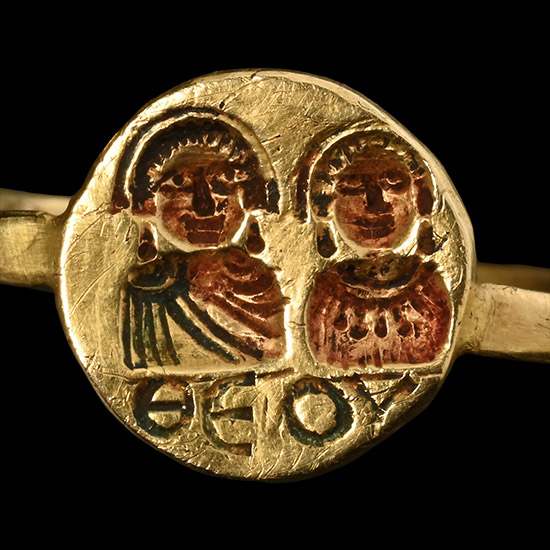
Byzantine Gold Ring with Married Couple
Circa 6th-7th century A.D.Estimate: £1,800 - 2,400 (+bp*)
Opening Bid: £900
Discoid bezel incuse image of two facing busts with beaded headresses, legend 'ΘΕΟΥ' (belonging to god) below, later round-section hoop. 3.24 grams, 21.00 mm overall, 14.95 x 17.74 mm internal diameter (approximate size British L 1/2, USA 6, Europe 11.87, Japan 11)
Private collection, 1980s. Acquired on the UK art market. Private collection, London, UK. This lot has been checked against the Interpol Database of stolen works of art and is accompanied by search certificate no.13489-262461.
Some types of marriage rings exhibit schematic images of the couple in either formal bust form or full length. The bride and groom flank usually a cross and/or a figure of Christ, identifiable by his cruciform nimbus. Christ blesses the couple by joining their hands or by resting his own hands on their shoulders. Here the image of Christ is substituted by the inscription ‘of God’, with the meaning that the marriage is holy and belongs to God. -
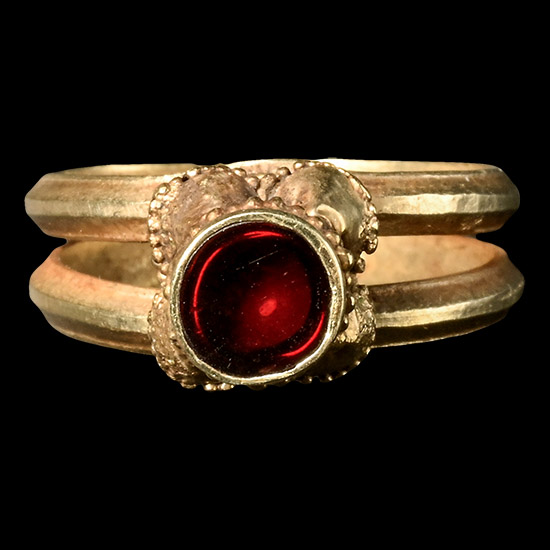
Byzantine Electrum Architectural Ring with Flat Bed Garnet
Circa 6th-9th century A.D.Estimate: £1,800 - 2,400 (+bp*)
Opening Bid: £900
The circular hoop composed of two carinated hoops, a finely decorated trumpet bezel set with a later flat-cut deep red garnet framed by a fine band of granules, and four oval beads enriched with granules supporting the bezel. 5.76 grams, 31.57 mm overall, 17.90 x 18.03 mm internal diameter (approximate size British P, USA 7 1/2, Europe 16.23, Japan 15)
Ex collection of a professional lady, 1970-1990s. Accompanied by a previous catalogue information page with provenance. This lot has been checked against the Interpol Database of stolen works of art and is accompanied by search certificate no.13536-263217.
The architectural shape of the ring copies Eastern Roman prototypes, and it is possible that it was made in Western workshops of the Migration period, which tend to be more ornate, with greater use of twisted wire filigree and garnet. Eastern Gothic and Merovingian versions of the architectural ring have been found widely in central and Western Europe. -
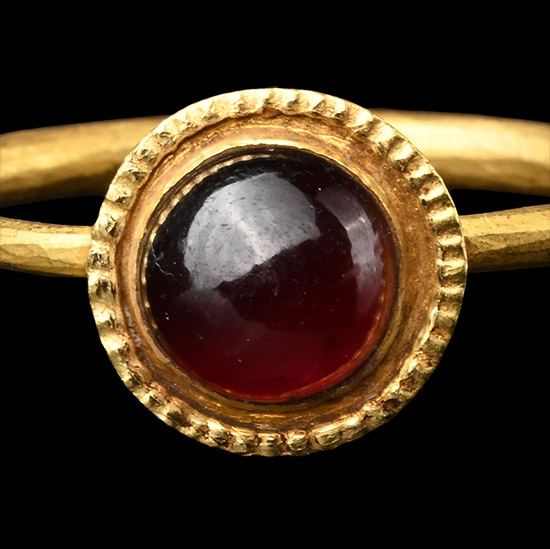
Byzantine Gold Ring with Cabochon Garnet
Circa 14th-15th century A.D.Estimate: £1,200 - 1,700 (+bp*)
Opening Bid: £600
Flared cell with corrugated rim, inset garnet cabochon, the round-section hoop with granulated collar at each junction, possibly added later. 5.28 grams, 29.68 mm overall, 20.82 mm internal diameter (approximate size British R 1/2, USA 8 3/4, Europe 19.38, Japan 18)
From a UK collection formed in the 1980s. Property of an Essex, UK, gentleman. -
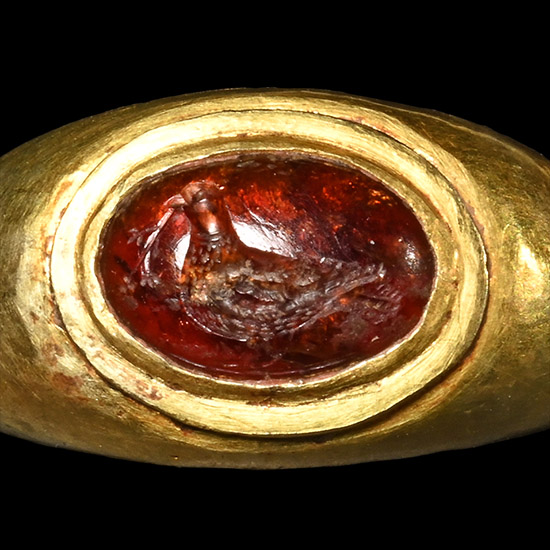
Early Byzantine Gold and Garnet Gemstone Ring with Bird
Constantinople, circa 5th-6th century A.D.Estimate: £1,200 - 1,700 (‡+bp*)
Opening Bid: £667
Hollow-formed with inset cloison, incuse profile bird motif. 3.52 grams, 22.74 mm overall, 17.38 mm internal diameter (approximate size British K 1/2, USA 5 1/2, Europe 10.58, Japan 10)
Private collection, acquired on the German art market in 1993; thence by descent.
The ring belongs to the type I, variant 3, of Roman gold rings according to Ruseva-Slokoska’s classification. These rings had massive ellipsoid hoops with bands semi-circular on the outside, wider and thicker towards the shoulders.

