
Ancient Art, Antiquities, Books, Natural History, Stamps & Coins

-
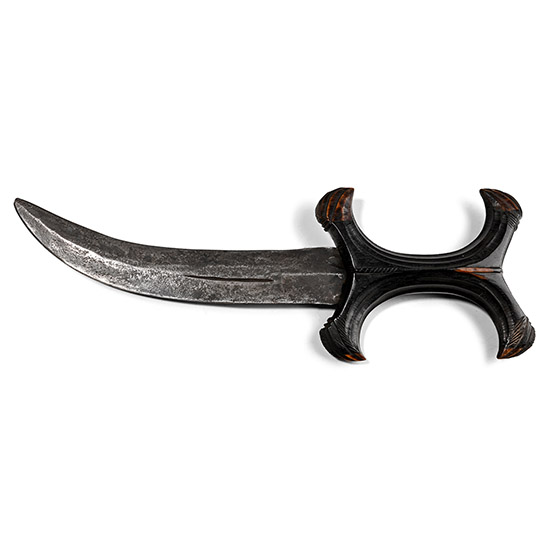
Beja or Hadendoa Curved Dagger
Sudan, late 19th-early 20th century A.D.Estimate: £80 - 100 (+bp*)
Opening Bid: £5
Comprising a thin leaf-shaped two-edged blade in an X-shaped wooden hilt with carved fluting and median rib. 188 grams, 30 cm
From the private collection of Peter Clayton, FCILIP, Dip, Arch, FSA, FRNS, Hemel Hempstead, Hertfordshire, UK; formed since the late 1950s. -
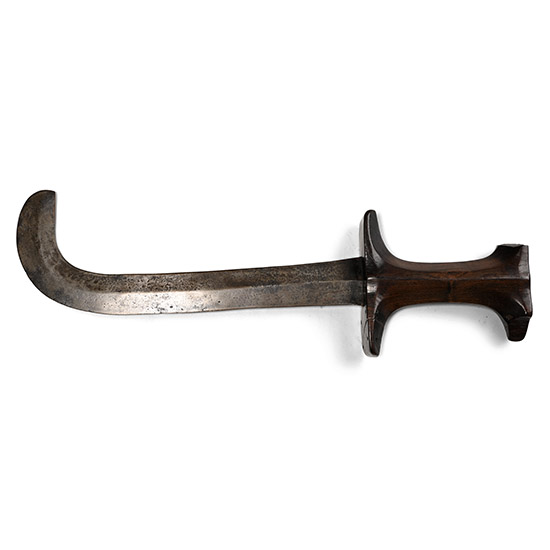
Beja or Hadendoa Curved Dagger
Sudan, late 19th-early 20th century A.D.Estimate: £80 - 100 (+bp*)
Bids: 1 | Current Bid: £5
With traditional X-shaped carved hilt (lateral arms partly absent); narrow lentoid-section two-edged blade with hooked end for slicing. 243 grams, 32.7 cm
From the private collection of Peter Clayton, FCILIP, Dip, Arch, FSA, FRNS, Hemel Hempstead, Hertfordshire, UK; formed since the late 1950s. -

Western Asiatic Polished Stone Macehead
3rd-2nd millennium B.C.Estimate: £80 - 100 (+bp*)
Opening Bid: £5
With slightly carinated equator to the globular body and tubular shaft. 377 grams, 91 mm
From the collection of North West London, UK, gentleman, early 2000s. -
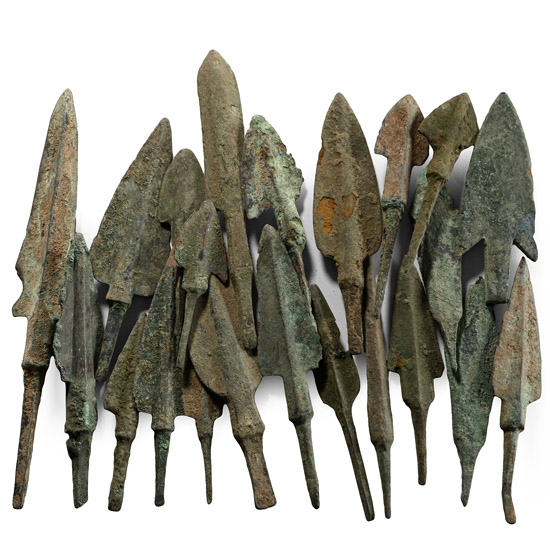
Western Asiatic Mounted Bronze Arrowhead
2nd-1st millennium B.C.Estimate: £50 - 70 (+bp*)
Opening Bid: £5
Including barbed-and-tanged, flat lozengiform, leaf-shaped and other types. 309 grams total, 5.3-13.1 cm
Ex Abelita collection, 1980s-2010. -
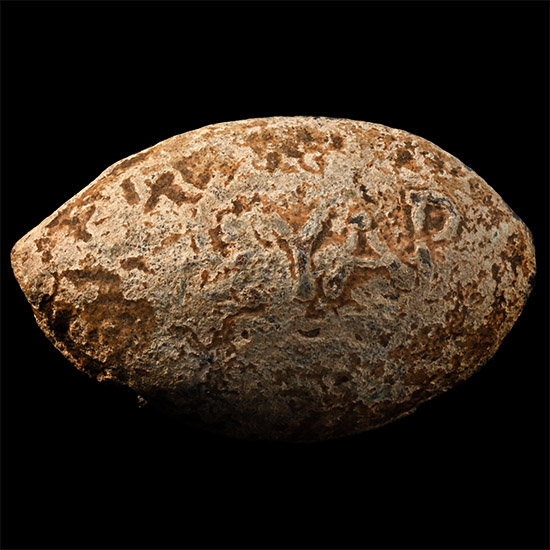
Greek Lead Slingshot inscribed EYAP//MANHC
3rd-2nd century B.C.Estimate: £100 - 140 (+bp*)
Opening Bid: £50
Biconical in profile with letters 'MANHC' on one side and 'EYAP' on the other side. 25.17 grams, 27 mm
From a German private collection, formed since the 1980s.
This slingshot bullet is inscribed with two names. On one side, the Lydian name Manes; on the other, a name starting with Euar(…). -
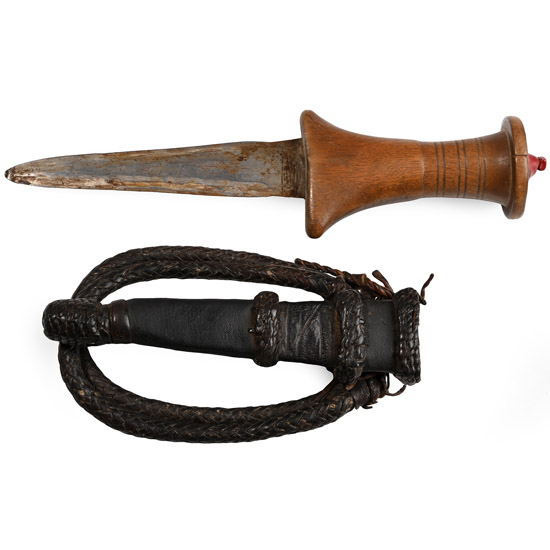
Mahdi Arm Dagger with Sheath
Sudan, late 19th-early 20th century A.D.Estimate: £80 - 100 (+bp*)
Bids: 1 | Current Bid: £5
Comprising a thin triangular two-edged blade in a carved wooden hilt with integral crossguard and pommel with a conical button; wooden sheath with leather covering, two braided leather thongs each forming a thick suspension loop and similar binding forming a chape. 172 grams, 26.2 cm
From the private collection of Peter Clayton, FCILIP, Dip, Arch, FSA, FRNS, Hemel Hempstead, Hertfordshire, UK; formed since the late 1950s. -
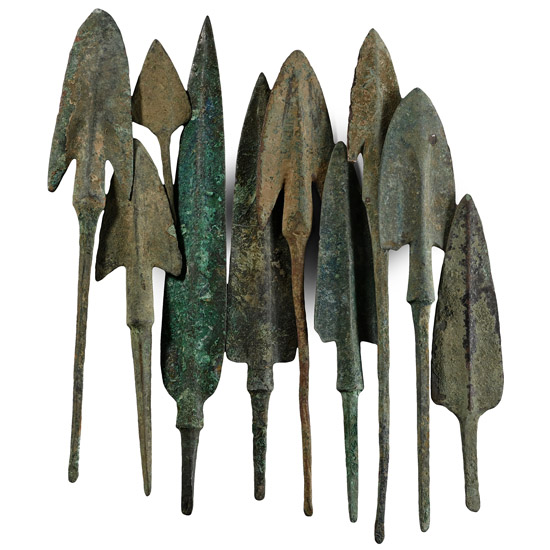
Western Asiatic Bronze Arrowhead Collection
2nd-1st millennium B.C.Estimate: £100 - 140 (+bp*)
Opening Bid: £55
Including barbed-and-tanged, leaf-shaped, triangular and other types. 242 grams total, 6-16.6 cm
Ex Abelita collection, 1980s-2010. -
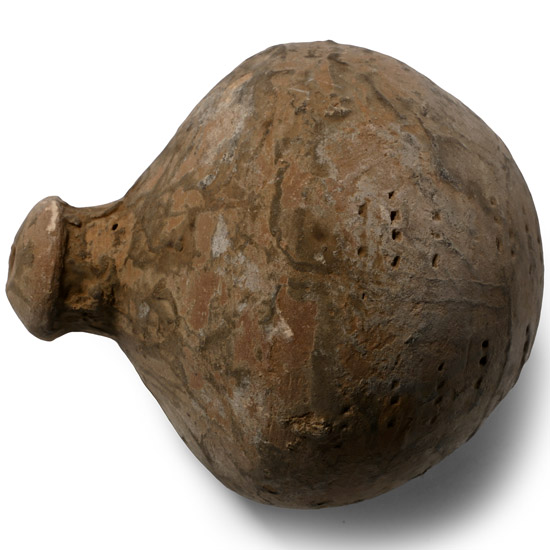
Byzantine 'Greek Fire' Ceramic Fire Bomb or Hand Grenade
9th-11th century A.D.Estimate: £80 - 100 (+bp*)
Bids: 1 | Current Bid: £5
Ovoid in profile with domed filler hole; intended to be filled with explosive liquid and a wick, and used as a hand grenade. 370 grams, 10.4 cm
From an important specialist collection, London, UK, 1990s onwards. Accompanied by an academic paper by military specialist Dr Raffaele D'Amato, dated 15 July 2019 and titled 'Eastern Roman Empire - Greek Fire Bomb or Hand Grenade (μεσαίον kακάβιον) 9th-11th century AD'.
Apart from the use of siphons or manual flame-throwers called cheirosiphona, special corps of Roman soldiers employed terracotta grenades, in the form of small jars, abundantly evidenced in archaeological excavations. They were called μεσαία kακαβιά or κυτροκακάβια where the former had a bulbous shape and the latter a more cylindrical form. -
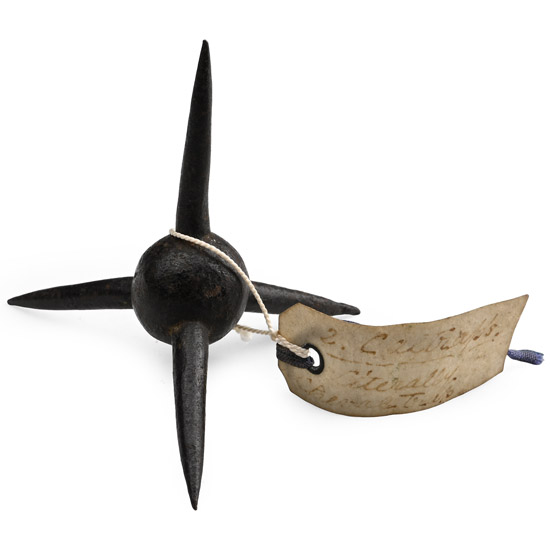
Medieval Iron Caltrop
15th-16th century A.D.Estimate: £40 - 60 (+bp*)
Bids: 4 | Current Bid: £20
Comprising a sphere with four radiating round-section spikes; old collector's label 71 grams, 82 mm
From the private collection of Peter Clayton, FCILIP, Dip, Arch, FSA, FRNS, Hemel Hempstead, Hertfordshire, UK; formed since the late 1950s.
Caltrops were strewn in front of an army in order to injure attacking horses or infantry stepping on them. The design means that they always land with one spike vertical. -
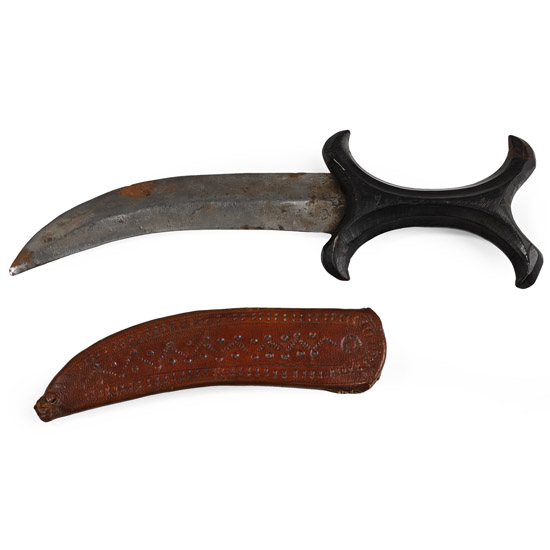
Beja or Hadendoa Curved Dagger with Sheath
Sudan, late 19th-early 20th century A.D.Estimate: £80 - 100 (+bp*)
Opening Bid: £5
Comprising a thin leaf-shaped two-edged blade with curved tip in an X-shaped wooden hilt with carved fluting; leather sheath with stamped detailing and suspension ring to reverse. 140 grams, 26.5 cm
From the private collection of Peter Clayton, FCILIP, Dip, Arch, FSA, FRNS, Hemel Hempstead, Hertfordshire, UK; formed since the late 1950s. -
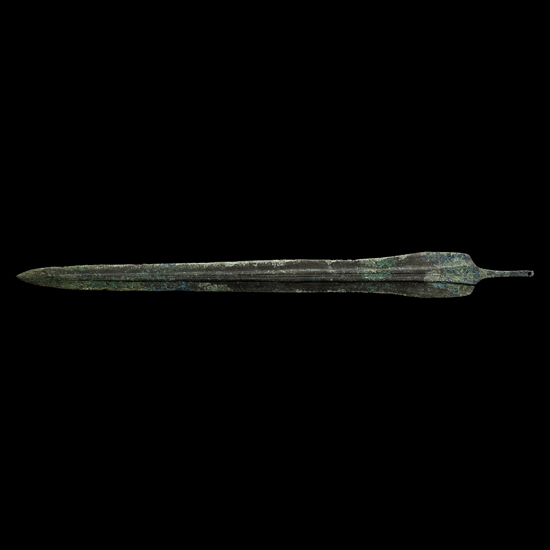
Luristan Bronze Tanged Dirk
Early 1st millennium B.C.Estimate: £100 - 140 (+bp*)
Opening Bid: £50
Comprising a slender blade with a raised midrib with grooves, a short rectangular-section tang pierced at the end. 200 grams, 41.5 cm
Ex Abelita family collection, 1980s-2000s.
The Luri people produced a quantity of fine metalwork, which, according to Dr Khorasani, could be due to a settled period arising as a result of the defeat of the Elamites by the Babylonians, leaving the Luristani people in relative peace for a period of time after 1200 BC. According to Khorasani, 'A culture of innovation and experimentation flourished, and the repertoire of the Luristan smiths expanded in the period between 1150-1050 B.C.' -
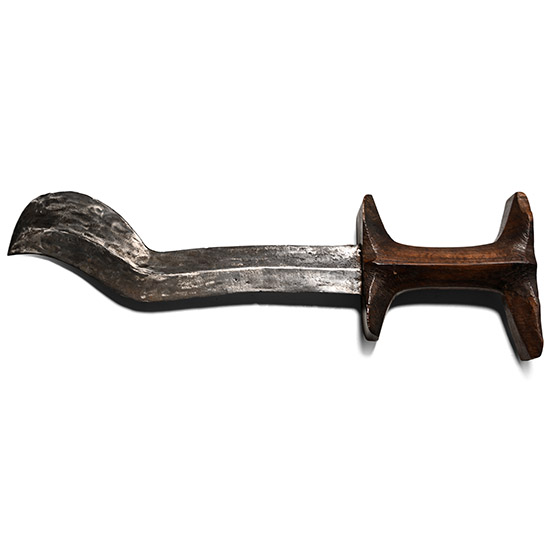
Large Beja Ham-Stringing Curved Knife
Sudan, late 19th century A.D.Estimate: £80 - 100 (+bp*)
Opening Bid: £5
With traditional X-shaped carved hilt, narrow two-edged blade with hooked end for slicing. 255 grams, 32.5 cm
From the private collection of Peter Clayton, FCILIP, Dip, Arch, FSA, FRNS, Hemel Hempstead, Hertfordshire, UK; formed since the late 1950s.
