
Ancient Art, Antiquities, Books, Natural History, Stamps & Coins

-
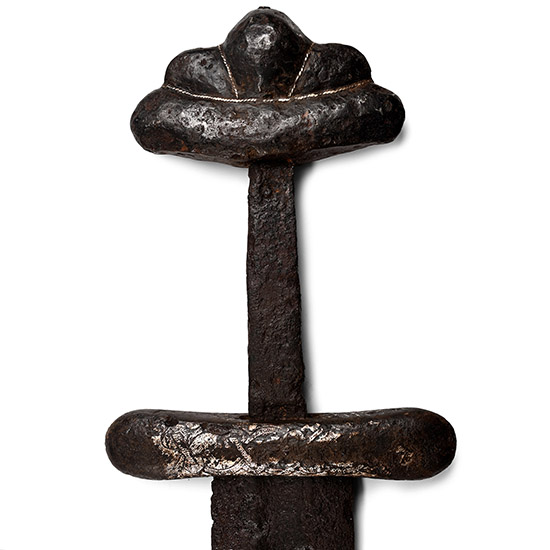
Viking Iron Sword with Silver-Inlaid Hilt
10th-early 11th century A.D.Estimate: £5,000 - 7,000 (+bp*)
Bids: 2 | Current Bid: £3,000
Double-edged Petersen Type S sword with a gently tapering long blade, the rounded point well preserved; the well-defined cutting edges show strong traces of employment with battle-nicks along the entire length; straight blade with a slender tang; the shallow tapering fullers visible showing shallow traces of pattern-welding; the boat-shaped guard with rounded ends and applied Ringerike Style ornament; short grip, the upper guard curved upwards and separated from the three-lobe pommel by inlaid silver wire; possibly later inlaid silver bands marking the separation between the lobes 985 grams, 91.3 cm
From the private collection of a London gentleman, from his grandfather's collection formed before the early 1970s. Accompanied by an academic report by Dr Raffaele D’Amato. This lot has been checked against the Interpol Database of stolen works of art and is accompanied by search certificate no.13443-262858. -
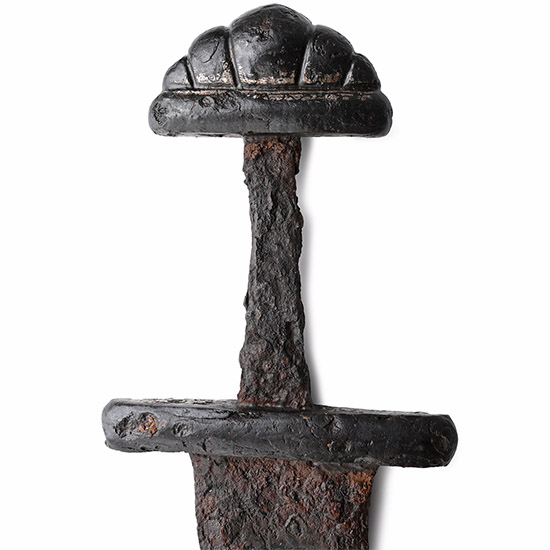
Scandinavian Viking Iron Sword with Silver Inlaid Hilt
Circa 9th-10th century A.D.Estimate: £5,000 - 7,000 (+bp*)
Bids: 14 | Current Bid: £1,800
Double-edged cutting sword of Petersen's Type K, with parallel-sided blade, shallow fullers showing some traces of pattern-welded construction and a possible inscription (+VLFBERHT+?) on both sides, short rectangular-section tang, boat-shaped lower guard with silver ring-chain ornament to the upper face; five-lobed pommel with remains of silver-sheet ornament to lower edge. 770 grams, 69.2 cm long
Private collection formed in Europe in the 1980s. Westminster collection, central London, UK Accompanied by an academic report by Dr Raffaele D'Amato. This lot has been checked against the Interpol Database of stolen works of art and is accompanied by search certificate no.13433-261728.
This blade of 9th or 10th century A.D. is most beautifully shaped bearing a possible ‘VLFBERHT’ inscription, with the iron inlay of pattern-welded form. The elements of the hilt are inlaid in silver. Petersen regarded his type K with its characteristic five (rarely seven) lobed pommel as being native by Frankish lands by the Rhine, and speculated that the type came to Norway in the first half of 9th century as a result of Viking raids. -
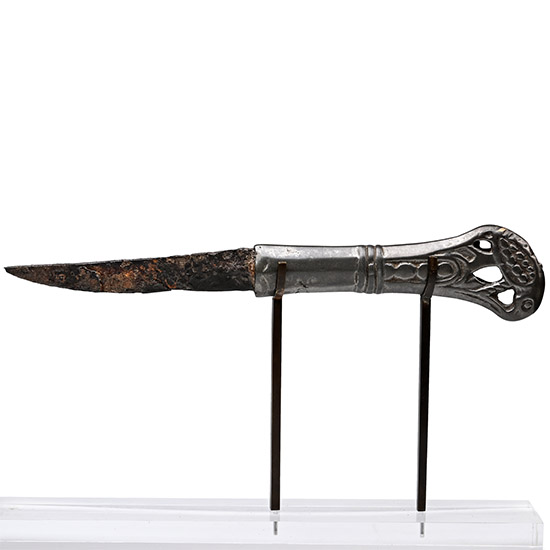
Western Siberian Iron Knife with Handle in the Shape of a Raptor
Circa 10th century A.D.Estimate: £1,800 - 2,400 (‡+bp*)
Opening Bid: £900
Single-edged iron blade attached to the hexagonal baluster in high-tin bronze; triple band forming a collar at the transition to the figural butt formed as a pecking raptor with long claws sitting on a stylised tree; annular punched eyes and pellets on the wings and the interior of the tree; mounted on a custom-made stand. 155 grams total, knife: 17 cm, 17.9 cm wide including stand
Ex W.L., USA, early 1990s. with Artemis Gallery, 26 September 2016, USA. This lot has been checked against the Interpol Database of stolen works of art and is accompanied by search certificate no.13528-263112.
Objects created in the West Siberian animal style served as ornamentation, offered protection against evil forces, and brought good fortune, while simultaneously signalling the high status of their owners. The West Siberian animal style represents a vivid artistic chapter in the history of the peoples of Western Siberia. Today, it is recognised, alongside the well-known ‘Scytho-Siberian’ and ‘Permian’ animal styles, as a distinct cultural phenomenon. -
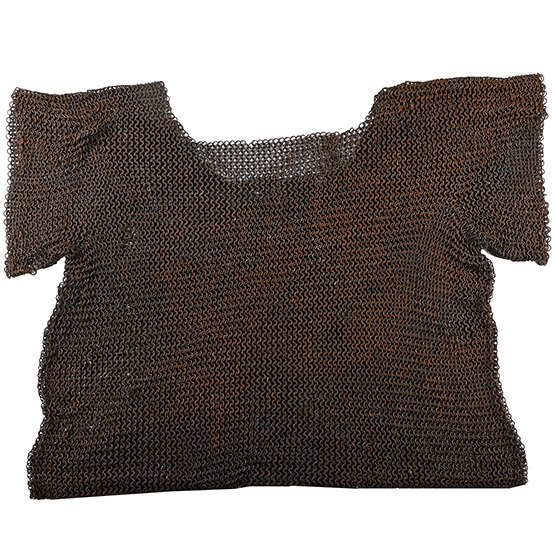
Medieval Warrior's Iron Chain Mail Armour Shirt
Circa 15th century A.D.Estimate: £3,000 - 4,000 (+bp*)
Bids: 2 | Current Bid: £800
A butted short-sleeved chainmail shirt made of thick oval rings assembled in the usual system of one-to-four; in an excellent state of preservation, with over 95% of the rings intact, very few broken or corroded, with no later additions. 9.93 kg, 87 x 56 cm
Acquired on the German art market before 2000. Private collection, South Germany. Accompanied by an academic report by Dr Raffaele D'Amato. This lot has been checked against the Interpol Database of stolen works of art and is accompanied by search certificate no.13066-249665.
In the German-manufactured ring mail armours, in the 15th century A.D., the rings protecting the breast were very thick, whereas the sleeved mail armours were thinner. Master armourers from Nuremberg were famous for this production across Europe. -
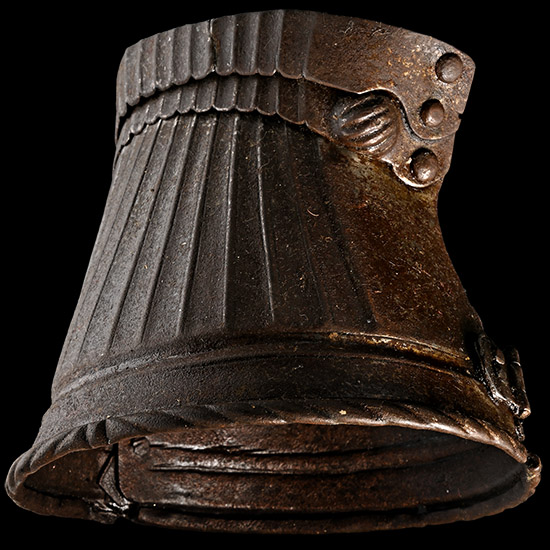
Maximilian Steel Mitten Gauntlet with Reference Number 1.32 in Yellow
Germany, circa early 16th century A.D.Estimate: £600 - 800 (+bp*)
Opening Bid: £300
Wrist and the upper hand section from an armoured gauntlet, with flared cuff and ropework detailing to the rim, vertical fluting to the cannon and two attached articulated plates; cannon hinged at one edge and with sliding catch to the other; marked '1.32'. 180 grams, 12 cm
Acquired on the UK art market. From a gentleman's collection in East Sussex, UK.
This armour part was destined to protect the hand and the wrist. The 'mitten gauntlet' consisted of a longer, narrow conical cuff tapering to the wrist and cut at the top to form a point. By the beginning of the 15th century, the 'mitten gauntlet' had become popular and was to remain so for the rest of the century and into the first half of the 16th century, especially in German-dominated areas of Europe. -
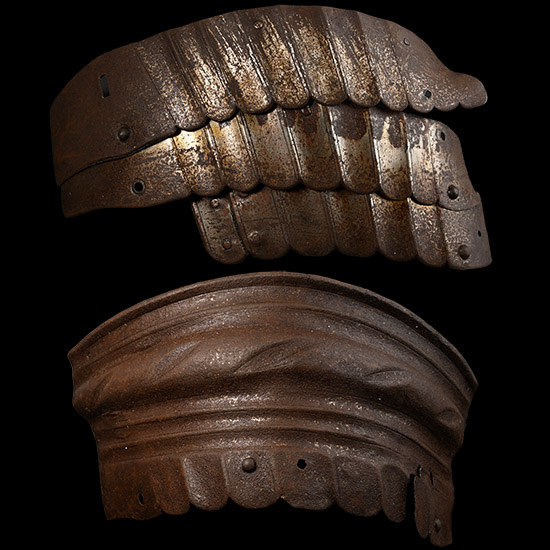
Maximilian Articulated Steel Plate Armour Tassets
Germany, circa early 16th century A.D.Estimate: £500 - 700 (+bp*)
Opening Bid: £250
Comprising: a curved panel with a rolled rim, horizontal carinated bands and median bowed band with diagonal slash detailing, fluted lower edge with holes for articulating rivets; group of three plates with vertical fluting, with sliding rivets providing articulation; with matching '1.306' reference numbers. 424 grams total, 22.3-24.5 cm
Acquired on the UK art market. From a gentleman's collection from East Sussex, UK.
The matched reference numbers could indicate that the pieces came from the same harness. One piece appears to be a piece of a tasset – a thigh defence. The embossed band is imitating the fashionable ‘puffed and slashed’ textile garments seen on 16th-century armour. Sixteenth-century armour often imitated textile fashions in their form and decorative elements. The second piece may be a tasset. The incised lines for the fluting on the exterior surface appear to be of more mechanical manufacture, as do the slot for the sliding rivet and the empty rivet hole on one side. -
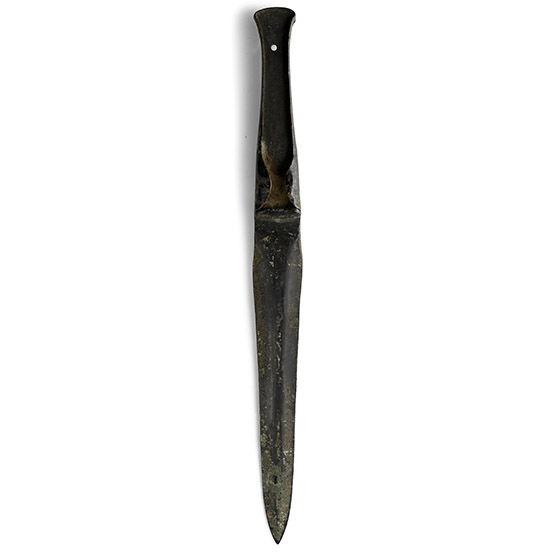
Luristan Bronze Dagger
13th century B.C.Estimate: £180 - 240 (+bp*)
Opening Bid: £90
With a lentoid-section blade, tongue-shaped in plan, with an integral tapering hilt with flared finial, lateral flanges to accept a panel of bone to each face forming the grip. 185 grams, 32.5 cm
Ex Abelita family collection, 1980s-2000s.
The art of Luristan can be described as the art of nomadic herdsmen and horsemen with an emphasis on the crafting of small, easily portable objects, among these a great number of bronze weapons. The rich and noble aristocrats of the Luristan, Elamites, Hurrians, Lullubians, Kutians, and Kassites went to battle splendidly equipped and wore magnificent bronze armour, using maces, spears and daggers as offensive weapons, alongside spears, bows and arrows. -
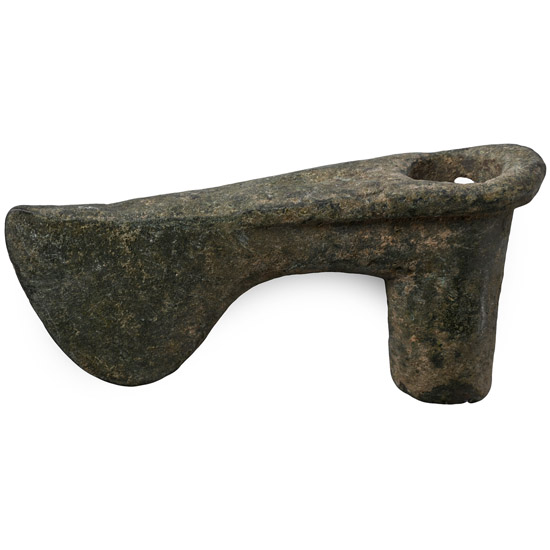
Luristan Bronze Axehead
2nd-1st millennium B.C.Estimate: £100 - 140 (+bp*)
Opening Bid: £50
With a short socketted shaft and flange to the mouth, a broadening blade towards the cutting edge. 374 grams, 12.3 cm
Ex Abelita collection, 1990s. -
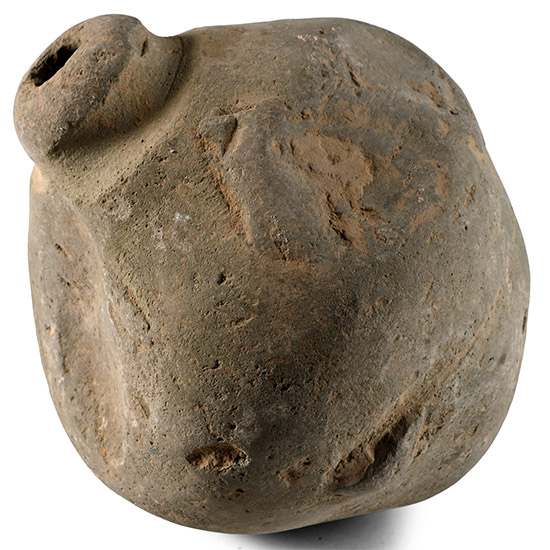
Byzantine 'Greek Fire' Ceramic Fire Bomb or Hand Grenade
9th-11th century A.D.Estimate: £70 - 90 (+bp*)
Bids: 1 | Current Bid: £5
Bulbous body with rounded base and domed filler hole; intended to be filled with explosive liquid and a wick, and used as a hand grenade. 590 grams, 10.3 cm
Ex important collection of weaponry, London, UK, 1980-1990s. Accompanied by an academic paper by military specialist Dr Raffaele D'Amato, dated 15 July 2019 and titled 'Eastern Roman Empire - Greek Fire Bomb or Hand Grenade (μεσαίον kακάβιον) 9th-11th century AD'.
Apart from the use of siphons or manual flame-throwers called cheirosiphona, special corps of Roman soldiers employed terracotta grenades, in the form of small jars, abundantly evidenced in archaeological excavations. They were called μεσαία kακαβιά or κυτροκακάβια, where the former had a bulbous shape and the latter a more cylindrical form. -
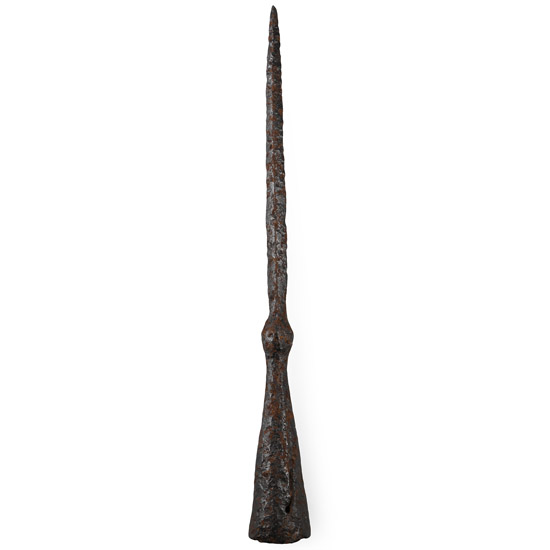
Eastern Balkans Period Socketted Spear
Circa 14th century A.D.Estimate: £80 - 100 (+bp*)
Opening Bid: £5
Socketed spearhead with a spheroconic transition; the long, square-sectioned point separated from the socket by a small sphere. 245 grams, 31 cm
Acquired on the UK art market since the 1960s. From the private collection of Mr J.P.H., a Woolwich, UK, collector, his collection formed since the 1960s. -
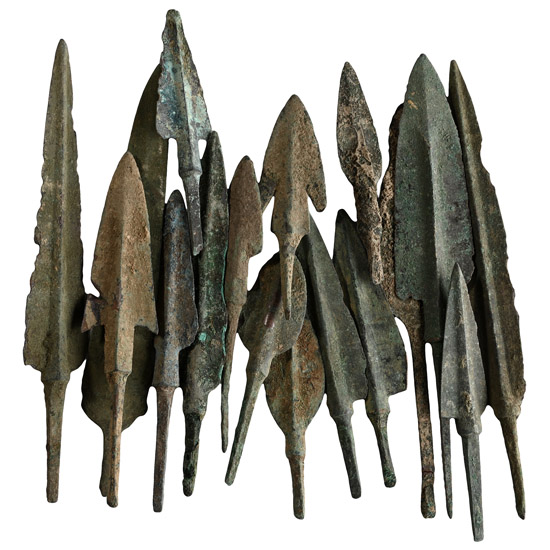
Western Asiatic Bronze Arrowhead Collection
2nd-1st millennium B.C.Estimate: £100 - 140 (+bp*)
Opening Bid: £50
Comprising barbed-and -tanged, triangular, leaf-shaped and other typs. 331 grams total, 8-16.5 cm
Ex Abelita collection, 1980-2010. -
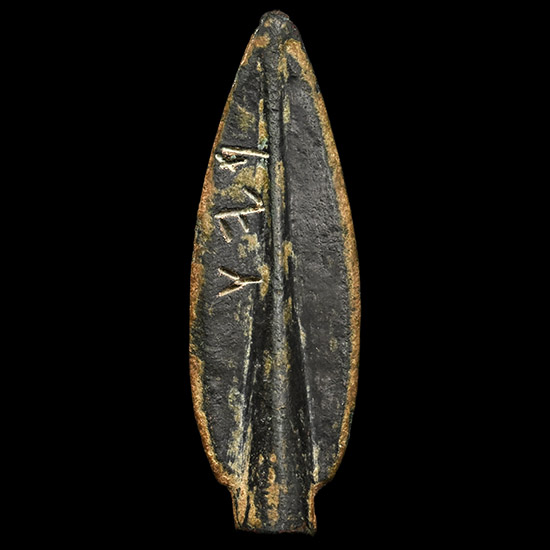
Phoenician Bronze Arrowhead with Inscription
5th century B.C.Estimate: £500 - 700 (+bp*)
Opening Bid: £250
Leaf-shaped arrowhead with a raised midrib extending to a tubular, short socket, Phoenician letters on both sides. 5.34 grams, 41 mm
London gentleman's collection, 1970-1990s, by descent.
The style of the socketed arrowhead is related to the period of the Achaemenid Empire. Although the Phoenician arrowheads with inscriptions are mostly prevalent at the end of the Bronze Age, the arrowhead can prove that ownership inscriptions on this kind of weapon persisted over time.
