-
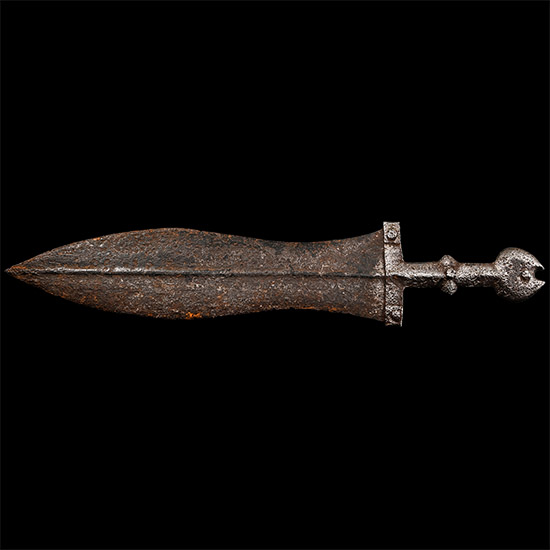
Roman Iron Pugio Dagger
Circa 3rd century A.D.Estimate: £2,500 - 3,500 (+bp*)
Opening Bid: £1,250
Leaf-shaped wide blade with a narrow waist, a thick crossbar and a lozenge-section handle with a double-lobed pommel; accompanied by a custom-made display stand. 772 grams total including stand, dagger: 343 grams, 37 cm
Spanish collection, German auction, 1980s. Ex John Lawton private collection, Surrey, UK. Accompanied by a copy of a previous illustrated catalogue page, including provenance This lot has been checked against the Interpol Database of stolen works of art and is accompanied by search certificate no.13495-263284.
This dagger belongs to the last period of evolution of the Roman type III pugio, and to the blade types of the III period, according to the Saliola-Casprini classification (Saliola-Casprini, 2012, nos.45,54). Compared to the previous types of the 1st century A.D., the slender, lanceolate blade shows a considerable size, up to 45 cm long or longer, with a plain appearance and no decoration, even on the scabbard, when preserved. -
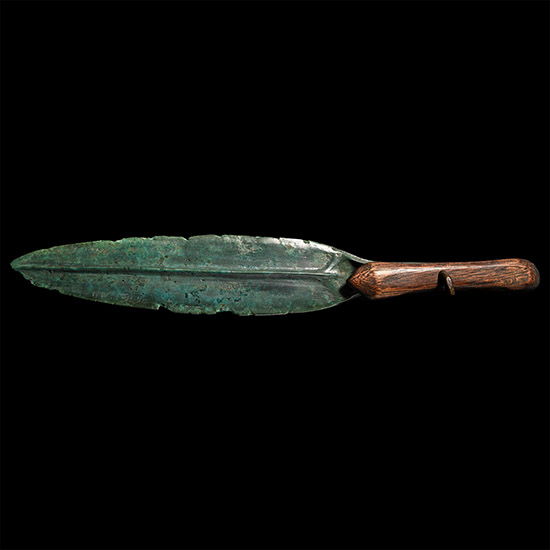
Celtic Bronze Knife
Iron Age, Central Europe, circa 800-500 B.C.Estimate: £1,000 - 1,400 (+bp*)
Opening Bid: £500
Leaf-shaped flat blade with a prominent midrib, set with a modern wooden grip and accompanied by a custom-made display stand. 221 grams total including stand, dagger: 25 cm
German collection, Numisart, Munich, 1990s. Ex John Lawton private collection, Surrey, UK. Accompanied by a copy of a previous illustrated catalogue page, including provenance. -
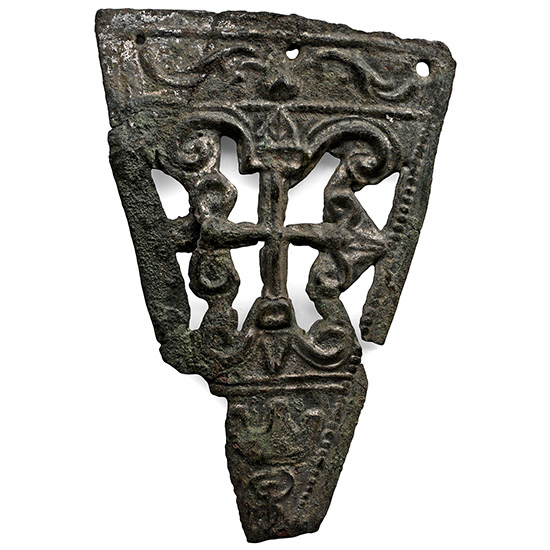
Roman Tinned Bronze Mainz-Type Gladius Sword Chape
Circa 1st century A.D.Estimate: £400 - 600 (+bp*)
Opening Bid: £75
Triangular in plan with repoussé ornament; outer frame with bands of pellets enclosing decorative panels: above, acanthus scrolls with tendrils emanating from a central vase; in the middle, openwork cross with acanthus scrolls; in the base, a pelta and other motifs; three fixing holes at the upper edge, apex absent; inked '693' notation. 11.84 grams, 83 mm
Ex Wiltshire, UK, collection, 1990s. -
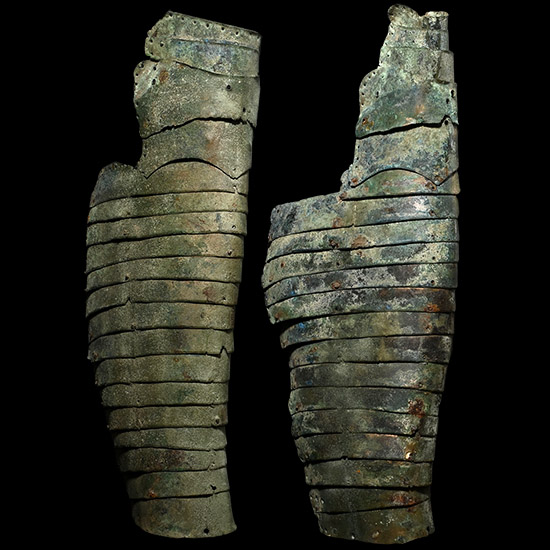
Pair of Roman Lamellar Greaves of a Heavily Armoured Mounted Cataphractarius Soldier
2nd-3rd century A.D.Estimate: £20,000 - 30,000 (+bp*)
Opening Bid: £10,000
A complete pair of lamellar greaves, anatomically formed protection featuring curved, overlapping metal plates (lames), the knee area having large plates and cut-outs at the sides to enable better movement; the left greave consists of nineteen overlapping U-shaped metal strips, whilst the right consists of twenty, each with two rivets at each end of every strip. 1.8 kg total, 45-50.5 cm
Acquired on the Munich art market in the 1990s. From a South German private collection. German export licence no.15771. Accompanied by an academic report by Prof. Dr Phil. Peter Rothenhöfer and Dr Raffaele D'Amato. This lot has been checked against the Interpol Database of stolen works of art and is accompanied by search certificate no.13540-263658.
A close example in construction technique and material is an arm guard (manica) from Newstead (Trimontium). The heavy armoured cavalrymen (cataphractarii) were often protected entirely on arms and legs, as shown by the Dura Europos graffito and echoed in the words of Nazianzius describing the clibanarii of Maxentius (Pan., XXII,5ff.): 'In the army they are called clibanarii, the men are covered in the upper part, an armour (lorica) which extends down to the horses’chest (pectora equorum) and hang to their forelegs protects them from the injury of a wound without impending their gait…' Nazanzius speaks of an ostentatio armorum (display of armour) and of operti ferro exercitus (army covered with iron). A long splint-armour gauntlet with metal staves had already begun to appear as early as the third century in the Roman army. It had an Iranian origin and is typical of Eurasian horse people. -
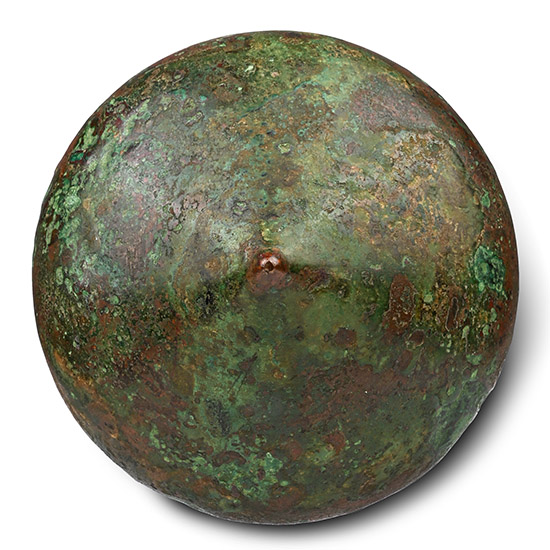
Urartu Bronze Shield Umbo
Circa 7th-6th century B.C.Estimate: £1,000 - 1,400 (‡+bp*)
Opening Bid: £550
Discoid in plan with swept curved profile and central raised point; mounted on a custom-made stand. 1.04 kg total, 20.5 cm including stand
Private collection, South Germany, acquired on the French art market in the 1980s. with Gorny & Mosch, München, 14 December 2005, no.306. -
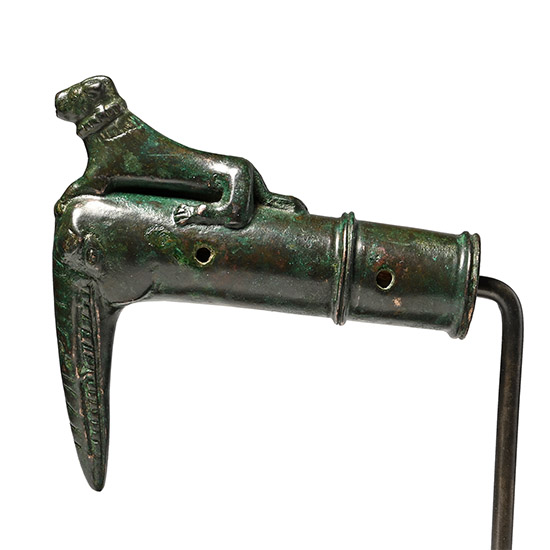
Luristan Bronze Pickaxe with Crouching Dog
Circa early 1st millennium B.C.Estimate: £1,500 - 2,000 (+bp*)
Opening Bid: £750
The body of the axe resembling a stork's head with incised lines on the sides, a tubular socket with a collared dog reclining on the top and perforations on the sides. 373 grams total, 15.2 cm high including stand
European private collection, 1990s. Ex John Lawton private collection, Surrey, UK. Accompanied by a copy of a previous illustrated catalogue page, including provenance. -
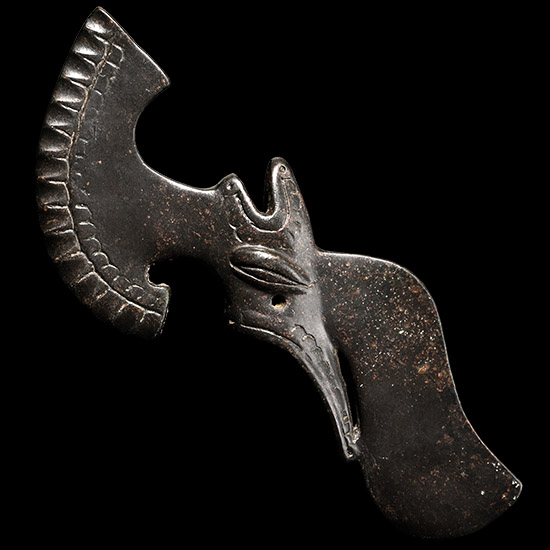
Western Asiatic Ceremonial ‘Eye’ Axehead
Circa 2000 B.C.Estimate: £1,500 - 2,000 (+bp*)
Opening Bid: £750
Featuring a blunt fan-shaped blade and a sloping counterbalance to the rear; the edge of the blade decorated with an undulating border, embellished with a bulging eye relief on each side of the socket; mounted on a custom-made display stand. 537 grams total including stand, axehead: 20 cm wide
London collection of weapons, 1990s-2010s. Ex John Lawton private collection, Surrey, UK. Accompanied by a copy of a previous illustrated catalogue page, including provenance. -
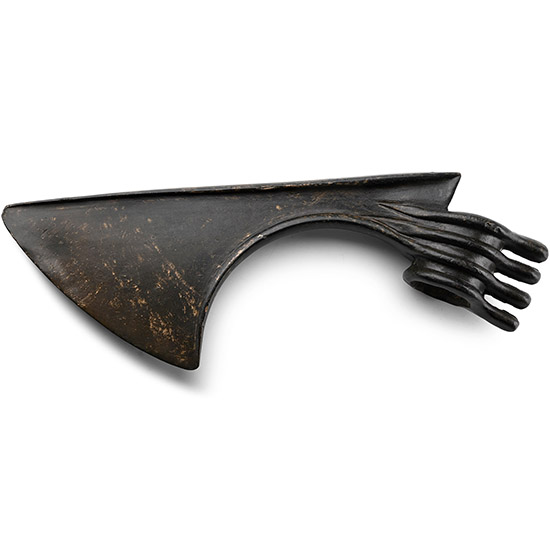
Luristan Bronze Comb-Backed Axehead
2nd-1st millennium B.C.Estimate: £500 - 700 (+bp*)
Opening Bid: £275
With ribbed socket terminating in a butt formed of four cones, the blade expanding from the socket in a swept arc with reinforcing rim to upper and lower edges. 368 grams, 21.5 cm
Ex Abelita collection, 1980s-2010. -
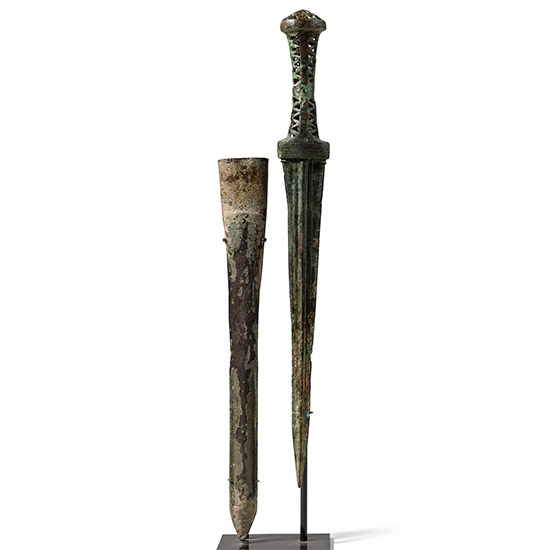
Western Asiatic Bronze Dagger with Openwork Hilt and Scabbard
2nd-1st millennium B.C.Estimate: £3,000 - 4,000 (+bp*)
Opening Bid: £1,500
Comprising a long slender blade with a stepped mid-rib and narrow point, waisted openwork tubular hilt with domed pommel, transverse scaphoid-section guard; narrow sheet-bronze scabbard with flared mouth (cracked); mounted on a custom-made stand. 434 grams total, dagger: 31.2 cm
Acquired on the UK art market, 1990s-2000s. Private collection, London, UK. This lot has been checked against the Interpol Database of stolen works of art and is accompanied by search certificate no.13464-262414.
The openwork grips of these daggers were created using the lost wax process. The openwork was cut into the original wax, and after casting, it was inlaid with cream-coloured stone, some of which survives. These short daggers were still in use in the Early Median and Achaemenid Periods, between 800 and 600 B.C. -
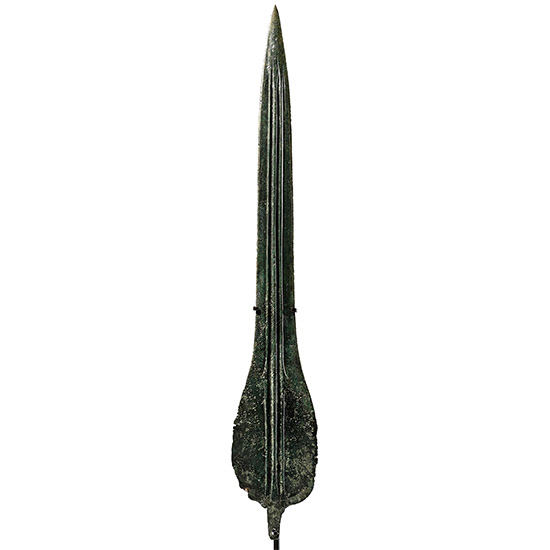
Luristan Bronze Sword Blade
13th-7th century B.C.Estimate: £600 - 800 (+bp*)
Opening Bid: £300
Slender blade widening at the base, three raised median ribs extending to the short tang; accompanied by a custom-made display stand. 420 grams total, 41 cm high including stand
German collection, cologne 1990s. Ex John Lawton private collection, Surrey, UK.
According to Moorey, such categories of swords were distributed in the Northern Iran area, as proved by the Amarlu finds. Based on the example from the Ashmolean Museum, he dated them to the end of the 2nd millennium B.C., more precisely to a period between the 14th and 13th centuries B.C. The type was in use until the 7th century B.C. -
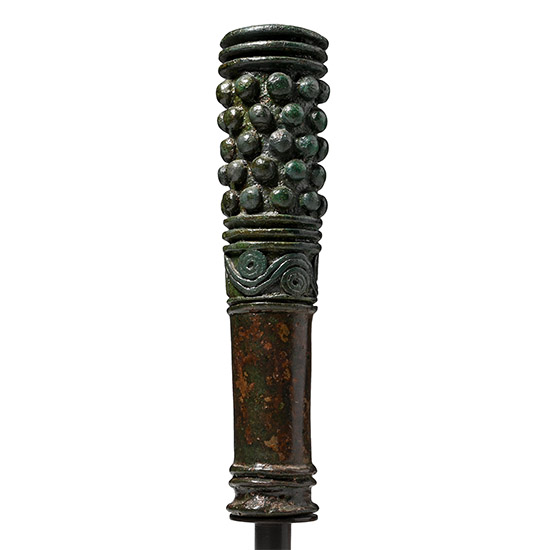
Mesopotamian Bronze Macehead with Raised Bosses
Early 2nd millennium B.C.Estimate: £600 - 800 (+bp*)
Opening Bid: £333
Of cylindrical shape, the upper section with prominent bosses and flanges, a short cylindrical shaft edged at top and bottom with collars; mounted on a custom-made stand. 630 grams total, 21 cm including stand
with ArtAncient, 2010. Private collection, London. -
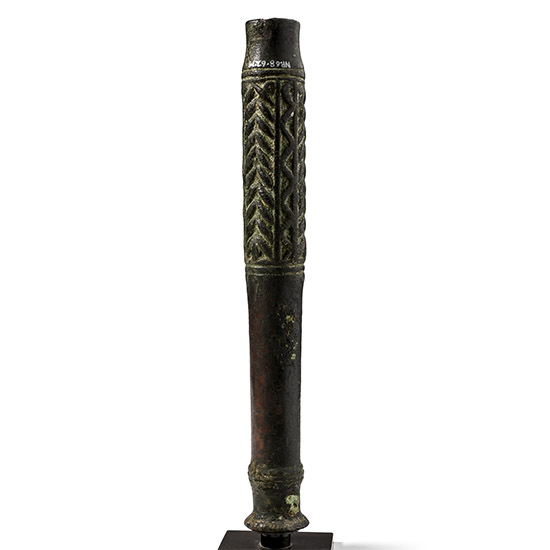
'The Chrysler Museum' Mesopotamian Bronze Macehead with Incised Decoration
Early 2nd millennium B.C.Estimate: £800 - 1,000 (+bp*)
Opening Bid: £444
Tubular in plan with low-relief braided panel and undulating lines; scooped profile at each end and securing collar; mounted on a custom-made stand. 647 grams total, 25.6 cm including stand
Ex Chrysler Museum of Art, Virginia, accession no.NP.68.62.M. with ArtAncient, 2010. Private collection, London, UK.

