-
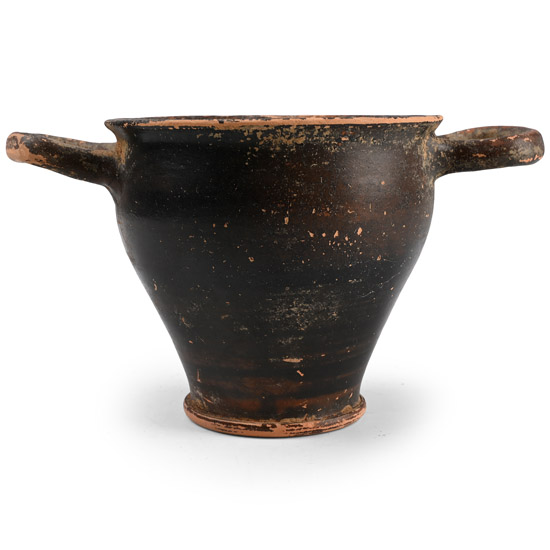
Greek Black Glazed Skyphos
South Italian, 5th-4th century B.C.Estimate: £150 - 200 (+bp*)
Bids: 1 | Current Bid: £5
Mammiform body with pedestal base and two loop handles below the everted rim. 170 grams, 16.5 cm
Acquired on the UK art market since the 1990s. From the property of a late Lincolnshire, UK, gentleman; thence by descent. -

Greek Terracotta White-Ground Painted Lekythos Attributed to the Athena Painter
Circa 510-500 B.C.Estimate: £4,000 - 6,000 (‡+bp*)
Opening Bid: £2,000
Cylindrical with stepped foot, five palmettes above the shoulder, dynamic frieze of two men visiting two hetairai, each of the figures dressed in long pleated garments, at the centre of the scene, a hetaira on the right reaching towards the bearded male and gently touching his chin with her open hand, a tall draped table behind her with an amphora underneath and a standing bird on the top. 459 grams, 26.4 cm
H.A.C. (Herbert A. Cahn), 19 October 1979. Private collection, Bern, Switzerland. Accompanied by an original thermoluminescence analysis report no.N125q45 by Oxford Authentication. This lot has been checked against the Interpol Database of stolen works of art and is accompanied by a search certificate number no.12644-236376.
The Athena Painter is known as the painter who designed several Greek black-figure pottery works using the 5th-century BC white-ground technique. He specialised in lekythoi and refers to Athena as the main subject in his works. Together with the Theseus Painter, they continued the tradition of painting large lekythoi. His black figures are of high quality, and in addition to lekythoi, he decorated other potteries such as oenochoai. Some archaeologists say that he may have been the same person as the Bowdoin Painter of red-figure pottery, although they may have just worked in the same workshop. -
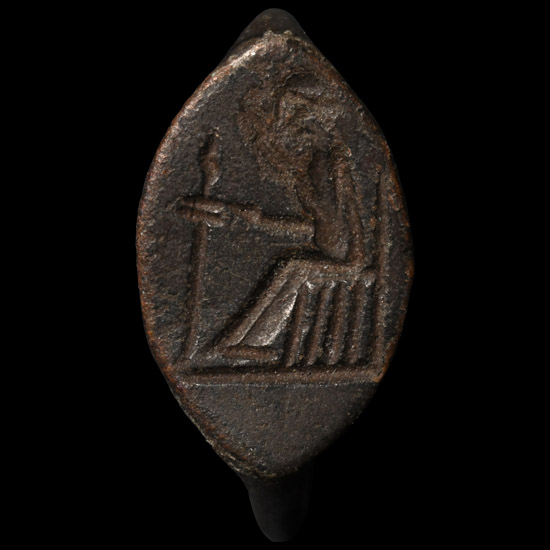
Large Greek Bronze Ring with Seated Figure
Circa 4th-2nd century B.C.Estimate: £100 - 140 (+bp*)
Bids: 1 | Current Bid: £5
Featuring a slender round-section hoop and a large lentoid bezel with a seated figure holding a staff. 3.41 grams, 25.02 mm overall, 15.70 x 20.51 mm internal diameter (approximate size British O, USA 7, Europe 14.98, Japan 14)
From the private collection of a European gentleman (1942-2024), formed since the 1970s. -
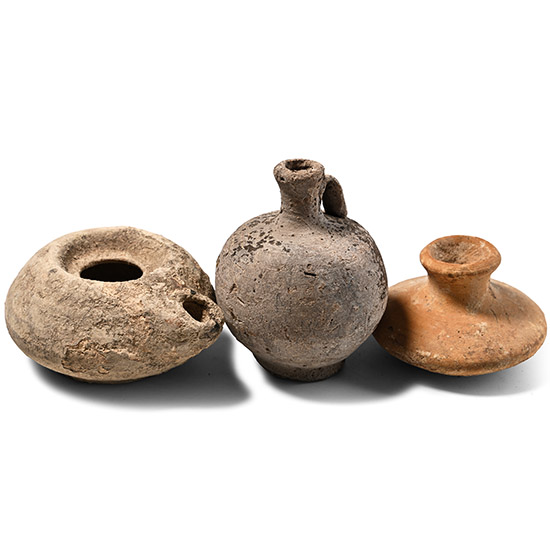
Greek Terracotta Vessel and Oil Lamp Group
Hellenistic, circa 3rd-2nd century B.C.Estimate: £60 - 80 (+bp*)
Bids: 1 | Current Bid: £5
Comprising: a juglet with a bulbous body and a narrow neck, small strap handle to the rear; a squat vessel with flared neck; a round oil lamp with a short nozzle. 197 grams total, 59-78 mm
Acquired on the UK art market since the 1990s. From the property of a late Lincolnshire, UK, gentleman; thence by descent. The juglet accompanied by a previous catalogue information slip. -
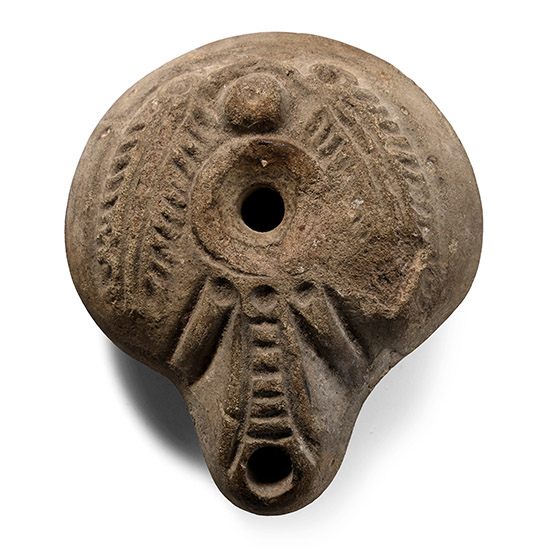
Greek Terracotta Oil Lamp
Circa 1st century B.C.Estimate: £80 - 100 (+bp*)
Bids: 1 | Current Bid: £5
Biconvex in profile with short nozzle and impressed 'ear of wheat' motif; with old collector's ticket 'Ancient Greek Very pretty lamp of fine style in red glaze. 1st century. Quite perfect: a cabinet specimen.' 85 grams, 83 mm
From Alexandria. From the estate of a deceased Sussex private collector since the early 20th century. Accompanied by an old original handwritten collector's ticket. -
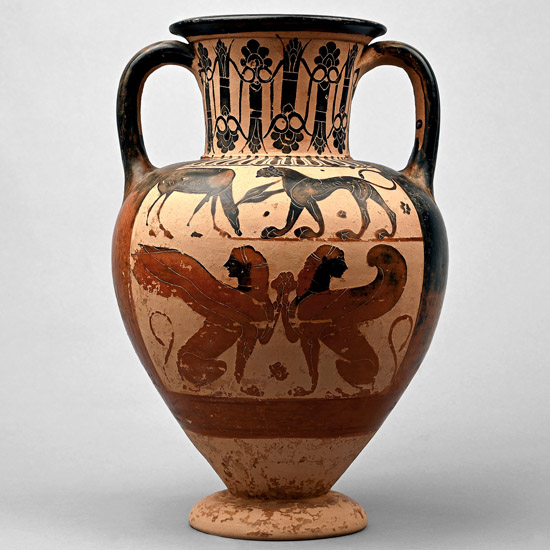
Greek Terracotta Amphora Attributed to the Phineus Painter
Chalcidian, circa 525 B.C.Estimate: £4,000 - 6,000 (‡+bp*)
Opening Bid: £2,000
Piriform body with splayed foot and narrow handles; the neck with slender lotus blossoms and palmettes, Side A) two opposing roosters with a lotus blossom in between, two standing swans flanking, below a youth on horseback holding the reins of a trotting horse, a man and a woman behind the horse; Side B) a grazing deer before an advancing panther looking back, two opposing sphinxes below with their heads turned back and front paws raised. 1.06 kg, 28 cm
Ex Münzen und Medaillen A.G., H. Cahn, Basel, 13 April 1985. Private collection, Bern, Switzerland. This lot has been checked against the Interpol Database of stolen works of art and is accompanied by a search certificate number no.12643-236366.
An important work by the leading master of the 'Chalcidian' workshop, which, despite the name, is not to be located in Chalkis itself but rather in a Chalcidian colony in Magna Graecia (possibly Rhegion). Within the oeuvre of Phineus, who is known for his neck-amphorae, examples with two image zones are very rare—see, for example, the fragmentary amphora in the Faina Collection in Orvieto, with similar sphinxes. -

Greek Painted Pottery Aryballos
Corinthian, circa 6th century B.C.Estimate: £250 - 350 (‡+bp*)
Opening Bid: £125
With a narrow neck and a broad rim to the mouth, a short strap handle to the rear; painted concentric rings around the mouth. 212 grams, 75 mm
Private collection, acquired in 1994; thence by descent.
From the 8th century B.C., Corinthian pottery vessels were exported to Greek colonies in South Italy and the coast of Asia Minor. They were used to hold perfumed oil, an essential item for the wealthy middle classes of the time. In Italy, especially in Etruria, local workshops produced imitations of Corinthian vessel types for a clientele of Greek settlers and local populations with a taste for Greek fashions. -
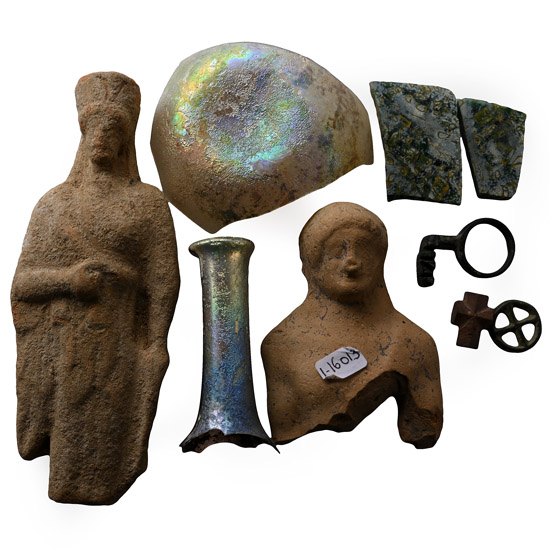
Greek and Later Artefact Collection
6th century B.C. and laterEstimate: £300 - 400 (‡+bp*)
Opening Bid: £180
Mixed group of items, including iridescent glass vessel fragments, a key ring, a kore statuette fragment, and others. 159 grams total, 1.6-12.8 cm
Private collection, Switzerland. -
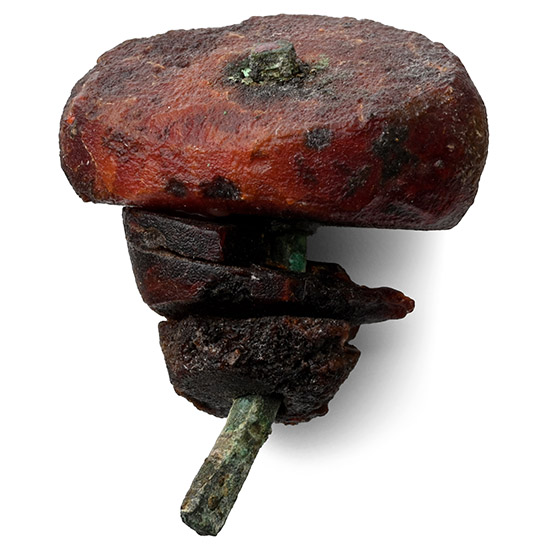
Etruscan Bronze Bracelet Fragment with Three Amber Beads
Etruscan or Italic, 7th-5th century B.C.Estimate: £70 - 90 (+bp*)
Opening Bid: £5
Comprising three irregular dark red amber beads on a square-section rod. 15.65 grams, 48 mm
Formerly in the Kuizenga collection, The Netherlands; the collection formed from the 1970s onwards. Acquired from Helios Gallery Antiquities, Wiltshire, UK. Property of a North Lincolnshire, UK, gentleman. Accompanied by a copy of the Helios Gallery Antiquities certificate of authenticity with stock no.H3955x6. -
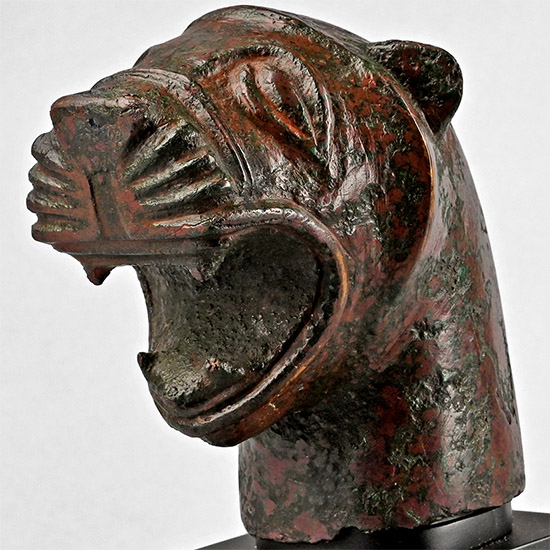
Etruscan Bronze Lion Head
Central Italy, late 6th century B.C.Estimate: £7,000 - 9,000 (‡+bp*)
Opening Bid: £3,500
A decorative fitting with roaring mouth and protruding fangs and tongue, the whiskers depicted in raised radiating ridges, with lidded, elongated almond-shaped eyes and small, round ears; mounted on a custom-made display stand. 1.11 kg total, 17.5 cm including stand
with Christie’s, New York, 8 June 2001, no.58. Donati collection, Lugano, prior to 1982. Collection of Banca della Svizzera Italiana, Lugano, prior to 1986. Formerly in the Bourgknecht collection, Switzerland. Accompanied by Art Loss certificate no.S00123227. This lot has been checked against the Interpol Database of stolen works of art and is accompanied by a search certificate number no.13230-249992.
This head was probably, as was the parallel head of the Barberini Tomb, originally attached to a magnificent bronze cauldron. These large cauldrons of hammered bronze were realised with the heads and necks of two lions and two gryphons attached to the rim. The cauldrons were spherical in form and rested on a stand. -
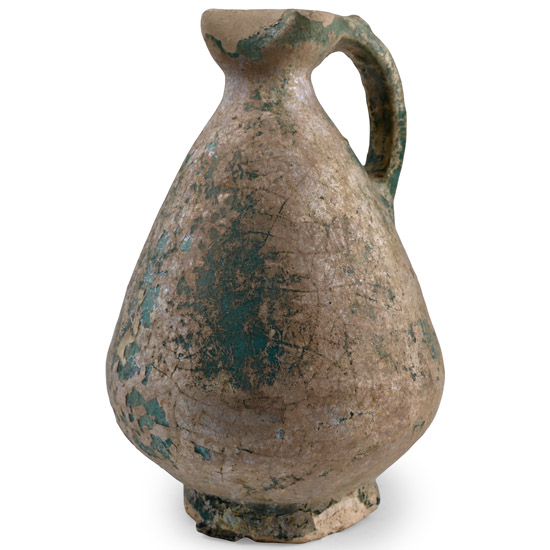
Parthian Green Glazed Jug
Circa 2nd century B.C.-2nd century A.D.Estimate: £60 - 80 (+bp*)
Opening Bid: £5
Piriform in profile with basal ring, pinched mouth forming a spout, strap handle. 208 grams, 13.5 cm
Acquired on the UK art market since the 1990s. From the property of a late Lincolnshire, UK, gentleman; thence by descent. -
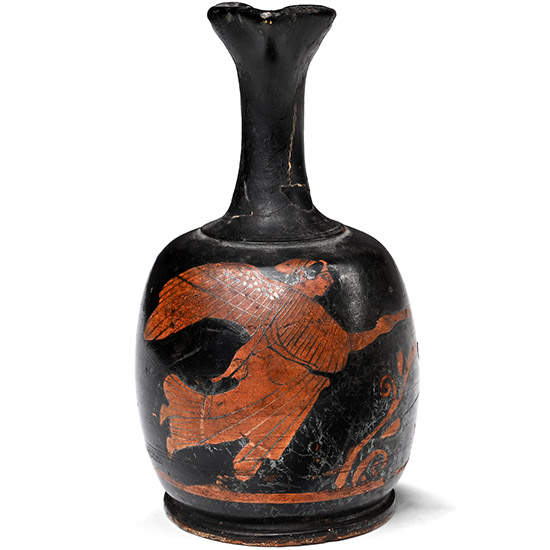
Greek Red Figure Ware Squat Lekythos with the Goddess Nike
Attic, circa 440-420 B.C.Estimate: £300 - 400 (+bp*)
Bids: 4 | Current Bid: £25
Rounded body with narrow neck and leaf-shaped mouth, strap handle to the rear, the body showing a flying goddess Nike holding a patera; restoration to the neck and the handle. 137 grams, 12.1 cm
Acquired Hastings, London Road, July 1958, for £2.00. From the private collection of Peter Clayton, FCILIP, Dip, Arch, FSA, FRNS, Hemel Hempstead, Hertfordshire, UK; formed since the late 1950s. Accompanied by an old handwritten information card by Peter Clayton, collection no.46.

