-
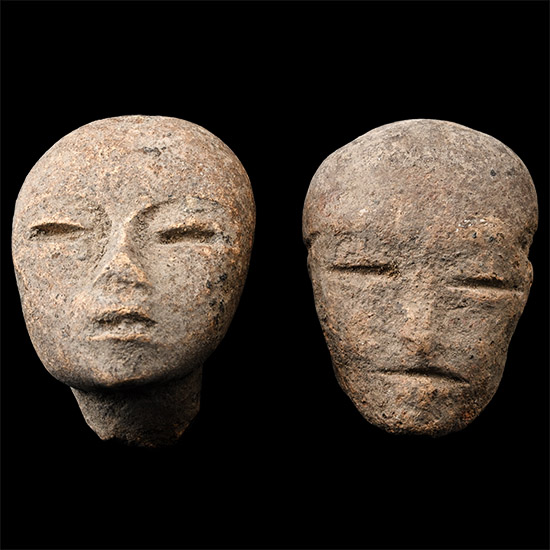
Phoenician Terracotta Head Group
Mid 1st millennium B.C.Estimate: £50 - 70 (+bp*)
Bids: 1 | Current Bid: £5
Each of bulbous profile with pinched nose and incised eyes and mouth. 31 grams total, 33-34 mm
From the private collection of a European gentleman (1942-2024), formed since the 1970s. -
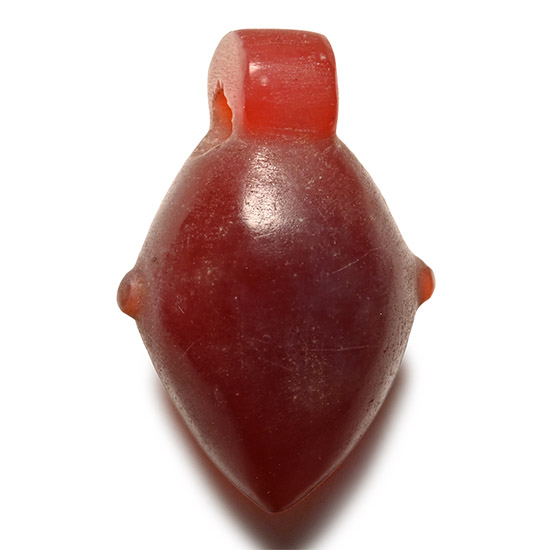
Egyptian Carnelian Heart Amulet
Late Period, 664-332 B.C.Estimate: £100 - 140 (+bp*)
Bids: 1 | Current Bid: £50
Carved with tiny lateral lugs, surmounted by a suspension loop. 1.04 grams, 15 mm
Ex London collection, 1990s. -
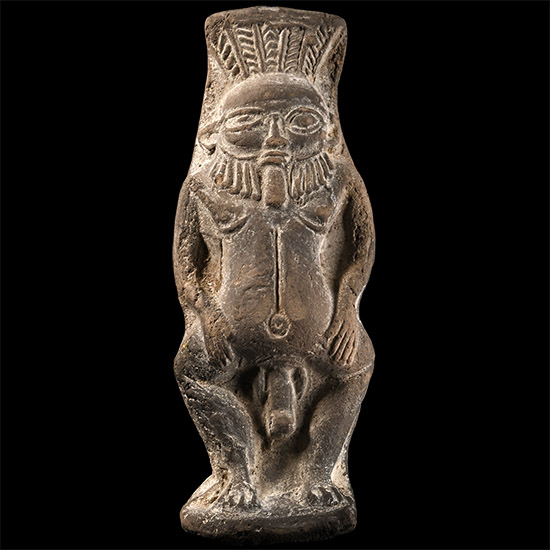
Egyptian Style Terracotta Bes Figure
Early 20th century A.D.Estimate: £20 - 30 (+bp*)
Opening Bid: £5
Standing on a pillar and wearing a feather crown, his hands resting on his knees, large protruding ears and a grimacing expression. 151 grams, 13.3 cm
Acquired in Luxor, Egypt. From a private collection formed in the 1930s. -
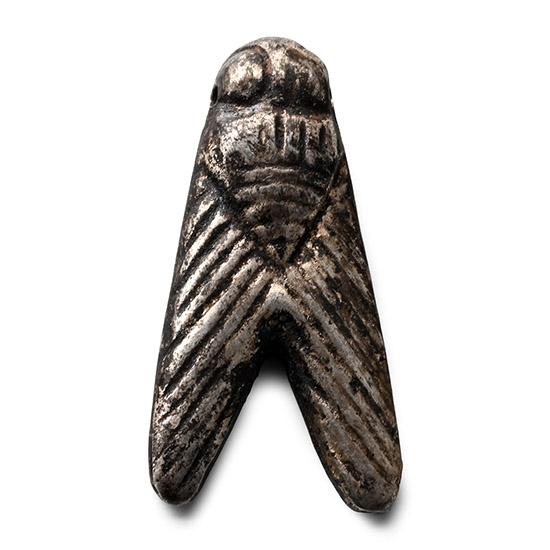
Egyptian Silver Fly Amulet
Late Period, 664-332 B.C.Estimate: £80 - 100 (+bp*)
Bids: 1 | Current Bid: £5
With detailing to the body and head, ribbed suspension loop above the head. 1.09 grams, 17 mm
London, UK, gentleman, 1990s.
Fly amulets were believed to protect against insect bites and to ward off troublesome flying creatures through apotropaic magic. Some believe they may have even symbolised the fly’s fecundity. Additionally, pharaohs bestowed gold fly-shaped pendants as military awards to honour soldiers' bravery and persistence in battle. -
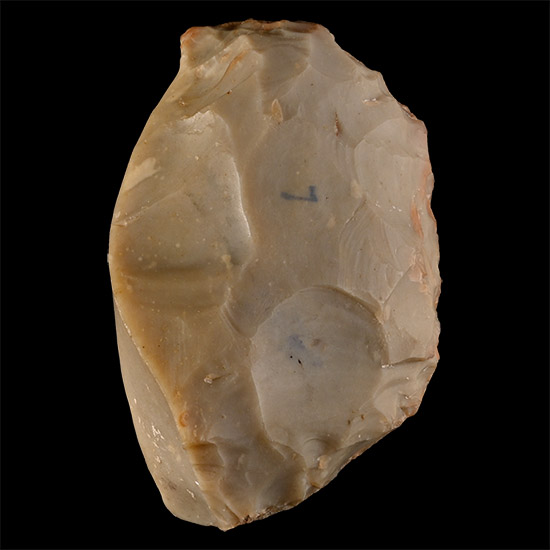
Fawcett Collection Egyptian Stone Age Knapped Chert Axe with Fawcett Monogram
Neolithic Period, circa 6,000 B.P.Estimate: £60 - 80 (+bp*)
Opening Bid: £5
Biconvex in section with cortex to the equator; marked 'Egypt' and monogram. 97.8 grams, 67 mm
Ex Dr Hugh Alderson Fawcett (1891-1982), a general practitioner and antiquarian who built an important collection of ancient implements, weapons and ornaments. The present part of the collection was gifted to Haselmere Parish Priest Charles Borelli (c.1914-2000) of Farnham, a member of the Borelli family from Italy who emigrated from Lake Como in 1828 to set up the Borelli family watch and jewellery business; thence by family descent to his nephew. -
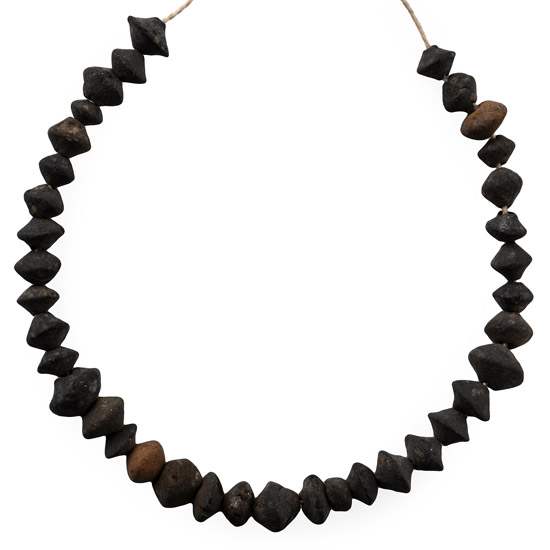
Egyptian Biconical Faience Mummy Bead String
New Kingdom-Late Period, circa 1550-332 B.C.Estimate: £30 - 40 (+bp*)
Bids: 1 | Current Bid: £5
Restrung group of dark brown biconical beads. 4.65 grams, 16 cm
Excavated from Egypt in 1914. From the private collection of Mr David Sams and his wife Elizabeth Kate Sams, gentry and amateur archaeologists who travelled to Egypt in 1914 with their daughter Ethel. Mr Sams and his wife led digging expeditions from which these items come from the family estate of Mr and Mrs Sams, by direct descent to their granddaughter. -
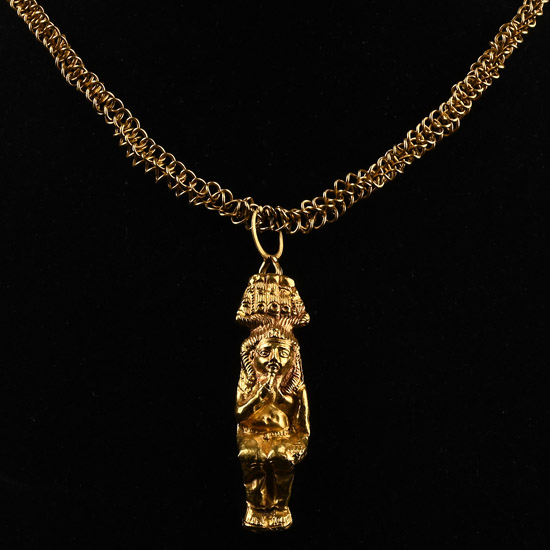
Egyptian Gold Necklace with Harpocrates Pendant
Roman Period, 1st century B.C.-1st century A.D.Estimate: £12,000 - 17,000 (‡+bp*)
Opening Bid: £6,667
Gold chain of double-looped links terminating in corrugated end elements, with hook-and-eye clasp; suspension ring embellished with applied granulation and a ribbed loop; hollow-formed sheet-gold pendant in the round depicting Harpocrates seated, his right forefinger raised to his mouth, wearing a finely detailed nemes headdress surmounted by a complex hemhem, crown incorporating multiple hedjet elements, flanking uraei, and ram's horns. 49.80 grams, 40.5 cm
Ex Elie Boustros collection, Lebanon. Private collection, acquired in the late 1980s-early 1990s; thence by descent. This lot has been checked against the Interpol Database of stolen works of art and is accompanied by search certificate number no.13203-249297.
The fully three-dimensional modelling of the pendant aligns it with a group of high-quality Roman-period Egyptian goldwork characterised by pronounced plasticity and sculptural ambition. A pertinent comparison may be drawn with the gold diadem depicting Serapis from the Dush Treasure, discovered concealed within the wall of a Roman fort in the Baris Oasis (Reddé, M., Douch IV. Le trésor de Douch, DFIFAO 28, Cairo, 1992). That assemblage, plausibly associated with a nearby temple of Serapis and Isis, demonstrates a similarly bold treatment of divine imagery in precious metal. Comparable small-scale representations of Harpocrates in gold - often amuletic in function - are known from Roman Egypt, though examples combining such intricate crown iconography with fully rounded modelling remain relatively rare. The present piece therefore occupies an interesting position between personal adornment and cultic or apotropaic object, reflecting both Alexandrian iconographic synthesis and provincial workshop virtuosity. Harpocrates is the Greek version of the Egyptian Hor-pa-khered, which means ‘Horus the Child’. This name refers to Horus as the divine infant of Isis and Osiris. Wearing an amulet of Harpocrates was believed to provide the same protection that Isis offered to her beloved son. -
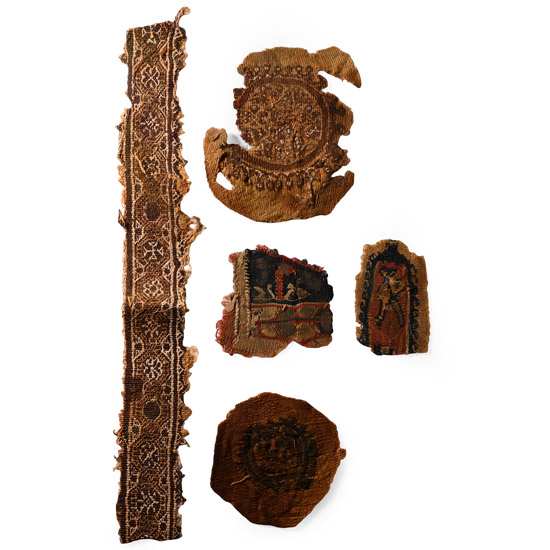
Egyptian Coptic Textile Fragments of Orbiculi, Segementa and Tablia from a Tunic with Animals, Geometric and Cross Decoration
Circa 6th-8th century A.D.Estimate: £100 - 140 (+bp*)
Bids: 1 | Current Bid: £5
Comprising a small orbiculus, with a lion, green on brown linen; fragment of a clavus, in red, yellow, green wool, s-torsion, with figures and scalloped borders; a large orbiculus, in red wool on purple linen, dentilled edges; a fragment of a tapestry with vegetal ornaments in red, yellow and green wool; a long tunic segmentum with crosses and stars inside lozenges, in yellow and dark purple. 17.94 grams total, 7.6-35.5 cm
Acquired 1970s-1996. Property of a North American collector. London collection, 2016.
The fragments are decorative parts of tunics. These are fabrics of great decorative finesse, with some elements displaying an unusual and extremely well-preserved colour palette. The large segmentum with crosses most likely belonged to an ecclesiastical garment. -
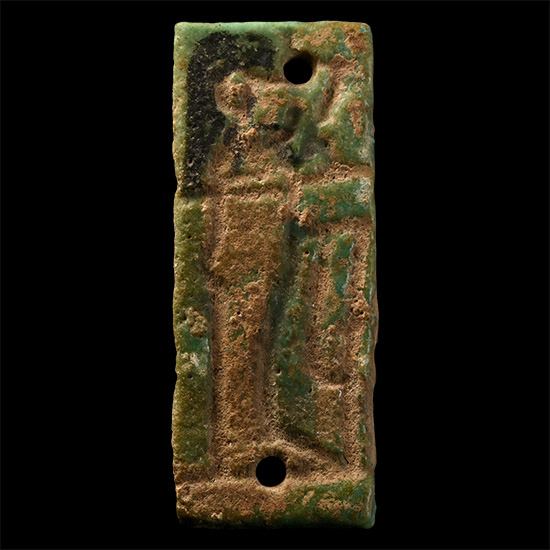
Egyptian Faience Amuletic Imsety Son of Horus Plaque
Late Period, circa 664-332 B.C.Estimate: £100 - 140 (+bp*)
Bids: 1 | Current Bid: £5
Rectangular green-glazed plaque with standing figure of Imsety in profile, with black pigment to the wig; pierced to the top and bottom; accompanied with a handwritten note reading 'Ancient Egyptian. Fayence pectoral amulet- impressive figure of Imseti, one of the four sons of Horus'. 5.98 grams, 49 mm
From the collection of David Donlan (1947-2025), a dedicated and lifelong collector with a passion for the ancient world and the natural sciences, forming his collection from 1960s onwards, using many reputable dealers across the United Kingdom, including the well-regarded Coincraft and The Parthenon Gallery. Accompanied by an old handwritten information ticket.
The Four Sons of Horus safeguarded the deceased's internal organs. The human-headed Imsety protected the liver, the baboon-headed Hapy the lungs, the jackal-headed Duamutef the stomach, and the falcon-headed Qebehsenuef the intestines. Plaques, such as this one, were sewn onto the mummy's wrappings or visceral packages. -

Greek Core-Formed Glass Amphoriskos
5th-3rd century B.C.Estimate: £1,500 - 2,000 (+bp*)
Opening Bid: £833
Elongated piriform amphora shape, tubular neck and everted rim, decorated with polychrome festooning and trails, applied amber-green handles and knop foot. 152 grams, 18 cm high
Acquired in the early 1990s. Ex private American collection; thence by descent. Private collection since 1998. This lot has been checked against the Interpol Database of stolen works of art and is accompanied by search certificate no.12206-222129. -
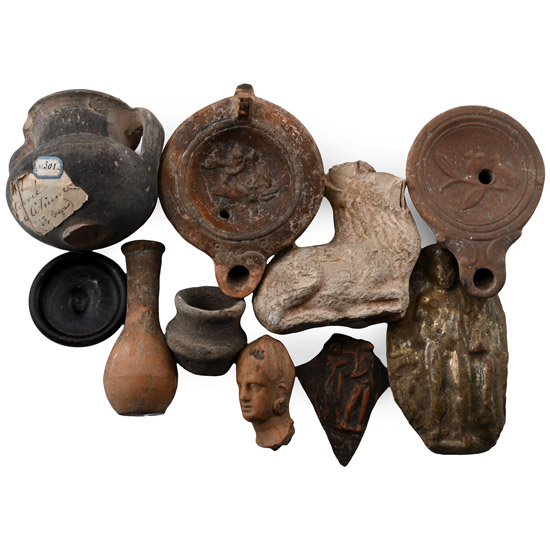
Greek and Later Artefact Collection
3rd century B.C.-3rd century A.D.Estimate: £400 - 600 (‡+bp*)
Opening Bid: £180
Including moulded glass vase fragment with standing Herakles figure, oil lamp with dolphin and triton, moulded female bust with earring, and other items. 465 grams total, 33-95 mm
Private collection, Switzerland. -
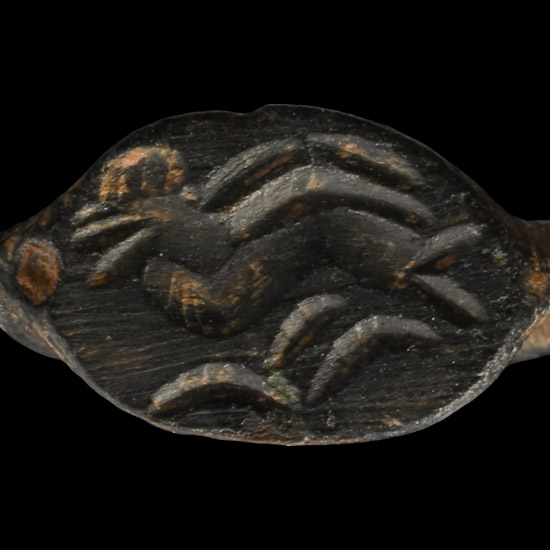
Greek Child's Bronze Ring with Animal
6th century B.C.Estimate: £40 - 60 (+bp*)
Bids: 1 | Current Bid: £5
Ellipsoid bezel with incuse crouching gryphon motif. 0.89 grams, 14.41 mm overall, 10.74 mm internal diameter
From the private collection of a European gentleman (1942-2024), formed since the 1970s.

