
Ancient Art, Antiquities, Books, Natural History, Stamps & Coins

-
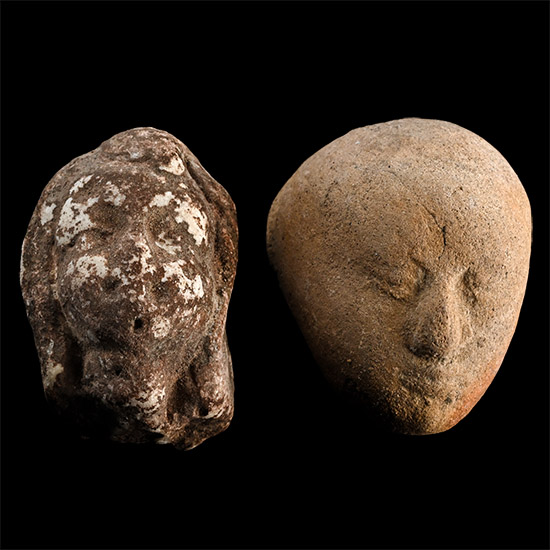
Phoenician Terracotta Head Group
Mid 1st millennium B.C.Estimate: £50 - 70 (+bp*)
Bids: 1 | Current Bid: £5
One mould formed with shoulder-length hair and puffy features; the other hollow to the reverse. 28.5 grams total, 33-34 mm
From the private collection of a European gentleman (1942-2024), formed since the 1970s. -
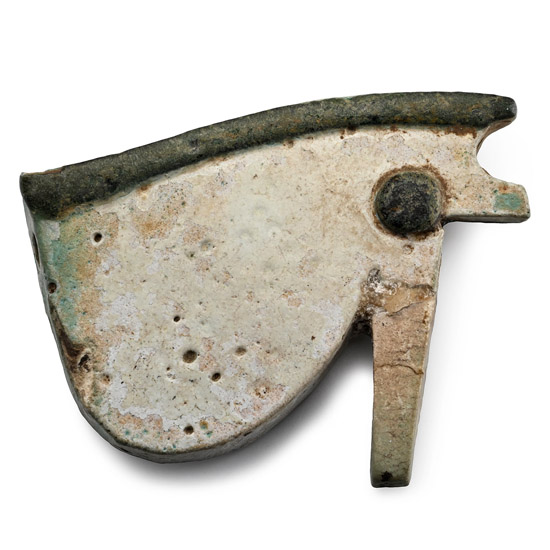
Large Egyptian Faience Eye of Horus Amulet
Third Intermediate Period, circa 1069-664 B.C.Estimate: £200 - 300 (+bp*)
Opening Bid: £100
Sizeable wedjat-eye amulet with applied black detailing to the pupil and brow. 16.5 grams, 50.4 mm
with Archaeologia, Switzerland, before 1983. Ex private North American collection. London private collection, 2016.
The wedjat-eye amulet symbolises the healed eye of the god Horus, representing both human and falcon elements. The name wedjat in ancient Egyptian means ‘the one that is sound.’ According to Egyptian mythology, Horus' eye was wounded or taken by the god Seth and later restored by Thoth. The wedjat-eye amulet was believed to protect its wearer and confer qualities of recovery and regeneration. It was highly popular and was used by both the living and the dead. -
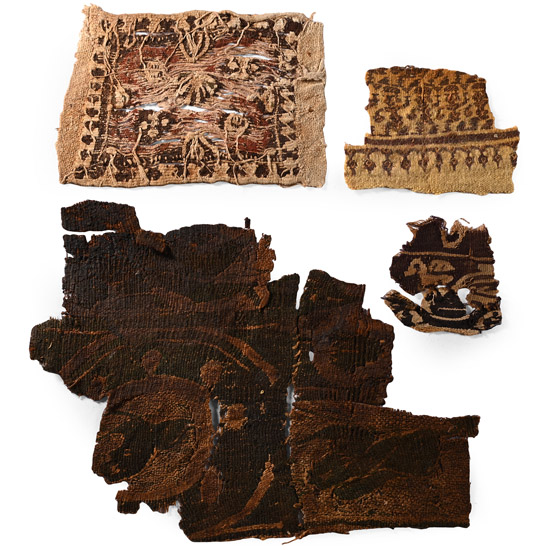
Egyptian Coptic Tunic Textile Fragments of Segmenta and Tablia with Figures, Animals and Geometric Decoration
Circa 5th-7th century A.D.Estimate: £70 - 90 (+bp*)
Bids: 1 | Current Bid: £5
Comprising: a large segmentum in linen and wool, with hares and lions, hunters with shields, purple wool on linen, S-torsion; fragment of a tabula with borders in dentellid decoration; a complete tabula in red, white and purple; small parts of a clavus with floral and animal embroidery. 27 grams total, 5.4-24.2 cm
Acquired 1970s-1996. Property of a North American collector. London collection, 2016.
The fragments are decorative parts of tunics. These are fabrics of great decorative finesse, with some elements displaying an unusual and extremely well-preserved colour palette. -
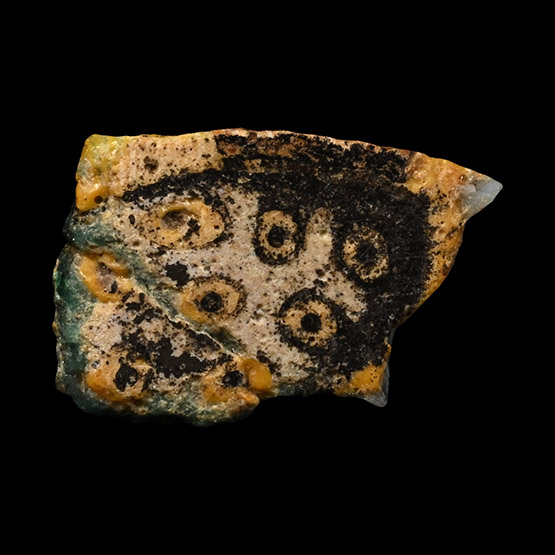
Egyptian Glass Panel with Eyes
Late Period, 664-332 B.C.Estimate: £200 - 300 (+bp*)
Opening Bid: £106
Irregular glass panel fragment with inlaid mosaic eye motifs; repaired. 1.57 grams, 18 mm
From the collection of a gentleman, acquired on the London art market in the 1990s. -
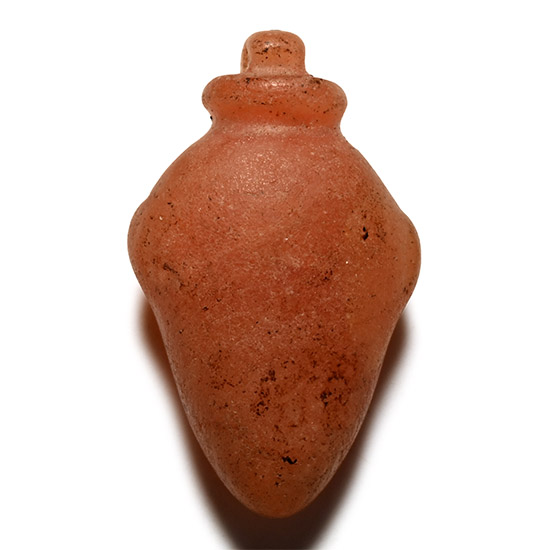
Egyptian Orange Jasper Heart Amulet
Late Period, 664-332 B.C.Estimate: £100 - 140 (+bp*)
Opening Bid: £50
Carved with lateral lugs, a pronounced rim surmounted by a suspension loop. 4.44 grams, 27 mm
Ex London collection, 1990s.
In ancient Egyptian belief, the heart (ib) was the centre of intelligence, emotions, and behaviour. It was also believed to store a person's memories. During the Weighing of the Heart ceremony in the afterlife, the heart could speak on the deceased's behalf and account for their lifetime of actions before Osiris. For this reason, Egyptians placed heart amulets on the mummy to protect the organ and ensure a favourable outcome in judgement. -
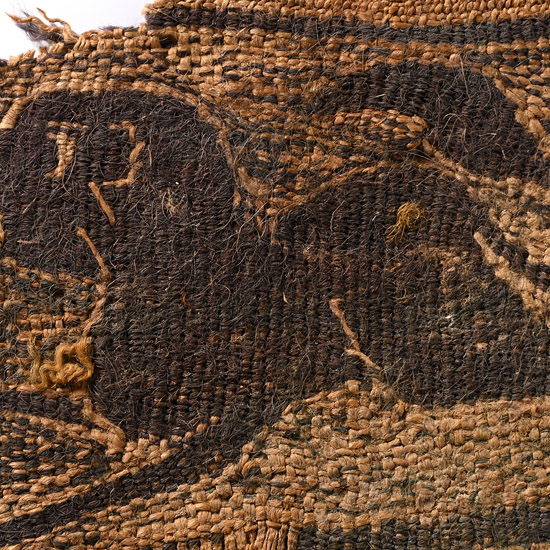
Egyptian Coptic Textile Fragment of a Clavus from a Tunic with Embroidered Lion
Circa 4th-5th century A.D.Estimate: £50 - 70 (+bp*)
Bids: 1 | Current Bid: £5
With a representation of a running lion, with its tail curved over its body. 2.58 grams, 90 mm
Acquired 1970s-1996. Property of a North American collector. London collection, 2016.
The theme of rabbits or hares, in association with other characters and animals of the Dionysian thiasos (here, a lion), in a hunting setting, has notable parallels. Such representations are linked to narratives of the Dionysian cycle. -
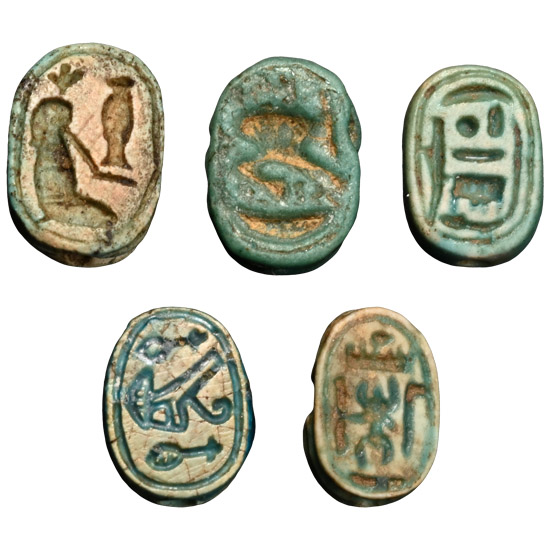
Egyptian Miniature Blue Glazed Scarab Collection
Late Period, 664-332 B.C.Estimate: £200 - 300 (‡+bp*)
Opening Bid: £100
Comprising: three scarabs, each with hieroglyphs on the underside; a scaraboid with two ankh motifs on the underside; and a bifacial ellipsoidal plaque with hieroglyphs on each face. 1.78 grams total, 8-9 mm
Private collection of Kal Noselson, New York, acquired between 1976 and the late 1990s; thence by descent. Accompanied by the collector's original inked images. -
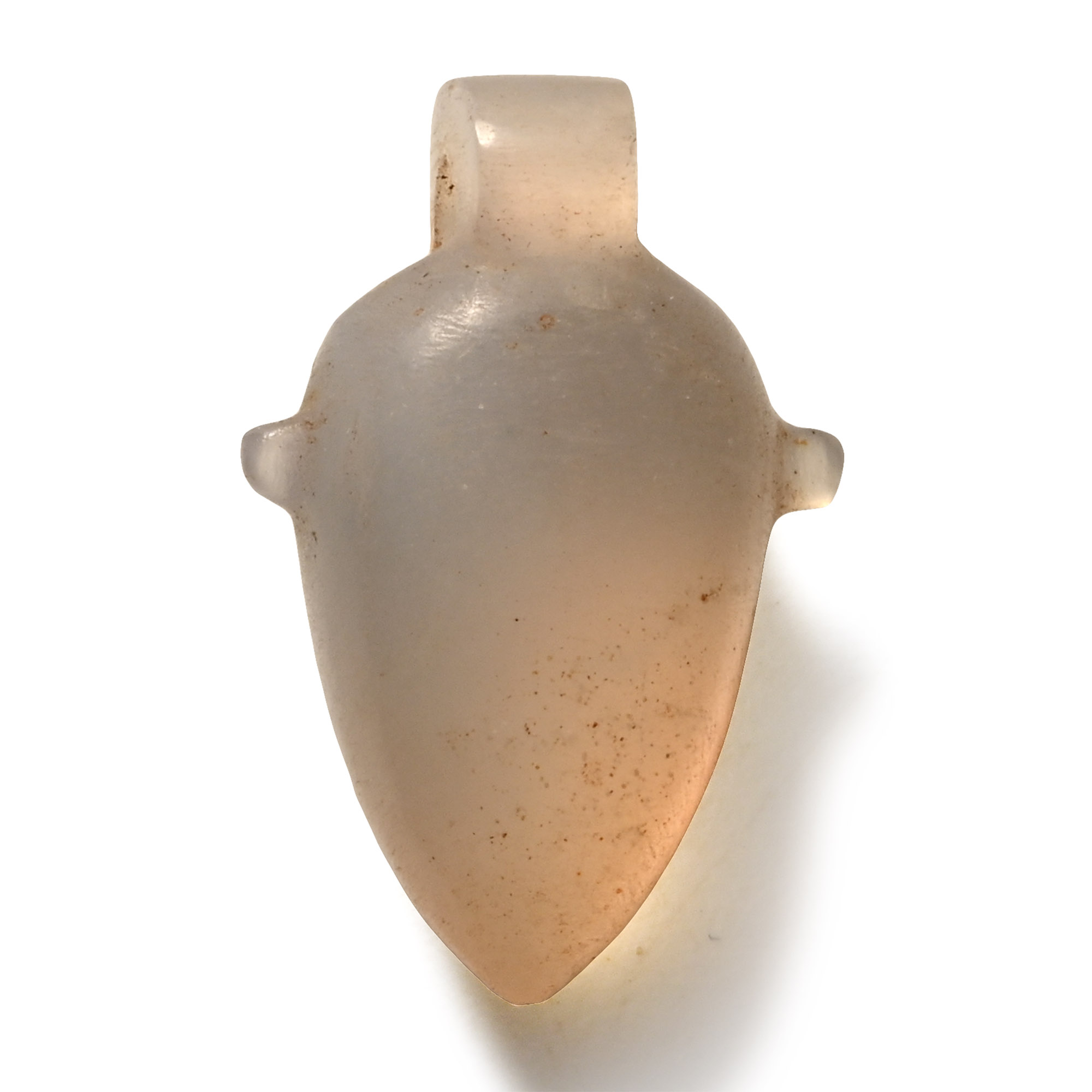
Egyptian Chalcedony Heart Amulet
Late Period, 664-332 B.C.Estimate: £100 - 140 (+bp*)
Opening Bid: £50
Carved with lateral lugs and surmounted by a suspension loop. 0.85 grams, 15 mm
Ex London collection, 1990s.
Ancient Egyptians viewed the heart (ib) as the seat of intelligence, emotions, behaviour, and memory. During the ‘Weighing of the Heart’ ceremony, it spoke for the deceased before Osiris and accounted for their actions. For this reason, Egyptians placed heart amulets on mummies to protect the organ and secure a favourable judgment. -
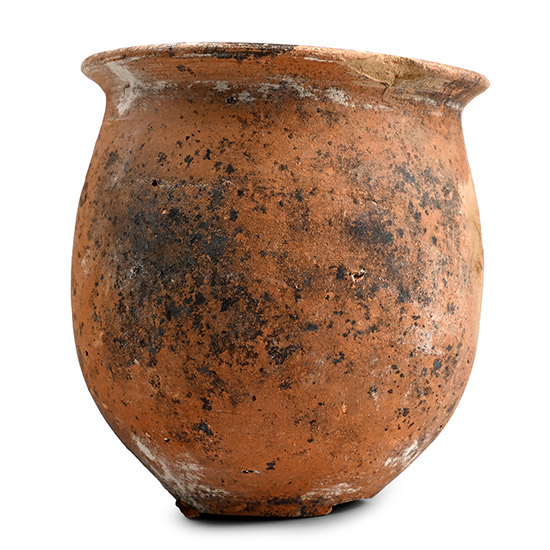
Egyptian Terracotta Jar
Roman Period, 30 B.C.-323 A.D.Estimate: £50 - 70 (+bp*)
Opening Bid: £5
Ovoid in profile with flared everted rim to the mouth; repaired. 140 grams, 85 mm
Acquired on the UK art market since the 1990s. From the property of a late Lincolnshire, UK, gentleman; thence by descent. -
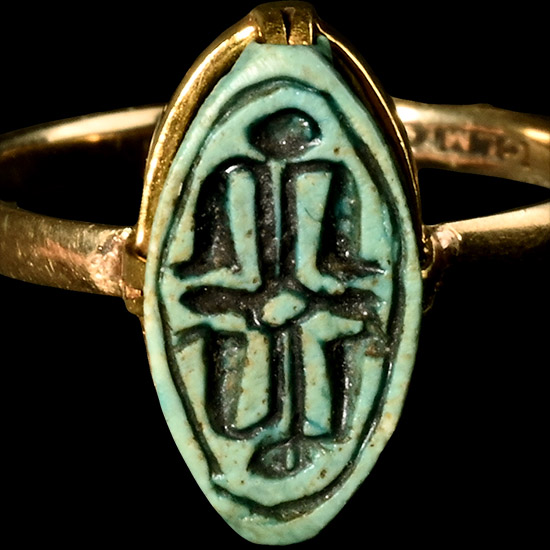
Egyptian Blue Faience Cowroid with Uraei in Gold Ring
Third Intermediate Period, 1069-860 B.C.Estimate: £500 - 700 (+bp*)
Opening Bid: £250
Slender, lentoid form with a finely striated edge design; the main motif comprises four outward-facing uraei, one in each quadrant, with a sun disc at each end, mounted in a modern gold ring. 2.33 grams, 22.62 mm overall, 16.76 mm internal diameter (approximate size British M, USA 6, Europe 12.46, Japan 12)
Private collection, London. -
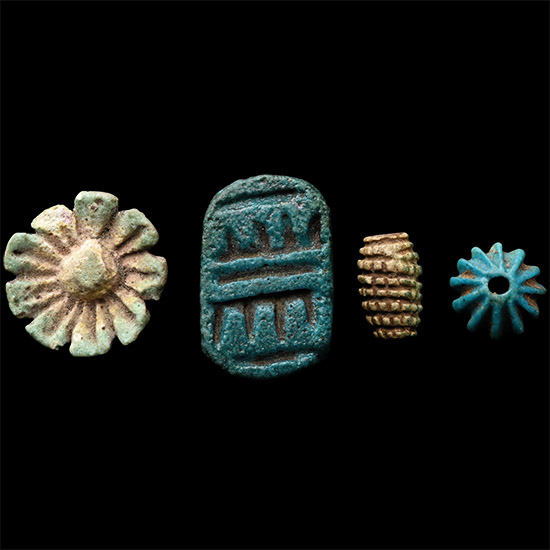
Egyptian Decorative Glazed Faience Amulet Collection
Late Period, 664-332 B.C.Estimate: £100 - 140 (‡+bp*)
Opening Bid: £45
Comprising: two rosette beads, one tubular bead and a stamp-seal amulet, all with a drill hole; one rosette bead slightly worn. 5.77 grams total, 11-24 mm
with Tajan Auction, 22 October 2004, no.172. -
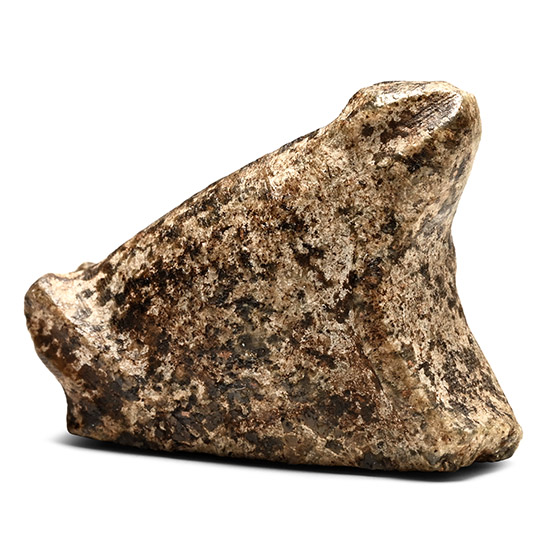
Egyptian Amulet in the Shape of a Squatting Frog
Late Period, 664-332 B.C.Estimate: £500 - 700 (‡+bp*)
Opening Bid: £275
Carved in the round in a squatting pose, with rear legs poised to leap. 9.2 grams, 27 mm
Ex Herbert A. Cahn, Basel, 1970s; thence by descent.
Frog amulets in ancient Egypt symbolised fertility, rebirth, and renewal. Associated with the goddess Heqet, who was linked to childbirth and life-giving forces, they were especially popular for fertility and for protection during pregnancy and labour. Their association with the annual Nile flood, which brought new life to the land, further emphasised their symbolism of revival and abundance.
