-
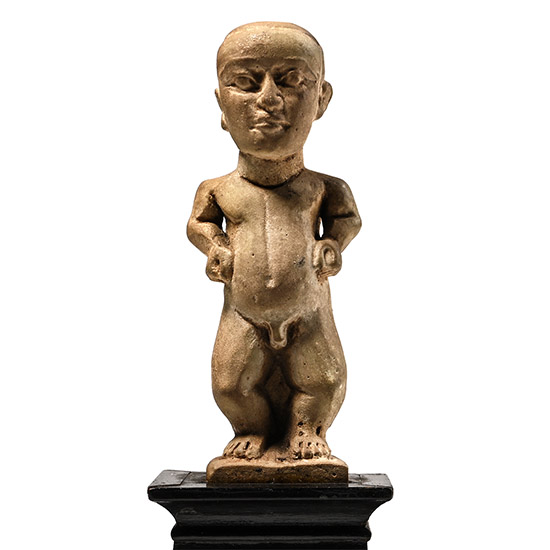
Large Egyptian Faience Pataikos Amulet
Late Period, 664-332 B.C.Estimate: £1,200 - 1,700 (‡+bp*)
Opening Bid: £675
Standing nude with slightly bent legs on an integral trapezoidal base; short arms bent and clenched fists resting at the sides of his slightly protruding belly; finely modelled eyes, nose, mouth and ears; flat, close-fitting cap indicating the hair; suspension loop at the nape of the neck for use as an amulet. 80 grams total, 12.5 cm including stand
Ex Ms.E.C.(1923-2014), Israel. Inherited by his son D.L., Switzerland.
Herodotus mentions Pataikos as a dwarf-like depiction of Ptah, though the god's ancient Egyptian name remains unclear. These small amulets symbolise Ptah’s immense magical power, which helps protect the wearer from dangerous creatures such as snakes and crocodiles. The deity’s role in the funerary sphere is explained in Spell 164 of the Book of the Dead, where Pataikos is used to safeguard the deceased’s heart from attacks by enemies and from bodily decay. -
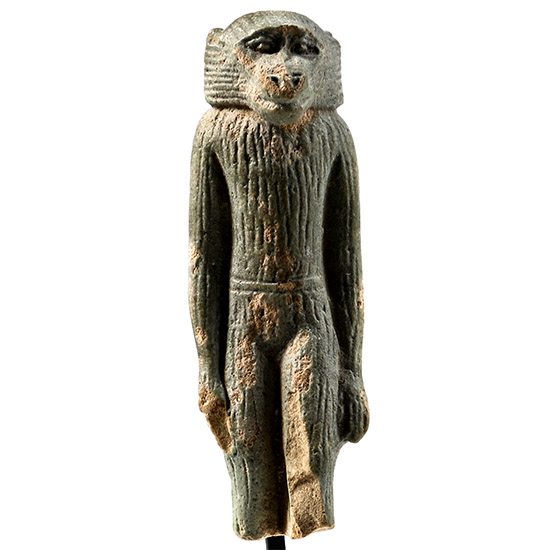
Egyptian Faience Amulet in the Shape of a Striding Monkey
Late Period, 664-332 B.C.Estimate: £1,200 - 1,700 (‡+bp*)
Opening Bid: £675
Formed as a striding African savannah monkey (Chlorocebus aethiops), or grivet, with human proportions but monkey hair texture; long arms hanging close to the body, hands extended downward; an incised belt at the waist; a suspension loop at the reverse (repaired); with a custom-made stand. 68.9 grams total, amulet: 57 mm, 13.5 cm high including stand
Private collection of an English amateur archaeologist (1849-1927), thence by descent. with Bonhams Auction, 5 October 2011, no.360. Thereafter, private collection of Erika (1934-2025) and Jakob (1927-2025) Binkert, Binningen, Switzerland; acquired in 2012 from Jean-David Cahn AG, exhibition Aegyptiaca, Basel. Thence by descent.
In the minds of the ancient Egyptians, male monkeys' behaviour may have linked them to masculinity, suggesting that, when worn as an amulet, they could have served a magical role in the reproductive cycle, facilitating birth in this life and rebirth in the afterlife. Alternatively, the prolonged care that females provide for their offspring may have linked the monkey with maternal protection and fertility. These associations may have been reinforced here by the monkey’s greenish faience, which symbolised renewal. -
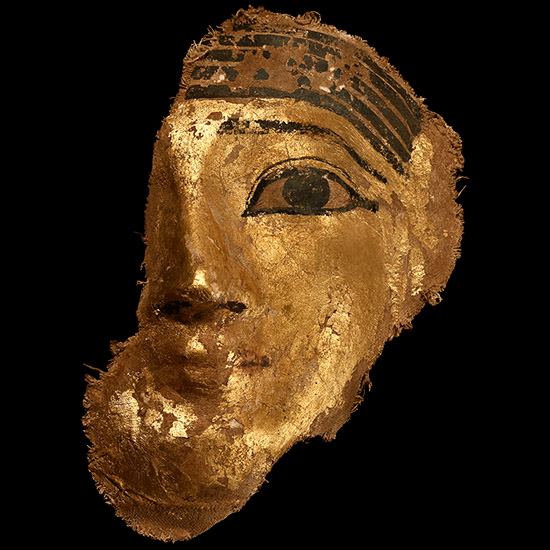
Egyptian Gilt Cartonnage Mask
Late Period, circa 600-300 B.C.Estimate: £600 - 800 (+bp*)
Opening Bid: £300
Fragmentary mask in cartonnage (layers of linen and plaster) with a gilded surface and details of the striated wig, eye, nostrils and lips added in black pigment. 16 grams, 21.2 cm
Private Edgewater, Florida, USA, collection; acquired by James W. Anonymous sale; UK auction house, early 2000s. Private collection, 2022. J.W.Collection, acquired 2026. Accompanied by a copy of two previous illustrated catalogue pages. -
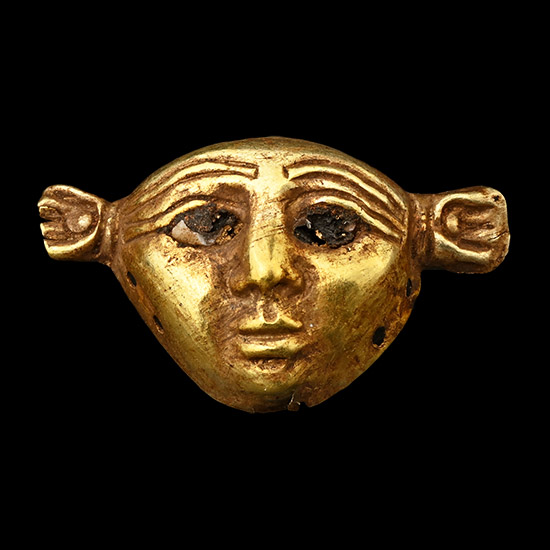
Egyptian Gold Hathor Face Mask
Late Period-Ptolemaic Period, circa 664-30 B.C.Estimate: £1,800 - 2,400 (+bp*)
Opening Bid: £900
Depicted as a woman's head with cow ears, her eyebrows and cosmetic lines carefully defined, with her eyes retaining traces of inlay. 0.96 grams, 28 mm
From the collection of a UK gentleman, London, UK, by descent from his family collection 1970s.
This particular appearance of Hathor, with a human head and cow ears, often appears on columns, particularly in temples associated with goddesses or mammisi-temples ("birth houses"), which were devoted to the birth of a goddess's divine son. The form also appears in the decoration of sistra used in Hathoric and birth-related rituals. Therefore, this diminutive gold image embodies Hathor's symbolic protective potency in all matters maternal. -
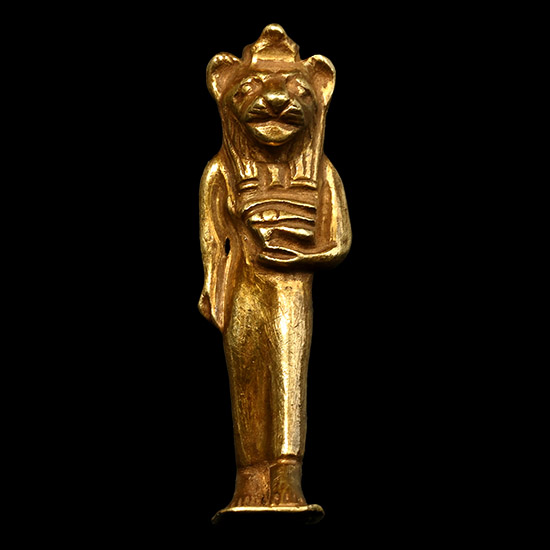
Egyptian Gold Sekhmet Statuette
Late-Ptolemaic Period, circa 664-30 B.C.Estimate: £5,000 - 7,000 (+bp*)
Opening Bid: £2,500
Figure of the lioness-headed goddess standing on a rectangular plinth, wearing a striated lappet wig with uraeus and an ankle-length, tight-fitting dress, her right arm extended down her side and her left hand holding a wedjat-eye symbol against her chest; a suspension loop behind her head. 5.31 grams, 28 mm
From the collection of a UK gentleman, London, UK, by descent from his family collection 1970s. This lot has been checked against the Interpol Database of stolen works of art and is accompanied by search certificate no.13544-263324.
The wedjat-eye and lioness are potent, often intertwined symbols in ancient Egyptian mythology. The wedjat, representing Horus’s healed eye, signifies protection and healing, while the lioness—linked to the goddesses Sekhmet and Wadjet—embodies power and fierce defence as the “Eye of Ra”. Together, in amulets and in Egyptian art, they convey healing, protection, and strength. -
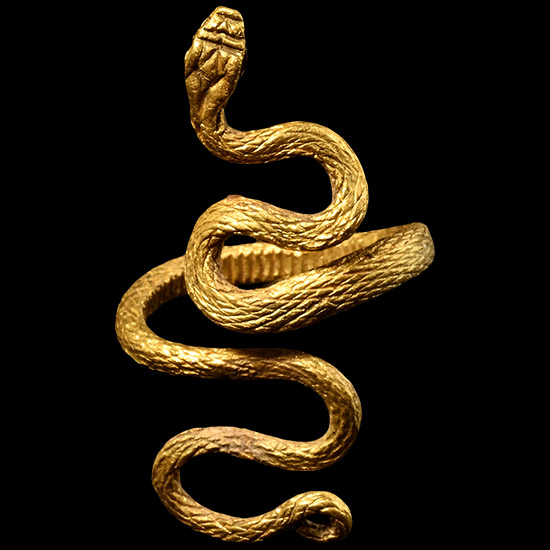
Egyptian Gold Snake Ring
Roman Period, 30 B.C.-323 A.D.Estimate: £2,000 - 3,000 (+bp*)
Opening Bid: £1,000
Formed as a slender-bodied coiled snake, featuring eye, head, and scale detailing on the body. 6.96 grams, 23.75 mm overall, 18.72 mm internal diameter (approximate size British M 1/2, USA 6 1/4, Europe 13.09, Japan 12)
Ex German art market, 2000s. Acquired from an EU collector living in London. From the collection of a Surrey, UK, gentleman. This lot has been checked against the Interpol Database of stolen works of art and is accompanied by search certificate no.13541-261559. -
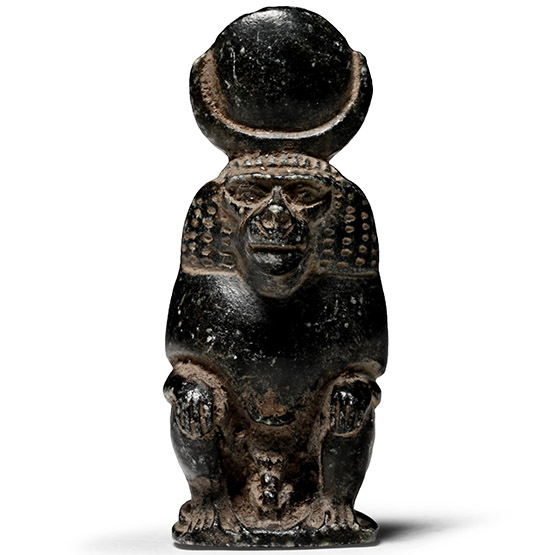
Egyptian Green Stone Baboon Statuette
New Kingdom, 1550-1070 B.C.Estimate: £1,500 - 2,000 (‡+bp*)
Opening Bid: £825
Carved in the round as an amuletic baboon figure with a lunar crescent-and-disc headdress and a ribbed suspension loop behind the head. 6.21 grams, 33 mm
Private collection, acquired in the late 1980s-early 1990s; thence by descent. This lot has been checked against the Interpol Database of stolen works of art and is accompanied by search certificate no.13180-249315.
Amulets depicting the squatting baboon wearing the lunar headdress can represent either Thoth or Khonsu. -
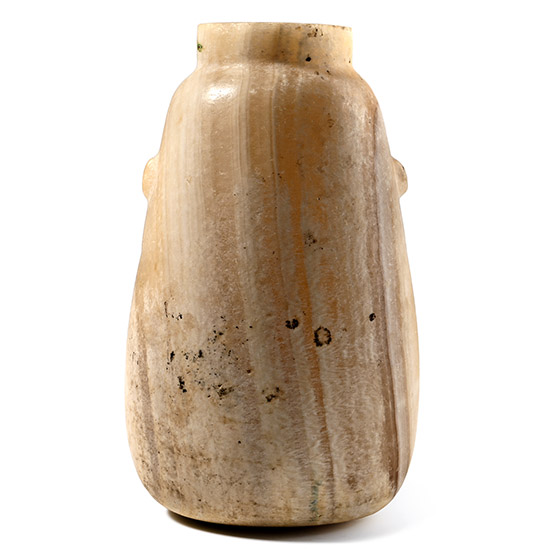
Large Egyptian Alabaster Alabastron
Late Period, 664-332 B.C.Estimate: £1,200 - 1,700 (‡+bp*)
Opening Bid: £650
Elongated vessel widening slightly towards the flat base with broad, cylindrical neck; vertical rim to the mouth, probably slightly reground; two lateral knob handles. 867 grams, 15.5 cm
Body intact. Some dark discolourations.
Acquired from Galerie Arete, Zurich, 15 April 1988. Ex private collection, Therwil, Switzerland.
The veining of the finely polished alabaster underscores the vessel’s form; the interior is smoothed, but the base lacks the same polish as the wall and was either reground or not polished in the first place. -
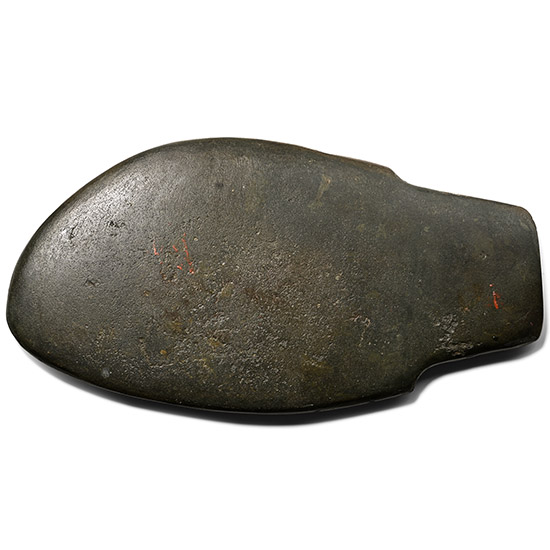
Large Egyptian Green-Gray Slate Fish Palette
Predynastic, Naqada II, 4th millennium B.C.Estimate: £2,000 - 3,000 (‡+bp*)
Opening Bid: £1,175
Broad and flat, the outline is shaped like a stylised, schematic fish, with an ovoid body, rounded front edge, and a gently tapering 'tail' at the rear. 858 grams, 25.3 cm
Private collection, Paris, France. Auction Millon, Paris, 27 May 2019, no.109. This lot has been checked against the Interpol Database of stolen works of art and is accompanied by search certificate no.13496-263056.
Predynastic fish palettes are among the more common zoomorphic types and were produced with varying degrees of naturalism and detail. This example has a similar profile to one recovered from the Predynastic cemetery at Tarkhan (Petrie, W.M.F., Corpus of Prehistoric Pottery and Palettes, London, 1917, pl. LV, 54J). -
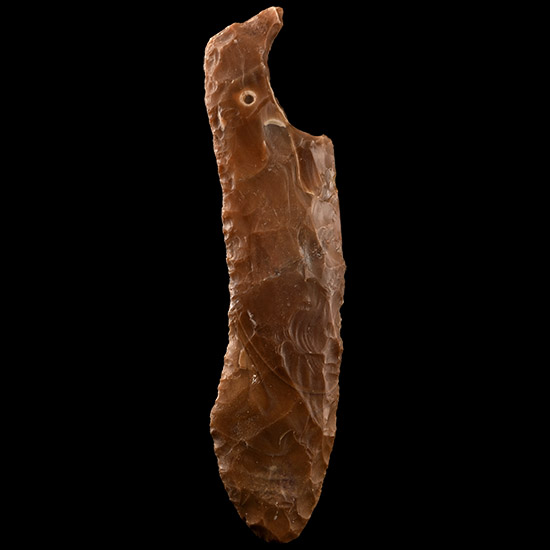
Large Egyptian Stone Age Knapped Flint Knife
Predynastic-Early Dynastic Period, Naqada II-2nd Dynasty, circa 3500-2686 B.C.Estimate: £1,000 - 1,400 (+bp*)
Opening Bid: £400
Large, expertly knapped bifacial tool with a distinct curved spine and relatively straight cutting edge, and an offset, integrated tang or handle section for hafting; the surface displays controlled flaking patterns typical of high-status ritual or funerary implements from this era. 99 grams, 19.8 cm
From the old English private collection of Mr P.D.R., acquired before 1980. -
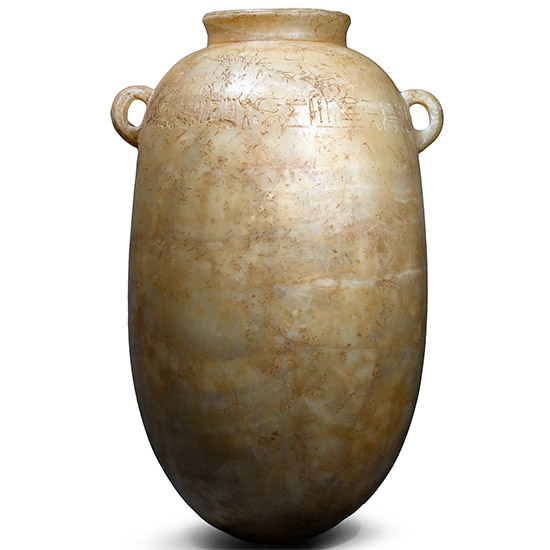
Very Large Egypto-Phoenician Alabaster Alabastron with Hieroglyphic Inscription
Third Intermediate Period-Late Period, circa 1077-525 B.C.Estimate: £12,000 - 17,000 (‡+bp*)
Opening Bid: £6,000
Barrel-shaped in profile, with a rounded base, broad shoulder and flared mouth, and two integral lateral loop handles; a single line of incised hieroglyphic text around the shoulder. 420 grams, 37 cm
Formerly in a private collection, Beirut, Lebanon, 1990s. Swiss private collection, acquired from Mr H., Geneva, 2010. Accompanied by a copy of an Art Loss Register certificate, no.S00059830 This lot has been checked against the Interpol Database of stolen works of art and is accompanied by search certificate number no.13221-249178.
In the Phoenician necropolises of Andalusia, the deceased's ashes were enclosed in luxurious alabaster urns of Egyptian manufacture. At Almuñécar, for example, some urns in the Phoenician necropolis preserved inscriptions and emblems of various Egyptian pharaohs, who ruled the Nile region between the 16th and 8th centuries B.C. Alabaster vessels of this type, originally containing fine wines, have been discovered, albeit in smaller numbers, in the royal palaces of Assur and Samaria in the East, as part of war booty or gifts exchanged between royal houses. -
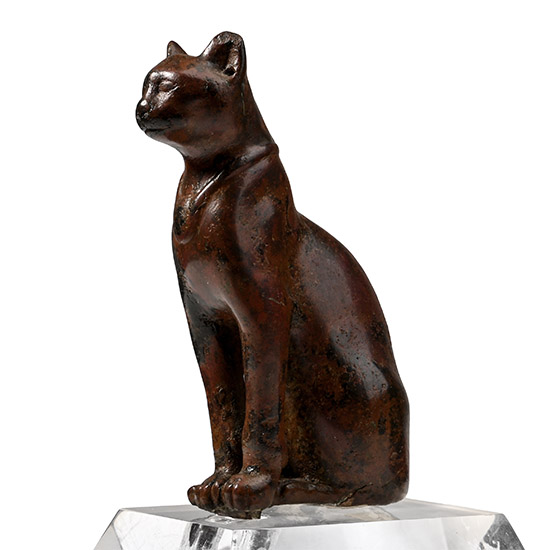
'The Fitzgerald' Egyptian Bronze Statue of the Seated Cat Goddess Bastet
Late Period, 26th-30th Dynasty, circa 664-332 B.C.Estimate: £3,000 - 4,000 (+bp*)
Bids: 1 | Current Bid: £5
Modelled seated, its tail wrapped around one side of its body and resting on a front paw, both ears pierced, wearing a collar featuring a large amuletic pendant, a rectangular tang for attachment to a separate element below; mounted on a 1970s custom-made perspex display stand. 470 grams total including stand, cat: 11.2 cm high
Dr Desmond Fitzgerald collection, no.28. Ex Nick Wright, 1990. From the collection of Charlie Watts (Rolling Stones drummer). This lot has been checked against the Interpol Database of stolen works of art and is accompanied by search certificate no.13462-261733.
The cat was the most sacred animal in ancient Egypt and associated with the cat-headed goddess Bastet, daughter of Re. When represented in human form as a cat-headed female, she usually holds a sistrum (a musical rattle) in her right hand with a supine cat on its top, and an aegis in her left. Small kittens are often shown at her feet. Her most important cult centre was at Bubastis (Tell Basta) in the north-east Delta. The site today is heavily ruined and the temple destroyed. Sir Flinders Petrie excavated at Bubastis and other nearby Delta sites in the 1880s. Tombs of some of the temple officials have been found nearby, and vast cemeteries of mummified cat burials left as votive offerings; so many thousands were found that they were used locally as fuel. Since Petrie’s investigations, the site has been abandoned and only in recent years have excavations begun to be undertaken. In painted nobles’ tombs at Thebes, a cat is often represented seated beneath the chair of the noble’s wife. In the 5th century BC, the Greek historian Herodotus wrote that the festival of Bastet at Bubastis was the most elaborate of all those in Egypt. The Roman geographer Strabo wrote that the cat was so revered in Egypt that an Egyptian dashed into his burning house to save the cat, then returned to rescue his family.

