-
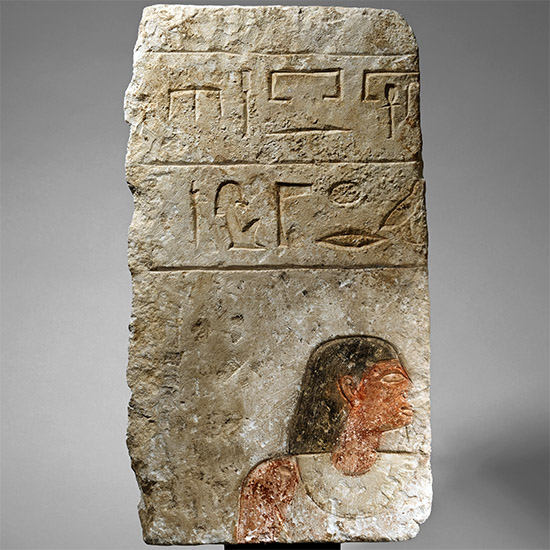
Egyptian Limestone Relief with Painted Head and Hieroglyphics
Old Kingdom, 2686-2181 B.C.Estimate: £6,000 - 8,000 (‡+bp*)
Opening Bid: £3,000
Rectangular panel with incised decoration in three registers: the top line reads: '...Per-ankh, Per-aa, Semer-heb(?)', names of two institutions, 'House of Life' and 'Great House', and a title, possibly 'courtier of the council'; the second line reads '...imakhu netjer-aa', meaning 'honoured before the Great God'; the lower register preserves the upper body and profile head of a man with shoulder-length hair, wearing a broad collar, with face and body painted red and hair black; mounted on a custom-made stand. 17.7 kg total, 51 cm including stand
with Archaeologia, Switzerland, before 1983. Ex private North American collection. London private collection, 2016. This lot has been checked against the Interpol Database of stolen works of art and is accompanied by search certificate no.13447-260649. -
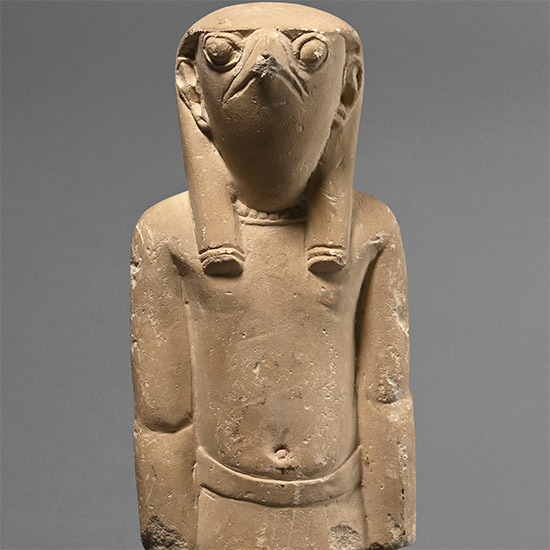
Large Egyptian Limestone Statue of the Falcon God Horus
Graeco-Roman Period, 332 B.C.-323 A.D.Estimate: £1,500 - 2,000 (+bp*)
Opening Bid: £350
Carved in the round figure of Horus wearing a tripartite wig and beaded collar, a belted kilt to the waist; mounted on a custom-made stand. 2.42 kg total, 33.5 cm high including stand
From a UK private collection. with Mallams, Oxford, Library Sale, 2025. Acquired by the current owner from the above. Accompanied by a copy of an illustrated academic report by Simone Musso. -
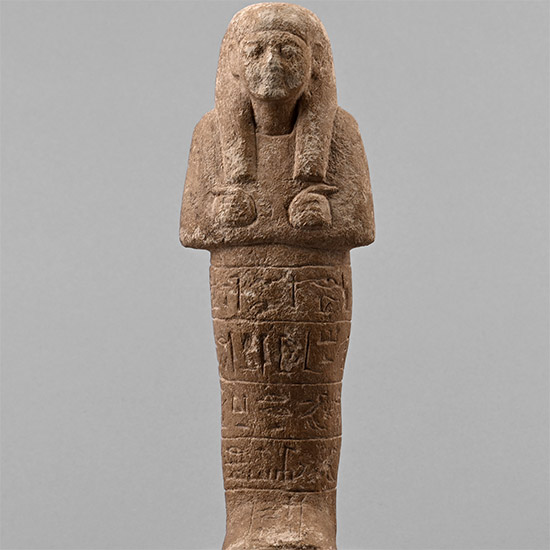
Egyptian Limestone Shabti of Neferrenpet
New Kingdom, 19th Dynasty, Ramesside Period, circa 1100 B.C.Estimate: £5,000 - 7,000 (‡+bp*)
Opening Bid: £2,725
Mummiform type with arms crossed and hands modelled in relief; face framed by a tripartite wig with long lappets; four horizontal lines of inscription around the front and back of the lower body, separated by border lines and interrupted by a vertical band on the reverse; accompanied by a custom-made display stand. 708 grams total, 25.2 cm high including stand
Surface slightly worn, especially in the face and at the tips of the feet.
Ex Roger Liechti (1934 -2010), Petit-Lancy, Switzerland. Thence by descent in the family, Switzerland. This lot has been checked against the Interpol Database of stolen works of art and is accompanied by search certificate no.13472-263059.
Neferrenpet was a popular New Kingdom name, borne by a Vizier of the South, one of the most important officials serving Ramesses II. A large (32 cm high) limestone shabti for him is now in Florence (Aubert, J-F., Aubert, L., Statuettes Égyptiennes: chaouabtis, ouchebtis, Paris, 1974, p. 96). The Metropolitan Museum of Art holds a smaller limestone shabti (19 cm) from the time of Ramesses II, inscribed for a sculptor named Neferrenpet (Hayes, W.C., The Scepter of Egypt. A Background for the Study of the Egyptian Antiquities in The Metropolitan Museum of Art, Vol 2, New York, 1990 (reprint), p. 426). However, because the inscription on the present shabti includes no titles, it remains uncertain whether it belonged to either of them or to another person with the same name. -
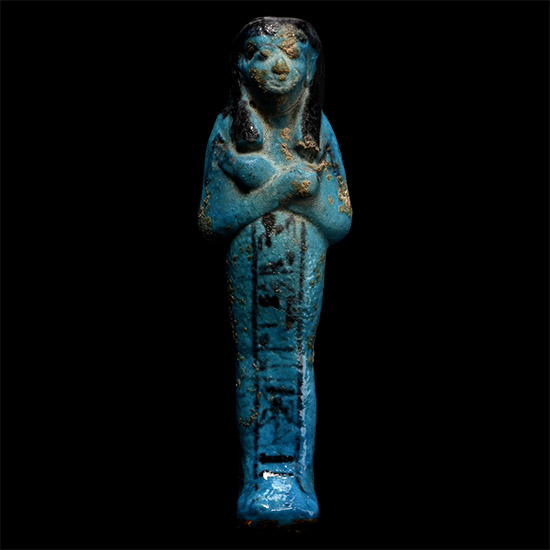
Egyptian Blue Glazed Hieroglyphic Shabti
Third Intermediate Period, circa 1069-945 B.C.Estimate: £800 - 1,000 (‡+bp*)
Bids: 1 | Current Bid: £450
Mummiform figure wearing a lappet wig, arms crossed, holding hoes; black pigment detailing on the hair, face, and seed bag hanging across the back; a panel of hieroglyphic text on the lower body. 77 grams, 12.3 cm
Ex Carl Leonhard Burckhardt-Reinhard (1902-1965), formed since 1922, Egypt. Inherited by his son Christopher Burckhardt in 1966, Switzerland. Since then in the possession of his wife, Switzerland. -
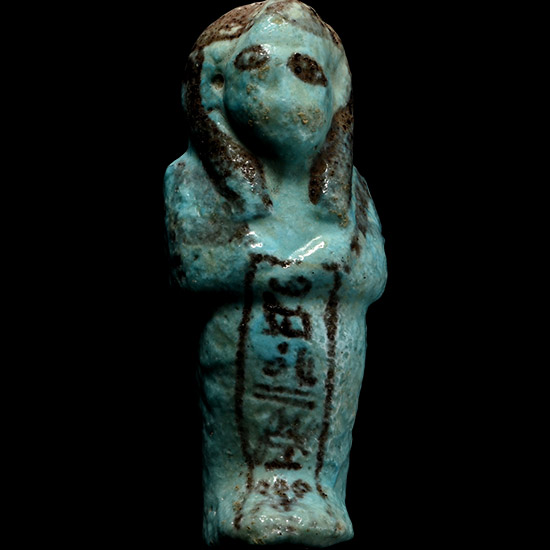
Egyptian Blue Glazed Shabti of Iset-em-khebit
Third Intermediate Period, 21st Dynasty, circa 1077-943 B.C.Estimate: £600 - 800 (‡+bp*)
Opening Bid: £320
Squat mummiform figure wearing a black-painted tripartite wig, arms crossed, holding agricultural implements and a seed bag across the back, painted in black; a hieroglyphic panel on the lower body reading: 'The Osiris, Iset-em-khebit (Ꜣs.t-m-Ꜣḫ-bı͗.t)'. 80 grams, 93 mm
Ex Carl Leonhard Burckhardt-Reinhard (1902-1965), formed since 1922, Egypt. Inherited by his son Christopher Burckhardt in 1966, Switzerland. Since then in the possession of his wife, Switzerland.
Shabtis for Iset-em-khebit were recovered from the second 'Priest's of Amun Cache' at Deir el-Bahari. -
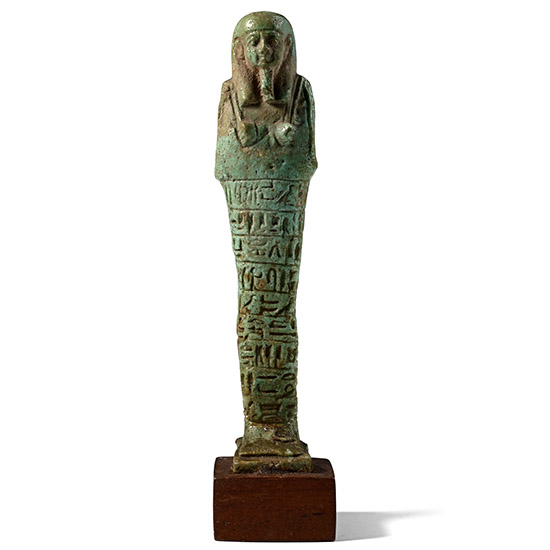
Egyptian Blue-Glazed Faience Shabti for Hornakht, Born of Nefertyti
Late Period, 664-332 B.C.Estimate: £600 - 800 (+bp*)
Bids: 2 | Current Bid: £10
Slender olive-green mummiform shabti wearing a lappet wig and a false beard, with arms crossed, the left hand holding a pick and the right a hoe and the cord of a seed bag, which hangs from the back shoulder; with nine horizontal bands of deeply incised hieroglyphs on the lower body, giving the Book of the Dead spell and the names of the owner, Hornakht, and his mother, Nefertyti; supplied with a two-page printed report covering the transliteration and translation of the text; mounted on a custom-made stand with an old 'Ancient Egyptian B.C.900' label. 80.9 grams total, 16 cm high including stand
From the estate of a deceased Sussex private collector since the early 20th century. Accompanied by a copy of an illustrated academic report with translation by Simone Musso. -
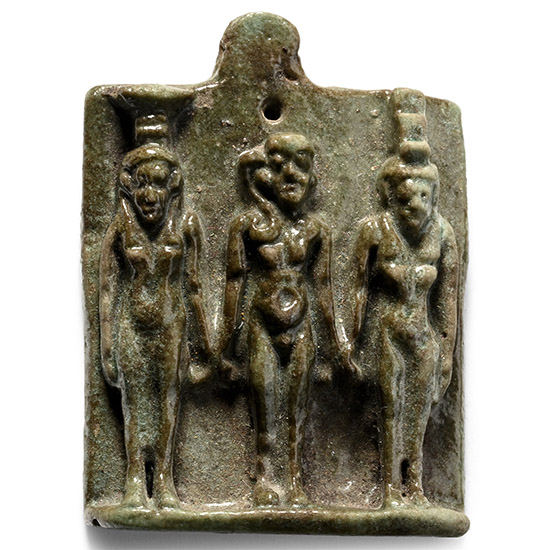
Large Egyptian Green Glazed Faience Triad Amulet
Late Period-Ptolemaic Period, 664-30 B.C.Estimate: £1,500 - 2,000 (+bp*)
Opening Bid: £750
Depicting the youthful Horus with a long, curling sidelock, flanked by the goddess Nephthys on the left and Isis on the right, standing on an integral plinth against a flat back slab with a suspension loop above; Isis wearing a stepped throne headdress, and Nephthys and Isis wearing headdresses comprising the hieroglyphs spelling their names, the trio clasping hands demonstrating the women's protection and guardianship. 19.7 grams, 52 mm
Ex mid-20th-century collection. Ex London, UK, collection. From a Cambridgeshire, UK, dealership. Accompanied by a previous catalogue information page.
Nephthys and Isis were sisters, while Horus is the son of Isis and Osiris, making Nephthys his aunt and the secondary maternal figure in this triad. -
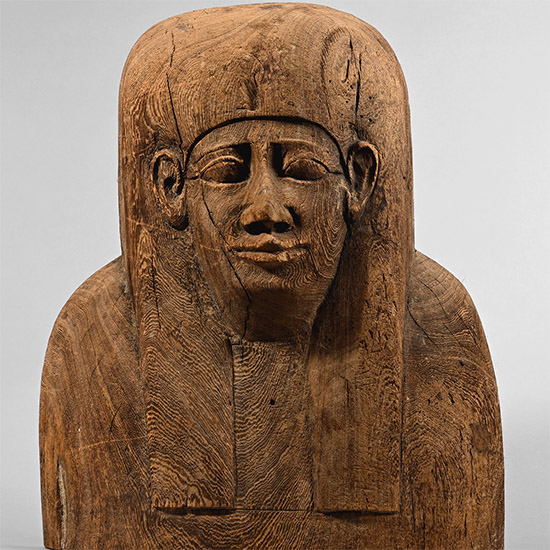
Large Egyptian Wooden Mummy Coffin
Late Period-Ptolemaic Period, circa 664-30 B.C.Estimate: £6,000 - 8,000 (‡+bp*)
Opening Bid: £3,000
Upper half of the front of a coffin, carved in high relief, with a deep hollow on the reverse; the face and tripartite wig are carefully executed, with fine facial modelling; thin raised-relief eyebrows, large almond-shaped eyes framed above by cosmetic lines, a widely splayed nose, a broad, narrow-lipped mouth, a broad chin above a fleshy neck, and forward-facing, internally detailed ears; an attachment point on the chest for a separate collar or other adornment; the back features two mortises (one with a partial tenon still in place). 5.15 kg, 57.7 cm high
with Archaeologia, Switzerland, before 1983. Ex private North American collection. London private collection, 2016. This lot has been checked against the Interpol Database of stolen works of art and is accompanied by search certificate no.13516-260648. -
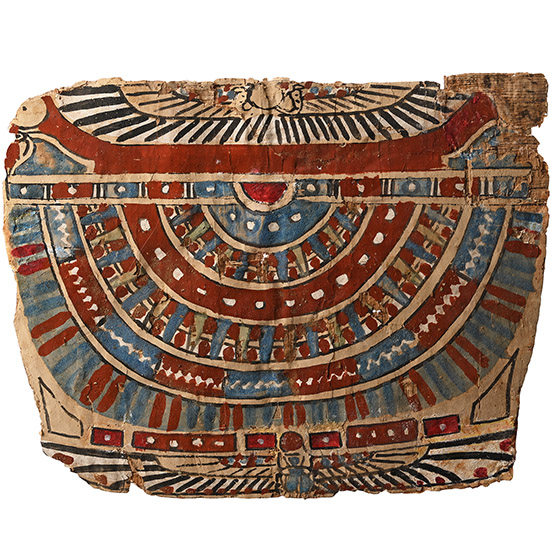
Egyptian Cartonnage Pectoral Panel on Stand
Late Period-Ptolemaic Period, circa 664-30 B.C.Estimate: £1,500 - 2,000 (+bp*)
Opening Bid: £800
Rectangular panel with bands of triangles, teardrops and other motifs in white, red, blue and pale green; winged scarab at the bottom, lower portion of a winged sun disc flanked by uraei to the top; mounted on a custom-made stand. 2.06 kg total, 31.4 cm wide including stand
Ex early 20th century collection, London, UK. Accompanied by a copy of a previous illustrated catalogue page, including provenance. This lot has been checked against the Interpol Database of stolen works of art and is accompanied by search certificate no.13518-263302.
This piece was probably part of a set of cartonnage trappings placed on the mummy. -
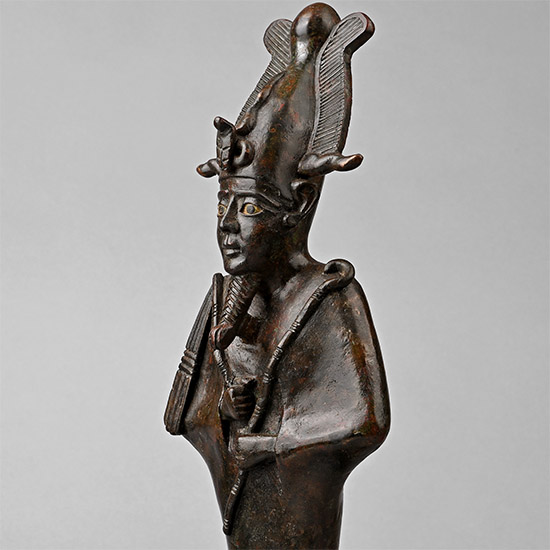
Large Egyptian Bronze Statue of Osiris
Late Period-Ptolemaic Period, circa 664-30 B.C.Estimate: £18,000 - 24,000 (+bp*)
Opening Bid: £9,000
Modelled in the round, standing erect and wearing a long, tight-fitting garment, with hands emerging from openings to hold the nekhakha flail and heka crook; on his head is an atef crown, consisting of the white crown with lateral feathers, ram's horns and a uraeus; below his chin extends a braided false beard, supported behind with a short tab; the eye sockets inlaid with glass; mounted on a custom-made stand. 3.76 kg total, 41.5 cm high including stand
From an old Japanese private collection formed in the 1970s. Mr M.S. prior to 1988. Acquired from the above 18 April 1988. M. Yekta, UK private collection UK. Acquired from the above 17 Aug 2021. This lot has been checked against the Interpol Database of stolen works of art and is accompanied by search certificate no.13469-262425.
Osiris was one of the most important gods of ancient Egypt, associated with the afterlife, resurrection and the regeneration of life. As ruler and judge of the dead, he offered the promise of rebirth to those who hoped to attain eternal life. Bronze statuettes of Osiris were dedicated in temples and placed in tombs as votive offerings. They expressed personal piety and devotion while invoking the god’s protection and his power to grant rebirth in the afterlife. -

Large Egyptian Blue Faience Taweret Vessel
Late Period, 26th Dynasty, 664-525 B.C.Estimate: £6,000 - 8,000 (‡+bp*)
Opening Bid: £3,000
Composite animal figure with a hippopotamus's head and body, a crocodile's tail, and a human torso with arms, topped with a finely striated tripartite wig; the right hand, positioned beneath the left nipple, encloses a drilled hole connecting to the hollow body; a hole at the top of the head; mounted on a custom-made stand. 160 grams total, 17.3 cm including stand
Ex private French collection, since the early 1990s. Acquired from Galerie Reiner, rue Bonaparte, Paris. Artcurial, Paris, 6 November 2013, no.55. Accompanied by an academic report by Egyptologist Paul Whelan. Accompanied by a copy of French passport no.150578. This lot has been checked against the Interpol Database of stolen works of art and is accompanied by search certificate number no.13189-249212.
The vessel’s shape indicates it was likely used in magical and libationary rituals meant to invoke Taweret’s protective powers during childbirth and maternity. Usually depicted as a female hippopotamus with lion-like arms and legs and a crocodile’s back and tail, Taweret remains one of the most distinctive and recognisable deities in the Egyptian pantheon. Her name comes from the Egyptian word for "great" or "large" (tꜣwꜣrt), emphasising her powerful and protective nature. -
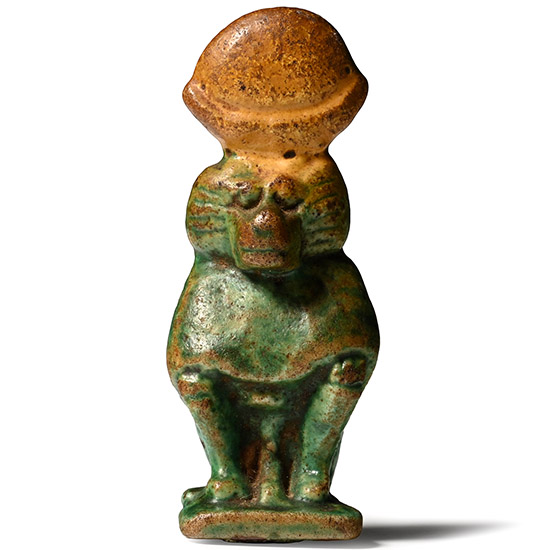
Egyptian Green and Yellow Glazed Baboon Amulet
Circa 2nd-1st century B.C.Estimate: £500 - 700 (‡+bp*)
Opening Bid: £250
Green-glazed baboon modelled in the round on a D-shaped base, wearing a lunar crescent-and-disc headdress in contrasting yellow glaze. 14.2 grams, 52 mm
Private collection of Kal Noselson, New York, acquired between 1976 and the late 1990s; thence by descent. Accompanied by a copy of a typed invoice, 28 June 1979.

