-
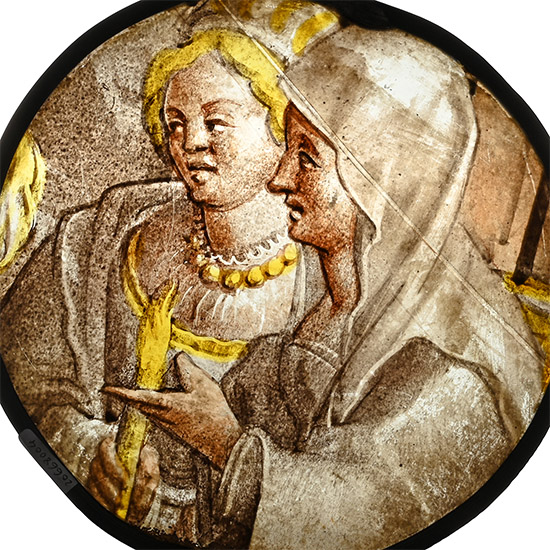
Medieval Stained Glass Roundel with Two Women in Conversation
Northern France, circa 1530-1540 A.D.Estimate: £1,000 - 1,400 (+bp*)
Bids: 1 | Current Bid: £5
With painted scene of two females, one in profile and the other in three-quarter view holding a lit candle; mounted in a lead came. 260 grams, 20.7 cm
Private collection, London, UK. -
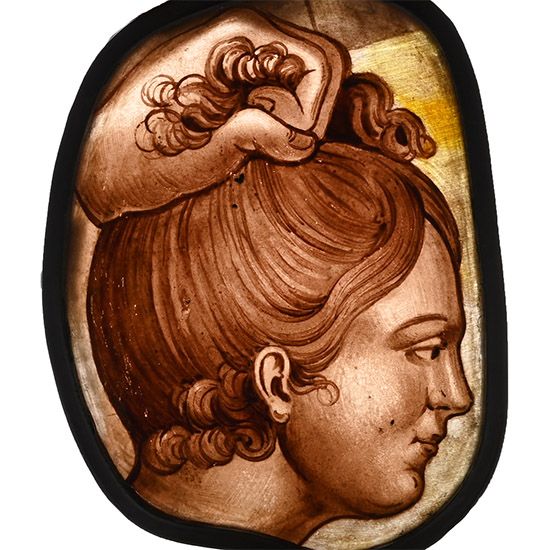
Medieval Stained Glass Section of Woman About to be Martyred
Northern France, circa 1530 A.D.Estimate: £800 - 1,000 (+bp*)
Bids: 1 | Current Bid: £5
With a finely painted profile head of a young woman, her hair being roughly gripped by the large hand of a male executioner, mounted in a lead-came frame. 64 grams 10.5 cm
Tomkinson’s Stained Glass Ltd, 2011.
This meticulously painted fragment would originally have been part of a much larger scene detailing the life of a female martyr. Such narratives became popular in the later Middle Ages thanks to the widespread dissemination of collected accounts detailing the lives of saints, most famously the Golden Legend of Jacobus de Voragine. -
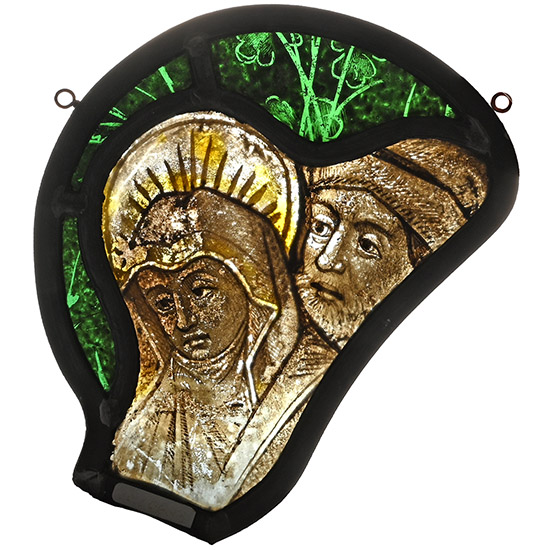
Medieval Stained Glass with Joseph and the Virgin From a Scene Showing the Flight into Egypt
France, Burgundy, circa 1460 A.D.Estimate: £500 - 700 (+bp*)
Bids: 1 | Current Bid: £5
Irregular window fragment with male head, female bust and woodland setting, mounted in lead cames. 215 grams, 17 cm
De Baecque Vente aux Encheres, 5 March 2022, no.51 (Part). -
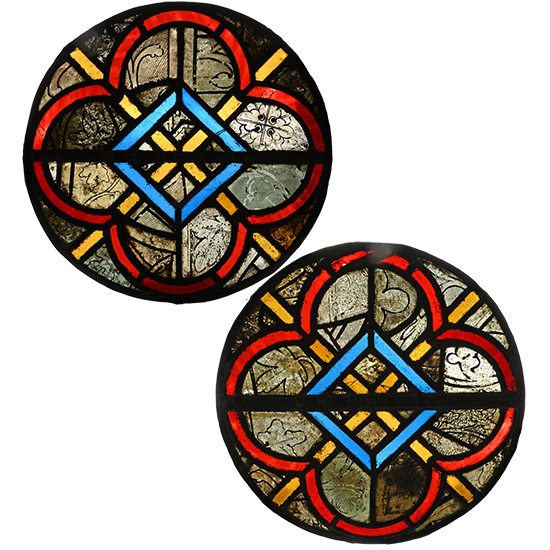
Medieval Stained Glass Roundel Pair
Northern France, circa 1280 A.D.Estimate: £600 - 800 (+bp*)
Bids: 1 | Current Bid: £5
Comprising: matched pair, each a discoid panel with lead frame, inner quatrefoil of coloured glass with central square frame; modern hooks for suspension. 3.7 kg total, 38 cm wide each
Charles van der Heyden, Rotterdam, until 1994; by descent within the family until 2020. -
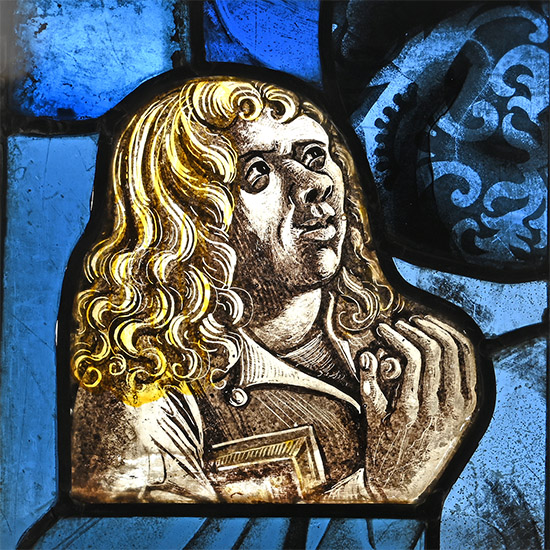
Medieval Stained Glass Panel of Saint John the Evangelist
Germany, Upper Rhine Valley or Swabia, circa 1490 A.D.Estimate: £1,500 - 2,000 (+bp*)
Bids: 2 | Current Bid: £10
The bust-length image of the grieving saint depicted with long, flowing blond locks, gazing upwards, a book tucked under his arm; the surround made up of mainly dark blue glass panel fragments. 566 grams, 24.6 cm high
The Monastery Stained Glass, Towcester, 2010. -
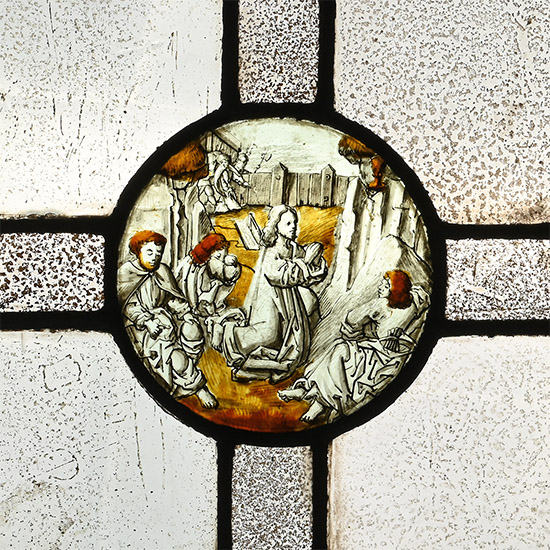
Medieval Stained Glass Section of The Agony in the Garden
Germany, Swabia, circa 1500 A.D.Estimate: £2,000 - 3,000 (+bp*)
Bids: 1 | Current Bid: £5
Rectangular panel formed from a central disc, arms and quadrants; at the centre, Christ kneeling on a patch of grass between two high, rocky outcrops, extending his hands in prayer towards a golden chalice perched among rocks above him; around him, three disciples who recline in sleep, having failed to keep watch over Christ, all three clothed in full-length garments; a small bridge over a running brook separating Christ and his sleeping disciples from the approaching figures of Judas Iscariot and a group of armed Roman soldiers arriving to arrest Christ; mounted in lead-cames. 497 grams, 24.5 cm
Ex Fritz Geiges (1853-1935) collection, Freiburg im Breisgau. Walther Bremen collection, Krefeld, by 1964. Lempertz, Cologne, 2005, no.196. Klaus Tiedemann collection, acquired from the above. This lot has been checked against the Interpol Database of stolen works of art and is accompanied by search certificate no.13479-262829.
The scene is one of the key moments leading up to Christ's Crucifixion that is described in detail in all four of the Gospels: the agony of Jesus in the garden of Gethsemane. -
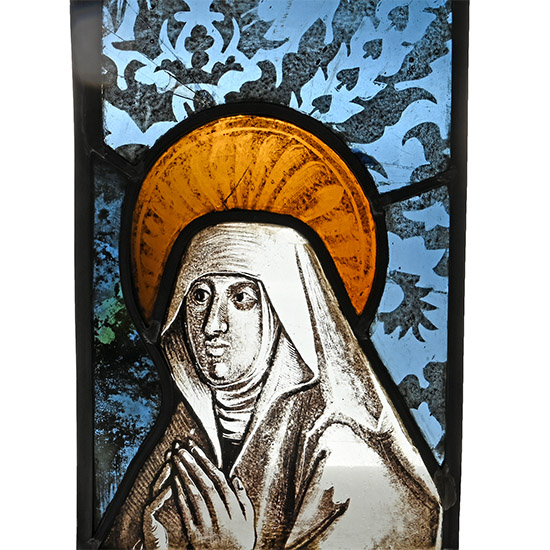
Medieval Stained Glass Panel of The Virgin Mary in Prayer
Possibly Nuremberg, circa 1480 A.D.Estimate: £1,500 - 2,000 (+bp*)
Bids: 1 | Current Bid: £5
Nimbate bust of the Virgin Mary in three-quarter view, wearing a veil and wimple, her hands pressed together in prayer; dark blue background simulating a cloth, decorated with a pattern evoking luxury velvets and damascened silks of the higher echelons of late-medieval society. 610 grams, 28 cm
The Monastery Stained Glass, Towcester, 2010.
The employment of shading technique characterised by thick black hatching marks over a stippled ground tone is a defining feature of Bavarian glass painting from the late 15th century to the first decades of the 16th century. -
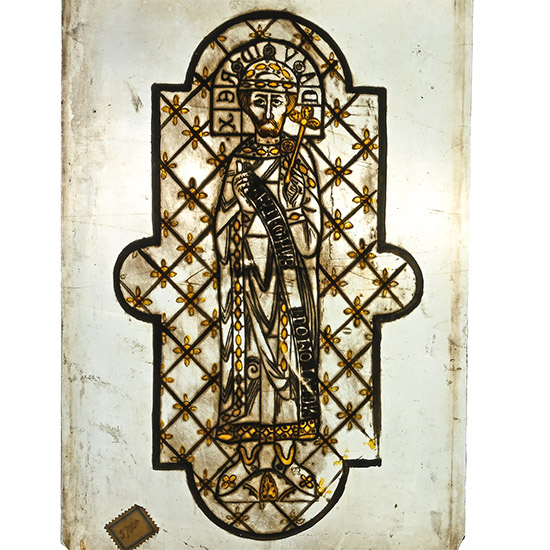
Medieval Stained Glass Panels with Saint Catherine and King David
Circa 1500 A.D.Estimate: £400 - 600 (+bp*)
Bids: 1 | Current Bid: £5
Comprising: one panel depicting Saint Catherine robed, standing and holding a wheel in her raised hand, a field of fretwork with quatrefoils; the other fragmentary panel with a similar background, with King David standing, supporting a scroll bearing the inscription 'Beati qui habitant in domo tua, Domine' Psalm 84:5 (Vulgate: Psalm 83:5), which translates as: 'Blessed are those who dwell in your house, Lord' and an arch around the head with the legend 'DAVID REX'. 380 grams total, 26 cm each
Auktionen in Heildelberg, 9 July 2026. -
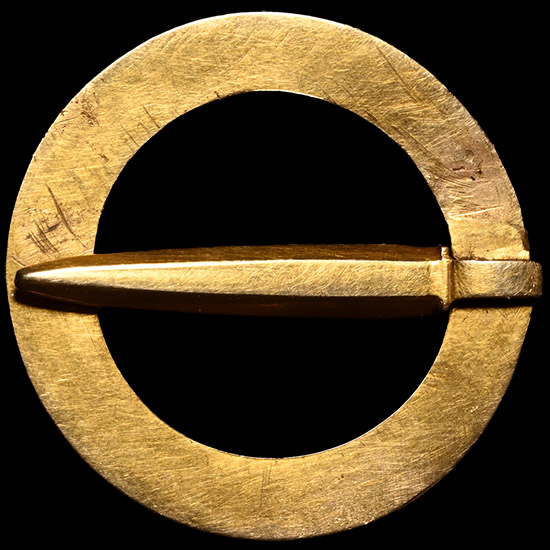
Large Medieval Solid Gold Annular Brooch
1400-1500 A.D.Estimate: £1,800 - 2,400 (+bp*)
Opening Bid: £900
Composed of an annular frame with a rectangular cross-section and flat upper and lower surfaces; the pin retained and in the form of a rectangular loop with a hexagonal-sectioned shaft; on the upper face of the pin, at the junction of the loop and shaft a raised transverse ridge; along the outer edge a visible join where the loop of the pin is folded around the frame, no constriction of the frame to accommodate the pin. 16.16 grams, 29 mm
Found whilst searching with a metal detector in North Northamptonshire, UK, on 6th April 2024; declared as Treasure under the Treasure Act with reference no.2024 T473, subsequently disclaimed by the Crown and returned to the landowner. Accompanied by a copy of the British Museum's Portable Antiquities Scheme (PAS) report no.NARC-2ADEC8. Accompanied by a copy of the Report on Potential Treasure for H M Coroner from Stoke Albany, Northamptonshire. Accompanied by a copy of a letter from The British Museum on behalf of the Secretary of State for Culture, Media and Sport, informing that the Crown's interest in this find has been disclaimed. This lot has been checked against the Interpol Database of stolen works of art and is accompanied by search certificate no.13455-260884.
A similar example has been recorded on the Portable Antiquities Scheme database, IOW-506491(2013-T72), and has been processed as Treasure, dating to the 15th-16th centuries. The thickness of the cross-section of the object is uncommon for Medieval annular frames, and the Isle of Wight example is extensively decorated, while this example is plain. In terms of form, this example is also similar to a copper-alloy example from York (YORYM1458), which, while similar in plan and section, is decorated with an engraved inscription. -
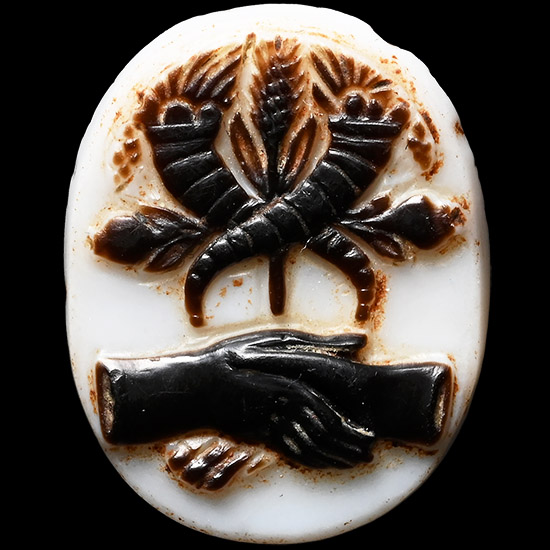
German Hohenstaufen Period Gemstone with Clasped Hands and Cornucopiae
13th century A.D.Estimate: £1,000 - 1,400 (+bp*)
Bids: 1 | Current Bid: £5
Oval intaglio with finely modelled clasped hand motif, dextrarum iunctio, above two cornucopiae crossed in front of an ear of wheat. 0.85 grams, 15 mm
Private European collection, 1990s. -
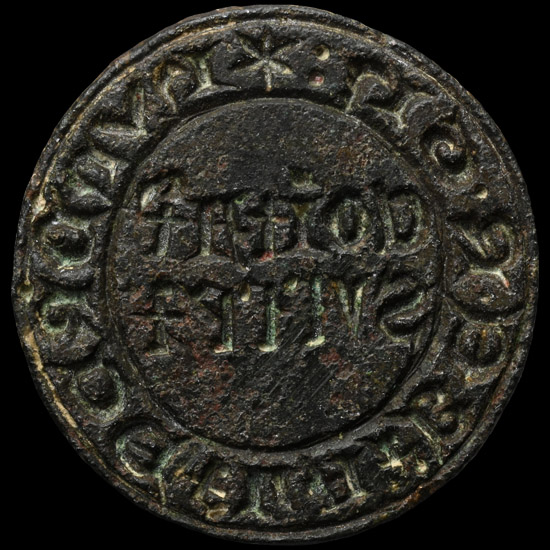
Medieval Bronze Official Flexborough Hundred Constable's Seal Matrix
England, East Sussex, circa 1350-1400 A.D.Estimate: £600 - 800 (+bp*)
Opening Bid: £300
Comprising a pierced trefoil terminal with a drilled circular pit above; flat-topped hexagonal pedestal with collar, the body of the matrix flaring to the circular die with orientation notch; the retrograde legend '* hVnDR DE FLAXBERGh' around the circumference of the die, and tondo with inscription in two registers 'COitat SVSSEX'; file marks on the trefoiled loop. 35.6 grams, 36 mm high
Found near Lewes, East Sussex, UK, in August 2024. Accompanied by a copy of the British Museum's Portable Antiquities Scheme (PAS) report no.SUSS-99E46F.
This is an official seal matrix used for labourers' passes from the hundred of Flexborough in the Rape of Pevensey, Sussex, which incorporated the ancient parishes of East Batchington, South Heighton and Seaford. Another official seal for the hundred of Foxearle in the Rape of Hastings is recorded on the PAS Database (SUSS-D8F8D5), which notes that the seals were probably used by the Constables, amongst whose duties were keeping the peace and, from the 14th century, providing passes for workmen seeking work beyond their own hundred. In 1285, King Edward I of England passed the Statute of Winchester, which 'constituted two constables in every hundred to prevent defaults in towns and highways'. Constables were unpaid and usually elected locally. Harvey and MacGuiness (1996:41) note: 'The Statute of Cambridge in 1388 ordered that labourers moving from the area where they lived should be given a pass sealed by someone appointed by the local justices of the peace, and describing the seal's design - it should name the county around the edge and the hundred, wapentake or town across the centre. (ibid: fig:35). Three years later sheriffs were ordered to have these seals made at once'. They quote 6 examples of surviving matrices (p.42), and others exist including three from Norfolk and two from Suffolk (Ashley and Richardson 1998). This example and the other Sussex example, SUSS-D8F8D5, name the county and hundred as required but reverse the arrangement laid out in the statute and seen on other seals, which have the county in the middle and the hundred around the edge. Research by Christopher Whittick in the archives of Battle Abbey has also identified a document bearing a seal for Battle Hundred which is similar in design to this example, with the county name in the middle and the hundred name around the edge. Unusually, the seal was used on a private charter dated 1361, which suggests Sussex hundreds were using standardised seals a generation before the statute of 1388. It also raises interesting questions about whether the existence of seals such as this influenced the 1388 statute. -
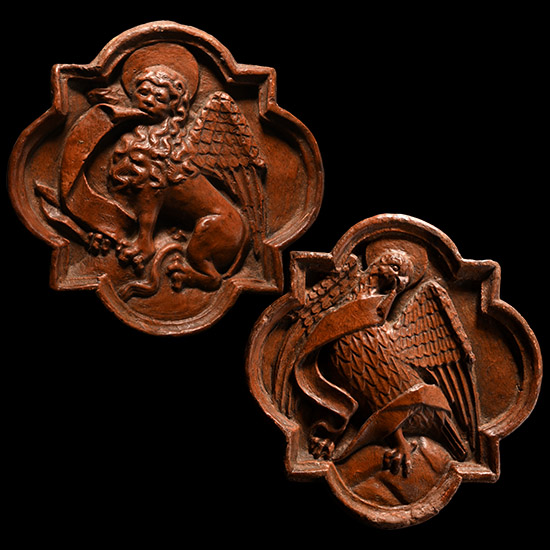
Medieval Red Clay Quatrefoil Tiles Decorated with Symbols of Saint John and Saint Mark
Circa 1500 A.D.Estimate: £1,000 - 1,400 (+bp*)
Opening Bid: £5
Comprising a pair of quatrefoil-shaped tiles, each with raised border and high-relief motif of an animal; one with a seated winged lion with a halo and a scroll representing Saint Mark; other with an eagle with a halo and a scroll representing Saint John. 2.53 kg total, 22.5 cm each
Private collection near Avignon, France.

