-
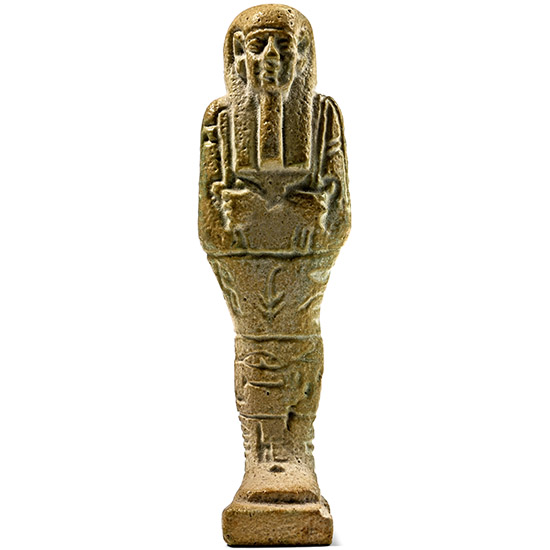
Egyptian Faience Shabti of the Overseer of Royal Children Horirani
Late Period, 26th Dynasty, 664-525 B.C.Estimate: £600 - 800 (+bp*)
Opening Bid: £5
Mummiform figure standing on a square plinth, wearing a plain, long lappet wig and a long false beard, with a finely modelled face; crossed arms, the left hand holding a pick and the right a hoe and a cord belonging to a plain seed bag suspended over the left shoulder; three horizontal lines of hieroglyphic text on the lower body. 32.1 grams, 88 mm
Acquired from Portobello Road, 18th March 1967, for 30 shillings. From the private collection of Peter Clayton, FCILIP, Dip, Arch, FSA, FRNS, Hemel Hempstead, Hertfordshire, UK; formed since the late 1950s. Accompanied by an old handwritten information card by Peter Clayton, collection no.120. -
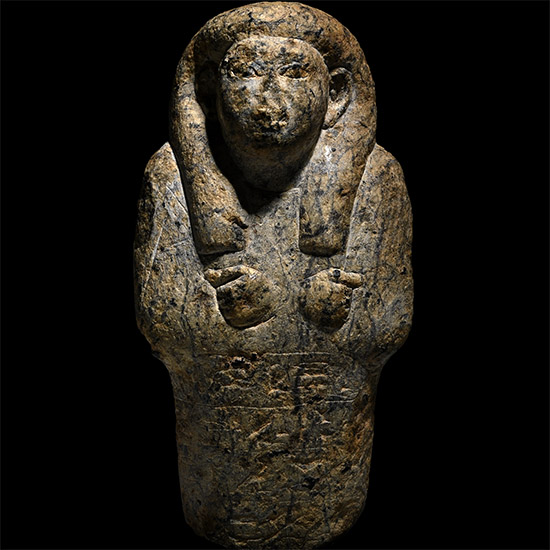
Egyptian Yellow and Black Serpentine Hieroglyphic Shabti
25th-26th Dynasty, circa 650-525 B.C.Estimate: £1,500 - 2,000 (+bp*)
Bids: 1 | Current Bid: £5
Fragment of a mummiform shabti wearing a heavy tripartite wig, with crossed hands on the chest holding faintly incised agricultural implements; four lightly incised horizontal lines of hieroglyphic text on the lower body; mounted on a custom-made stand. 455 grams total, 13.3 cm including stand
From the private collection of Peter Clayton, FCILIP, Dip, Arch, FSA, FRNS, Hemel Hempstead, Hertfordshire, UK; formed since the late 1950s.
Hardstone shabtis appear in the burials of certain high officials in the late 25th and early 26th Dynasties, after which faience became the predominant material for all shabti statuettes. -
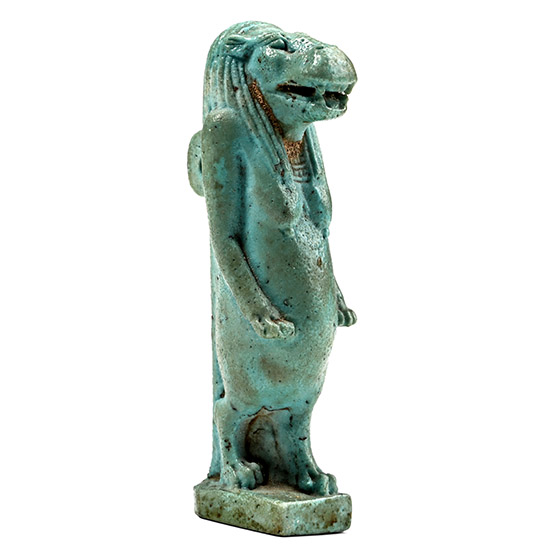
Egyptian Turquoise Blue Glazed Faience Amulet of Taweret
Late Period, circa 664-332 B.C.Estimate: £600 - 800 (+bp*)
Bids: 1 | Current Bid: £5
Amuletic pendant with the deity's characteristic hybrid animal elements, dominated by its hippopotamus head, with a plain dorsal pillar with a loop. 16.58 grams, 61 mm
Received as a gift from archaeologist Cyril Aldred, April 1970, when expecting their son Rupert. From the private collection of Peter Clayton, FCILIP, Dip, Arch, FSA, FRNS, Hemel Hempstead, Hertfordshire, UK; formed since the late 1950s. Accompanied by an old handwritten information card by Peter Clayton, collection no.124.
Taweret is an ancient Egyptian goddess associated with fertility, childbirth, motherhood, and protecting women during pregnancy and labour. She is depicted as a composite being with animal features and stands out as one of the most distinctive and striking deities in the Egyptian pantheon. Taweret’s name derives from the Egyptian word for "great" or "large" (tꜣwꜣrt), emphasising her formidable and protective nature. Cyril Aldred (1914-1991) was a British Egyptologist and art historian who served at the Royal Scottish Museum, Edinburgh, from 1937 until his retirement in 1974. He published widely on Egyptian art, including Old Kingdom Art in Ancient Egypt (1949) and Akhenaten, Pharaoh of Egypt (1968), and became a leading authority on Amarna Period art, notably through his 1973 Brooklyn Museum exhibition catalogue, Akhenaten and Nefertiti. -
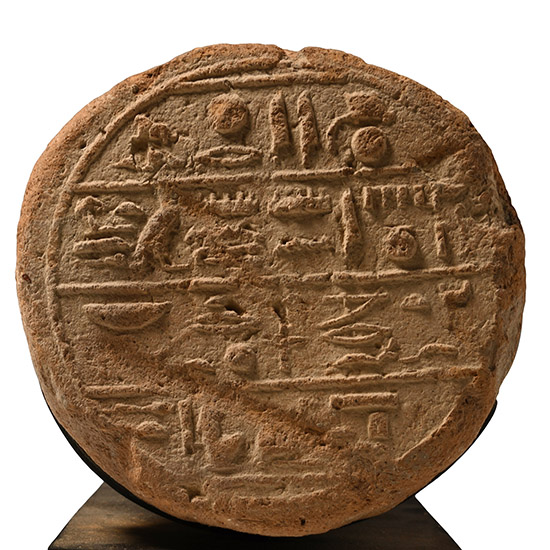
Egyptian Terracotta Funerary Cone of Montuemhat
Late Period, 25th-26th Dynasty, circa 700-650 B.C.Estimate: £600 - 800 (+bp*)
Bids: 1 | Current Bid: £5
Complete funerary cone with a long tapering form, the circular flat end impressed with four rows of hieroglyphic text, reading: 'Honoured before Osiris, fourth god’s servant (of) Amun, Montuemhat, true of voice, his wife, his beloved, king’s acquaintance, lady of the house, Shepenmut, true of voice'. 1.41 kg total, 27 cm wide including stand
Acquired from Abdoul Rassoul on the West Bank at Luxor, 1974-1980 when a guest lecturer. From the private collection of Peter Clayton, FCILIP, Dip, Arch, FSA, FRNS, Hemel Hempstead, Hertfordshire, UK; formed since the late 1950s.
Montuemhat, Mayor of Thebes and Governor of Upper Egypt, was possibly the most powerful official of his era in southern Egypt. He built one of the largest and most lavishly decorated nonroyal tombs known (TT34), which still dominates the Asasif landscape today. Shepenmut was Montuemhat's second wife. -
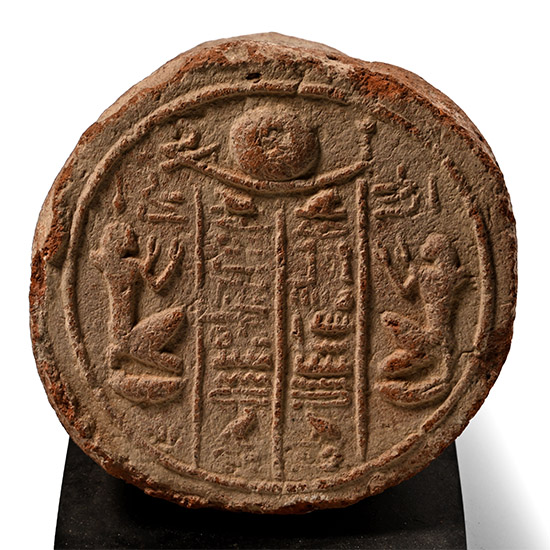
Egyptian Terracotta Funerary Cone of Montuemhat
Late Period, 25th-26th Dynasty, circa 700-650 B.C.Estimate: £500 - 700 (+bp*)
Bids: 1 | Current Bid: £5
Front portion of a tapering funerary cone for the high official, Montuemhat, the circular front impressed with the depiction of a solar bark surmounting four columns of hieroglyphs; the two left-hand columns: 'The Osiris, overseer of the southern city, Montuemhat, true of voice'; the two right-hand columns: 'The Osiris, fourth god’s servant, Montuemhat, true of voice.' 626 grams total, 12.2 cm wide including stand
Acquired from Abdoul Rassoul on the West Bank at Luxor, 1974-1980 when a guest lecturer. From the private collection of Peter Clayton, FCILIP, Dip, Arch, FSA, FRNS, Hemel Hempstead, Hertfordshire, UK; formed since the late 1950s.
At least fourteen different cones bear Montuemhat's name, some of which mention his family members. From Montuemhat's tomb in the Asasif at Thebes (TT34). -
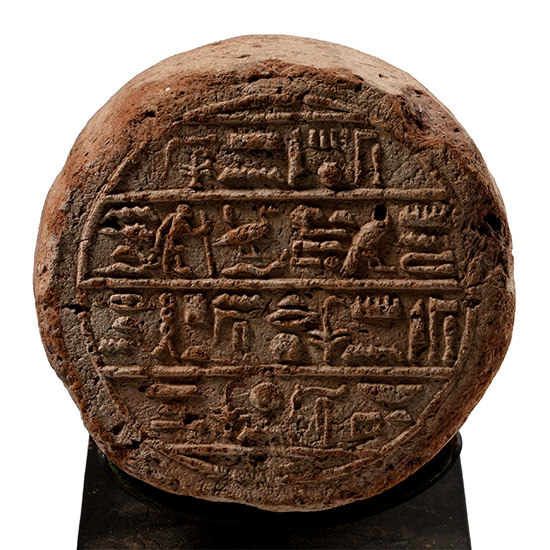
Egyptian Terracotta Funerary Cone of Montuemhat
Late Period, 25th-26th Dynasty, circa 700-650 B.C.Estimate: £500 - 700 (+bp*)
Bids: 1 | Current Bid: £5
The front portion of a tapering funerary cone, with the circular flat end bearing four horizontal lines of impressed hieroglyphic text, reading: 'Fourth god’s servant (of) Amun, overseer of Upper Egypt, Montuemhat, true of voice, the eldest son of his body, god’s servant (of) Amun, king’s acquaintance, Nes(u)ptah, born of the lady of the house, Nesykhonsu, true of voice'. 1.24 kg total, 15.5 cm wide including stand
Acquired from Abdoul Rassoul on the West Bank at Luxor, 1974-1980 when a guest lecturer. From the private collection of Peter Clayton, FCILIP, Dip, Arch, FSA, FRNS, Hemel Hempstead, Hertfordshire, UK; formed since the late 1950s.
Some funerary cones for Montuemhat, such as this example, include members of his family, in this instance naming his son, Nesuptah, and his son’s mother, Nesykhonsu, who was Montuemhat’s first wife. From Montuemhat's tomb in the Asasif at Thebes (TT34). -
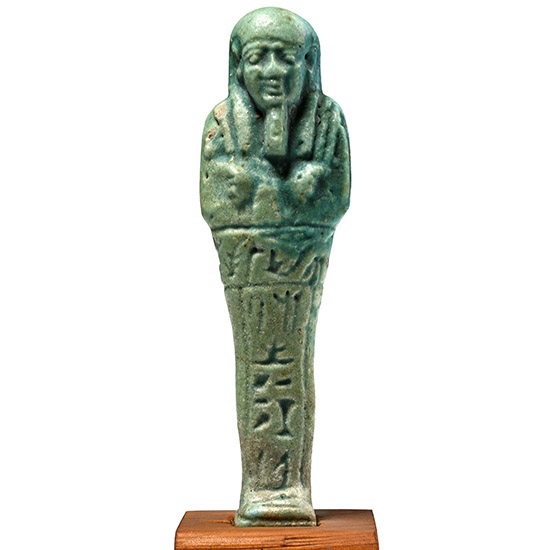
Egyptian Blue Glazed Faience Shabti of the Royal Scribe Aahmes
Persian Period, circa 6th century B.C.Estimate: £500 - 700 (+bp*)
Opening Bid: £5
Mummiform figure wearing a lappet wig and long false beard, arms crossed over the chest; the left hand holds a pick, the right a hoe, and a cord from a small seed bag hangs over the shoulder; plain dorsal pillar; a T-form hieroglyphic text arrangement on the lower body, with the horizontal line reading: 'The illuminated one, the Osiris, the royal scribe Aahmes,' and the central column 'born to Hotep-Bastet, true of voice'; with a wooden display stand bearing the legend 'Ushabi of Aahmes, Royal Scribe, Persian period'. 44.7 grams, 10.7 cm (62.2 grams total, 12.2 cm including stand)
Acquired Herne Bay High Street, circa February 1957, for 2 shillings and sixpence. From the private collection of Peter Clayton, FCILIP, Dip, Arch, FSA, FRNS, Hemel Hempstead, Hertfordshire, UK; formed since the late 1950s. Accompanied by an old handwritten information card by Peter Clayton, collection no.4. -
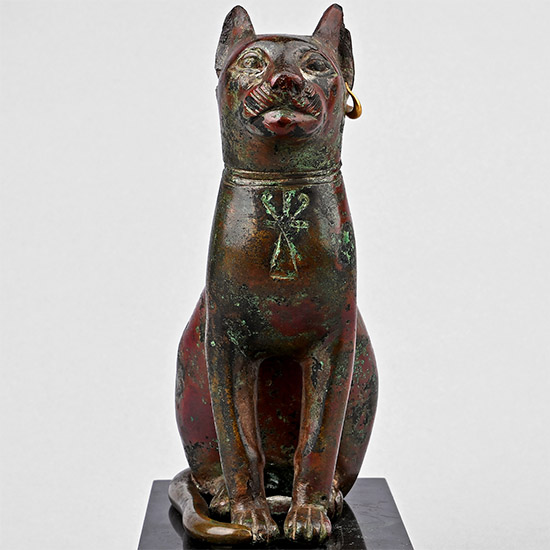
'The Clayton' Large Egyptian Bronze Seated Cat Statue of the Goddess Bastet
Late Period, 26th Dynasty, circa 664-525 B.C.Estimate: £20,000 - 30,000 (+bp*)
Opening Bid: £10,000
Naturalistically modelled in the round, hollow-formed in a seated pose with an incuse collar and Hathor-symbol pendant on its chest, both ears pierced to accept gold earrings (one absent); with a custom-made stand adapted to accommodate the sizeable tang on the statue's underside. 932 grams, 16 cm (1.99 kg total, 19.5 cm high including stand)
Acquired by Norman Davis from Spinks in 1956. Received as a gift from an American friend, Norman Davis of Seattle, circa 1972. From the private collection of Peter Clayton, FCILIP, Dip, Arch, FSA, FRNS, Hemel Hempstead, Hertfordshire, UK; formed since the late 1950s. This lot has been checked against the Interpol Database of stolen works of art and is accompanied by search certificate no.13471-262917.
In ancient times, the cat was revered as the sacred animal of the goddess Bastet, whose principal cult centre was at Bubastis in the Nile Delta. Her cult expanded throughout Egypt during the Late Period, when many votive bronze statuettes were produced. To the Egyptians, the cat symbolised protection, motherhood, and, later, gentleness and domesticity, qualities associated with Bastet, especially as she evolved from a fierce lioness into a more benevolent feline goddess. The symbol on the chest of the present statuette is associated with another protective goddess, Hathor. Standing figurines of Bastet are sometimes shown holding a Hathoric sistrum, a ritual musical instrument linked to joy, music, and divine protection, particularly for mothers and children. The symbol on this bronze statuette would have served the same purpose. -
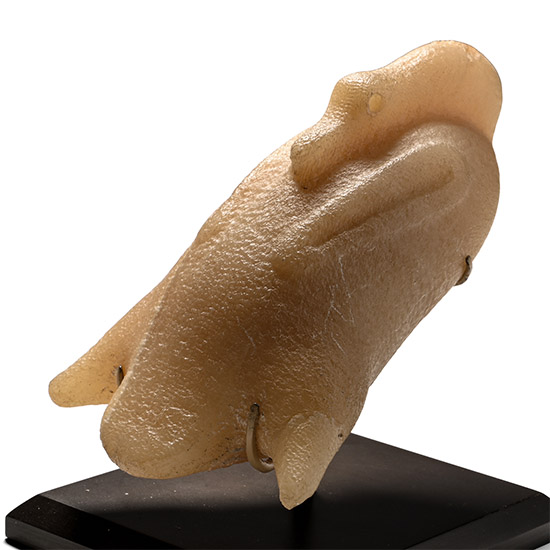
Egyptian Alabaster Trussed Duck
Old Kingdom, 6th Dynasty, circa 2345-2181 B.C.Estimate: £4,000 - 6,000 (+bp*)
Opening Bid: £2,000
Delicately carved in the round with the head and neck laid backwards along the spine, the eyes recessed for inlays (absent); mounted on a custom-made stand. 891 grams total, duck: 12.2 cm long
Private French collection acquired before 1970. Bonhams Antiquities, 29 April 2009, no.58 (sold for £5,400.00). Bonhams Antiquities, 23 October 2013, no.8 (sold for £7,500.00). Prince collection, UK, 2013-2017. Accompanied by a French passport no.099505. This lot has been checked against the Interpol Database of stolen works of art and is accompanied by search certificate number no.12942-245247.
Small statuettes of ducks, prepared for cooking, were created to provide imperishable offerings for the tomb. These birds appeared in almost every offering list and were depicted being brought to the tomb by offering bearers in wall scenes. -
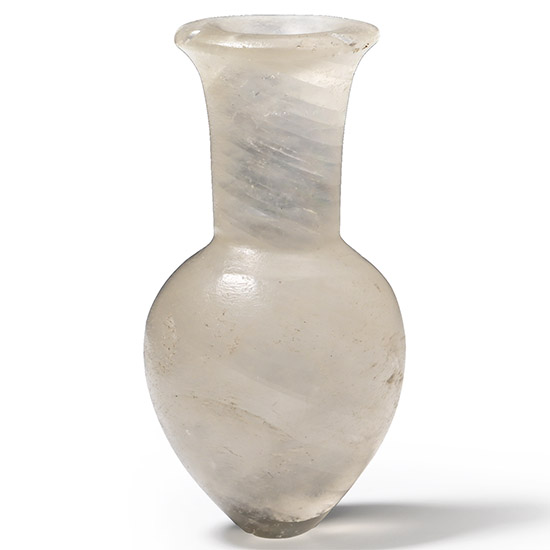
Egyptian Rock Crystal Dummy Vessel
Old Kingdom, 5th-6th Dynasty, circa 2500-2200 B.C.Estimate: £2,000 - 3,000 (+bp*)
Opening Bid: £1,000
Model amphora with a piriform body, a long, flaring, trumpet-like neck and rim, and a shallow depression at the top. 55 grams, 59 mm
with Archaeologia, Switzerland, before 1983. Ex private North American collection. London private collection, 2016. This lot has been checked against the Interpol Database of stolen works of art and is accompanied by a search certificate no.13231-249997.
This was one of the model vessels in a set associated with the 'Opening of the Mouth' ritual, which revived the deceased. -
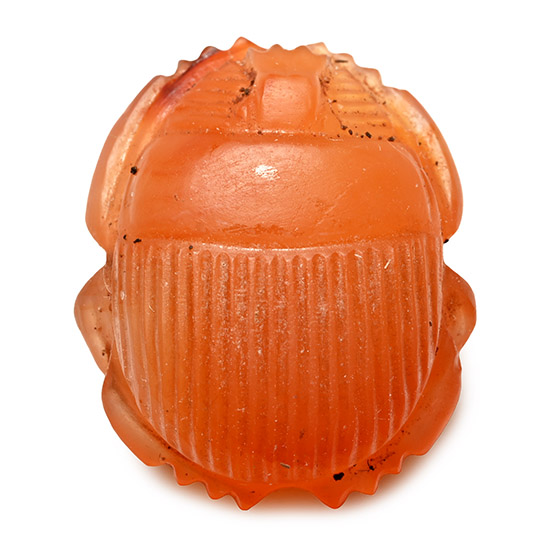
Egyptian Carnelian Heart Scarab
Late Period, 664-332 B.C.Estimate: £800 - 1,000 (+bp*)
Opening Bid: £400
With fine anatomical detailing on the body and striated wingcase, legs folded beneath the body and flanked by a ribbed suspension loop. 2.55 grams, 17 mm
From a mid 20th century collection.
The scarab amulet was one of ancient Egypt’s most widespread symbols, signifying rebirth, transformation, and protection. Modelled on the dung beetle associated with the sun god Khepri—believed to roll the sun across the sky—it embodied the cycle of life and renewal. Widely used from the early Middle Kingdom onwards, scarabs served as funerary amulets, personal charms, and seals, often inscribed with prayers or names. They reflect both spiritual beliefs and daily life in ancient Egypt. Naturalistic scarabs made of semi-precious stones, such as this example, are a characteristic feature of Late Period burials. -
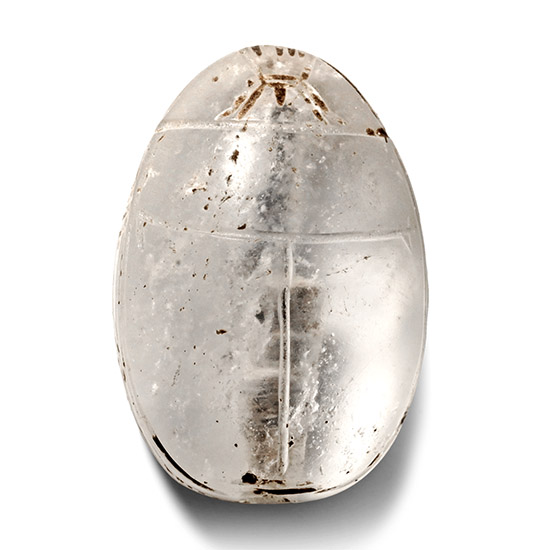
Egyptian Rock Crystal Scarab
Late Period, circa 664-332 B.C.Estimate: £700 - 900 (+bp*)
Opening Bid: £350
Oval body, with lightly incised detailing of the clypeus, head, prothorax, elytra, and legs; underside plain; longitudinally pierced for suspension. 4.82 grams, 22 mm
Ex Belinda Elliston collection, a member of the Egyptian Exploration Society, 1940s onwards.

