-
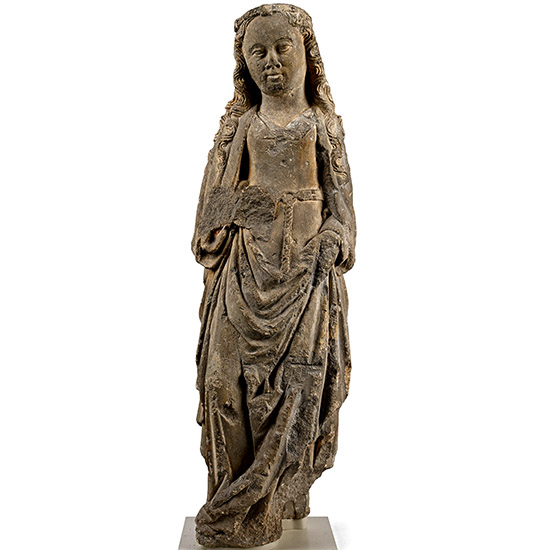
Medieval Stone Sculpture of St Mary Magdalene
France, early 15th century A.D.Estimate: £3,000 - 4,000 (+bp*)
Bids: 3 | Current Bid: £15
Modelled in high relief with dorsal pillar; maiden in advancing pose with fillet to the brow and curly tresses falling to the shoulders, girdle with loop and chain to the waist, copious folds of the robe lifted by the left hand, right hand at waist-height; mounted on a custom-made stand. 21.5 kg total, 70 cm high including stand
French-Swiss private collection. The items were acquired in the 2010s to be displayed on the property in Ain, France. Following the move, they disposed of some of the items. This lot has been checked against the Interpol Database of stolen works of art and is accompanied by search certificate no.13514-262848.
By the early 13th century, bodies in Gothic sculpture acquired more three-dimensional mass, more flexibility, more natural poses and drapery, and individual faces. Later 13th-century sculpture gave up this monumental power for more specific anatomy, actions, and emotions. Late 14th -century and 15th-century work continued in the direction of greater mass and more detailed faces. -
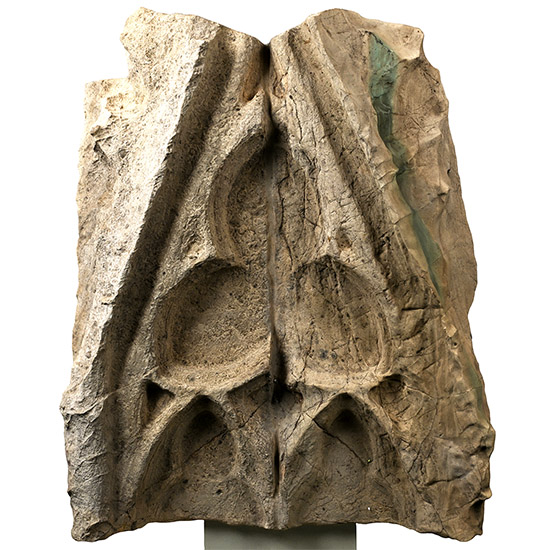
Monumental Medieval Stone Gable from a Butress of York Minster Chapter House
England, York Minster Chapter House, circa 1280-1300 A.D.Estimate: £3,000 - 4,000 (+bp*)
Opening Bid: £5
Carved in low relief with blind tracery composed of an elongated trilobe on top of two pointed arches, also carved with trefoil cusps. 250 kg approximately, 103 cm including stand
Sold at York Minster Stone Auction, 20th February 2010, no.63. Accompanied by an original certificate of authenticity.
The buttresses of the chapter house were built primarily to support its very large wooden roof, and their innovative design has been much discussed for this and their role in the building's drainage system. York Minster is one of England's most interesting and significant buildings. The chapter house was begun in about 1280 as a centrally planned, octagonal structure, and it was constructed as a venue for the meeting of the members of the chapter. -
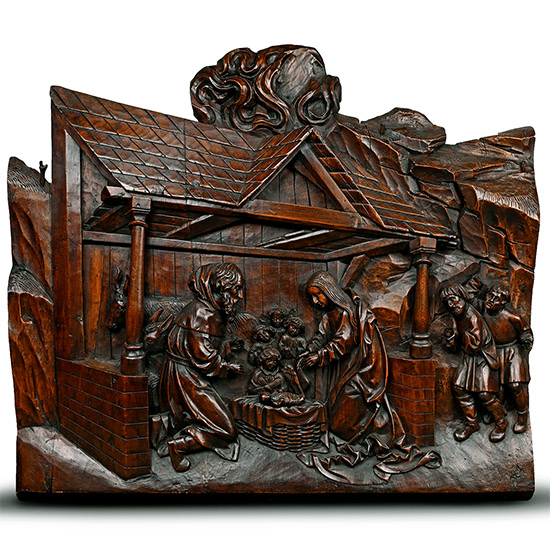
Medieval Wooden Panel of The Nativity
Germany, Middle Rhine Valley, circa 1500 A.D.Estimate: £4,000 - 6,000 (+bp*)
Bids: 1 | Current Bid: £5
Carved in high relief, depicting an open-fronted wooden structure with a tiled or shingled roof and gabled dormer; beneath the roof, a wickerwork crib with the Christ Child, Mary and Joseph on each side of the crib and gazing down adoringly, a group of angels behind the crib, a pair of shepherds look on from the right, an ox and an ass behind Joseph; suspension wire to the reverse. 9.5 kg, 79.5 cm h x 91 cm w
Private collection, Burgundy, circa 1960s. This lot has been checked against the Interpol Database of stolen works of art and is accompanied by search certificate no.13552-262840.
The compositional model for this relief comes from the Bladelin Triptych painted by Rogier van der Weyden around 1450, which for the first time set the architectural setting of the stable in which the Nativity takes place on the diamond rather than with its fourth wall parallel to the picture plane. The treatment of the carving and the ambitious planar construction of the stable's roof and columns can be compared with sculpture produced in Freiburg, Colmar and Strasbourg at this date, by artists including Hans Wydyz and Weit Wagner. -
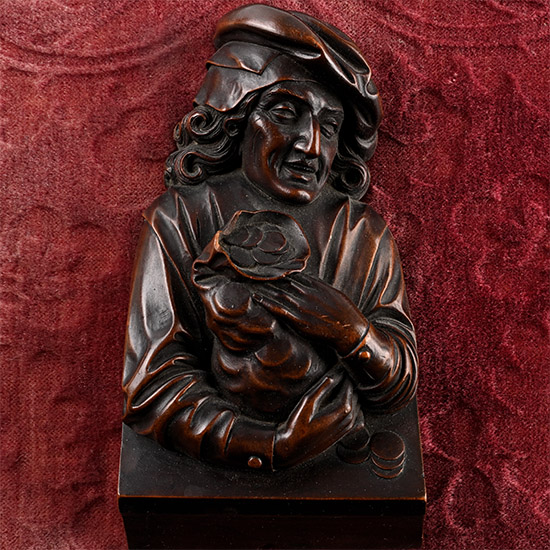
Post Medieval Wooden Bas Relief Representing a Gentleman Illustrating an Allegory of Avarice
Belgium, Antwerp, 17th century A.D.Estimate: £3,000 - 4,000 (+bp*)
Bids: 2 | Current Bid: £10
Carved in the half-round, clean-shaven man with cap and flowing hair clutching a bag of coins to his chest with more coins on the surface of the table; mounted on a velvet-covered board with faux-shell detailing to the frame. 689 grams, 33.5 x 27.1 cm
Private collection, Spain, 2024. This lot has been checked against the Interpol Database of stolen works of art and is accompanied by search certificate no.13546-262841.
In the historical context of the Netherlands and Flanders (particularly during the 16th and 17th centuries), the depiction of the seven deadly sins was a central theme in moralising and satirical art. The allegory of Avarice was frequently represented in paintings, as well as in sculptures and wooden bas-reliefs intended for furnishings, architectural panels, or private collections. -
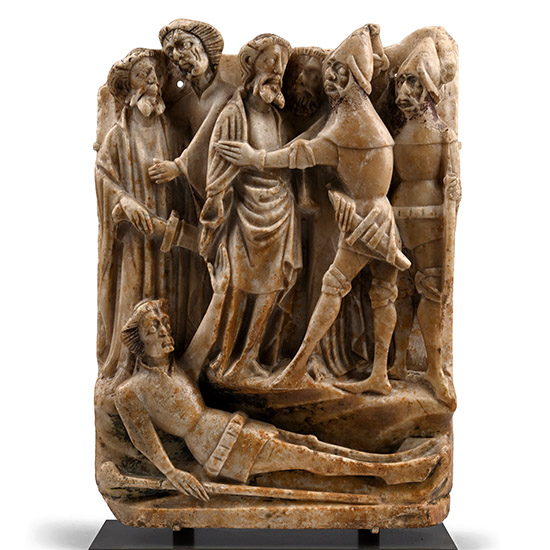
Medieval Alabaster Panel with The Betrayal and Arrest of Christ
England, Nottingham Alabaster, Midlands, circa 1420 A.D.Estimate: £5,000 - 7,000 (+bp*)
Bids: 2 | Current Bid: £10
Rectangular panel with figural scene in high relief; above, two figures left in bassinets and plate armour arrest two standing figures in loose robes; behind them, a tall figure stretching his hand across the chest of another robed figure drawing a sword; below, beneath a ledge, a supine figure extending his left hand towards the central figure above, his right hand holding a walking staff; mounted on a custom-made stand. 10.4 kg total, 37.5 cm high including stand
Collection of Aäron Vecht (1186-1965), Rokin 30, Amsterdam (his paper collection label adhered to the reverse). with Joanna Booth, London, UK. Private collection, London, UK, acquired from the above 11th June 2011. This lot has been checked against the Interpol Database of stolen works of art and is accompanied by search certificate no.13527-262845.
The iconography of the betrayal of Christ is ancient, with its earliest roots tracing back to Early Christian art. From its inception, the soldiers arresting Jesus in the Garden of Gethsemane were depicted as Roman warriors. It is important to note that artists typically rendered their weapons and armour in the contemporary style of their own eras, rather than using historically accurate Roman attire. This artistic convention persisted until the fall of the Eastern Roman Empire. As a result, Byzantine depictions of the arrest offer a dynamic chronicle of military evolution, showcasing the changing equipment of the Roman army and local militias throughout the Middle Ages. Similarly, when this iconography was adopted by other Western and Eastern medieval states, it mirrored the military advancements of nations outside the Byzantine sphere. Consequently, the representation of the arrest at Gethsemane serves as one of the richest visual sources available for studying medieval military equipment. -
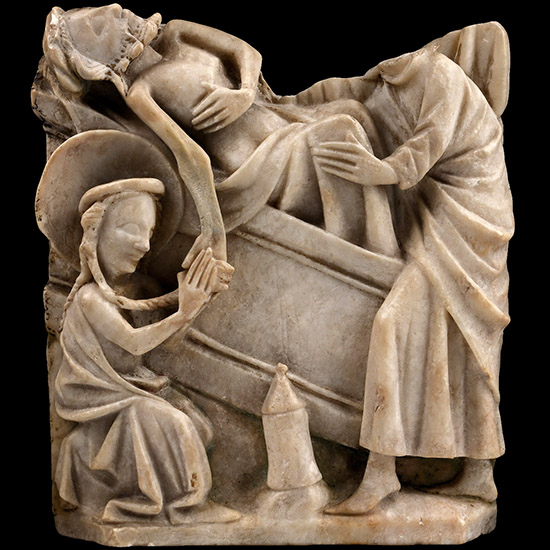
Medieval Stone Panel with The Entombment of Christ
England, Nottingham Alabaster, Midlands, circa 1440-1460 A.D.Estimate: £3,000 - 4,000 (+bp*)
Bids: 2 | Current Bid: £10
High-relief carving depicting a figural scene: nimbate Mary Magdalene crouching at bottom left, extending her hand with one braid of her hair towards the extended right hand of a supine Christ resting on a rectangular tomb; robed figure of Joseph of Arimathea to the right with a lantern at his feet, supporting the folded knees of the supine figure; on a wooden base with framed and felt-covered board to the rear. 5.75 kg, 36 cm high
Joanna Booth, London, UK, 2011. This lot has been checked against the Interpol Database of stolen works of art and is accompanied by search certificate no.13524-262844.
The entombment of Christ is a widely interpreted topic in the religious art of the Middle Ages: the scene always includes the presence of Mary Magdalene holding the hand of Christ and Joseph of Arimathea, who, according to the Gospel of John (XIX, 38-42), placed Jesus in his own unused tomb. -
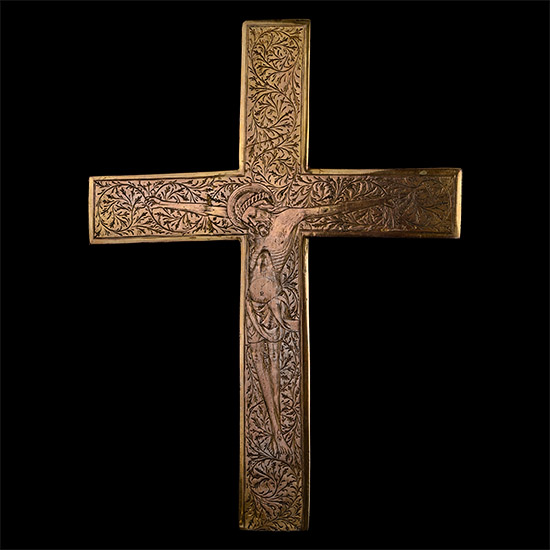
Gothic Gilt Copper Cross with Corpus Christi
Circa 1430 A.D.Estimate: £3,000 - 4,000 (+bp*)
Bids: 6 | Current Bid: £220
Hollow-formed cross with reserved Corpus Christi on a field of scrolled tendrils; reverse with similar tendril ornament and square panel to the end of each arm bearing the symbol of an evangelist. 452 grams, 27.4 cm
Collection of Richard Steiskal-Paur, Vienna. This lot has been checked against the Interpol Database of stolen works of art and is accompanied by search certificate no.13530-262853.
The image on the crucifix was realised according to the style of the period. Christ is at the centre of the cross, facing the viewer; his loincloth blowing to the left. At the foot of the cross, now missing, were probably Adam’s skull and bones. -
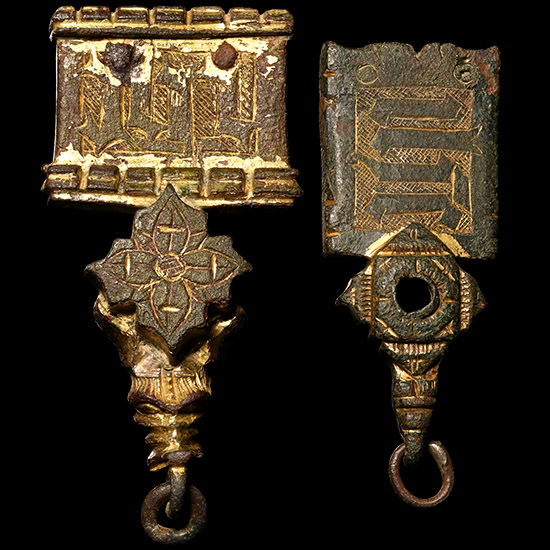
Medieval Gilt Bronze Inscribed Book Clasp Group
England, Kent, circa 1350-1450 A.D.Estimate: £500 - 700 (+bp*)
Opening Bid: £250
Comprising two book fittings: one a complete fitting of Howsam Type A.9.2, composed of three main elements: an attachment end, a boss, and a projecting terminal with an attached ring, the attachment end rectangular and hollow, with a decorated obverse and a plain reverse, and two iron rivets pierced through either side, the obverse of the plate bordered on two sides by defined squares, seven at the top and six at the base, between these a slightly recessed central field, on which inscribed the letters ‘IHC’ in an ornate serif font, the attached lozenge-shaped boss moulded in relief of a four-petalled floral, whilst the reverse with a single circular depression on the underside, the projecting terminal in the form of a stylised snouted animal head, moulded in relief, whilst the reverse is plain and undecorated, at the end of this terminal an attached loop with another separate ring attached at a right-angle; the other with a tiered lozenge-shaped boss and a looped terminal, rectangular plate with two rivets in situ, the upper face with an inscription 'IHC' on a hatched gilt background. 74.7 grams total, 67-78 mm
Found whilst searching with a metal detector in Barham, Kent, UK; one recorded with PAS. Property of a Kent gentleman, a specialist medieval collector. Accompanied by a copy of the British Museum's Portable Antiquities Scheme (PAS) report no.KENT-3AF321.
The PAS report states: 'This object is a book fitting of Howsam A.9.2 (Howsam, 2010). The A.9 type fastenings are typically elaborate in both form and decoration, as demonstrated by this example. This object would have functioned by means of the strap-and-pin mechanism (Howsam, 2010, pp. 39). The Christogram engraved on the central field is in relation to the first three letters of the name Jesus in Greek (ΙΗΣΟΥΣ) transliterated into Latin letters. Unlike other comparable examples, this script runs 90º anti-clockwise. This object adds to a corpus of similar examples recorded on this database. This object adds to a corpus of similar examples recorded on this database: NMS-7D0635, IOW-7D75B7, BERK-AC4903, NMS-369AB8 and LIN-74ACFC.' -
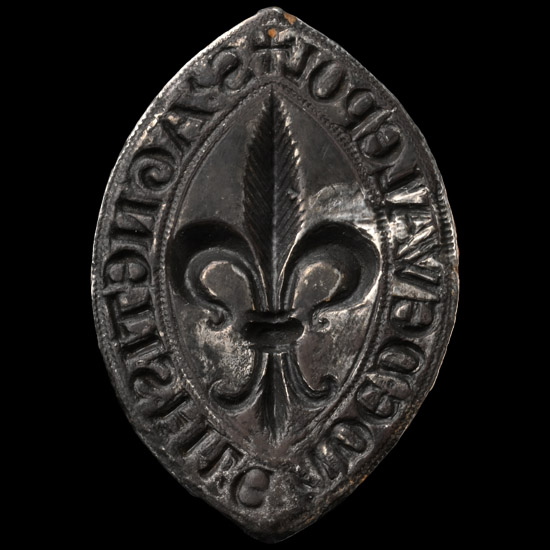
Medieval Silver Vesica-Shaped Seal Matrix of Agnes Daughter of Adam of Walpole
Circa 13th-14th century A.D.Estimate: £1,200 - 1,700 (+bp*)
Opening Bid: £600
With central fleur-de-lys motif, border with legend '+ S' AGNETIS FILE ADE DE WALEPOL'; supplied with an impression. 11.1 grams, 36.4 mm
Acquired on the UK art market in the 1980s. From an East Anglian private collection.
Adam’s home was one of the two villages named Walpole in East Anglia, one in Norfolk, one in Suffolk. -
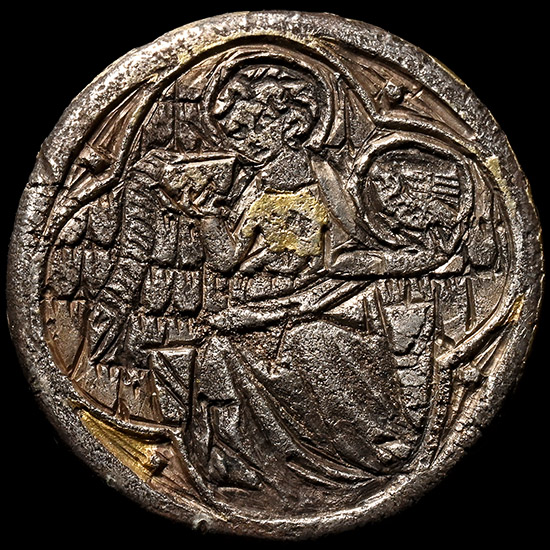
Medieval Silver-Gilt Reliquary Box Mount with Engraved Saint John the Evangelist in Quatrefoil
England, Kent, circa 13th-14th century A.D.Estimate: £500 - 700 (+bp*)
Opening Bid: £250
Circular, slightly domed mount with a narrow inner quatrefoil border, outside the angles of the quatrefoil, the spandrels containing a raised dot, with linear marks resembling keying, and one spandrel (lower left) appears to have traces of gilding over these; the quatrefoil filled with a seated human figure, nimbate and with a full skirt and tight bodice, the bodice appears to be gilded and it may be that the object was 'parcel' (partly) gilded to emphasise the clothing, also wearing a cloak covering the shoulders; the right hand holding a cup, raised to the mouth; the left hand reaching out towards a perching bird surrounded by a circle (perhaps also a nimbus, showing that it is a holy bird); the bird with its wings held out above its body and its head and beak held upwards; the background filled with motifs, across the centre two rows of half-ovals, each with a pair of V-shaped indentations in the top resembling tulip flowers, a triangular pillar to each side of the legs, each decorated with a pair of oblique grooves, an enigmatic strip decorated with oblique ribbing, running upwards from the lower part of the left-hand foil to the open top of the cup, the lower end appearing to have a face in profile with eye and open jaw, possibly representing a snake or serpent. 2.76 grams, 19 mm
Found whilst searching with a metal detector on 25th September 2014 near Mersham, Kent, UK; declared as Treasure under the Treasure Act with reference number 2017T553, disclaimed by the Crown and returned to the finder. Property of a Kent gentleman, a specialist medieval collector. Accompanied by a copy of the British Museum's Portable Antiquities Scheme (PAS) report no.PUBLIC-FF66A3. Accompanied by a copy of the report on the find of potential Treasure for H M Coroner. Accompanied by a copy of the letter from the British Museum stating that the Crown's interest in this find has been disclaimed.
The PAS report states: 'This scene might perhaps be interpreted as showing St John the Evangelist (author of the Gospel of St John) with his symbol of an eagle and a chalice with a serpent. The later refers to a poisoned chalice, either the cup mentioned by Jesus to James and John in Matthew ch. 20 v. 23, or the chalice mentioned in the Golden Legend (written c.1260 and extremely popular for the rest of the medieval period) in Ch.9 of which John is said to have survived drinking a cup of poison in an attempt to convert a pagan. Although the figure looks female, John was often depicted with delicate features and beardless. The high quality of the ornament suggests a late medieval date. It may be related to plaques from late medieval reliquary box pendants.' -
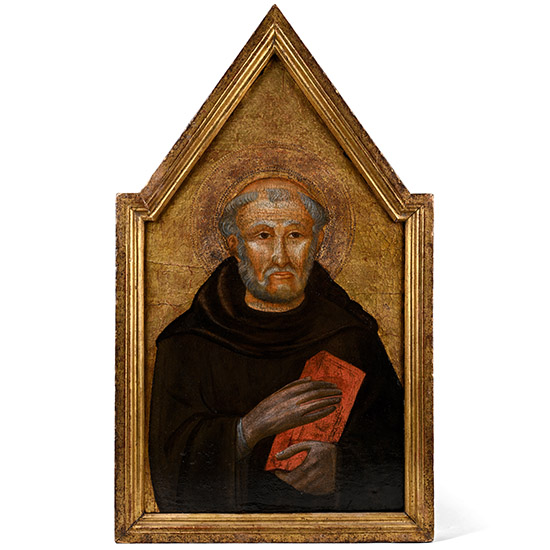
Medieval Painting of Saint Francis of Assisi
Italy, circa 1360-1380 A.D.Estimate: £3,000 - 4,000 (+bp*)
Bids: 1 | Current Bid: £5
Rectangular body with triangular arch to the upper edge; gilt finish to gesso-covered board and stepped frame; facing bust with pounced nimbus framing the grey-haired tonsured head, with short beard; dark brown monastic habit with hood over a grey undertunic visible at the cuff; both hands supporting a red-covered book; Sienna School, label to reverse: 'Firenze Sept,1935 Ecole Siennoise. No.934. A.K.K.K'. 3.6 kg, 69.5 cm high
Private collection, Geneva, formed in the 1980s; thence by descent. This lot has been checked against the Interpol Database of stolen works of art and is accompanied by search certificate no.13513-262847.
One of the earliest known portraits of the saint was painted by Cimabue while he was working on the frescoes at the Basilica of Assisi. Executed on a wooden panel, tradition holds that this board originally served as the lid for the humble wooden coffin in which Saint Francis was laid to rest immediately after his death. Over the centuries, the depiction of the saint was refined by masters like Giotto and other prominent Medieval and Renaissance artists, including the Master of Paciano, Taddeo di Bartolo, Benozzo Gozzoli, and Niccolò di Liberatore. Together, their works offer a focused yet deeply evocative journey, tracing how the saint’s image evolved alongside his rapidly growing cult. This artistic legacy is closely intertwined with the influential Sienese school of painting. -
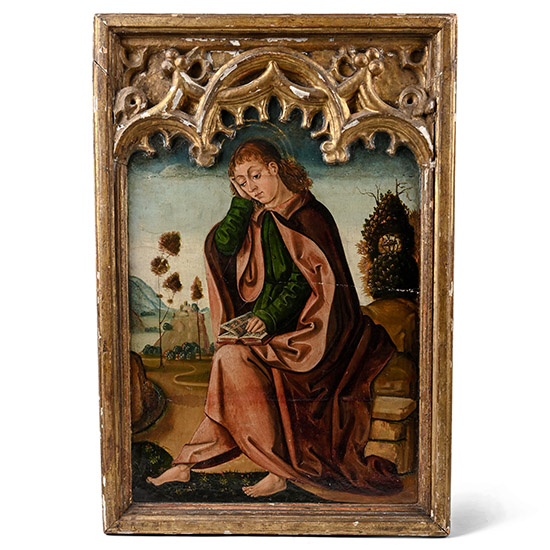
Medieval Painting of Saint John on Patmos
Spain, circa 1500 A.D.Estimate: £3,000 - 4,000 (+bp*)
Bids: 1 | Current Bid: £5
Oil on board in a gilt-moulded frame with arcade detailing at the top; youthful figure shown sitting on a stone bench, barefoot with right leg extended; head bowed and book supported on the left knee, wearing a green tunic and large brown hooded travelling cloak; set in a landscape with hilltop city in the middle distance; reinforcing straps and suspension to the reverse. 4.15 kg, 61.5 cm high
Ex Vicar Anders Frostenson (1906-2006), Sweden. This lot has been checked against the Interpol Database of stolen works of art and is accompanied by search certificate no.13515-262842.
It was common in Western art of this period to depict Saint John on Patmos as a youthful figure. By contrast, the Eastern tradition tended to represent him as an old man. In this regard, if we accept that the author of the Apocalypse was Saint John the Evangelist, he would have been approximately ninety years old at the time of its composition. However, painters such as Francisco Pacheco portrayed Saint John the Evangelist on multiple occasions and, notably, tended to depict him as a young man.

