-
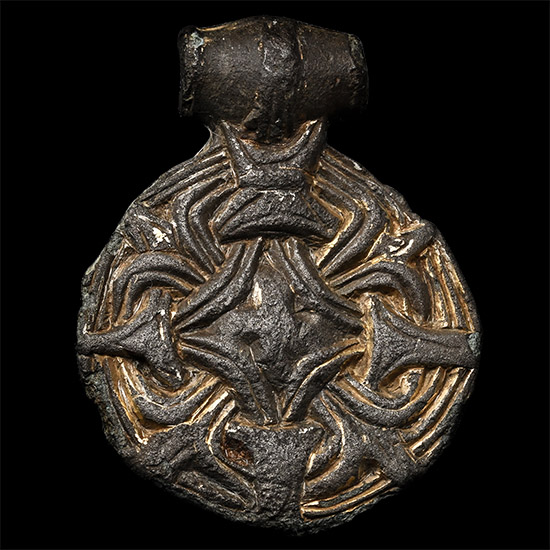
Anglo-Scandinavian Viking Gilt Bronze Borre Style Pendant
Circa 11th century A.D.Estimate: £300 - 400 (+bp*)
Opening Bid: £150
Disc pendant with low-relief Borre style looped tendrils motif, remains of attachment bar to the top. 13.9 grams, 39.8 mm
Acquired on the UK art market in the 1980s. From an East Anglian private collection. -
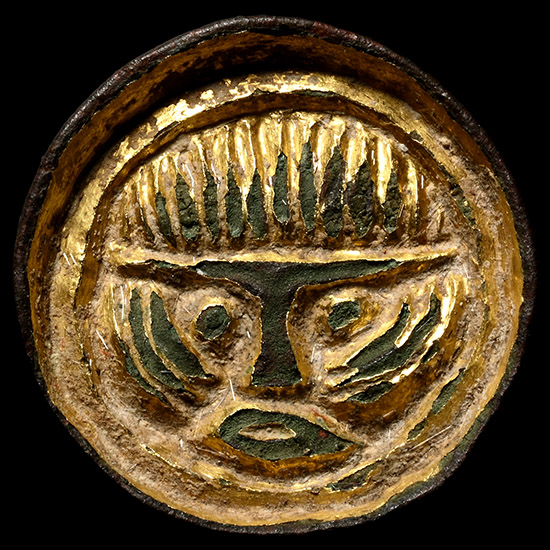
Anglo-Saxon Gilt Bronze Button Brooch with Face of a Warrior
Circa 6th century A.D.Estimate: £200 - 300 (+bp*)
Opening Bid: £100
With raised border and chip-carved warrior mask motif; remains of pin-lug and catch to the reverse. 3.39 grams, 17.09 mm
Acquired on the UK art market in the 1980s. From an East Anglian private collection. -
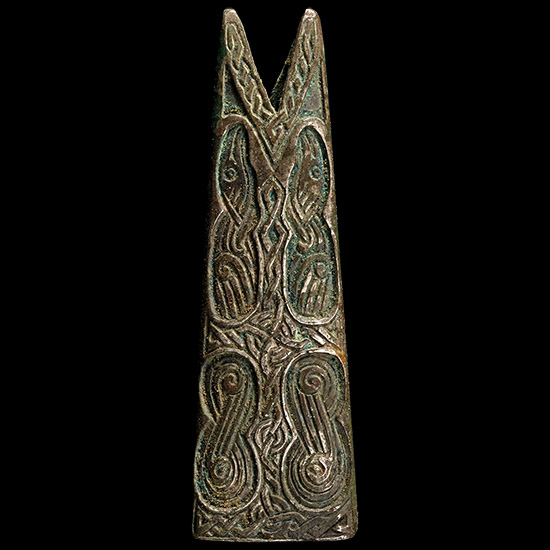
Viking Silvered Bronze Fish Pendant with Interlaced Design
Circa 10th century A.D.Estimate: £600 - 800 (+bp*)
Bids: 1 | Current Bid: £5
Comprising a tapering, rectangular-section body with a flat base and an indented triangular mouth; three small piercings on each side of the body; fish body decorated with four reserved panels with low-relief interlacing bands; two circular piercings on each side of the body. 23 grams, 54 mm
Private collection formed in Europe in the 1980s. Westminster collection, central London, UK. -
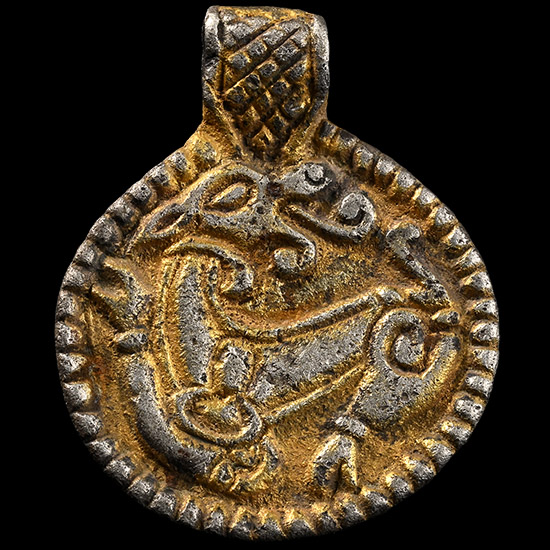
Viking Silver-Gilt Pendant with Beast Facing Back
Circa 9th-11th century A.D.Estimate: £500 - 700 (+bp*)
Bids: 1 | Current Bid: £5
With integral hatched loop, low-relief, regardant Jellinge style beast with beaded border. 9.34 grams, 35 mm
Private collection formed in Europe in the 1980s. Westminster collection, central London, UK. -
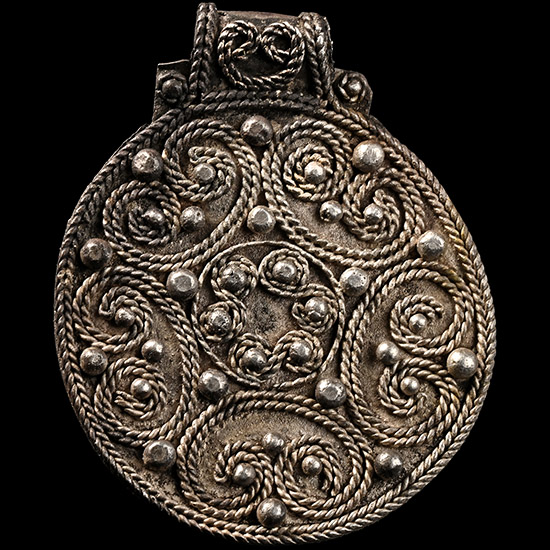
Viking Silver Pendant with Filigree Scrolls
Circa 9th-11th century A.D.Estimate: £500 - 700 (+bp*)
Bids: 2 | Current Bid: £10
Discoid type with pelleted roundel to centre, ropework border enclosing scrolled filigree and granulation ornament. 5.11 grams, 35 mm
Private collection formed in Europe in the 1980s. Westminster collection, central London, UK. -
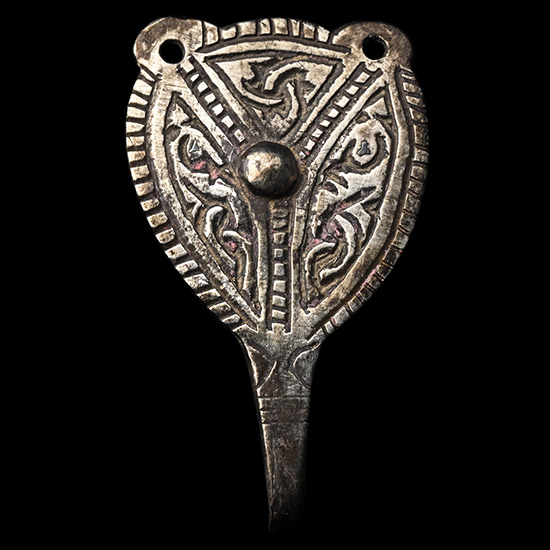
Anglo-Saxon Silver Hooked Tag with Niello Inlaid Interlaced Panels
Circa 800-950 A.D.Estimate: £500 - 700 (+bp*)
Opening Bid: £250
Of Read's Class D, Type 1, piriform in plan with convex, rounded edges narrowing to a point at the integral hook, rectangular in cross-section and tapering to a recurved tip; at the shoulders, two pierced lugs forming attachment points and a central dome-headed rivet; obverse decorated with engraved Trewhiddle style motifs - a central hatched tribrach motif dividing the plate into three panels with pointed three-part knot above and lateral lenticular panels with Trewhiddle plant tendrils; peripheral hatched border running each side of the attachment loops and around the plate to the base of the hook; upper section of the hook with two engraved lateral arcs; the sharp tip of the integral hook absent. 3.8 grams, 38 mm
Found near Lewes, East Sussex, UK, on 7th September 2025; declared as potential Treasure under the Treasure Act with Treasure reference no.2025T1455, subsequently disclaimed and returned to the finder. Accompanied by a copy of the British Museum's Portable Antiquities Scheme (PAS) report no.SUSS-71D76C.
The engraved recesses of the decorative design would have contained black niello inlay, of which only one small triangular area survives on the left of the plate. The reverse of the plate is plain, with the flattened shank of the rivet projecting from the centre of the plate. The metal surfaces have a dark grey silvery patina. The 'hooked tag' fastener functioned by connecting with a matching eye section (see Read, 2008, no.108) or via a simple metal ring sewn into the fabric (ibid., fig.9). Examples of Class D hooked tags have been found in Birka, Sweden, in a 10th-century male burial, positioned at each knee with woollen twill textile remains on the reverses suggesting they were used to secure leg wrappings. The Bayeux tapestry also shows both Normans and Anglo-Saxons with horizontal banding on the legs, which have been interpreted as leg wrappings. (ibid.24). Other possible functions have been for securing purses or bags, suggested by a hoard of Anglo-Saxon coins found at Tetney, Lincs, which also contained a pair of single sharp, hooked clasps (ibid.24). This form of hooked tag fits Read (2008) Class D type 1 with two or more rounded knops for attachment at the end of the plate opposite to the hook (p.27). The hatched tribrach design with interstices filled with interlace is paralleled by a copper-alloy hooked tag in Read, no.113; and, for an example with a central boss/domed rivet, see: no. 12. Most hooked tags are copper-alloy, but silver examples of this form with niello decoration that have been submitted through the treasure process include: 2019T687 (SUR-19BC54), also with Trewhiddle style zoomorphic decoration separated by a tribach form and 2016T608 (KENT-076AE5), also with Trewhiddle style ornament in three fields. The Trewhiddle style decoration provides a date of the ninth to early tenth centuries for this object. -
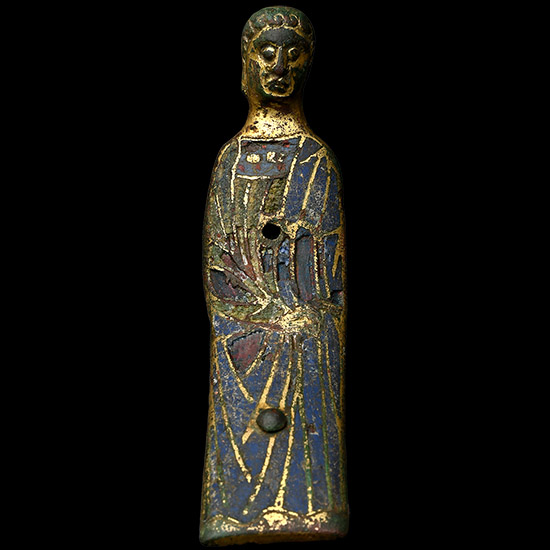
Large Medieval Limoge Enamelled Gilt Bronze Saint
Late 12th century A.D.Estimate: £1,500 - 2,000 (+bp*)
Opening Bid: £750
Comprising a flat, tongue-shaped body with a segmented surface with remains of blue and red enamel; above, the head modelled in the half-round with short curly hair, round eyes and a flat nose; two rivet-holes to the body. 41.5 grams, 92 mm
Acquired on the UK art market in the 1980s. From an East Anglian private collection. -
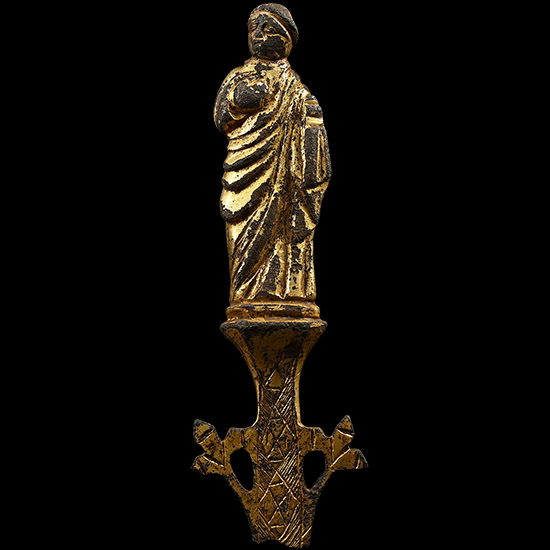
Medieval Gilt Reliquary Figure of a Saint
13th-15th century A.D.Estimate: £600 - 800 (+bp*)
Opening Bid: £300
Modelled in the round on an ornate mount; the saint with tonsured hairstyle, draped floor-length robe, right hand drawn up to the chest and left hand holding a book; ferrous pin to the rear of the head to attach a separate halo; octagonal-section trumpet-shaped base developing to a foliate stem with hatched detailing. 91 grams, 10.6 cm
Fine condition.
Found Romney Marsh area, Kent, UK, 1990-2020. Property of a Kent, UK gentleman. -
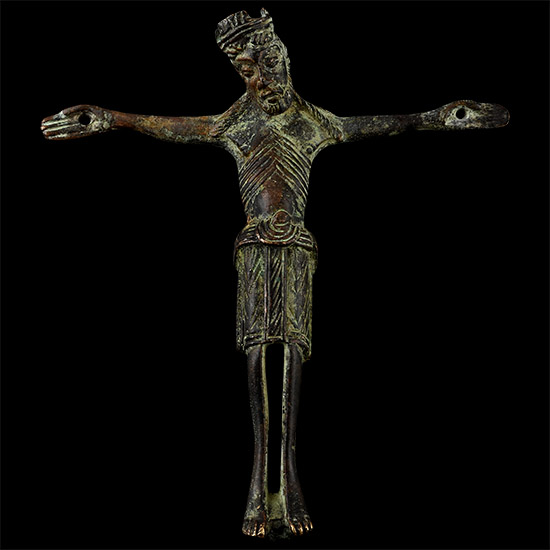
Medieval Bronze Corpus Christi Crucifix
Swabia, 12th century A.D.Estimate: £2,000 - 3,000 (+bp*)
Bids: 2 | Current Bid: £10
Modelled in the half-round and hollow to the reverse, with extended arms and elongated hands, crowned head tilted and lentoid eyes downcast in solemn expression, long hanks of hair falling on his shoulders; wearing a knee-length pleated garment, secured to the waist with a thick cord; chevron rib detailing; pierced hands and block beneath feet. 150 grams, 14.1 cm
From the collection of Prof. Dr Rudolf Schnellbach, the Director of the Baden State Museum. This lot has been checked against the Interpol Database of stolen works of art and is accompanied by search certificate no.13529-262856.
In accordance with the old tradition derived from Byzantium, Christ is depicted as alive, with nailed hands. It may have once been part of an altar decoration or, rather, placed above or in the chancel arch of a church. -
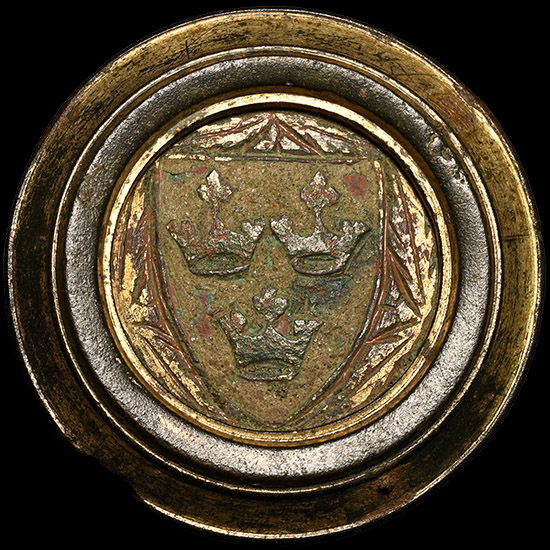
Large Medieval Knight's Gilt Bronze Heraldic Horse Harness Roundel with Three Crowns for the Bishop of Ely
Circa 13th-15th century A.D.Estimate: £800 - 1,000 (+bp*)
Opening Bid: £400
Discoid panel with reserved heater shield on foliage field; three crowns each with a median cross pommee upstand; mounted in a tiered gilt-bronze circular frame (possibly later). 29.68 grams, 50 mm
Found Romney Marsh area, Kent, 1990-2015. Property of a Kent gentleman, a specialist medieval collector.
Two enamelled heraldic pendants of this shape are illustrated in Ashley (2002, fig. 21, nos. 197 and 198), both bearing the same decoration, the three crowns, which are the arms of the Bishop of Ely. Ashley describes them as a comparatively rare type (2002, 23). The blazon of the arms is given as 'Gules three crowns Or' (2002, 45). Horse-harness pendants date from the 12th to the 14th centuries, but were more common in the late 13th and early 14th centuries (Griffiths 1986). Similar records on the PAS database include NMS-6FF080, NMS-A4F8A2, LEIC-344ED2, WAW-600DE5, CAM-67BD16 (with suspension mount), WILT-9C5CEE. -
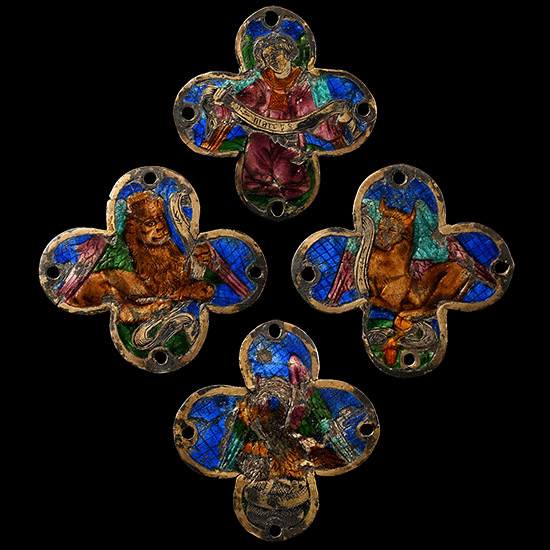
Medieval Gilt Basse-Taille Plaques from a Processional Cross Depicting Evangelists
Spain, Catalonia, circa 1400-1420 A.D.Estimate: £3,000 - 4,000 (+bp*)
Bids: 2 | Current Bid: £10
Group of four quatrefoil plaques, each with a hole at the end of each arm for attachment; champ-levé enamelled images of the symbols of the evangelists: angel, ox, and lion, one with an image of a pelican piercing her side with her own beak, symbolising Christ's Passion; each with a looped and draped band, the angel holding a banner with a legend 'marcus' in bastarda script. 27.49 grams total, 48-50 mm
Galerie Ratton Ladriere, 2021. This lot has been checked against the Interpol Database of stolen works of art and is accompanied by search certificate no.13470-262833.
Processional crosses in late medieval Catalonia were richly decorated with gilt silver and basse-taillle plaques. In terms of the typology of Catalan crosses in the later Middle Ages, the present work was part of a 'cruz flordelisada' (cross adorned with a fleur-de-lis), which was a Catalan fashion in the 14th and 15th centuries, and which was used in Christian processions. -
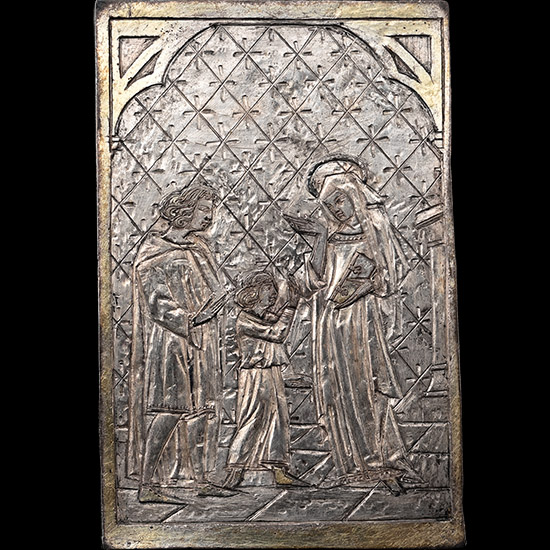
Medieval Silver Plaque Depicting Presentation Scene
Northern France or Flanders, 15th century A.D.Estimate: £2,000 - 3,000 (+bp*)
Bids: 1 | Current Bid: £5
Rectangular plaque with reserved border and fluted spandrels to the upper corners; figural scene with standing nimbate female in veiled robe holding a book in one hand; before her, a standing child with hand raised towards her and behind him an adult male in knee-length tunic with a travelling cloak; altar with stepped base, paved floor, latticework with quatrefoils at the nodes; mounted on a custom-made stand. 241 grams total, 94 mm, 15.3 cm including stand
Mrs Chester D. Tripp. Gifted to the Cleveland Museum of Art in honour of William Wixom, 1979. Deaccessioned by the museum before 2000. Private collection, Scotland, acquired at auction in Zurich in 2000. This lot has been checked against the Interpol Database of stolen works of art and is accompanied by search certificate no.13543-262827.
The plaque shows a child being presented by his father to a nimbate female saint wearing a veil covering her hair. The plaque features fictitious cusped architectural arches that spring from small corbels at each of the upper corners and embellish the plain borders framing the scene, as well as the tiled floors and diaper-pattern background ornamented with small cross motifs.

