
Ancient Art, Antiquities, Books, Natural History, Stamps & Coins

-
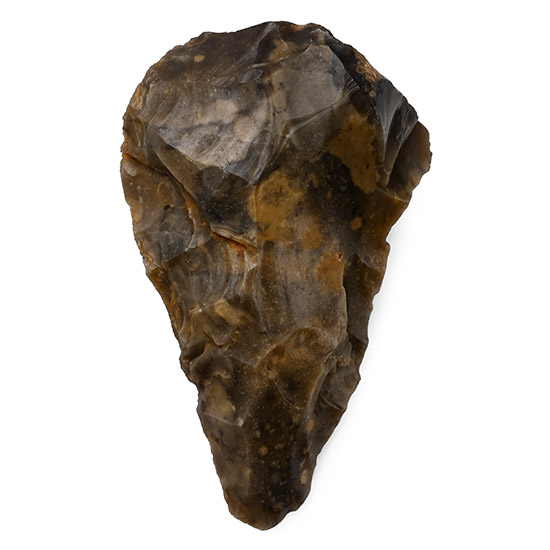
Swanscombe British Stone Age Knapped Ficron Handaxe
Lower Palaeolithic Period, circa 420,000-380,000 B.P.Estimate: £120 - 170 (+bp*)
Bids: 2 | Current Bid: £10
Scaphoid in section with irregular broad point, cortex to the butt with old pencilled legend 'SW[...]E'. 95 grams, 85.6 mm
Found Swanscombe, Kent, UK. From the original collection of Henry Dewey. From the collection of a London, UK, gentleman.
Attributed to Homo heidelbergensis -
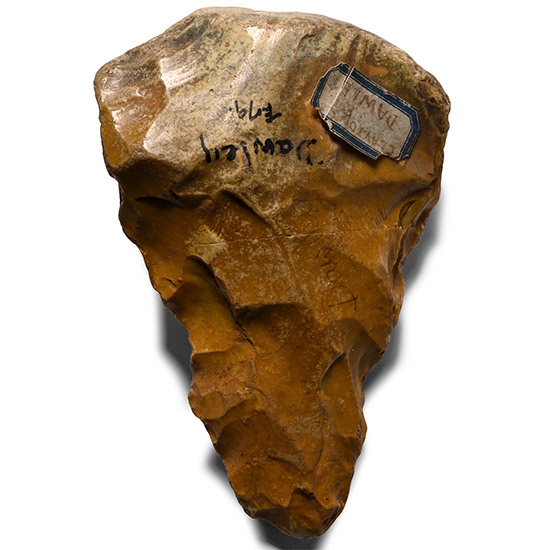
Dawley British Stone Age Knapped Ficron Handaxe
Lower Palaeolithic Period, circa 600,000-2500,000 B.P.Estimate: £120 - 170 (+bp*)
Bids: 2 | Current Bid: £10
Leaf-shaped in plan with broad rounded butt; an old label reading 'Clayton's, Dawley', inked legend 'Dawley E79'; repaired. 180 grams, 93 mm
Found at Clayton’s Pit, Dawley, Middlesex, UK. From the collection of a London, UK, gentleman.
Clayton’s Pit sat on the Lynch Hill Terrace and was used for commercial brick earth and gravel digging in the 19th and 20th centuries. Many of the stone tools recovered are held in the British Museum and the Museum of London. -
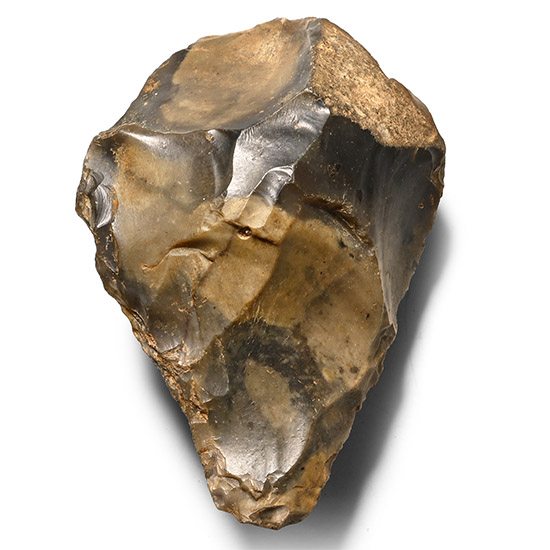
Swanscombe Stone Age Knapped Hand Axe
Middle Palaeolithic Period, circa 150,000-60,000 B.P.Estimate: £120 - 170 (+bp*)
Bids: 2 | Current Bid: £45
Piriform in plan with thick bulb at the base; old findspot label 'Kent / Swanscombe'. 122 grams, 80 mm
Found Swanscombe, Kent, UK. From the private collection of Peter Clayton, FCILIP, Dip, Arch, FSA, FRNS, Hemel Hempstead, Hertfordshire, UK; formed since the late 1950s.
The name of the site is associated with 'Swanscombe Man', the remains of a late Homo erectus or an early Homo sapiens individual. Recent investigation suggests that the remains are those of a 400,000-year-old early Neanderthal woman. -
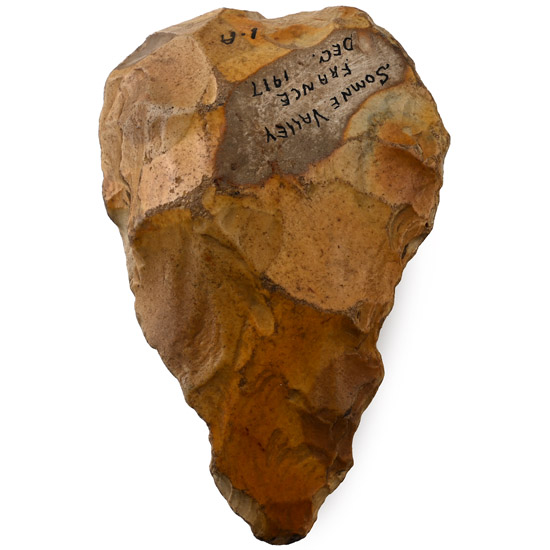
Somme Valley French Stone Age Handaxe
Lower Palaeolithic Period, Acheulean, circa 650,000-350,000 B.P.Estimate: £150 - 200 (+bp*)
Bids: 6 | Current Bid: £220
Piriform in plan and biconvex in section with broad butt. 184 grams, 10.2 cm
Found in the Somme Valley, France, December 1917. From the collection of an Australian collector before being brought back to the UK. Acquired on the UK art market in the 2020s. From a private collection.
Attributed to Homo Heidelbergesis. After the Battle of the Somme during WW1, the area around the Somme became a quieter location where soldiers recuperated. There are reports that many Stone Age artefacts were found during this time while soldiers were not on the front line. With the landscape being turned over considerably and trenches being hand-dug, this is not surprising. -
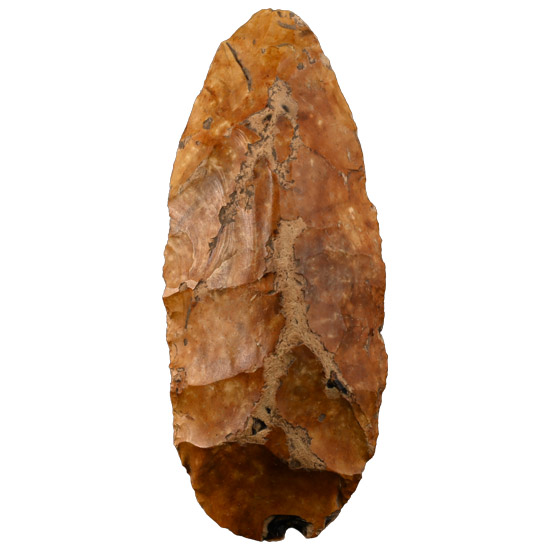
British Stone Age Flint Handaxe
Mesolithic Period, 7,000-5,000 B.P.Estimate: £300 - 400 (+bp*)
Opening Bid: £100
Leaf-shaped in plan and lentoid in section with light tan colouration shading to a deep amber at the edges. 276 grams, 13.9 cm
Found Bottisham, Cambridgeshire, UK, 2022. With old Noonans auction lot ticket. -
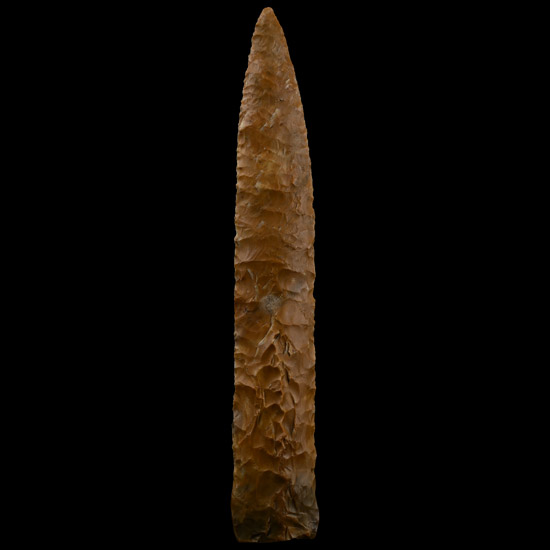
Danish Type IIIb Stone Age Knapped Flint Dagger
Neolithic Period, circa 4,100-3,950 B.P.Estimate: £400 - 600 (+bp*)
Bids: 1 | Current Bid: £5
Leaf-shaped in plan and lozenge-form in profile, with flattened tapering point. 46 grams, 14.7 cm
Acquired as part of a collection of Danish Neolithic flint artefacts from a Swedish auction house. From the private collection of a S.W. London, UK, gentleman. -
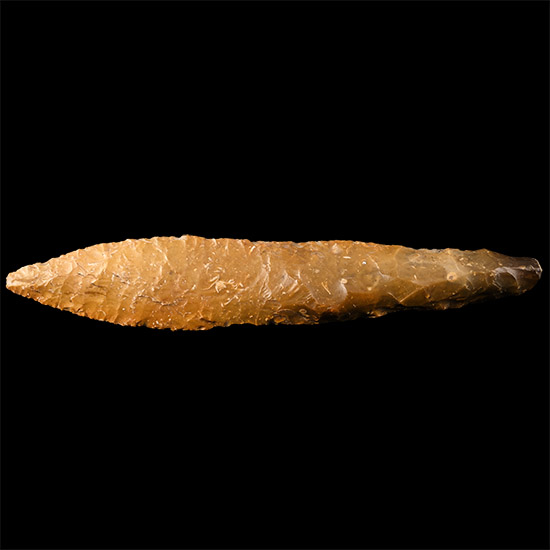
Danish Stone Age Knapped Flint Dagger
Neolithic Period, circa 5,000 B.P.Estimate: £400 - 600 (+bp*)
Bids: 1 | Current Bid: £5
Finely knapped elongated blade in honey-brown flint with ripple-like flaking on the blade, the handle worked to a triangular profile. 65 grams, 17.5 cm
Acquired in West Mersea, 23rd April 1977 for £15.00. From the private collection of Peter Clayton, FCILIP, Dip, Arch, FSA, FRNS, Hemel Hempstead, Hertfordshire, UK; formed since the late 1950s. Accompanied by an old typed information card by Peter Clayton, collection no.135. -
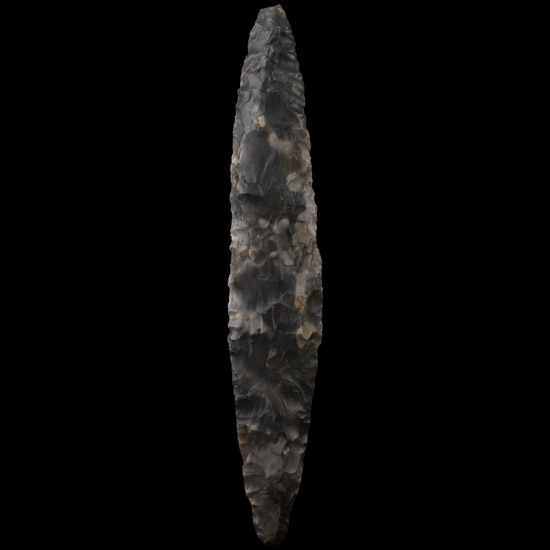
Danish Type 1a Stone Age Knapped Flint Lanceolate Dagger
Neolithic Period, circa 4,400-4,050 B.P.Estimate: £400 - 600 (+bp*)
Bids: 1 | Current Bid: £5
Biconvex in section with parallel edges and tapering ends. 53 grams, 17 cm
From an old Netherlands collection. Ex British private collection. From the private collection of a S.W. London, UK, gentleman. -
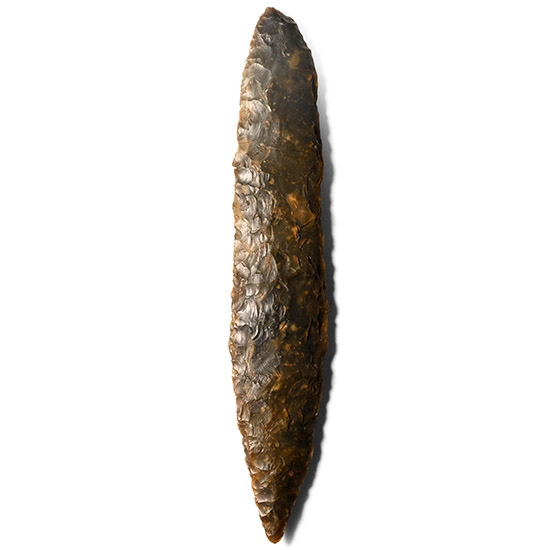
Danish Knapped Flint Dagger
Neolithic Period, circa 3950-3600 B.P.Estimate: £300 - 400 (+bp*)
Opening Bid: £5
Slender leaf-shaped blade with long lateral edges; old inked legend 'DENMARK' to one face. 45.4 grams, 15.5 cm
From the collection of Haselmere Parish Priest, Charles Borelli (c.1914-2000) of Farnham, who was part of the Borelli family from Italy who emigrated from Lake Como in 1828 to set up the Borelli family watch and jewellery business; thence by family descent to his nephew. -
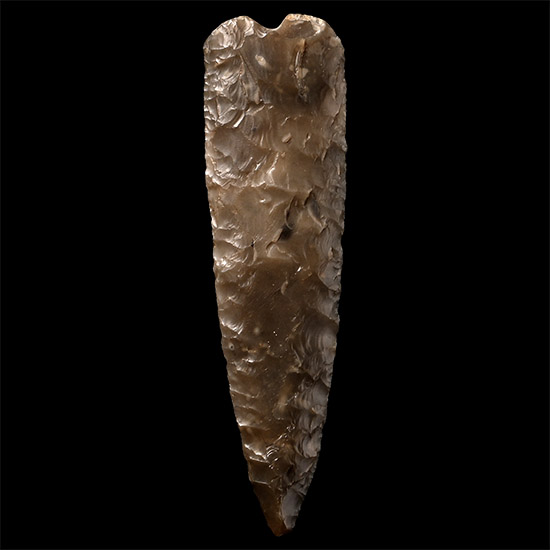
Fawcett Collection Danish Stone Age Knapped Flint Lanceolate Dagger Blade with Fawcett Monogram
Late Neolithic Period, circa 4,400-3,500 B.P.Estimate: £300 - 400 (+bp*)
Bids: 2 | Current Bid: £10
Leaf-shaped in plan with notch to the butt, inked 'DEN.47' notation beneath monogram; complete and in wonderful condition, offered in a wooden presentation case. 17.11 grams, 85 mm
Found Denmark, 1947(?). Ex Dr Hugh Alderson Fawcett (1891-1982), a general practitioner and antiquarian who built up an important collection of ancient implements, weapons and ornaments. The present part of the collection having been gifted to Haselmere Parish Priest, Charles Borelli (c.1914-2000) of Farnham; who was part of the Borelli family from Italy who emigrated from Lake Como in 1828 to set up the Borelli family watch and jewellery business; thence by family descent to his nephew. -
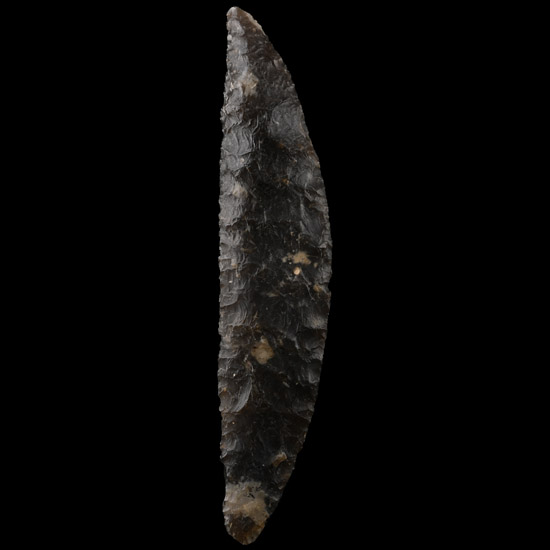
Very Large Danish Stone Age Knapped Senonian Flint Sickle
Bronze Age Period, circa 3,500 B.P.Estimate: £180 - 240 (+bp*)
Opening Bid: £5
With curved back and tapering ends, professionally repaired. 56 grams, 16.5 cm
Ex J. Sherman collection, U.S.A. From the private collection of a S.W. London, UK, gentleman. -
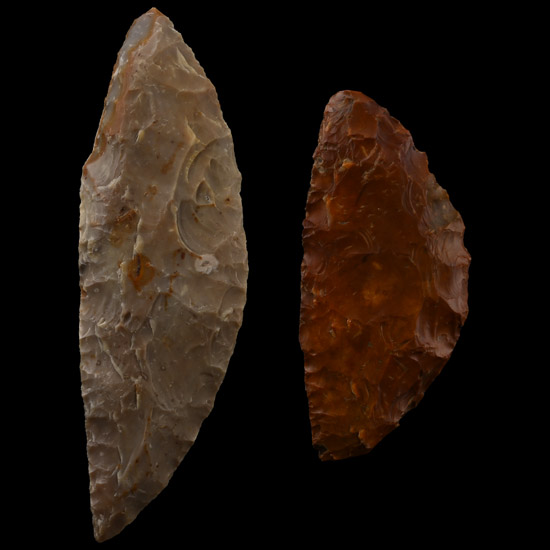
Danish Stone Age Knapped Flint Sickle Group
Neolithic Period, circa 4,500-3,500 B.P.Estimate: £200 - 300 (+bp*)
Opening Bid: £5
Comprising two knabbed sickles with slender curved body and pointed ends. 55.5 grams total, 7.2-10.5 cm
Acquired as part of a collection of Danish Neolithic flint artefacts from a Swedish auction house. From the private collection of a S.W. London, UK, gentleman.
