-
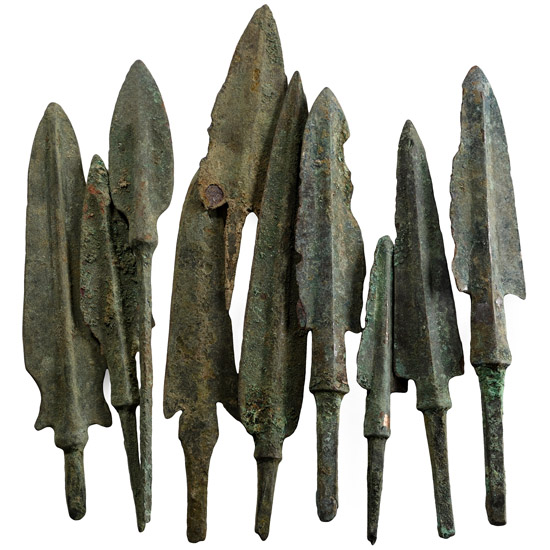
Western Asiatic Mounted Bronze Arrowhead Group
2nd-1st millennium B.C.Estimate: £50 - 70 (+bp*)
Opening Bid: £5
Including flat leaf-shaped, triangular, barbed and other types. 237 grams total, 8.5-13.2 cm
Ex Abelita collection, 1980s-2010. -
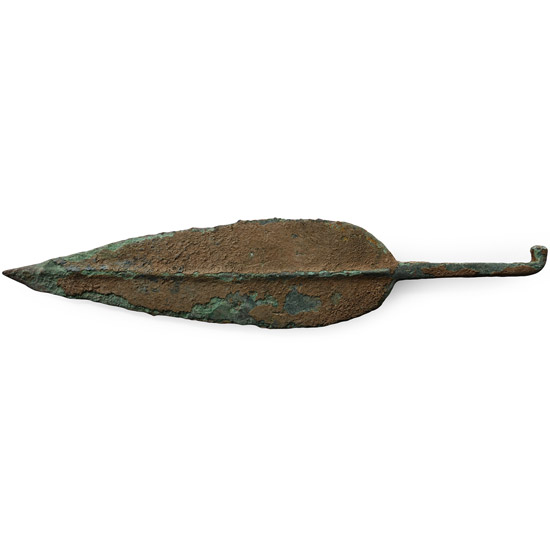
Luristan Bronze Tanged Spearhead
14th-10th century B.C.Estimate: £100 - 140 (+bp*)
Opening Bid: £50
Large leaf-shaped blade with a narrow midrib and a rectangular-section tang with bent finial. 275 grams, 30.4 cm
Ex Abelita collection, 1990s. -
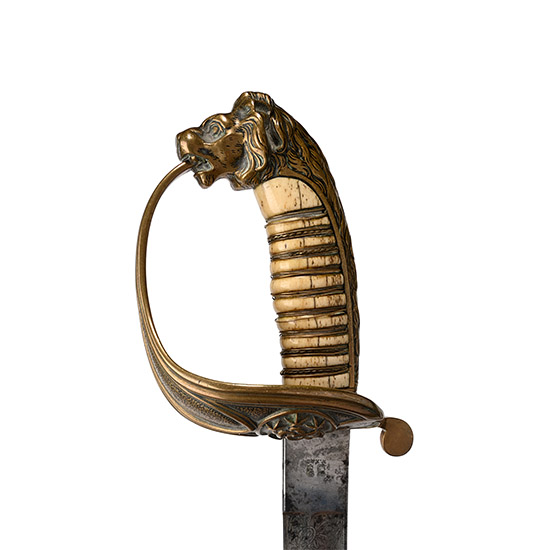
Turkish Naval Officer's Dress Sword with Scabbard
Circa 1900 A.D.Estimate: £300 - 400 (+bp*)
Bids: 1 | Current Bid: £1
Single-edged blade, almost straight with thick back and narrow tip, shallow fuller to each face; brass lion-head sleeve to the bone grip with wire binding; solid swept lion-head knuckle-guard with lug and hinged rear plate pierced to accept a sword-knot, low-relief escutcheon with anchor and three stars; ricasso with stamped 'W.K. &C' beneath a crowned bust and helmet; back stamped '[Wey]ersberg Kirschbaum & Cie. Solingen'; wooden-framed scabbard with black leather covering, brass chape, plaque and frog with two suspension rings, fixed with screws; edge of blade nicked and scored at tip, scabbard split along centreline; old collector's label 'Turkish (Ottoman) Naval Sword c.1900'. 1.32 kg, 96.3 cm
From the private collection of Peter Clayton, FCILIP, Dip, Arch, FSA, FRNS, Hemel Hempstead, Hertfordshire, UK; formed since the late 1950s.
The blade-maker Weyersberg Kirschbaum & Cie. was formed in 1883 from the merger of two earlier factories. -
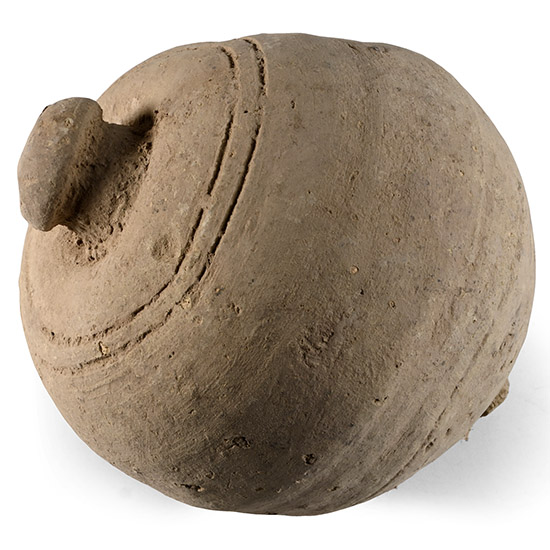
Byzantine 'Greek Fire' Ceramic Fire Bomb or Hand Grenade
9th-11th century A.D.Estimate: £70 - 90 (+bp*)
Bids: 1 | Current Bid: £5
Bulbous body with rounded base and domed filler hole, two circumferential bands above the shoulder; intended to be filled with explosive liquid and a wick, and used as a hand grenade. 772 grams, 12.2 cm
Ex important collection of weaponry, London, UK, 1980-1990s. Accompanied by an academic paper by military specialist Dr Raffaele D'Amato, dated 15 July 2019 and titled 'Eastern Roman Empire - Greek Fire Bomb or Hand Grenade (μεσαίον kακάβιον) 9th-11th century AD'.
Apart from the use of siphons or manual flame-throwers called cheirosiphona, special corps of Roman soldiers employed terracotta grenades, in the form of small jars, abundantly evidenced in archaeological excavations. They were called μεσαία kακαβιά or κυτροκακάβια, where the former had a bulbous shape and the latter a more cylindrical form. -
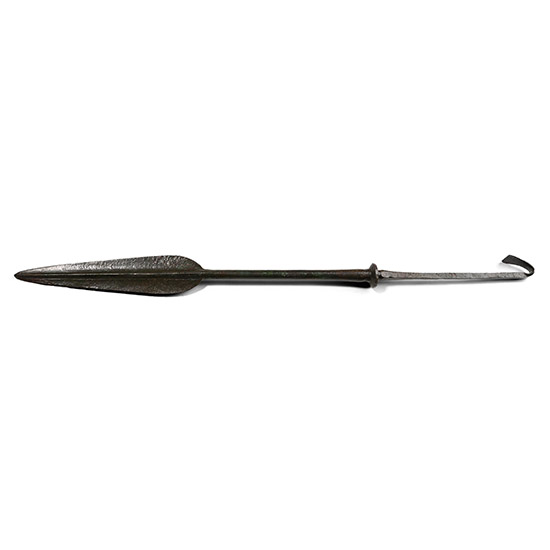
Luristan Bronze Javelin Head
2nd-1st millennium B.C.Estimate: £200 - 300 (+bp*)
Opening Bid: £100
Comprising a slender leaf-shaped two-edged blade with midrib extending to a columnar neck with median bulb and dished collar; square-section tang with bent fish-tail finial. 215 grams, 45.5 cm
Ex Abelita collection, 1980s-2010. -
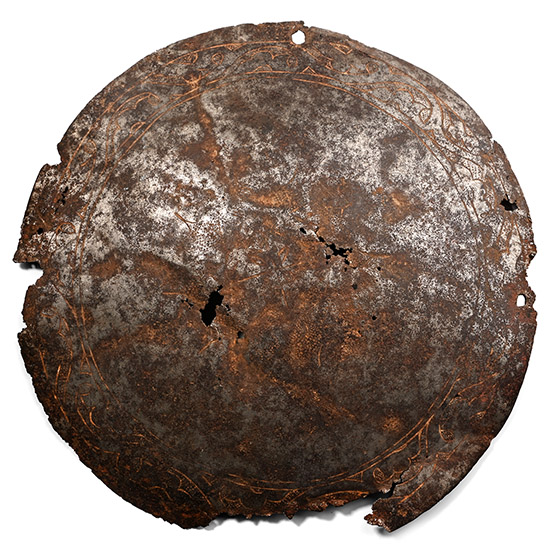
Indo-Persian Decorated Iron Shield Boss
Circa 13th-14th century A.D.Estimate: £60 - 80 (+bp*)
Opening Bid: £5
Slightly domed disc with attachment holes at the rim; incised border of reserved scrolled tendrils on a pounced field. 95 grams, 16.5 cm wide
Acquired on the UK art market. From a gentleman's collection from East Sussex, UK. -
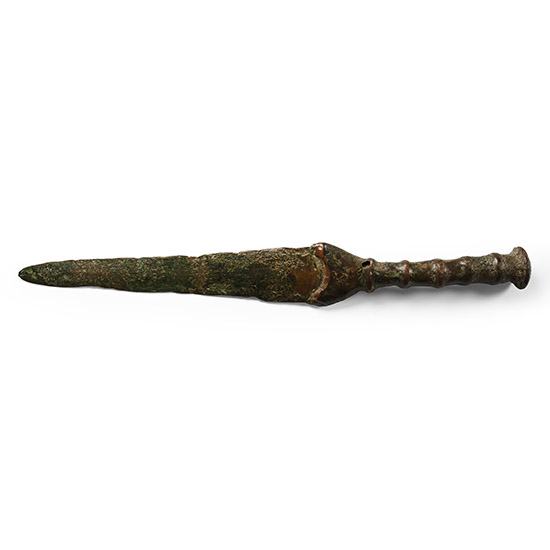
Luristan Bronze Dagger
13th-7th century B.C.Estimate: £150 - 200 (+bp*)
Opening Bid: £75
Comprising a two-edged leaf-shaped lentoid-section blade, crescentic lower guard, ribbed hilt and domed finial. 93 grams, 20.1 cm
Acquired before 1983. Ex London gallery, 1990s. This lot is accompanied by an illustrated lot declaration signed by the Head of the Antiquities Department, Dr Raffaele D'Amato. -
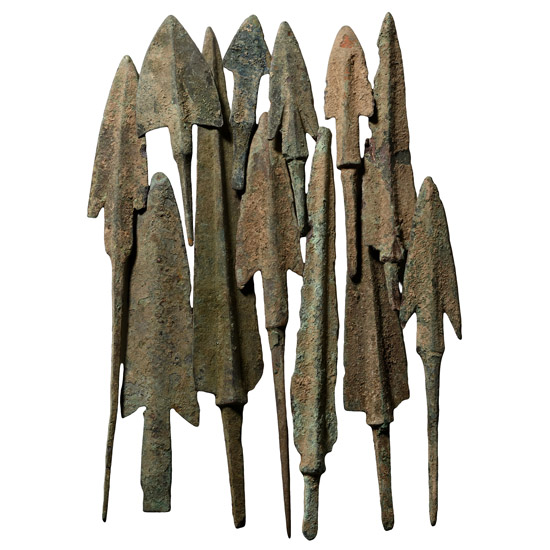
Western Asiatic Bronze Arrowhead Collection
2nd-1st millennium B.C.Estimate: £100 - 140 (+bp*)
Opening Bid: £50
Including triangular, leaf-shaped, barbed and other types. 215 grams total, 5.7-15.6 cm
Ex Abelita collection, 1980-2010. -
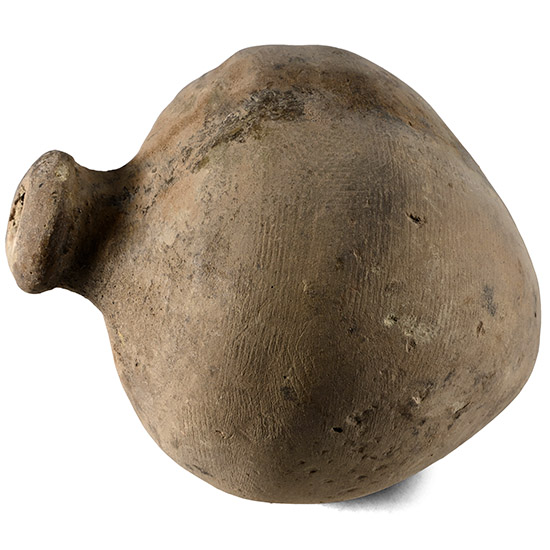
Byzantine 'Greek Fire' Ceramic Fire Bomb or Hand Grenade
9th-11th century A.D.Estimate: £70 - 90 (+bp*)
Bids: 1 | Current Bid: £5
Bulbous body with rounded base and domed filler-hole; intended to be filled with explosive liquid and a wick, and used as a hand grenade. 555 grams, 10.6 cm
Ex important collection of weaponry, London, UK, 1980-1990s. Accompanied by an academic paper by military specialist Dr Raffaele D'Amato, dated 15 July 2019 and titled 'Eastern Roman Empire - Greek Fire Bomb or Hand Grenade (μεσαίον kακάβιον) 9th-11th century AD'.
Apart from the use of siphons or manual flame-throwers called cheirosiphona, special corps of Roman soldiers employed terracotta grenades, in the form of small jars, abundantly evidenced in archaeological excavations. They were called μεσαία kακαβιά or κυτροκακάβια, where the former had a bulbous shape and the latter a more cylindrical form. -
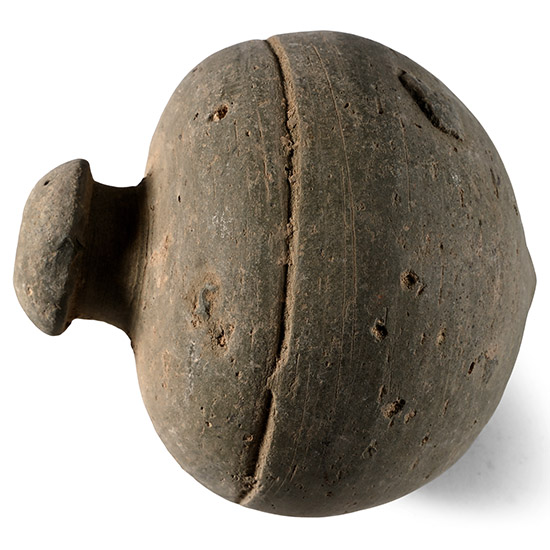
Byzantine 'Greek Fire' Ceramic Fire Bomb or Hand Grenade
9th-11th century A.D.Estimate: £70 - 90 (+bp*)
Bids: 1 | Current Bid: £5
Bulbous body with rounded base and domed filler hole, an impressed circumferential band on the shoulder; intended to be filled with explosive liquid and a wick, and used as a hand grenade. 370 grams, 93 mm
Ex important collection of weaponry, London, UK, 1980-1990s. Accompanied by an academic paper by military specialist Dr Raffaele D'Amato, dated 15 July 2019 and titled 'Eastern Roman Empire - Greek Fire Bomb or Hand Grenade (μεσαίον kακάβιον) 9th-11th century AD'.
Apart from the use of siphons or manual flame-throwers called cheirosiphona, special corps of Roman soldiers employed terracotta grenades, in the form of small jars, abundantly evidenced in archaeological excavations. They were called μεσαία kακαβιά or κυτροκακάβια, where the former had a bulbous shape and the latter a more cylindrical form. -
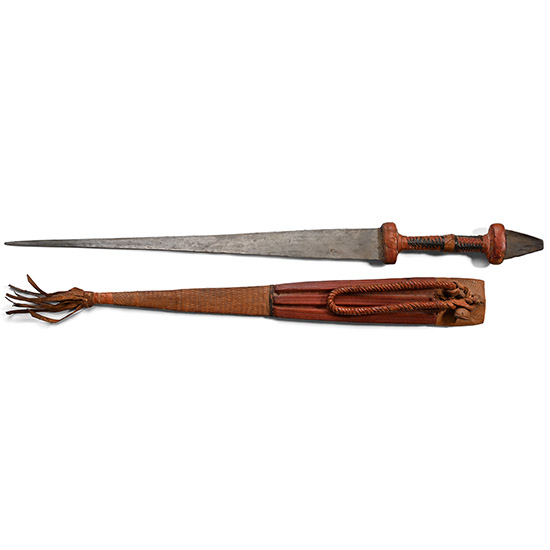
African Hausa Long Tebu Style Dagger and Sheath
Nigeria,19th-early 20th century A.D.Estimate: £100 - 140 (+bp*)
Bids: 1 | Current Bid: £5
With narrow triangular iron blade; wooden crossguard, grip and upper guard all with moulded and braided leather covering, trapezoidal flange finial; leather sheath with wooden carcass, reptile-skin frog and chape with braided knot finial; braided suspension loop and attachment buttons. 320 grams,72.5 cm
From the private collection of Peter Clayton, FCILIP, Dip, Arch, FSA, FRNS, Hemel Hempstead, Hertfordshire, UK; formed since the late 1950s. -
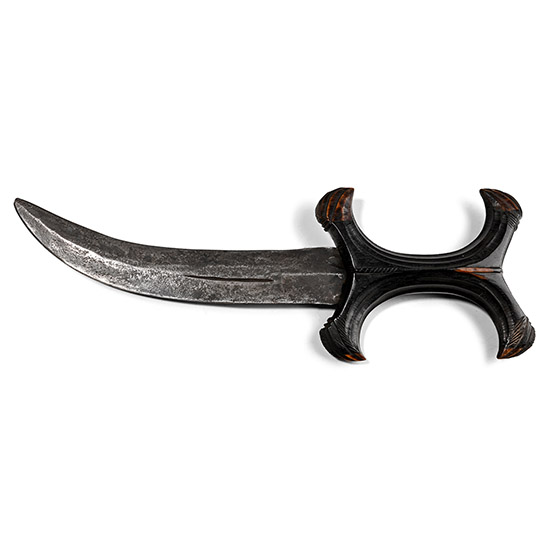
Beja or Hadendoa Curved Dagger
Sudan, late 19th-early 20th century A.D.Estimate: £80 - 100 (+bp*)
Opening Bid: £5
Comprising a thin leaf-shaped two-edged blade in an X-shaped wooden hilt with carved fluting and median rib. 188 grams, 30 cm
From the private collection of Peter Clayton, FCILIP, Dip, Arch, FSA, FRNS, Hemel Hempstead, Hertfordshire, UK; formed since the late 1950s.

