-
.jpg)
Neo-Assyrian Terracotta Head of Pazuzu
Circa 8th-6th century B.C.Estimate: £1,000 - 1,400 (+bp*)
Opening Bid: £500
Modelled with a grimacing expression and exposed teeth, long horns extending from the brow towards the back of the head; pierced through the rear edge; accompanied by a custom-made display stand. 73 grams, 75 mm (119 grams total, 10.5 cm including stand)
Private Swiss collection, before 2005. Private collection, London. -
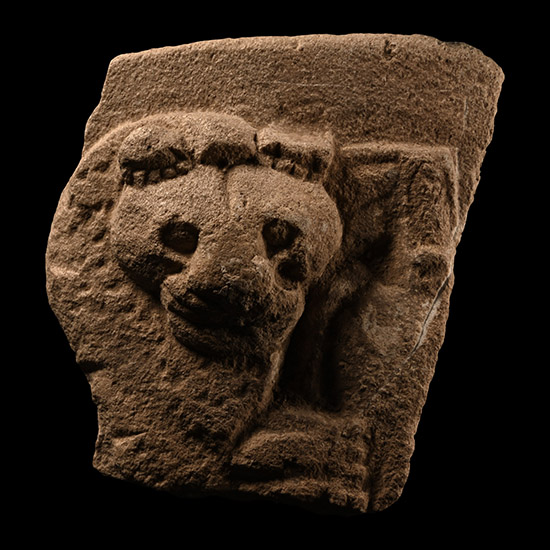
Sumerian Limestone Plaque with Lion
3rd millennium B.C.Estimate: £500 - 700 (‡+bp*)
Bids: 3 | Current Bid: £400
Fragment from a plaque or large bowl with high-relief head and foreparts of a lion with broad piriform face and sunken eyes; rounded rim above. 246 grams, 96 mm
Ex Mr J.K. Maryland, USA. Private collection. Acquired in 1999.
From a technical point of view, the sculpture, in low relief, belonged to a ritual element with profile figures highlighted by an extremely delicate internal modelling, with space between the various decorative bands that admirably preserves the figure of the lion, giving it full value, according to an artistic principle also found in the seals of the Jemdet Nasr period (2800-2600 BC). -
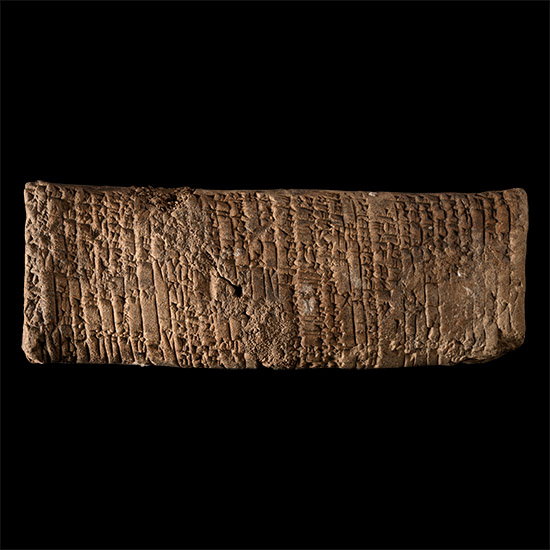
Large Old Babylonian Cuneiform Tablet with Administrative Text
Circa 2000-1900 B.C.Estimate: £800 - 1,000 (+bp*)
Bids: 1 | Current Bid: £650
Long tablet with rows of densely arranged impressed cuneiform text on one side. 363 grams, 15.5 cm
Private collection, 1980s. UK private collection before 2000. Acquired on the UK art market. Private collection, London, UK. Academically researched and catalogued by the late Professor Lambert. Accompanied by an original handwritten slip written by Professor Wilfrid George Lambert. -
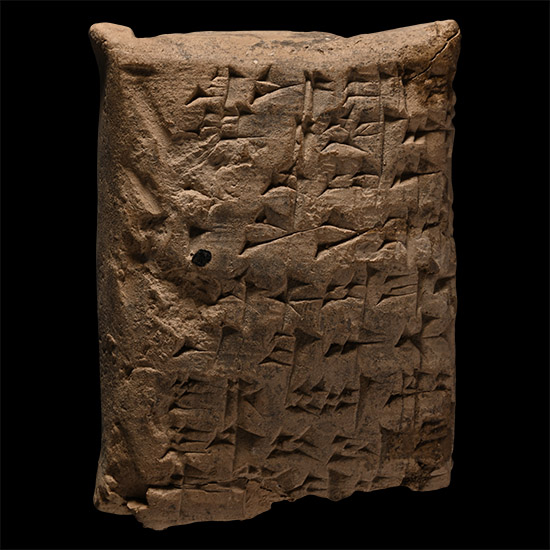
Old Babylonian Cuneiform Tablet with Legal Text
Circa 2000-1900 B.C.Estimate: £500 - 700 (+bp*)
Bids: 7 | Current Bid: £650
The majority of a pillow-shaped tablet with impressed cuneiform text on three sides and a cylinder seal impression on the short face. 214 grams, 76 mm
Private collection, 1980s. UK private collection before 2000. Acquired on the UK art market. Private collection, London, UK. Academically researched and catalogued by the late Professor Lambert. Accompanied by an original handwritten slip written by Professor Wilfrid George Lambert. -
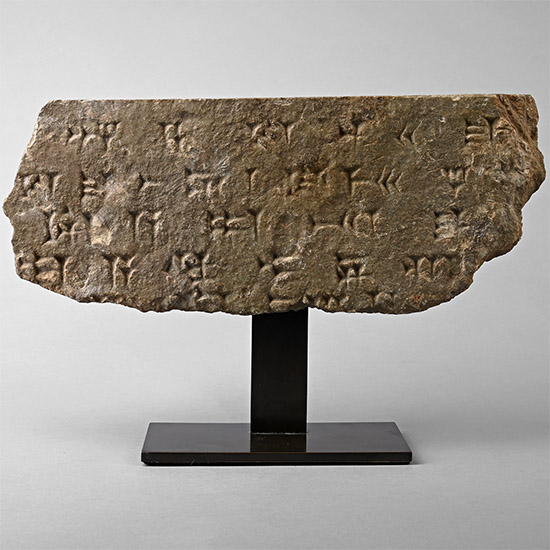
Large Neo-Assyrian Cuneiform Frieze Section with Annals for King Ashurnasirpal II
883-859 B.C.Estimate: £7,000 - 9,000 (+bp*)
Bids: 1 | Current Bid: £4,250
A stone frieze with four lines of large cuneiform text accompanied by documentation to support that this a section from the annals of King Ashurnasirpal II: 'Ashurnasirpal (II), great king, mighty king, king of the universe, king of Assyria, son of Tukulti-Ninurta (II), great king, mighty king, king of the universe, king of Assyria, son of Adad-nirari (II), great king, mighty king, king of the universe, king of Assyria, valiant man, who acts with the support of the weapons of Assur, his lord, who has no equal among the princes of the four regions, king who has subdued (the territories extending) from the opposite bank of the Tigris to Mount Lebanon and the Great Sea, the entire land of Laqû, the land of Suhu as far as the city of Rapiqu. He conquered the sources of the Subnat river as far as the land of Nirbu…'; mounted on a custom-made display stand. 2.85 kg total, 36.5 cm wide including stand
Belgian private collection, acquired before 1960, and thence by descent to the collector's widow. with Mrs Drees (?), Brussels, acquired from the widow of the above, 2004. with Pierre Bergé & Associés, Paris, 28 October 2006, lot 219. with Gorny & Mosch, Munich, 12 December 2023, lot 416. This lot has been checked against the Interpol Database of stolen works of art and is accompanied by search certificate number no.13369-258955.
Most of the reliefs and inscriptions of this king are in the British Museum and Louvre. Further holdings are in the New York Historical Society, the Metropolitan Museum of Art and Yale University. They celebrated the glory of the Assyrians at the apogee of their Empire. -
.jpg)
Western Asiatic Basalt Tablet with Cuneiform Inscription
2nd-1st millennium B.C.Estimate: £2,000 - 3,000 (‡+bp*)
Opening Bid: £1,000
Architectural fragment with rectangular band to one edge, carved decorative detailing with inscription. 7.85 kg, 32.6 cm
Private collection, Europe, thence by descent. Private collection, since the late 1980s. This lot has been checked against the Interpol Database of stolen works of art and is accompanied by a search certificate number no.12521-231989.
Amid the many architectural, sculptural, and textual riches of Assyria and Mesopotamia, the broken pieces of basalt bearing fragmentary cuneiform inscriptions have received little attention, but are of fundamental importance. Despite being quite fragmentary, these broken pieces of basalt are the remains of an important witness to the Assyrian imperial presence in the Near East. -
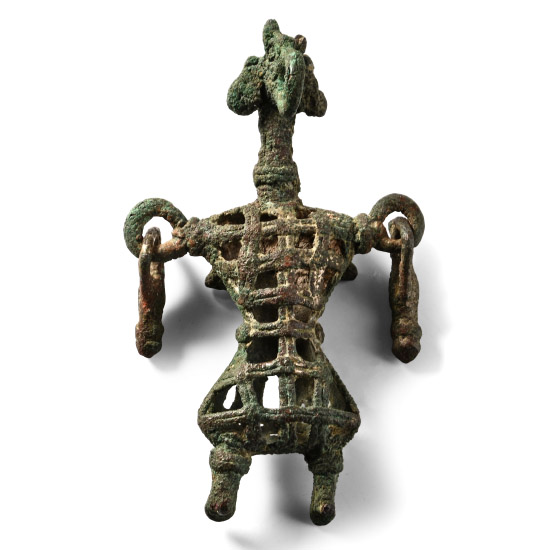
Amlash Bronze Fertility Figure with Baby
13th-12th century B.C.Estimate: £700 - 900 (+bp*)
Opening Bid: £350
Formed as a standing figure cradling an infant; stylised facial and anatomical detailing; openwork cage structure and suspension loop to the reverse of the head. 58.6 grams, 91 mm
Ex Samuel Dubiner (1914-1993), Canada, a prominent businessman, arts patron, and one of the world's most distinguished collectors of Bronze Age and Iron Age Iranian art, including Amlash material. Acquired by the current owner from the above, circa 1985-1995. -
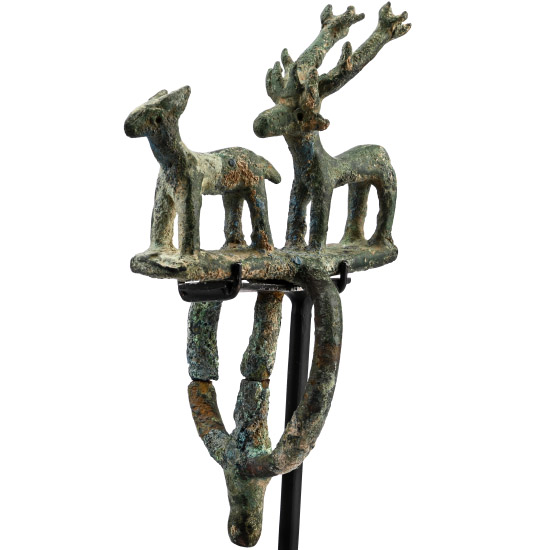
Hittite Bronze Standard Finial with Animal
Circa 13th-10th century B.C.Estimate: £1,500 - 2,000 (+bp*)
Opening Bid: £750
With a central bar with a semi-circle on either side, surmounted by a flat platform with a stag with large, elaborate horns, standing behind a doe; accompanied by a custom-made display stand. 405 grams, 17 cm (922 grams total, 31 cm including stand)
From a private collection, since 1989. Ex West London, UK collection. -
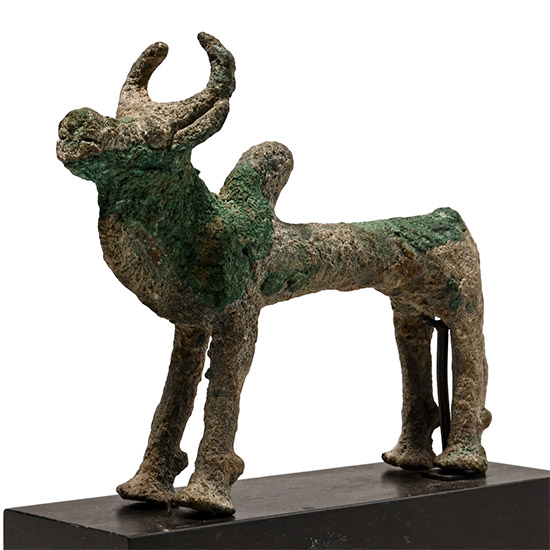
Bactrian Copper Standing Zebu
3rd-2nd millennium B.C.Estimate: £1,200 - 1,700 (+bp*)
Opening Bid: £600
Standing with head raised, dewlap to the chin and chest, angled hump behind the shoulders; mounted on a custom-made stand. 215 grams, 11.1 cm wide (351 grams total, 11.7 cm including stand)
Acquired before 1972. with a London, UK gallery. Private collection, UK. -
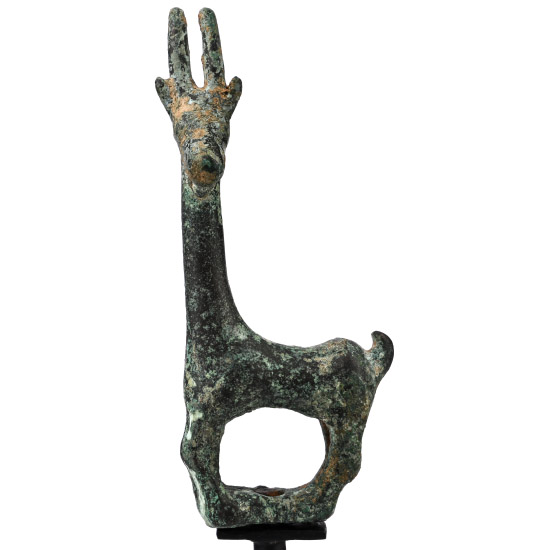
Luristan Bronze Antelope Statuette
13th-7th cenury B.C.Estimate: £400 - 600 (+bp*)
Bids: 1 | Current Bid: £200
Depicted standing with head erect and prominent curving horns; mounted on a custom-made display stand. 98 grams, 96 mm (279 grams, 22.6 cm including stand)
From a private collection, since 1989. Ex West London, UK collection. -
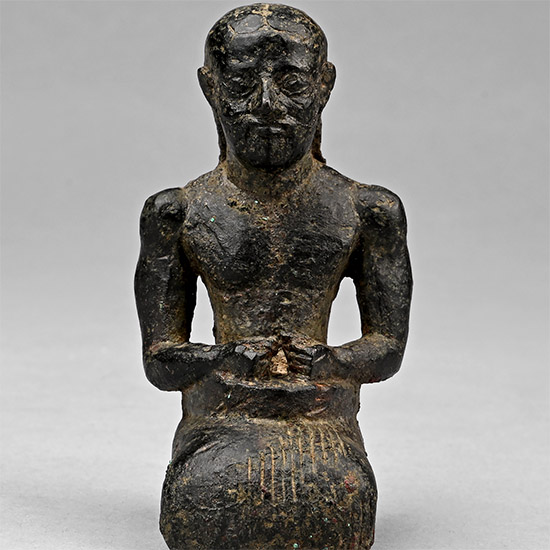
Western Asiatic Bronze Statuette of a Kneeling Priest
Late 3rd millennium B.C.Estimate: £4,000 - 6,000 (+bp*)
Bids: 3 | Current Bid: £3,600
Modelled as a kneeling priest wearing a knee-length kilt, the long hair combed back from the face and extending down the back, arms bent, and fists clenched, resting on the belt, recessed to the underside. 359 grams, 83 mm
Ex London family collection, since the 1970s. Accompanied by a report of metallurgical analytical results, written by Metallurgist Dr Brian Gilmour of the Research Laboratory for Archaeology and the History of Art, University of Oxford. This lot has been checked against the Interpol Database of stolen works of art and is accompanied by search certificate number no.13313-258236.
This powerful figure was probably lost-wax cast in arsenical copper, as were many Near Eastern bronzes of the 3rd millennium. He is muscular with broad shoulders, a strong chest and a well-toned, rippling abdomen. The pleated long garment is typical of the Mesopotamian men. Very interesting is his praying gesture, which is typical of the statuette of Ur culture. -
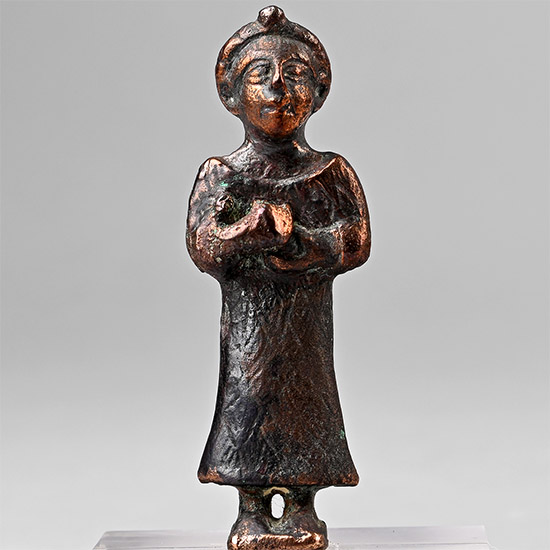
Middle Elamite Copper Figure of a Worshipper
Circa 1500–1100 B.C.Estimate: £4,000 - 6,000 (+bp*)
Opening Bid: £2,000
Figure of a worshipper with the hands raised at the waist and standing barefoot on a rectangular plinth, wearing a dress without any visible seams, the embroidery and pattern of the fabric represented by a concentric chevron design; stylised facial features and large almond-shaped eyes, thick twisted roll of fabric holding the hair with a small knot at the top; set on a custom-made stand. 106 grams total, 87 mm including stand
with Mr Modjallal Iradj, France. Acquired by a London, UK gallery, 18 March 1977. Private collection, UK. This lot has been checked against the Interpol Database of stolen works of art and is accompanied by search certificate number no.13370-257696.
The Elamite culture was an important civilisation in the ancient Near East that lasted for many centuries, from the 3rd millennium to the 6th century BC. They developed their own style of art, metalwork, and seal designs, as well as their own form of cuneiform writing. Although the Elamites were eventually absorbed into later empires, many aspects of their culture continued to influence the ancient world around them. Objects of this type are understood to be ritual or votive gifts.

